4. Uma Forma Aderente
4. A Clinging Form
Então fizemos dessa gota de fluido uma forma aderente
Then We made that drop of fluid into a clinging form
O Alcorão descreve a etapa seguinte do embrião humano em desenvolvimento com a palavra ʿalaqah. Esta palavra tem vários significados, entre eles: pendurar, estar suspenso, ser pendurado, grudar, agarrar-se, aderir e fixar-se. Pode também significar apanhar, ser apanhado, ser afixado ou anexado.48
The Qur’an describes the next stage of the developing human embryo with the word `alaqah. This word carries various meanings including: to hang, to be suspended, to be dangled, to stick, to cling, to cleave and to adhere. It can also mean to catch, to get caught, to be affixed or subjoined.48
Outras conotações da palavra ʿalaqah incluem uma substância semelhante a uma sanguessuga, com a aparência de um verme; ou de uma disposição "rastejante", inclinada a sugar sangue. Por fim, seu significado inclui o barro que se agarra à mão e o sangue espesso e coagulado, por causa de sua aderência. 49
Other connotations of the word `alaqah include a leech-like substance, having the resemblance of a worm; or being of a ‘creeping’ disposition inclined to the sucking of blood. Finally, its meaning includes clay that clings to the hand and thick, clotted blood - because of its clinging together. 49
INTERPRETAÇÃO CIENTÍFICA
SCIENTIFIC INTERPRETATION
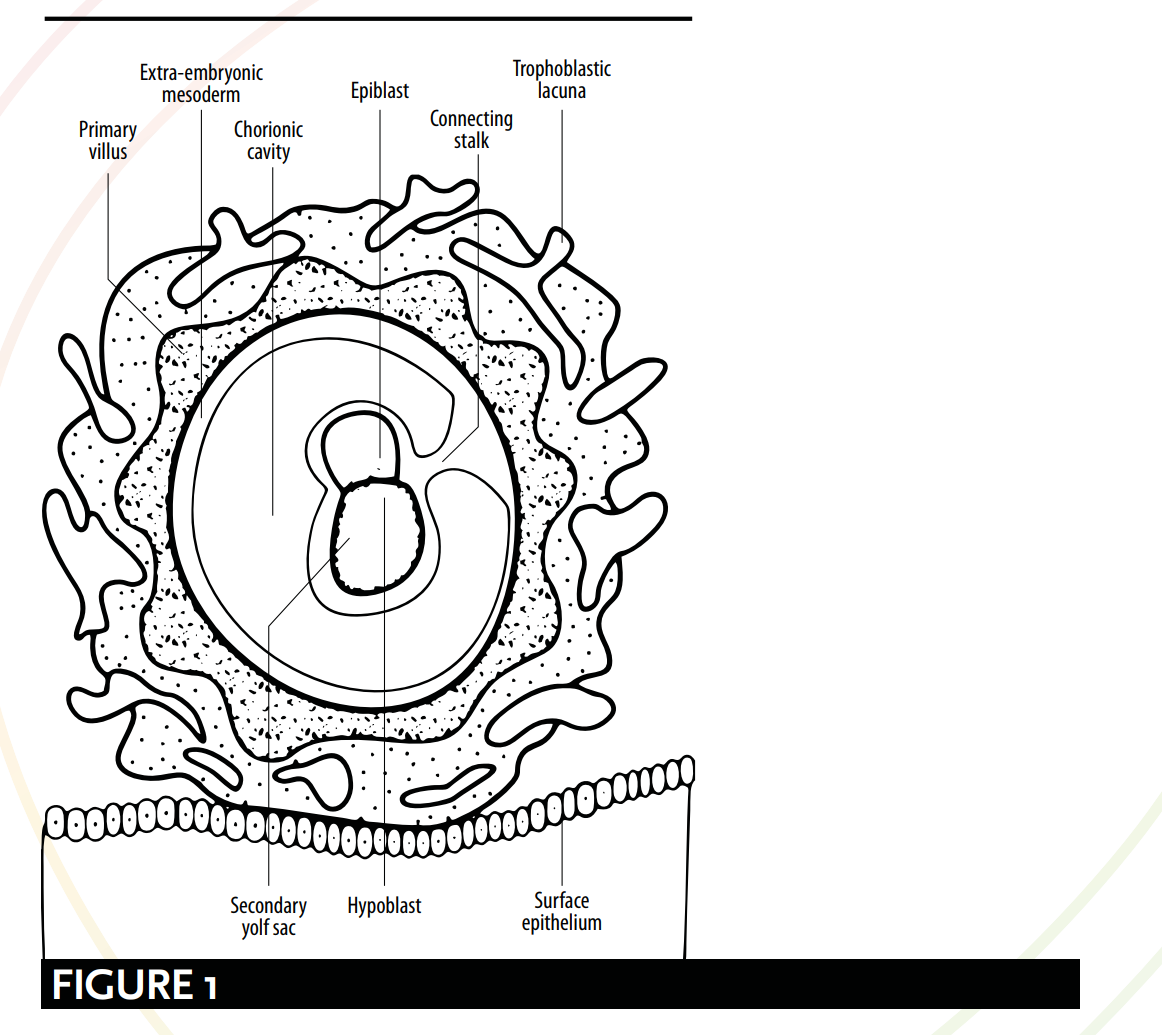
Segundo a embriologia moderna, os diversos significados da palavra `alaqah correspondem a diferentes estágios do desenvolvimento do embrião. Podem ser traçadas comparações entre as descrições corânicas e científicas da aparência do embrião e de sua relação com o útero. De acordo com a embriologia moderna, a partir do 15º dia o embrião fica pendurado ou suspenso por meio do "pedúnculo de conexão" [ver Figura 1] e obtém nutrientes pelo contato com os vasos sanguíneos maternos. Essa descrição guarda uma semelhança impressionante com o quadro pintado pela palavra `alaqah – uma substância "pendente" ou "suspensa", que obtém nutrientes do sangue de seu hospedeiro.
As defined by modern embryology, the myriad of meanings for the word `alaqah correspond to various stages of the embryo’s development. Comparisons can be drawn between qu’ranic and scientific depictions of the embryo's appearance and its relationship with the womb. According to modern embryology, from day 15 the embryo is hanging or suspended via the ‘connecting stalk’ [see Figure 1] and it obtains nutrients through contact with the maternal blood vessels. This description bears a striking resemblance to the picture painted by the word `alaqah – a ‘hanging’ or ‘suspended’ substance, obtaining nutrients from its host’s blood.
Após isso, durante a 4ª semana, ocorrem dois processos: a formação do cérebro e da medula espinhal, conhecida como neurulação; e os estágios iniciais do dobramento do embrião. É com a conclusão desses dois processos que o embrião assume uma forma semelhante a uma sanguessuga, forma sugerida pela palavra `alaqah – uma substância rastejante, semelhante a uma sanguessuga ou a um verme [ver Figuras 2, 3 e 4].
Following this, during the 4th week, two processes occur: the formation of the brain and the spinal cord, known as neurulation; and the initial stages of the folding of the embryo. It is upon the culmination of these two processes that the embryo resembles a leech-like form suggested by the word `alaqah – a creeping, leech or worm-like substance [see Figure 2, 3 and 4].
PENDURADO/SUSPENSO
HANGING/SUSPENDED
Os embriologistas Barry Mitchell e Ram Sharma explicam os aspectos de "suspensão" ou "pendência" da fase de `alaqah. Eles descrevem o embrião como estando "conectado ao citotrofoblasto por um pedículo de conexão de mesoderma extraembrionário (tecido conjuntivo primitivo). O pedículo é o precursor do cordão umbilical." 50 A Figura 1 mostra o embrião conectado ao citotrofoblasto por meio de um pedículo de conexão, como se estivesse pendurado ou suspenso.
Embryologists Barry Mitchell and Ram Sharma explain the ‘hanging’ or ‘suspended’ aspects of the `alaqah stage. They describe the embryo as being, “connected to the cytotrophoblast by a connecting stalk of extra-embryonic mesoderm (primitive connective tissue). The stalk is the forerunner of the umbilical cord.” 50 Figure 1 shows the embryo connected to the cytotrophoblast via a connecting stalk, as if it were hanging or suspended.
OBTENÇÃO DE NUTRIENTES POR MEIO DOS VASOS SANGUÍNEOS
OBTAINING NUTRIENTS VIA BLOOD VESSELS
Com relação à forma como o embrião obtém seus nutrientes por meio do contato com os vasos sanguíneos maternos, Barry Mitchell e Ram Sharma escrevem: Devido ao rápido crescimento do embrião durante a segunda semana, há a necessidade de um meio mais eficiente de troca nutricional e gasosa. Isso é alcançado quando os vasos sanguíneos embrionários do córion entram em contato com os vasos sanguíneos maternos da decídua.51.
With regard to the way the embryo obtains its nutrients through contact with the maternal blood vessels, Barry Mitchell and Ram Sharma write: Due to the rapid growth of the embryo during the second week, there is a need for a more efficient means of nutritional and gaseous exchange. This is achieved when the embryonic blood vessels of the chorion come into contact with the maternal blood vessels of the decidua.51.
... [até a terceira semana]... A troca de nutrientes, gases respiratórios e produtos residuais entre o sangue materno e o sangue fetal ocorre através da membrana placentária, dentro dos espaços interviloso. O sangue materno entra nesses espaços a partir das artérias espiraladas, ramos da artéria uterina, trazendo nutrientes e oxigênio para o embrião e o feto.52
... [by the third week]... The exchange of nutrients, respiratory gases and waste products between the maternal and fetal blood takes place across the placental membrane within intervillous spaces. Maternal blood enters these spaces from the spiral arteries, branches of the uterine artery, bringing nutrients and oxygen for the embryo and fetus.52
Isto reforça a validade dos significados de ʿalaqah, e a evocação de imagens de uma entidade que obtém os seus nutrientes através do sangue.
This reinforces the validity of the meanings of `alaqah, and its evoking images of an entity obtaining its nutrients via blood.
NEURULAÇÃO E O DOBRAMENTO DO EMBRIÃO
NEURULATION & THE FOLDING OF THE EMBRYO
A fase de `alaqah sugere o processo de neurulação e as etapas iniciais do dobramento do embrião. A neurulação compreende a formação do cérebro e da medula espinhal entre os dias 19 e 25 (aproximadamente); e o dobramento do embrião envolve a aproximação da cabeça e da cauda. A combinação dessas duas mudanças fisiológicas faz com que o embrião se assemelhe a uma substância semelhante a uma sanguessuga.
The `alaqah stage suggests the process of neurulation and the initial stages of the folding of the embryo. Neurulation comprises of the formation of the brain and the spinal cord from days 19 to 25 (approx.); and the folding of the embryo involves the head and the tail being brought closer together. The combination of these two physiological changes causes the embryo to resemble a leech-like substance.
NEURULAÇÃO
NEURULATION
Ao final da neurulação, as extremidades cranial e caudal do tubo neural se fecham. Nesse ponto, o embrião adquire uma aparência semelhante à de uma sanguessuga 53 [ver Figura 2].
At the end of neurulation the cranial and caudal ends of the neural tube close. The embryo, at this point, becomes leech-like in appearance 53 [see Figure 2].
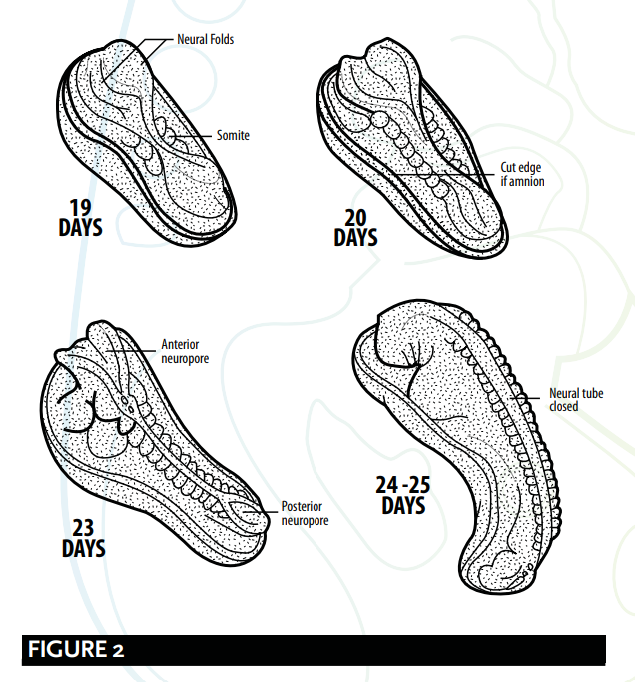
Barry Micthell e Ram Sharma explicam o processo de neurulação.
Barry Micthell and Ram Sharma explain the process of neurulation.
Por volta de 19 dias, na extremidade cranial da linha primitiva, o mesoderma subjacente e a notocorda induzem o ectoderma a formar a placa neural, que se arredonda para formar as pregas neurais. A placa neural inicialmente se expande na extremidade cranial. Aos 20 dias, a placa neural na região média do embrião permanece estreitada, mas se expande na extremidade caudal. A placa se aprofunda para formar o sulco neural, a partir do qual se forma o tubo neural. As extremidades cranial e caudal do tubo estão abertas e são conhecidas como neuróporo anterior e neuróporo posterior; estes eventualmente se fecham. 54
At about 19 days, at the cranial end of the primitive streak, the underlying mesoderm and notochord induce the ectoderm to form the neural plate, which rounds up to form the neural folds. The neural plate enlarges initially at the cranial end. At 20 days, the neural plate in the mid-region of the embryo remains narrowed, but it expands at the caudal end. The plate deepens to form the neural groove from which the neural tube forms. The cranial and caudal ends of the tube are open and are known as the anterior and posterior neuropores; these eventually close. 54
DOBRAMENTO DO EMBRIÃO
FOLDING OF THE EMBRYO
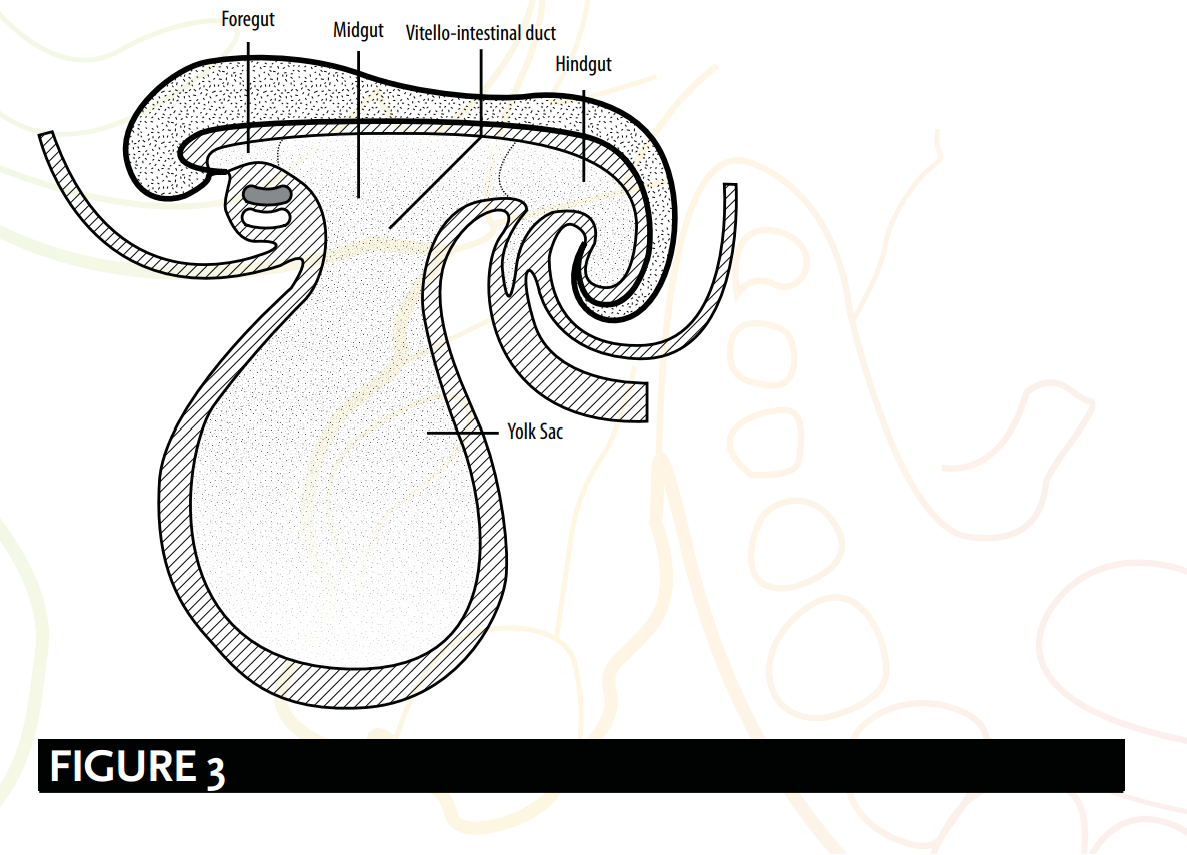
A dobragem do embrião também é responsável pela formação de uma forma semelhante a uma sanguessuga [ver Figura 3], ou, como descrevem os embriologistas, uma estrutura cilíndrica ou semelhante a um tubo. Os embriologistas Keith Moore e T. V. N. Persaud sugerem que:
The folding of the embryo is also responsible for forming a leech-like shape [see Figure 3], or as embryologists have described; a cylindric or tube-like structure. Embryologists Keith Moore and T. V. N. Persaud suggest that:
Um evento significativo no estabelecimento da forma corporal é o dobramento do disco embrionário trilaminar achatado em um embrião de formato algo cilíndrico. O dobramento resulta do rápido crescimento do embrião, particularmente do encéfalo e da medula espinhal. 55
A significant event in the establishment of body form is the folding of the flat trilaminar embryonic disc into a somewhat cylindric embryo. Folding results from the rapid growth of the embryo, particularly the brain and the spinal cord. 55
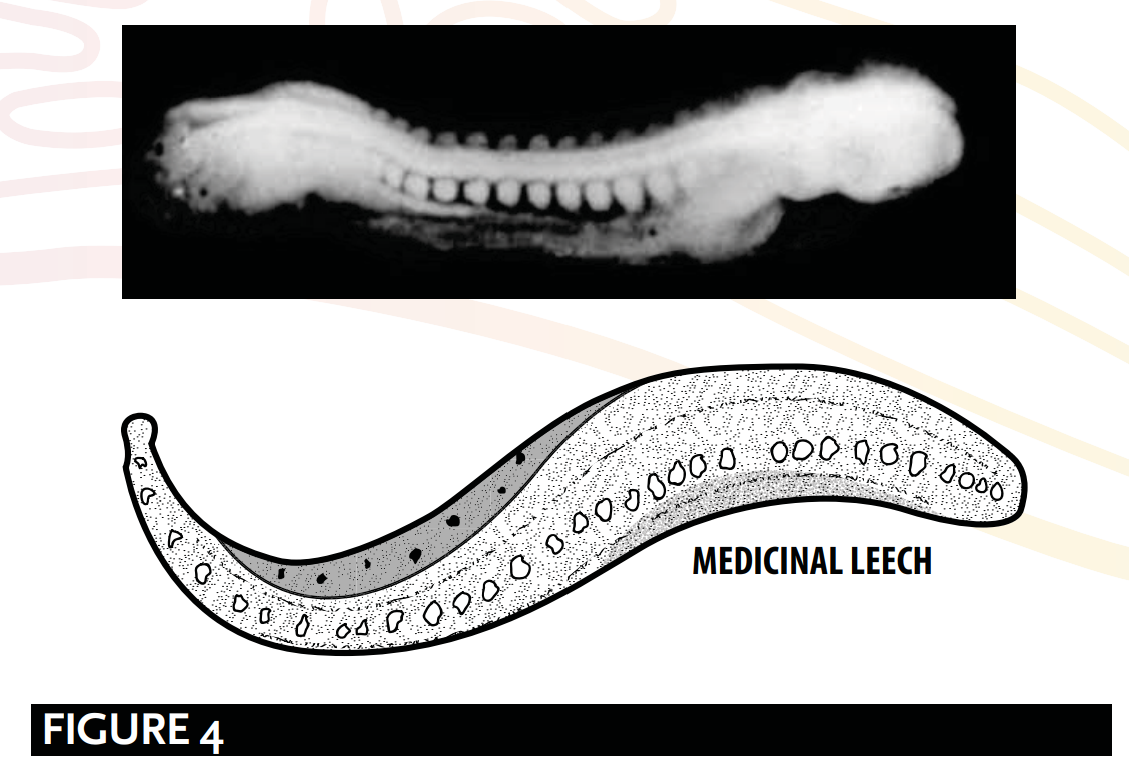
A estrutura semelhante a um tubo ou a uma sanguessuga [ver Figura 4], conforme explicado por Barry Mitchell e Ram Sharma, deve-se a:
The tube-like or leech-like structure [see Figure 4], as explained by Barry Mitchell and Ram Sharma, is due to:
Dobramento longitudinal, que ocorre entre os dias 21 e 24, resulta em … o embrião se curvando de modo que a cabeça e a cauda são aproximadas… [para] formar uma estrutura semelhante a um tubo. 56
longitudinal folding, which occurs between days 21 and 24, result[ing] in … the embryo [bending] so that the head and tail are brought closer together...[to] form a tube-like structure. 56
SUMÁRIO
SUMMARY
A fase da `alaqah:
The `alaqah stage:
O embrião está ligado ao citotrofoblasto por um pedículo de conexão, como se estivesse pendurado ou suspenso.
The embryo is connected to the cytotrophoblast via a connecting stalk, as if it were hanging or suspended.
A formação do cérebro e da medula espinhal, conhecida como neurulação, e durante as etapas iniciais do dobramento do embrião. É ao final desses processos que o embrião assume a aparência de uma sanguessuga.
The formation of the brain and the spinal cord, known as neurulation; and during the initial stages of the folding of the embryo. It is upon the culmination of these processes that the embryo appears leech-like.
O embrião obtém seus nutrientes por meio do contato com os vasos sanguíneos maternos. Isso se assemelha à ação de uma substância semelhante a uma sanguessuga, que obtém seus nutrientes a partir do sangue.
The embryo obtains its nutrients via contact with the maternal blood vessels. This mirrors the action of a leech-like substance obtaining its nutrients via blood.
GALENO E ʿALAQAH
GALEN & `ALAQAH
Os críticos afirmam que o uso da palavra ʿalaqah é uma descrição do segundo estágio do embrião humano segundo Galeno. A tradução de ʿalaqah como "coágulo de sangue" cria a impressão de que se trata da descrição de Galeno desse estágio:
Critics declare that the use of the word `alaqah is a description of Galen’s second stage of the human embryo. Their translation of the word `alaqah to ‘blood clot’ creates an impression of Galen's description of this stage:
Mas quando o coágulo tiver se enchido de sangue, e o coração, o cérebro e o fígado ainda não estiverem articulados nem formados, mas já tiverem certa solidez e tamanho considerável, este é o segundo período; a substância do feto já tem a forma de carne e não mais a forma de sêmen. 57
But when it [the clot] has been filled with blood, and heart, brain and liver are still unarticulated and unshaped yet have by now certain solidarity and considerable size, this is the second period; the substance of the foetus has the form of flesh and no longer the form of semen. 57
Há uma série de fraquezas nas implicações destes críticos:
There are a number of weaknesses with the implications of these critics:
1. Em primeiro lugar, o Alcorão não faz menção ao "coração, cérebro e fígado..."
1. Firstly, the Qur’an does not make a mention of the “heart, brain and liver...
"sendo ainda não articulada e sem forma definida, mas com uma certa solidez e de tamanho considerável"
[being] unarticulated and unshaped yet [with] a certain solidarity and [of a] considerable size”.
2. Em segundo lugar, a palavra ʿalaqah não significa sangue; antes, seus significados primários são "uma forma que se agarra" e "uma substância semelhante a uma sanguessuga". Alguns linguistas árabes atribuem à palavra ʿalaqah o sentido de "coágulo de sangue", não por ela estar cheia de sangue, mas por ela "se agarrar" por natureza. Essa interpretação corresponde ao significado primário da palavra.
2. Secondly, the word `alaqah does not mean blood; rather, its primary meanings are ‘a clinging form’ and ‘a leech-like substance’. Some Arab linguists would attribute the meaning of a ‘blood clot’ to the word `alaqah, not because of it being filled with blood, but instead due to it ‘clinging’ by nature. This interpretation matches the primary meaning of the word.
Em terceiro lugar, Galeno insiste que "o feto tem a forma de carne" durante o segundo estágio, enquanto o Alcorão afirma que o estágio da mudghah (um pedaço de carne mastigada ou massa de carne) vem depois do estágio da `alaqah.
3. Thirdly, Galen insists “the foetus has the form of flesh” during the second stage, whereas the Qur’an affirms the mudghah (a chewed piece of meat or lump of flesh) stage comes after the `alaqah stage.
4. Em quarto lugar, em seu livro Sobre as Faculdades Naturais, Galeno escreve: assim também acontece com o sêmen: ele possuía suas faculdades desde o início.58 A implicação incorreta de Galeno, de que o sêmen é o único responsável pelo material genético, é incompatível com o Alcorão e as tradições proféticas, e está em direta oposição a eles. Como já explorado anteriormente (ver Aristóteles, Galeno e a Nutfah), os textos-fonte islâmicos consideram a nutfah como uma gota ou fluido misturado, proveniente tanto do homem quanto da mulher, e confirmam que ambos, o homem e a mulher, são responsáveis pela genética da criança.59 Portanto, se o Profeta ﷺ copiou as opiniões de Galeno sobre o desenvolvimento humano, como é que ele rejeitou a ciência incorreta e usou apenas o que estava correto, mesmo sem qualquer meio, no Império Árabe do século VII, de saber quais opiniões eram precisas?
APRESENTAÇÃO ERRÔNEA DA APARÊNCIA DO EMBRIÃO
MISREPRESENTING THE EMBRYO’S APPEARANCE
Os comentaristas contemporâneos argumentam que o embrião só se assemelha a uma sanguessuga quando o saco vitelino é removido, e que, portanto, a descrição do ʿalaqah é uma deturpação da aparência do embrião nesta fase. No entanto, os embriologistas explicam que o saco vitelino é separado do embrião por uma estrutura extraembrionária, chamada celoma extraembrionário. Este fato refuta as alegações de deturpação, pois o saco vitelino não faz parte da estrutura do embrião.60
Contemporary commentators argue the embryo only looks leech-like when the yolk sac is removed, and that the `alaqah's description is therefore a misrepresentation of the embryo’s appearance at this stage. However, embryologists explain that the yolk sac is separated from the embryo by an extra-embryonic feature, called the extra-embryonic coelom. This fact disproves claims of misrepresentation as the yolk sac is not part of the structure of the embryo.60