5. Um Pedaço de Carne
5. A Lump Of Flesh
e depois fizemos daquela gota uma massa de carne
and then We made that form into a lump of flesh
A próxima etapa do desenvolvimento humano definida no Alcorão é a mudghah. Este termo significa mastigar, mastigação, mascar, ser mastigado e um pequeno pedaço de carne.61 62 Também descreve o embrião depois de passar para outra etapa e tornar-se carne.63 Outros significados incluem algo que os dentes mastigaram e deixaram marcas visíveis; e marcas que se alteram no processo de mastigação devido ao ato repetitivo.64 A etapa da mudghah é explicada com mais detalhe em outra passagem do Alcorão:
The next stage of human development defined in the Qur’an is mudghah. This term means to chew, mastication, chewing, to be chewed, and a small piece of meat.61 62 It also describes the embryo after it passes to another stage and becomes flesh.63 Other meanings include something that teeth have chewed and left visible marks on; and marks that change in the process of chewing due to the repetitive act.64 The mudghah stage is elaborated on further, elsewhere in the Qur'an:
então de um pedaço de carne (mudghah), formado e não formado. 65
then from a fleshy lump (mudghah), formed and unformed. 65
A palavra árabe usada aqui para "formada" é *mukhallqah*, que também pode significar "moldada" ou "modelada".66
The Arabic word used here for ‘formed’ is mukhallqah which can also mean ‘shaped’ or ‘moulded’.66
INTERPRETAÇÃO CIENTÍFICA
SCIENTIFIC INTERPRETATION
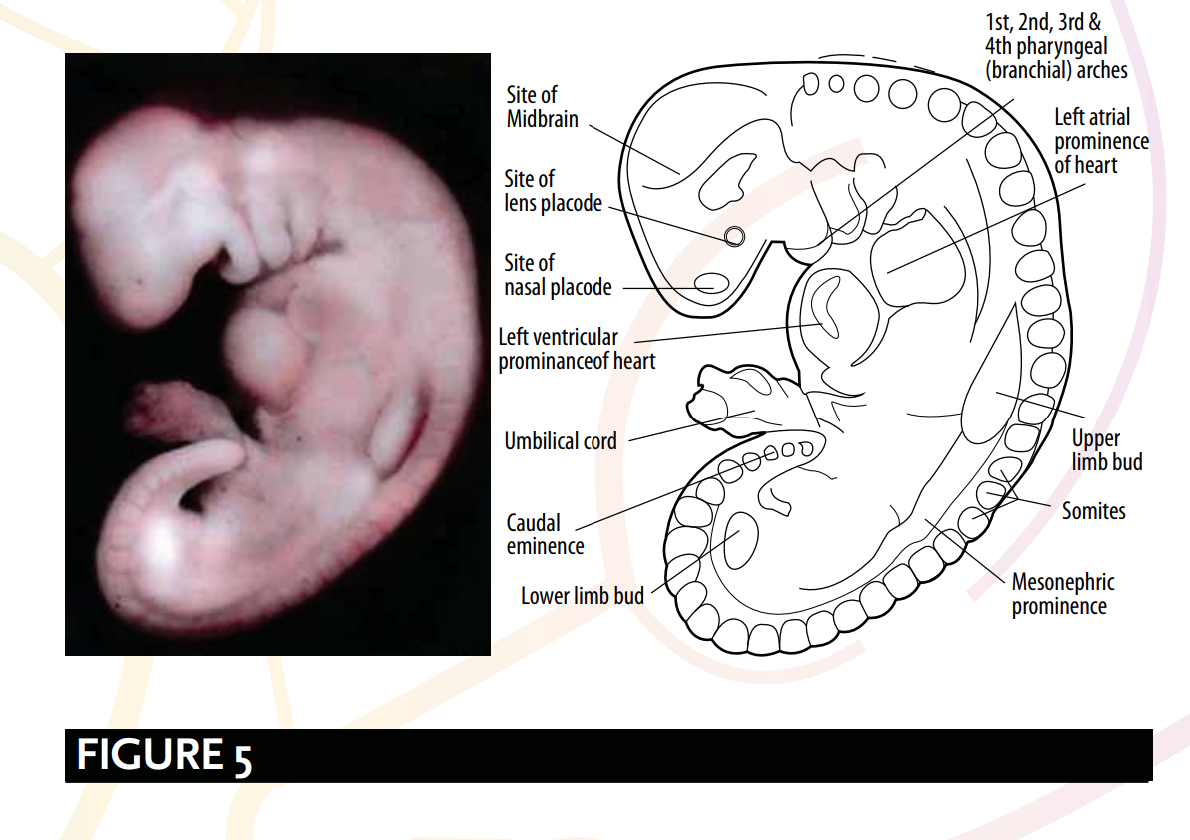
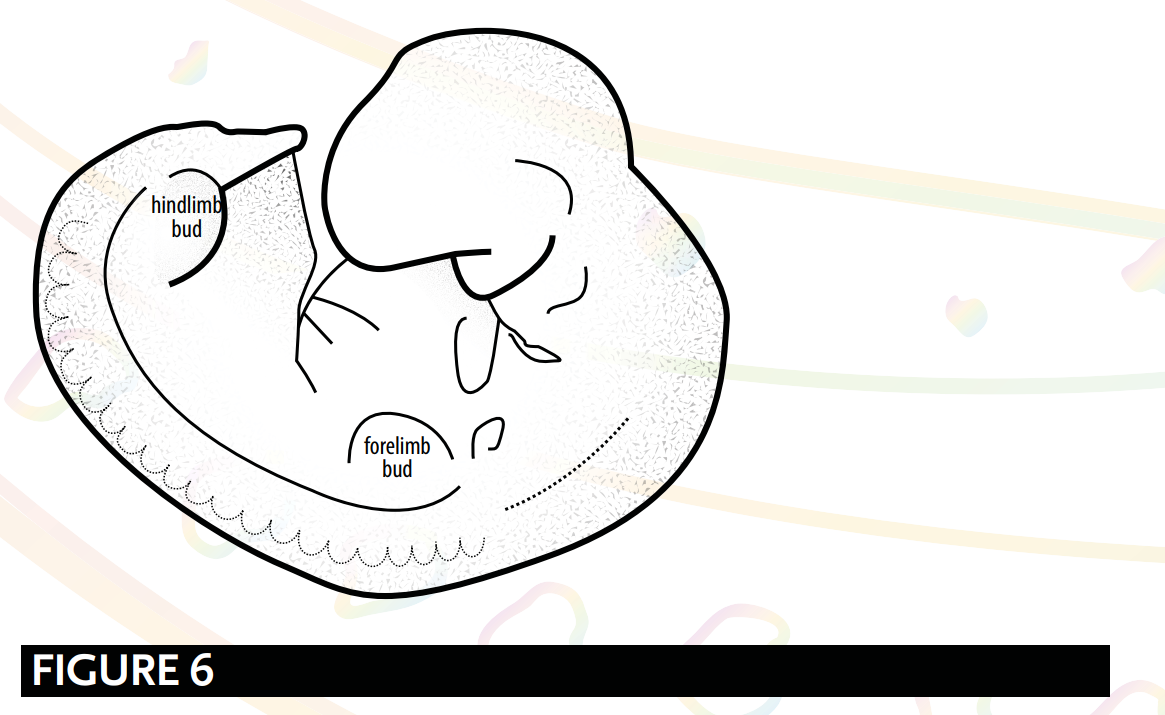
Adotando uma abordagem lexical para a interpretação da palavra, esta etapa trata da 4ª semana, quando começam a se desenvolver os somitos, que se assemelham a marcas de dentes [ver Figuras 5 e 6]. A aparência do embrião nesta fase, devido ao desenvolvimento dos somitos, corresponde aos significados: "ser mastigado" e "algo que os dentes mastigaram e deixaram marcas visíveis". Sobre o desenvolvimento dos somitos, Barry Mitchell e Ram Sharma escrevem:
Taking a lexical approach to the interpretation of the word, this stage deals with the 4th week, when somites, which resemble tooth-marks [see Figures 5 and 6], begin to develop. The appearance of the embryo at this stage, due to somite development, corresponds with the meanings: ‘to be chewed’ and ‘something that teeth have chewed and left visible marks on’. Concerning somite development, Barry Mitchell and Ram Sharma write:
Na quarta semana, as células mesenquimais situadas medialmente nos somitos migram em direção à notocorda para formar os esclerótomos [o mesênquima é o tecido conjuntivo embrionário de disposição frouxa presente no embrião].67
In the fourth week, the medially placed mesenchymal cells of the somites migrate towards the notochord to form scelerotomes [mesenchyme is the loosely arranged embryonic connective tissue in the embryo].67
Outro significado da palavra *mudghah* inclui algo que se assemelha a um pedaço de carne. Esta também é uma descrição precisa da aparência do embrião nesta fase. Curiosamente, a explicação corânica de *mudghah* como algo "formado e não formado" pode referir-se ao período organogenético, durante o qual todos os principais órgãos começaram a se desenvolver, mas ainda não estão totalmente formados.68 Este período também ocorre por volta da 4ª semana.
Another meaning for the word mudghah includes something looking like a morsel of flesh. This too is an accurate description of the embryo's appearance at this stage. Interestingly, the qur’anic explanation of mudghah as being “formed and unformed”, can refer to the organogenetic period, during which all the main organs have begun to develop, but are not yet fully formed.68 This period also occurs at around the 4th week
UMA SUBSTÂNCIA MASTIGADA
A CHEWED SUBSTANCE
Um argumento levantado pelos críticos a respeito da fase da mudghah é que um pedaço de carne mastigada ou um pedaço de carne não se assemelha ao embrião em nenhuma das etapas descritas pela embriologia moderna. Ao responder a isso, é necessário esclarecer o que constitui um "pedaço de carne mastigada". Isso inclui não apenas a mastigação, mas também algo que foi mastigado apenas uma vez. Isso mantém o significado da palavra mudghah, pois as marcas de mordida de fato se assemelham a um pedaço de carne mastigado uma vez. Isso é destacado por seu outro significado: "algo que os dentes mastigaram e deixaram marcas visíveis".
An argument raised by critics concerning the mudghah stage is that a chewed piece of meat or a lump of flesh does not resemble the embryo at any stage described by modern embryology. In responding to this, it is necessary to clarify what constitutes a ‘chewed piece of flesh’. It includes, not just mastication, but also something being chewed just the once. This maintains the meaning of the word mudghah as the bite marks do resemble a piece of meat chewed once. This is highlighted by its other meaning: ‘something that teeth have chewed and left visible marks on’.
SUMÁRIO
SUMMARY
A etapa da *mudghah*
The `mudghah stage:
O desenvolvimento dos somitos, que dá ao embrião a aparência de uma substância mastigada. O que parece um pedaço de carne mastigada é uma descrição precisa da aparência do embrião nesta fase.
The development of somites giving the embryo the appearance of a chewed substance. What looks like a morsel of flesh - an accurate description of embryo's appearance at this stage.
Também descreve o período organogenético (o desenvolvimento dos órgãos, ainda não totalmente formados).
It also describes the organogenetic period (the development of organs, not yet fully formed).
Como sempre, têm havido tentativas de comparar o termo corânico mudghah com a obra de Galeno, a fim de sustentar a visão de que o Profeta Muhammad ﷺ plagiou escritos gregos sobre o desenvolvimento humano. No entanto, ao analisar os escritos de Galeno e confrontá-los com os diversos e extensos significados da palavra mudghah, torna-se evidente uma diferença marcante. Galeno afirma:
As ever, there have been attempts to compare the qur’anic term mudghah with Galen’s work to substantiate the view that the Prophet Muhammad ﷺ plagiarised from Greek writings on human development. However, upon analysing Galen’s writings, bringing it in contrast to the various and extensive meanings of the word mudghah, a pointed difference is made distinct. Galen states:
O terceiro período segue a partir disto, quando, como foi dito, é possível ver com clareza as três partes governantes e uma espécie de contorno, uma silhueta, por assim dizer, de todas as outras partes. Verá a conformação das três partes governantes mais claramente, a das partes do estômago mais vagamente e, ainda muito mais, a dos membros. Mais tarde formam-se os "ramos", como Hipócrates os designou, indicando com o termo a sua semelhança com galhos de árvore.69
The third period follows on this, when, as was said, it is possible to see the three ruling parts clearly and a kind of outline, a silhouette, as it were, of all the other parts. You will see the conformation of the three ruling parts more clearly, that of the parts of the stomach more dimly, and much more still, that of the limbs. Later on they form ‘twigs’, as Hippocrates expressed it, indicating by the term their similarity to branches.69
Como foi explorado, o Alcorão menciona a mudghah como uma substância semelhante a algo mastigado e um pequeno pedaço de carne. Em contraste, Galeno discute a "conformação" das "três partes dominantes", as "silhuetas" e os "ramos", o que muito provavelmente se refere à formação dos ossos dos membros. Ele descreve essas três partes dominantes como sendo mais visíveis do que o estômago e os membros. No entanto, o Alcorão não faz nenhuma menção a isso, e sua menção à formação dos ossos dos membros ocorre na etapa seguinte. Portanto, é tanto implausível quanto impraticável sugerir que o Profeta Muhammad ﷺ tenha copiado as obras de Galeno, pois o Alcorão não inclui nenhuma das descrições fornecidas por Galeno nesta etapa.
As explored, the Qur’an mentions mudghah as a chewed-like substance and a small piece of flesh. In contrast, Galen discusses the “conformation” of “the three ruling parts”, “silhouettes” and “twigs”, which is most likely in reference to limb bone formation. He details these three ruling parts as being more visible than the stomach and the limbs. However, the Qur’an makes no mention of this, and its mention of the limb bone formation comes at the next stage. It is both implausible and impractical, therefore, to suggest the Prophet Muhammad ﷺ copied the works of Galen as the Qur’an does not include any of the descriptions provided by Galen at this stage