6. Ossos
6. Bones
e فَخَلَقْنَا الْعَلَقَةَ مُضْغَةً فَخَلَقْنَا الْمُضْغَةَ عِظَامًا فَكَسَوْنَا الْعِظَامَ لَحْمًا Since this is a Qur'an verse (text between { and }), here is the translation as requested: {e fizemos daquele coágulo um pedaço de carne, e fizemos daquele pedaço de carne ossos}
and We made that lump into bones
A partir do estágio de mudghah, são criados os `idhaam. Este é o estágio seguinte. A palavra `idhaam, na língua árabe, significa osso, e é aplicada especificamente aos ossos das mãos e dos pés, ou dos braços e das pernas de um animal, sobre os quais está a carne.70
From the mudghah stage, `idhaam are created. This is the next stage. The word `idhaam in the Arabic language means bone, and is specifically applied to the bones of the hands and feet, or of the arms and legs of an animal, upon which is the flesh.70
INTERPRETAÇÃO CIENTÍFICA
SCIENTIFIC INTERPRETATION
O estágio de *idhaam* diz respeito ao desenvolvimento do esqueleto axial e dos membros, ocorrendo por volta da 5ª semana. Barry Mitchell e Ram Sharma explicam:
The `idhaam stage pertains to the development of the axial and limb skeleton, occuring at around the 5th week. Barry Mitchell and Ram Sharma explain:
A origem das células mesenquimais que formam os tecidos esqueléticos varia em diferentes regiões do corpo. As células mesenquimais que formam o esqueleto axial originam-se dos somitos mesodérmicos, ao passo que os ossos do esqueleto apendicular derivam do mesênquima somatopleural do mesoderma da placa lateral. Após alcançarem o seu destino, as células mesenquimais se condensam e formam modelos dos ossos. A subsequente diferenciação das células mesenquimais em condroblastos ou osteoblastos é controlada geneticamente.71.
The origin of mesenchymal cells forming the skeletal tissues varies in different regions of the body. Mesenchymal cells forming the axial skeleton arise from the mesodermal somites, whereas the bones of the appendicular skeleton are derived from the somatopleuric mesenchyme of the lateral plate mesoderm. After reaching their destination the mesenchymal cells condense and form models of bones. The subsequent differentiation of mesenchymal cells into chondroblasts or osteoblasts is genetically controlled.71.
‘Ossos dos membros’ é o significado especificado da palavra `idhaam, e por isso pode referir-se ao desenvolvimento dos brotos dos membros, que dão origem ao desenvolvimento dos membros e do esqueleto apendicular. Barry Mitchell e Ram Sharma elaboram sobre a formação do membro e do esqueleto apendicular:
‘Limb bones’ is the specified meaning of the word `idhaam, and therefore can refer to the development of the limb buds which give rise to the development of the limbs and the appendicular skeleton. Barry Mitchell and Ram Sharma elaborate on the formation of the limb and appendicular skeleton:
O esqueleto apendicular é composto pelas cinturas dos membros e pelos ossos dos membros. Os ossos do esqueleto apendicular desenvolvem-se a partir de condensações mesenquimatosas, que se tornam modelos cartilagíneos.72 [See Figure 7]
The appendicular skeleton consists of limb girdles and the bones of the limbs. The bones of the appendicular skeleton develop from mesenchymal condensations which become cartilaginous models.72 [See Figure 7]
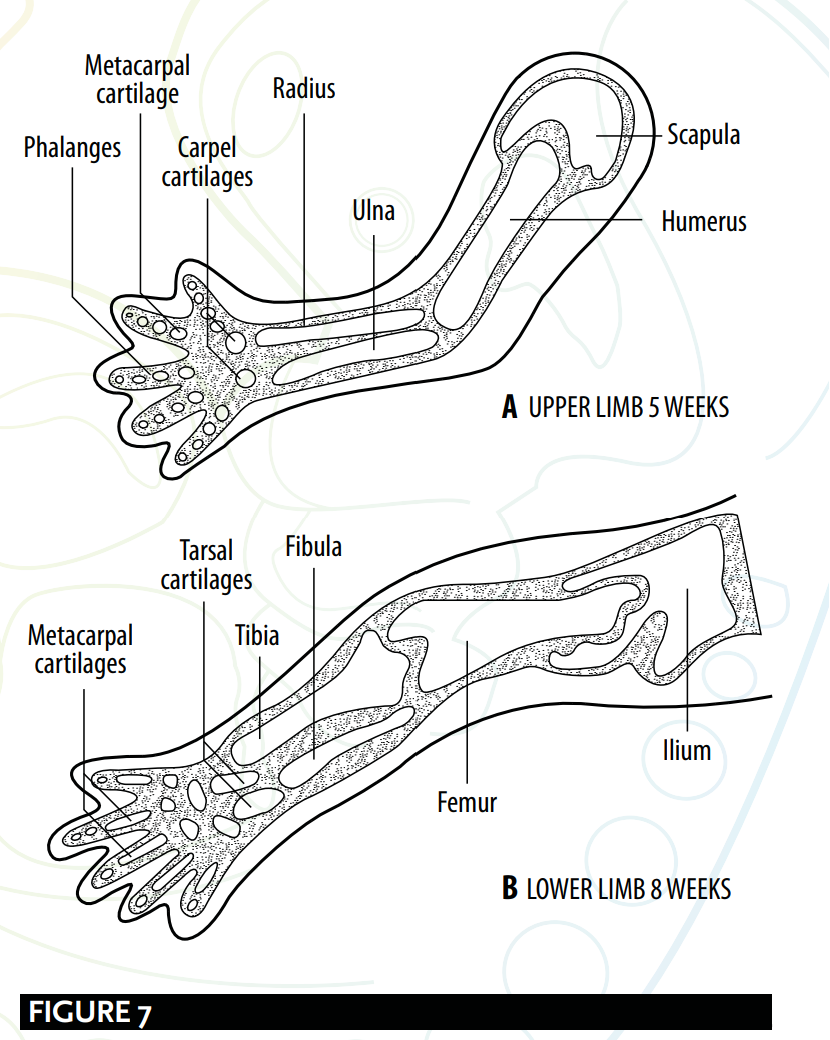
John Allen e Beverley Kramer também comentam sobre a formação dos ossos dos membros.
John Allen and Beverley Kramer also comment on limb bone formation.
O mesênquima do membro é, no início, uma massa homogênea, mas logo surgem condensações nele, e estas se condrificam para formar modelos cartilaginosos dos vários ossos. Cada modelo de cartilagem é envolvido por pericôndrio, que é uma condensação de mesênquima. Um centro de ossificação (centro de ossificação primário) é formado sobre cada modelo de cartilagem pelo crescimento para dentro de osteoblastos (células formadoras de osso) a partir do mesênquima circundante. O mesênquima circundante passa agora a ser chamado de periósteo (que envolve o osso). Os osteoblastos então produzem osso, dando origem aos elementos esqueléticos dos membros. 73.
The limb mesenchyme is at first a homogenous mass but soon condensations occur in it and these chondrify to form cartilaginous models of the various bones. Each cartilage model is surrounded by perichondrium which is a condensation of mesenchyme. An ossific centre (primary ossification centre) is formed upon each cartilage model by the ingrowth of osteobalsts (bone-forming cells) from the surrounding mesenchyme. The surrounding mesenchyme is now termed periosteum (surrounding the bone). Osteoblasts now produce bone which give rise to the skeletal elements of the limbs. 73.
Existem paralelos claros entre a fase qur'ânica do "idhaam" e a visão que a embriologia moderna tem, ou seja, o desenvolvimento do esqueleto axial, dos membros e do esqueleto apendicular.
There are clear parallels between the qur'anic `idhaam stage and the view modern embryology takes i.e. the development of the axial, limb and appendicular skeleton.
RESUMO
SUMMARY
A fase de `idhaam: A formação do esqueleto axial, dos membros e do esqueleto apendicular.
The `idhaam stage: The formation of the axial, limb and appendicular skeleton.
DE UM PEDAÇO DE CARNE A OSSOS
FROM A LUMP TO BONES
Um equívoco comum, geralmente cometido por não arabistas, é que este versículo pode ser traduzido literalmente como "e Nós fizemos aquele pedaço de carne em ossos". A partir disso, concluem que este versículo é anticientífico, porque um pedaço de carne não pode transformar-se em uma massa de ossos. No entanto, isso se baseia em uma compreensão grosseira da gramática árabe e da eloquência do Alcorão. Este versículo, do ponto de vista gramatical, possui os sentidos de: "e Nós fizemos dos/a partir do/de dentro do pedaço de carne ossos".
A common misconception, usually made by non-Arabists, is that this verse can be literally translated as “and We made that lump into bones”. From this, they conclude that this verse is unscientific because a lump of flesh cannot turn into a mass of bones. However, this is based upon a crude understanding of Arabic grammar and the Qur’an's eloquence. This verse, from a grammatical perspective, has the meanings of: “and We made of/from/out of the lump bones”.
Por isso Yusuf Ali traduz este versículo como "então fizemos dessa massa ossos"74; Shakir o traduz como "então Nós fizemos (nela) os ossos da massa de carne"; e A. J. Arberry, em sua tradução do Alcorão que ainda é utilizada por acadêmicos atualmente, traduz este versículo como "então Nós criamos dos tecidos ossos".75
This is why Yusuf Ali translates this verse as “then we made out of that lump bones”74; Shakir translates it as “then We made (in) the lump of flesh bones”; and A J Arberry, in his translation of the Qur’an which is still used by academics today, translates this verse as “then We created of the tissue bones”.75
OSSOS NÃO REAIS
NOT REAL BONES
Outra proposição dos comentaristas é que, nessa etapa, ainda não existem ossos reais. Argumenta-se que os aparentes ossos são apenas cartilagem, já que a ossificação está incompleta e, por isso, o Alcorão deveria estar impreciso. Embora seja uma contestação válida, ela está mal direcionada. A palavra `idhaam abrange a forma cartilaginosa dos ossos, à medida que a estrutura esquelética é formada. Além disso, o processo de ossificação começa por volta da 8ª semana,76 continuando após o nascimento, com a conclusão do processo de ossificação por volta da puberdade. Barry Mitchell e Ram Sharma explicam:
Another proposition from commentators is that at this stage there are no real bones. It is argued that the apparent bones are mere cartilage as ossification is incomplete and, as such, the Qur’an must therefore be inaccurate. Although a valid contention, it is misplaced. `idhaam encompasses the cartilaginous form of the bones as the skeletal framework is put in place. Additionally, the process of ossification begins by the 8th week,76 continuing on after birth, with the eventual completion of the ossification process at around puberty. Barry Mitchell and Ram Sharma explain:
Os centros de ossificação aparecem pela primeira vez nos ossos dos membros durante a oitava semana. Por volta da décima segunda semana, as diáfises dos ossos dos membros já estão ossificadas, embora os ossos do carpo, no punho, permaneçam cartilaginosos até depois do nascimento. A ossificação dos três maiores ossos do tarso, no tornozelo, começa por volta da 16ª semana, mas alguns dos menores ossos do tarso só se ossificam 3 anos após o nascimento.77.
The centres of ossification first appear in the limb bones during the eighth week. By the twelfth week, the shafts of the limb bones are ossified, though the carpal bones of the wrist remain cartilaginous until after birth. The ossification of the three largest tarsal bones of the ankle begins about 16 weeks, but some of the smaller tarsal bones do not ossify until 3 years after birth.77.
Deste ponto de vista, seria um absurdo médico supor que recém-nascidos ou adolescentes jovens não têm ossos apenas porque necessitam de ossificação, especialmente porque a ossificação se completa no fim do surto de crescimento da puberdade. No entanto, se fosse este o caso, e considerarmos esta fase como “sem ossos”, por assim dizer, as derivações da palavra `idhaam permitem uma interpretação abrangente, pois os “modelos cartilaginosos dos vários ossos”78 estão incluídos em seu significado.
From this perspective, it would be a medical absurdity to assume newborns or young teenagers do not have bones simply because they require ossification, especially since ossification completes at the end of the growth-spurt of puberty. Nevertheless if this were the case, and we are to take this stage as being ‘boneless’, as it were, the derisions of the word `idhaam allow for an all encompassing interpretation because the “cartilaginous models of the various bones”78 is included in its meaning.