3. Quem e o Que Nós Vemos?
3. Who And What Do We See?
O Poder de uma Imagem
The Power Of An Image
A forma como nos vemos e como imaginamos que os outros nos veem tem influência sobre a nossa autoidentidade e sobre a relação entre o "eu" e o "outro". Isto é refletido visualmente aqui, numa imagem evocativa intitulada "The Fear Is Still Me" (ver abaixo). A imagem sugere a persona bestial de um prisioneiro torturado que veste um capuz que oculta a sua identidade semelhante à de um urso.18
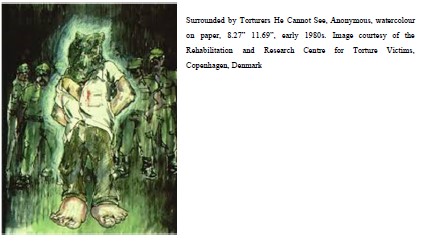
How we see ourselves and how we imagine ourselves being seen has a bearing on our self-identity and on the relationship between ‘self’ and ‘other’. This is reflected visually here in an evocative image entitled ‘The Fear Is Still Me’ (see below). The image suggests a bestial persona of a tortured prisoner donning a hood that conceals his bear-like identity.18
Embora "ele não consegue ver", ele é muito visível como uma peça central, como se fosse anunciado pelos guardas da prisão. Na imagem, aparece uma auréola. Perguntamo-nos se o halo que o envolve é o feixe de uma lanterna vindo de trás dele, um holofote que incide sobre ele, ou se o artista nos desafia a considerar oposições binárias, nas quais símbolos da vida humanizada e desumanizada se justapõem. A união dos guardas atrás dele contrasta com o isolamento do prisioneiro, e a formação de matilha dos guardas em contraste com o prisioneiro solitário, semelhante a um urso, é surpreendentemente irónica. É o prisioneiro ferido, semelhante a um urso, que foi caçado, e são os guardas da prisão que o anunciam.
Though “he cannot see” he is very much to be seen as a centre-piece as if heralded by the prison guards. In the image, there appears a halo. We wonder whether the halo etched around him is the beam of a torch from behind him, a floodlight shining onto him or whether the artist challenges us to consider binary oppositions wherein symbols of humanised and dehumanised life become juxtaposed. The togetherness of the guards behind him is set against the isolation of the prisoner though the pack-like formation of the guards and the lone bear-like prisoner is strikingly ironic. It is the wounded bear-like prisoner who has been hunted and the prison guards herald him.
Há muito a ser visto. O desenho sugere um indivíduo maior que a vida, embora seus pés salientes talvez reflitam membros inchados por espancamento, e nisso o prisioneiro parece desequilibrado. Como, porém, seus pés não apresentam ferimentos, eles poderiam, em vez disso ou simultaneamente, sugerir sua presença marcante? Não podemos ver suas mãos, mas imaginamos que ferimentos elas poderiam apresentar.
There is much to be seen. The cartoon suggests a larger-than-life individual though his protruding feet perhaps reflect limbs swollen by beating, and in this the prisoner appears imbalanced. Since however his feet bear no injuries might they instead or simultaneously suggest his stamped presence? We cannot see his hands however and imagine what injuries they might bear.
As roupas desleixadas do prisioneiro, com os botões da camisa e o zíper da calça abertos, são mais um contraste com as vestimentas "civilizadas" e arrumadas dos guardas da prisão. O fato de o prisioneiro estar encapuzado revela uma falta de identidade própria. Porém, em lugar do medo, da preocupação e da dor que se poderiam supor, o capuz, semelhante ao de um urso, transmite desafio e força.
The scruffy clothes of the prisoner with shirt buttons and trouser zip undone are a further contrast to the ‘civilised’ and neat attire of the prison guards. The fact that the prisoner is hooded reveals a lack of self-identity. Though, in place of his assumed fear, worry and pain, the bear-like hood projects defiance and strength.
Sem dúvida, os muçulmanos enfrentam uma barragem constante de notícias da imprensa que difamam a sua fé ou outros muçulmanos. Esta constante alteridade intensifica as ansiedades e acaba por moldar a forma como nos vemos a nós mesmos como um povo largamente definido pela violência. Motivos de barbárie e atraso, imagens de mulheres de hijab ou burca enquadradas em narrativas de medo e do desconhecido são algo comum. Butler observa que "os quadros através dos quais apreendemos, ou, de facto, deixamos de apreender as vidas dos outros como perdidas ou feridas (perdíveis ou feríveis) são politicamente saturados. São, em si mesmos, operações de poder. Não decidem unilateralmente as condições de aparecimento, mas o seu objetivo é, ainda assim, delimitar a própria esfera de aparecimento."19
Undoubtedly, Muslims face a constant barrage of press reports that vilify their faith or other Muslims. This constant othering heightens anxieties and comes to shape the way we see ourselves as a people largely defined through violence. Motifs of barbarity, backwardness, images of women in hijab or burqa framed around narratives of fear and the unknown are commonplace. Butler notes that ‘the frames through which we apprehend or, indeed, fail to apprehend the lives of others as lost or injured (lose-able or injurable) are politically saturated. They are themselves operations of power. They do not unilaterally decide the conditions of appearance, but their aim is nevertheless to delimit the sphere of appearance itself.’19
Tudor (2011) cita o seguinte exemplo para ilustrar como as atitudes e percepções em relação aos outros exercem forte influência sobre disposições simpáticas ou empáticas. Embora advirta contra generalizações, ele escreve:
Tudor (2011) strikes the following example to reflect how attitudes and perceptions of others have a strong bearing on sympathetic or empathic outlooks. Though cautioning against generalisations, he writes:
Reel Bad Arabs
Reel Bad Arabs
A pesquisa de Lendenman (1983) revelou sucessivas representações negativas dos árabes em charges políticas de jornais americanos como The Washington Post, The Washington Star, The Miami News, The Baltimore Sun e outros. A análise de Palmer (1995) sobre charges políticas no The Washington Post após as guerras de Israel de 1956, 1957 e 1973, e a Intifada palestina, mostrou que, mesmo antes da Primeira Guerra do Golfo, já se refletia a mesma tendência de retratos negativos e desumanizantes dos árabes, frequentemente dos árabes palestinos em especial. Tais imagens negativas são muitas vezes usadas para promover guerras americanas ou, no caso da análise de Palmer (1995), para promover as campanhas de Israel contra os palestinos.26 O estudo de Nasir (1979) sobre a representação dos árabes em filmes americanos entre 1894 e 1960
Lendenman’s (1983) research has revealed successive negative portrayals of Arabs in political cartoons in American newspapers such as The Washington Post, The Washington Star, The Miami News, The Baltimore Sun and others. Palmer’s (1995) analysis of political cartoons in The Washington Post following Israel’s wars of 1956, 1957 and 1973, the Palestinian Intifida. Even prior to the first Gulf War, there was reflected the same tendency of negative and dehumanising portrayals of Arabs, and oftentimes specifically Palestinian Arabs. Such negative images are often used to promote American wars, or in the case of Palmer’s (1995) analysis, to promote Israel’s campaigns against Palestinians.26 Nasir’s (1979) study of the portrayal of Arabs in American movies between 1894 and 1960
revelou uma imagem predominante dos árabes como atrasados, malvados e desumanos.27 No estudo abrangente de Shaheen sobre mais de 900 filmes de Hollywood lançados entre 1896 e 2001, é evidente uma tendência dominante das apresentações midiáticas dos árabes como o vilão desumanizado.28
revealed a predominant image of Arabs as backwards, evil and inhumane.27 In Shaheen’s comprehensive study of over 900 Hollywood movies released between 1896 and 2001, a dominant trend of media presentations of Arabs as the dehumanised villain is evident.28
Da mesma forma, Kamalipour (2000) avaliou a representação negativa dos árabes no rádio, na televisão e no cinema, revelando como os árabes são propensos a cometer atos de terrorismo contra americanos.29 Outros trabalhos de Ayish (1994) e Qazzaz (1975) mostraram como essas imagens mitológicas dos árabes como inerentemente malignos, violentos, incultos e ameaçadores são proeminentes nos livros didáticos de ciências sociais do ensino fundamental, do ginásio e do ensino médio, o que perpetuou estereótipos negativos sobre os árabes.
18 Kahleen McCullough-Zander e Sharyn Larson, ‘The Fear Is Still Me’ - http://www.nursingcenter.com/upload/static/230543/fear.pdf.
18 Kahleen McCullough-Zander and Sharyn Larson, ‘The Fear Is Still Me’ - http://www.nursingcenter.com/upload/static/230543/fear.pdf.
19 Judith Butler (2010) ‘Performative Agency’ in Journal of Cultural Economy, 3:2, p. 1.
19 Judith Butler (2010) ‘Performative Agency’ in Journal of Cultural Economy, 3:2, p. 1.
20 K. Tudor (2011). Understanding Empathy. Transactional Analysis Journal, 41(1), 39–57. Garber: 2004, p. 83.
20 K. Tudor (2011). Understanding Empathy. Transactional Analysis Journal, 41(1), 39–57. Garber: 2004, p. 83.
21 R. Srikanth, Constructing the Enemy: Empathy/Antipathy in U.S. Literature and Law (Philadelphia, Temple University Press: 2012), p. 158.
21 R. Srikanth, Constructing the Enemy: Empathy/Antipathy in U.S. Literature and Law (Philadelphia, Temple University Press: 2012), p. 158.
22 Kayla Williams, Love My Rifle More Than You (W.W. Norton, 2006), p. 249.
22 Kayla Williams, Love My Rifle More Than You (W.W. Norton, 2006), p. 249.
23 Herbert Kelman, "Violence Without Moral Restraint: Reflections on the Dehumanization of Victims and Victimizers", Journal of Social Issues, Vol. 29, No. 4, (1973), p. 48.
23 Herbert Kelman, “Violence Without Moral Restraint: Reflections on the Dehumanization of Victims and Victimizers”, Journal of Social Issues, Vol. 29, No.4, (1973), p. 48.
24 Jodi Halpern e Harvey M. Weinstein, Rehumanizing the Other: Empathy and Reconciliation, Human Rights Quarterly, Vol. 26, No. 3 (Ago., 2004), pp. 568-9.
24 Jodi Halpern and Harvey M. Weinstein, Rehumanizing the Other: Empathy and Reconciliation, Human Rights Quarterly, Vol. 26, No. 3 (Aug., 2004), pp. 568-9.
25 Jodi Halpern, From Detached Concern to Empathy: Humanizing Medical Practice 1 7-18 (2001), pp. 130-133; 143.