3. ¿A quién y a qué vemos?
3. Who And What Do We See?
El Poder de una Imagen
The Power Of An Image
La forma en que nos vemos a nosotros mismos y la forma en que imaginamos que los demás nos ven influye en nuestra identidad personal y en la relación entre el "yo" y el "otro". Esto se refleja visualmente en una evocadora imagen titulada "The Fear Is Still Me" (véase más abajo). La imagen sugiere la persona bestial de un prisionero torturado que se cubre con una capucha que oculta su identidad similar a la de un oso.18
How we see ourselves and how we imagine ourselves being seen has a bearing on our self-identity and on the relationship between ‘self’ and ‘other’. This is reflected visually here in an evocative image entitled ‘The Fear Is Still Me’ (see below). The image suggests a bestial persona of a tortured prisoner donning a hood that conceals his bear-like identity.18
Aunque «no puede ver», él es muy ciertamente el centro de atención, como si los guardias de la prisión lo anunciaran. En la imagen aparece un halo. Nos preguntamos si el halo que lo rodea es el haz de una linterna situada detrás de él, un foco que lo ilumina o si el artista nos invita a considerar oposiciones binarias en las que los símbolos de la vida humanizada y de la vida deshumanizada se yuxtaponen. La unión de los guardias que están tras él contrasta con el aislamiento del prisionero, y la formación de manada de los guardias frente al prisionero solitario, semejante a un oso, resulta sorprendentemente irónica. Es el prisionero herido, semejante a un oso, quien ha sido cazado, y los guardias lo anuncian.
Though “he cannot see” he is very much to be seen as a centre-piece as if heralded by the prison guards. In the image, there appears a halo. We wonder whether the halo etched around him is the beam of a torch from behind him, a floodlight shining onto him or whether the artist challenges us to consider binary oppositions wherein symbols of humanised and dehumanised life become juxtaposed. The togetherness of the guards behind him is set against the isolation of the prisoner though the pack-like formation of the guards and the lone bear-like prisoner is strikingly ironic. It is the wounded bear-like prisoner who has been hunted and the prison guards herald him.
Hay mucho que ver. La caricatura sugiere un individuo de tamaño superior al natural, aunque sus pies sobresalientes quizás reflejen extremidades hinchadas por golpes, y en esto el prisionero parece desequilibrado. Sin embargo, como sus pies no presentan heridas, ¿podrían en cambio, o simultáneamente, sugerir su presencia imponente? No podemos ver sus manos, pero imaginamos qué heridas podrían presentar.
There is much to be seen. The cartoon suggests a larger-than-life individual though his protruding feet perhaps reflect limbs swollen by beating, and in this the prisoner appears imbalanced. Since however his feet bear no injuries might they instead or simultaneously suggest his stamped presence? We cannot see his hands however and imagine what injuries they might bear.
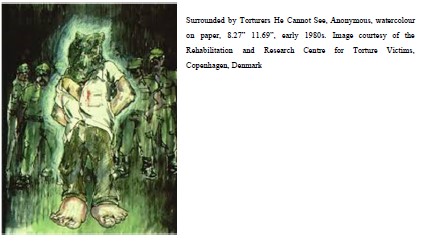
La ropa desaliñada del prisionero, con los botones de la camisa y la cremallera del pantalón desabrochados, supone un contraste adicional con la vestimenta "civilizada" y pulcra de los guardias de la prisión. El hecho de que el prisionero lleve capucha revela una falta de identidad propia. Sin embargo, en lugar del miedo, la preocupación y el dolor que cabría suponerle, la capucha, que recuerda a un oso, transmite desafío y fortaleza.
The scruffy clothes of the prisoner with shirt buttons and trouser zip undone are a further contrast to the ‘civilised’ and neat attire of the prison guards. The fact that the prisoner is hooded reveals a lack of self-identity. Though, in place of his assumed fear, worry and pain, the bear-like hood projects defiance and strength.
Sin duda, los musulmanes se enfrentan a un bombardeo constante de noticias de prensa que vilipendian su fe o a otros musulmanes. Esta constante alterización aumenta las ansiedades y termina por moldear la forma en que nos vemos a nosotros mismos como pueblo, definido en gran medida por la violencia. Son habituales los motivos de barbarie y atraso, y las imágenes de mujeres con hiyab o burka enmarcadas en narrativas de miedo y de lo desconocido. Butler señala que «los marcos a través de los cuales aprehendemos o, en realidad, no logramos aprehender las vidas de otros como perdidas o heridas (perdibles o dañables) están políticamente saturados. Son en sí mismos operaciones de poder. No deciden unilateralmente las condiciones de aparición, pero su objetivo es, no obstante, delimitar la esfera de la aparición misma».19
Undoubtedly, Muslims face a constant barrage of press reports that vilify their faith or other Muslims. This constant othering heightens anxieties and comes to shape the way we see ourselves as a people largely defined through violence. Motifs of barbarity, backwardness, images of women in hijab or burqa framed around narratives of fear and the unknown are commonplace. Butler notes that ‘the frames through which we apprehend or, indeed, fail to apprehend the lives of others as lost or injured (lose-able or injurable) are politically saturated. They are themselves operations of power. They do not unilaterally decide the conditions of appearance, but their aim is nevertheless to delimit the sphere of appearance itself.’19
Tudor (2011) pone el siguiente ejemplo para reflejar cómo las actitudes y las percepciones que se tienen de los demás influyen de manera notable en las posturas compasivas o empáticas. Aunque advierte contra las generalizaciones, escribe:
Tudor (2011) strikes the following example to reflect how attitudes and perceptions of others have a strong bearing on sympathetic or empathic outlooks. Though cautioning against generalisations, he writes:
Árabes malos de película
Reel Bad Arabs
Las investigaciones de Lendenman (1983) han revelado sucesivas representaciones negativas de los árabes en las caricaturas políticas de periódicos estadounidenses como The Washington Post, The Washington Star, The Miami News, The Baltimore Sun y otros. El análisis de Palmer (1995) sobre las caricaturas políticas en The Washington Post tras las guerras de Israel de 1956, 1957 y 1973, y la Intifada palestina, reflejó la misma tendencia a retratar a los árabes de forma negativa y deshumanizadora, y con frecuencia específicamente a los árabes palestinos. Incluso antes de la Primera Guerra del Golfo ya se observaba esta tendencia. Tales imágenes negativas se utilizan a menudo para promover guerras estadounidenses o, en el caso del análisis de Palmer (1995), para promover las campañas de Israel contra los palestinos.26 El estudio de Nasir (1979) sobre la representación de los árabes en el cine estadounidense entre 1894 y 1960
Lendenman’s (1983) research has revealed successive negative portrayals of Arabs in political cartoons in American newspapers such as The Washington Post, The Washington Star, The Miami News, The Baltimore Sun and others. Palmer’s (1995) analysis of political cartoons in The Washington Post following Israel’s wars of 1956, 1957 and 1973, the Palestinian Intifida. Even prior to the first Gulf War, there was reflected the same tendency of negative and dehumanising portrayals of Arabs, and oftentimes specifically Palestinian Arabs. Such negative images are often used to promote American wars, or in the case of Palmer’s (1995) analysis, to promote Israel’s campaigns against Palestinians.26 Nasir’s (1979) study of the portrayal of Arabs in American movies between 1894 and 1960
revelaba una imagen predominante de los árabes como atrasados, malvados e inhumanos.27 En el estudio exhaustivo de Shaheen sobre más de 900 películas de Hollywood estrenadas entre 1896 y 2001, se evidencia una tendencia dominante en las representaciones mediáticas que presentan a los árabes como villanos deshumanizados.28
revealed a predominant image of Arabs as backwards, evil and inhumane.27 In Shaheen’s comprehensive study of over 900 Hollywood movies released between 1896 and 2001, a dominant trend of media presentations of Arabs as the dehumanised villain is evident.28
De manera similar, Kamalipour (2000) evaluó la representación negativa de los árabes en la radio, la televisión y el cine, y reveló cómo a los árabes se les atribuye la tendencia a cometer actos terroristas contra los estadounidenses.29 Además, trabajos posteriores de Ayish (1994) y Qazzaz (1975) mostraron que imágenes míticas de los árabes como seres inherentemente malvados, violentos, incultos y amenazantes son prominentes en los libros de texto de ciencias sociales de la escuela primaria, la secundaria básica y el bachillerato, lo que perpetuó estereotipos negativos sobre los árabes.
18 Kahleen McCullough-Zander y Sharyn Larson, «The Fear Is Still Me» - http://www.nursingcenter.com/upload/static/230543/fear.pdf.
18 Kahleen McCullough-Zander and Sharyn Larson, ‘The Fear Is Still Me’ - http://www.nursingcenter.com/upload/static/230543/fear.pdf.
19 Judith Butler (2010) «Performative Agency» en Journal of Cultural Economy, 3:2, p. 1.
19 Judith Butler (2010) ‘Performative Agency’ in Journal of Cultural Economy, 3:2, p. 1.
20 K. Tudor (2011). Understanding Empathy. Transactional Analysis Journal, 41(1), 39–57. Garber: 2004, p. 83.
20 K. Tudor (2011). Understanding Empathy. Transactional Analysis Journal, 41(1), 39–57. Garber: 2004, p. 83.
21 R. Srikanth, Constructing the Enemy: Empathy/Antipathy in U.S. Literature and Law (Filadelfia, Temple University Press: 2012), p. 158.
21 R. Srikanth, Constructing the Enemy: Empathy/Antipathy in U.S. Literature and Law (Philadelphia, Temple University Press: 2012), p. 158.
22 Kayla Williams, Love My Rifle More Than You (W.W. Norton, 2006), p. 249.
22 Kayla Williams, Love My Rifle More Than You (W.W. Norton, 2006), p. 249.
23 Herbert Kelman, «Violence Without Moral Restraint: Reflections on the Dehumanization of Victims and Victimizers», Journal of Social Issues, Vol. 29, No. 4, (1973), p. 48.
23 Herbert Kelman, “Violence Without Moral Restraint: Reflections on the Dehumanization of Victims and Victimizers”, Journal of Social Issues, Vol. 29, No.4, (1973), p. 48.
24 Jodi Halpern y Harvey M. Weinstein, "Rehumanizing the Other: Empathy and Reconciliation", Human Rights Quarterly, Vol. 26, No. 3 (ago., 2004), pp. 568-9.
24 Jodi Halpern and Harvey M. Weinstein, Rehumanizing the Other: Empathy and Reconciliation, Human Rights Quarterly, Vol. 26, No. 3 (Aug., 2004), pp. 568-9.