La croyance (Aqeedah) et ce qui en émane en termes de statuts légaux (Hukm) ainsi que ce qui s'y construit en termes de pensées, constituent le fondement d'At-Taghyeer (le changement).
The Aqeedah and what emanates from it in terms of Ahkaam and what is built upon it in terms of thoughts, is the basis of At-Taghyeer (change).
Le comportement de l'être humain est lié à ce qu'il porte en termes de concepts. Les concepts (Mafaaheem) sont des convictions (Qanaa’aat) résultant d'une compréhension des choses et de leurs attributs, en plus de ce qui est bâti sur cette compréhension ou qui en émane en termes d'autres convictions.
The conduct of the human is tied to what he carries in terms of concepts. The concepts (Mafaaheem) are convictions (Qanaa’aat) resulting from a comprehension of things and their attributes in addition to what is built upon this comprehension or emanates from it in terms of other convictions.
Les concepts sont de deux types :
Concepts are of two types:
Le premier :
The first:
: Concepts concernant les choses. Il s'agit de convictions ou d'Ahkaam (statuts légaux [Hukm]) dont la source est la chose elle-même. Cela inclurait des affirmations telles que : « Le feu brûle », « Le poison tue », « L'alcool enivre », « La viande se mange tandis que la terre ne se mange pas », « L'augmentation de la pression génère une explosion (d'une certaine manière) », « La société est composée d'un ensemble d'individus liés par des relations permanentes » et « Le renouveau ne pourrait avoir lieu que par la pensée éclairée ».
: Concepts about things. These are convictions or Ahkaam (rulings) whose source is the things themselves. This would include statements like: ‘Fire burns’, ‘Poison kills’, ‘Alcohol intoxicates’, ‘Meat is eaten whilst soil is not eaten’, ‘The increased build-up of pressure generates an explosion (of sorts)’, ‘The society is composed of a collection of individuals bound by permanent relationships’ and ‘Revival would not occur except by way of the enlightened thought’.
Toutes ces pensées sont des descriptions ou des Ahkaam dont la source est leur sujet. Elles peuvent être correctes ou incorrectes selon leur conformité à la réalité ou leur contradiction avec celle-ci. Dans tous ces cas, elles sont considérées comme des concepts du point de vue de celui qui y a cru. Le comportement et la conduite de l'être humain sont liés à ses concepts sur les choses ; ainsi, quiconque est convaincu que sa nourriture a été empoisonnée n'en mangerait jamais, même s'il avait faim. De même, celui qui a soif cherchera de l'eau et rien d'autre, tandis que celui qui veut être ivre cherchera de l'alcool et rien d'autre.
All of these thoughts are descriptions or Ahkaam whose source is its subject. They could be correct or incorrect depending on their conformity to the reality or their contradiction to it. In all of these cases they are considered to be concepts in respect to the one who has believed in them. The human behaviour and conduct is tied to his concepts about things and so whoever is convinced that his food has been poisoned would never eat from it and even if he was hungry. Similarly the one who was thirsty would seek water and not something else whilst the one who wanted to be intoxicated would seek alcohol and nothing else.
Le deuxième type :
The second type:
Concepts (Mafaaheem) concernant la vie. Ce sont des convictions ou des Ahkaam dont la source est extérieure à leur sujet. Cela ressemble à des affirmations telles que : « La prière (Salah) est obligatoire (Fard) », « La fraude est illicite (Haram) » et « Tuer quelqu'un est illicite (Haram) », etc. La source de ce statut légal (Hukm) n'est pas la chose elle-même ou l'action, et celles-ci ne représentent que le domaine concerné ou la réalité sur laquelle porte le jugement, tandis que la source du jugement est autre chose et se trouve ailleurs.
Concepts (Mafaaheem) about life. These are convictions or Ahkaam whose source is external to its subject. This is like the statements: ‘The Salaah is Fard’, ‘Fraud is Haraam’ and ‘Killing someone is Haraam’ etc... The source of this Hukm is not the thing itself or the action and these only represent the subject area or the reality that is being judged upon whilst the source of the judgement is something else and lies elsewhere.
Ainsi, notre affirmation : « L'alcool enivre » reflète une description ou un attribut interne associé à l'alcool. Il s'agit d'un jugement porté sur une chose en raison de ce qu'elle contient ou de ce qu'elle entraîne. L'affirmation « L'alcool est illicite (Haram) » n'est toutefois pas un jugement porté sur une chose sur la base de ce qu'elle contient, mais représente plutôt un statut légal (Hukm) d'Allah (SWT).
So our statement: ‘Alcohol intoxicates’ reflects a description or an internal attribute associated to alcohol. It is a judgement made upon a thing due to what it contains or results in. The statement however ‘Alcohol is Haraam’ is not a judgement passed upon a thing on the basis of what is in it but rather it represents a Hukm from Allah (swt)
Qui décide de ce qui est illicite (Haram) et de ce qui est permis (Mubah).
who decides what to make Haraam and what to make Mubaah (permissible).
Le comportement de la personne est également lié à ses concepts sur la vie. S'il détenait le concept ou la compréhension selon laquelle la chair de porc est comestible et qu'elle pourrait satisfaire la faim, cela représenterait un concept concernant une chose. Le concept sur la vie est cependant que le porc est illicite (Haram), ce qui signifie qu'il est obligatoire pour lui de l'éviter et de s'en tenir éloigné. Cela deviendrait un concept pour celui qui a compris ce statut légal (Hukm) et y a cru, et cela aurait un effet sur son comportement et l'empêcherait de satisfaire sa faim avec du porc.
The behaviour of the person is also tied to his concepts about life. If he held the concept or understanding about the flesh of pig that it was edible and would satisfy hunger, then this would represent a concept about a thing. The concept about life however is that the pig is Haraam meaning that is obligatory for him to avoid and keep away from it. It would become a concept for the one who has comprehended this Hukm and believed in it and it would have an effect upon his behaviour and prevent him from satisfying his hunger from pig.
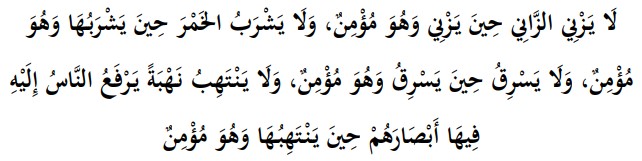
Lorsque le fornicateur commet la Zinaa, il n'est pas un croyant ; lorsque le buveur de vin boit de l'alcool, il n'est pas un croyant ; lorsque le voleur vole, il n'est pas un croyant ; et aucun pillard qui pille un objet de valeur qui attire l'attention des gens n'est un croyant lorsqu'il commet cet acte (AlBukhaari).
When the fornicator is committing Zinaa he is not a believer, when the alcohol drinker is drinking alcohol he is not a believer, when the thief steals he is not a believer and no plunderer who plunders a valuable thing that attracts the attention of people is a believer whilst he commits this act (AlBukhaari).
Il est donc obligatoire de restaurer les vérités (Haqaa’iq) dans les esprits afin de corriger le comportement et de le rectifier. Celles-ci incluent : les Haqaa’iq (vérités) des choses et les vérités charia'iques en termes de croyances et d'Ahkaam. On doit leur rappeler ces vérités afin qu'elles deviennent fraîches, fermement incarnées et présentes, et qu'elles aient, à ce titre, un effet sur le comportement.
It is therefore obligatory to restore the truths (Haqaa’iq) to the minds to correct the behaviour and to rectify it. These include: The Haqaa’iq (truths) of things and the Shar’iyah truths in terms of beliefs and Ahkaam. They must be reminded with them so that they become fresh, firmly embodied and present, and as such have an effect upon the behaviour.
Allah (SWT) a dit :
Allah (swt) said:

Et rappelle, car certes le rappel profite aux croyants (Adh-Dhaariyaat 55).
And remind for verily the reminder benefits the believers (Adh-Dhaariyaat 55).
C'est le contraire en ce qui concerne les mécréants, car leur rappeler les vérités et les concepts de la Shar’iyah ne leur est d'aucun profit. Ils les entendent comme des pensées, mais celles-ci ne représentent ni des vérités ni des concepts pour eux, et de ce fait, elles n'ont aucun effet sur leur comportement.
The opposite is the case in respect to the disbelievers because reminding them of the truths and Shar’iyah concepts does not benefit them. They hear them as thoughts but they do not represent truths for them nor do they represent concepts for them and as such they have no effect upon their behaviour.
Par conséquent, les concepts relatifs à la vie sont ce qui définit la manière dont l'être humain vit. Sa préoccupation principale n'est pas seulement de vivre, mais plutôt la manière dont il doit vivre, et sa préoccupation majeure ne porte pas sur la satisfaction de ses besoins, mais plutôt sur la manière dont il les satisfera. Pour cette raison, ses concepts sur la vie façonnent pour lui une manière et un style de vie spécifiques.
Therefore the concepts about life are what define the manner by which the human lives. His main concern is not just living but rather how he should live and his main concern is not about satisfying his needs but rather it concerns the manner by which he will satisfy them. For this reason his concepts about life fashion for him a specific manner and style of living.
Dans le cas où la source des concepts de la vie est extérieure aux choses et aux actions elles-mêmes, il n'est pas possible de les adopter sans être convaincu au préalable que la source est vraie ou qu'elle possède le pouvoir ou l'autorité de porter un jugement à leur sujet, et que ses Ahkaam sont valides et correctes.
In the case where the source of the concepts in life are external to the things and actions themselves, it is not possible to adopt them except after being convinced that the source is true or has the power or authority to make a judgment upon them, and that its Ahkaam are valid and correct.
L'Islam a établi que le Haakim (Juge) est Allah (SWT) et que la source des Ahkaam (règlements) est la révélation (Wahy).
Islaam has established that the Haakim (Judge) is Allah (swt) and that the source of the Ahkaam (rulings) is the Wahi (divine revelation)
révélé à Sayyidunaa Muhammad ﷺ.
revealed upon Sayyidunaa Muhammad (saw).
Allah (SWT) a dit :
Allah (swt) said:

Certes, le statut légal (Hukm) n'appartient qu'à Allah. Il a ordonné que vous n'adoriez que Lui (Yousuf 40).
Verily the Hukm (rule) is not but for Allah. He commanded that you do not worship other than him (Yousuf 40).
Et Il (SWT) a dit :
And He (swt) said:

Et quiconque ne juge pas selon ce qu'Allah a révélé, ceux-là sont les mécréants (Al-Maa’idah 44).
And whosoever does not judge by what Allah has revealed then it those who are the disbelievers (Al-Maa’idah 44).
Tout statut légal ou jugement autre que le statut légal (Hukm) d'Allah est un Taaghoot :
Every ruling or judgement other than the Hukm of Allah is Taaghoot:
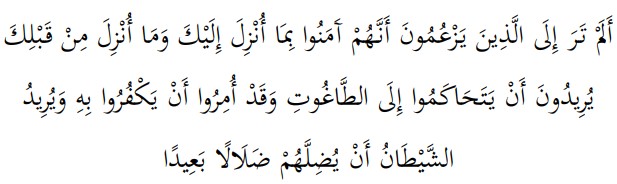
N'as-tu pas vu ceux qui prétendent avoir cru en ce qui t'a été révélé, [ô Muhammad], et en ce qui a été révélé avant toi ? Ils souhaitent se référer à la législation du Taghoot, alors qu'on leur a ordonné de le rejeter ; et Satan veut les égarer totalement (An-Nisaa 60).
Have you not seen those who claim to have believed in what was revealed to you, [O Muhammad], and what was revealed before you? They wish to refer legislation to Taghoot, while they were commanded to reject it; and Satan wishes to lead them far astray (An-Nisaa 60).
Ainsi, il ne reste aucun jugement laissé à l'esprit ou à l'être humain, et cela ne signifie pas que le rôle de l'esprit a été retiré ou qu'une limitation a été imposée à ses capacités. C'est plutôt parce que l'esprit et l'être humain ne possèdent pas les outils nécessaires pour porter un jugement ou rendre une sentence. Cela est dû au fait que la source de la sentence n'est pas la chose elle-même ou le sujet sur lequel la sentence sera rendue.
As such there is no judgement left to the mind or the human and this does not mean that the role of the mind has been taken away or that a limitation has been placed upon its capabilities. It is rather because the mind and the human do not possess the necessary tools to make judgement or pass a ruling. This is because the source of the ruling is not the thing itself or the subject that the ruling will be made upon.
Ainsi, ceux qui ont délégué la subsistance du statut légal (Hukm) aux gens, par exemple, ne se sont pas basés sur une preuve, mais ont plutôt erré et se sont égarés. Ils ont porté un concept qui n'est pas véridique et qui n'a aucune réalité, tout en niant la vérité en séparant la religion (Deen) de la vie, ce qui signifie qu'il n'y a aucun statut légal (Hukm) appartenant à Allah.
So those who have allocated the provision of the ruling to the people, for example, have not based this upon evidence and have rather wandered and gone astray. They have carried a concept which is not truthful and has no reality to it, whilst at the same time they have denied the truth by separating the Deen from life which means that there is no Hukm belonging to Allah.
Si le droit et le pouvoir de rendre des jugements et des sentences étaient donnés à l'être humain alors qu'il ne possède pas les outils nécessaires pour le faire, alors rien ne prévaudrait hormis ses désirs, ses inclinations et ses intérêts selon son propre point de vue. Ceux-ci seraient changeants et fluctuants, et il pourrait percevoir quelque chose de nuisible comme étant bénéfique, et voir une maladie comme un remède et une guérison.
If the right and power of issuing judgements and rulings was given to the human whilst he does not possess the necessary tools to do that, then nothing would prevail apart from his desires, inclinations and interests according to his viewpoint. These would be changing and fluctuate and he could see something that is damaging as being beneficial and he could see a disease as a medicine and cure.
Dans ce contexte, l'importance de la foi (Iman) en Allah, en la Prophétie et en le Qur’aan apparaît clairement. Cette foi (Iman) est la croyance (Aqeedah) qui a un effet sur le comportement, car elle fournit à l'être humain les concepts sur la vie qui définissent pour lui comment il doit vivre, son but dans la vie et le but derrière son comportement et sa conduite, qui est d'atteindre l'agrément d'Allah ‘Azza Wa Jalla.

Dis : « Vous indiquerons-Nous les plus grands perdants en ce qui concerne leurs œuvres ? Ce sont ceux dont l'effort s'est égaré dans la vie présente, alors qu'ils pensaient accomplir le bien. » (Al-Kahf 103-104).
Say: Shall We inform you of the greatest losers in respect to (their) deeds? [They are] those whose effort is lost in worldly life, whilst they were thinking that they are doing good (Al-Kahf 103-104).
Oui, les individus sont égarés et les peuples sont égarés, tout comme un poisson dans l'océan lorsqu'il mord à l'appât, ou comme la souris qui se précipite vers la nourriture placée dans un piège à souris.
Yes the individuals are led astray and the peoples are led astray just like a fish in the ocean when it takes the bait or the mouse that rushes to the food placed in a mouse trap.
L'être humain erre sans atteindre son but lorsqu'il s'engage sur un chemin dont il est convaincu qu'il y mènera, alors qu'en réalité, il marche dans la direction exactement opposée.
The human wanders around and does not arrive at his aim when he proceeds along a path that he is convinced will lead to it whilst in reality he is actually going in the exact opposite direction.
Il est également égaré lorsqu'il porte des concepts erronés sur la vie à la suite de l'ignorance ou de la distorsion, comme celui qui voit ou est amené à voir que l'usure (Riba) est licite (Halal), que la démocratie fait partie de l'Islam et que l'apprentissage de la charia est destiné à gagner sa vie, tout comme n'importe quel autre domaine de spécialisation ou profession. Lorsque les Haqaa’iq (vérités/faits) de l'Islam deviennent absents et que les esprits sont remplis de fausses pensées, telles que les pensées de libertés générales ou que changer la réalité déclinante est impossible dans notre génération actuelle ou dans les cent prochaines années, ou que ce changement est un don d'Allah et qu'il n'y a rien à faire pour nous sinon attendre ou attendre le Mahdi. Tout cela transforme les individus, les peuples ou la communauté (Ummah) en un ensemble de personnes paresseuses, poussées avec léthargie dans n'importe quelle direction que ceux qui leur ont inculqué ces concepts souhaitent, et cela les conduit à devenir des outils pour leurs ennemis alors qu'ils croient lutter contre eux.
He is also led astray when he carries incorrect concepts about life as a result of ignorance or distortion like the one who sees or is made to see that Ribaa is Halaal, that democracy is from Islaam and that learning the Sharee’ah is for the sake of earning a living just like any other area of specialisation or profession. When the Haqaa’iq (truths/facts) of Islaam become absent and the minds are filled with false thoughts like the thoughts of general freedoms or that changing the declined reality is impossible in our current generation or one hundred years, or that this change is a gift from Allah and that there is nothing for us to do apart from wait or to wait for the Mahdi. All of this transforms the individuals, peoples or the Ummah into a collection of lazy people sluggishly being driven in whatever direction those who have given them these concepts want them to and it leads them into becoming tools for their enemies whilst they believe that they are actually struggling against them.

Comme celui qui tend ses mains vers l'eau [de loin, l'appelant] pour qu'elle atteigne sa bouche, mais elle ne l'atteint pas (Ar-Ra’d 14).
Like the one who stretches his hands toward water [from afar, calling it] to reach his mouth, but it does not reach it (Ar-Ra’d 14).

Leur exemple est celui de celui qui a allumé un feu, mais quand il a illuminé ce qui l'entourait, Allah a retiré leur lumière et les a laissés dans les ténèbres [de sorte qu'ils] ne pouvaient plus voir (Al-Baqarah 17).
Their example is that of one who kindled a fire, but when it illuminated what was around him, Allah took away their light and left them in darkness [so] they could not see (Al-Baqarah 17).
Par conséquent, nous répétons que, pour changer le comportement, le rectifier et en faire un comportement correct et élevé qui atteint son but, il est essentiel de générer des concepts corrects sur les choses et la vie. À ce moment-là, la personne sera en mesure de subjuguer et d'utiliser les choses et leurs attributs avec succès, et sera en mesure d'adopter le comportement qui mène à son but et au plus grand de tous les objectifs, qui est l'obtention de l'agrément d'Allah ‘Azza Wa Jall :
Therefore, we repeat, that in order to change the conduct, rectify it and make it a correct elevated conduct that arrives at its purpose, it is essential to generate correct concepts about things and life. At that time the person will be in a good position to subjugate and utilise the things and their attributes successfully and will be in a good position to adopt the conduct that arrives to his purpose and the greatest of all objectives which is the attainment of the pleasure of Allah ‘Azza Wa Jall:

Mais recherche, par ce qu'Allah t'a donné, la demeure de l'au-delà ; et n'oublie pas ta part de ce monde. Et fais le bien comme Allah a fait le bien envers toi (Al-Qasas 77).
But seek, through that which Allah has given you, the home of the Hereafter; and [yet], do not forget your share of the world. And do good as Allah has done good to you (Al-Qasas 77).
La première des Haqaa’iq (vérités) et, de loin, la plus importante est la croyance (Aqeedah) qui définit les concepts de l'être humain concernant la vie. La croyance (Aqeedah) est que toutes choses ont été créées par un Créateur qui est Allah (SWT), qu'Allah a envoyé un Messager qui est Muhammad ﷺ avec la Risaalah (message) de Al-Islaam qui explique tout ce qui concerne l'être humain, et qu'Il (SWT) lui demandera des comptes sur la base de la foi (Iman) ou de la mécréance (Kufr) et sur la base de son respect de ce avec quoi le Prophète (Nabi) ﷺ est venu ou de son non-respect de celui-ci.
The first of the Haqaa’iq (truths) and absolutely its most important is the Aqeedah that defines the human’s concepts about life. The Aqeedah is that all things have been created by a creator who is Allah (swt), that Allah sent a Messenger who is Muhammad (saw) with the Risaalah (message) of Al-Islaam which explains everything that relates to the human being and that He (swt) will account him upon the basis of Imaan or Kufr and upon the basis of his abiding by what the Nabi (saw) came with or by his non-abidance to it.
Le but de la vie du musulman :
The Muslim’s purpose in life:
Parmi les plus importantes Haqaa’iq (vérités) après la foi (Iman), il y a le fait que l'être humain comprenne le but de sa création, c'est-à-dire ce qu'il doit s'efforcer d'accomplir.
From amongst the most important Haqaa’iq (truths) after Imaan is that the human understands the purpose of his creation i.e. that which he must strive to accomplish.
Allah (SWT) a dit :
Allah (swt) said:
Et Je n'ai créé les djinn et l'humain que pour M'adorer (AdDhaariyaat 56).
And I have not created the Jinn or humankind except to worship me (AdDhaariyaat 56).
L'adoration (Ibadah) envers Allah signifie avoir la foi (Iman) en Lui et Lui obéir. L'obéissance envers Lui Ta’Aalaa signifie l'engagement et l'adhésion (Al-Iltizaam) à tous Ses Ahkaam. Cela ne se limite pas aux actes d'adoration (Ibadah), à l'Akhlaaq (la morale) et aux Mu’aamalaat (les transactions sociétales), mais inclut plutôt tout ce qu'Allah (SWT)
The worship (‘Ibaadah) to Allah means having Imaan in Him and obedience to Him. Obedience to Him Ta’Aalaa means commitment and abidance (Al-Iltizaam) to all of His Ahkaam. This is not restricted to the acts of ‘Ibaadah, Akhlaaq (morals) and Mu’aamalaat (societal transactions) but rather includes everything that Allah (swt)
a commandé ou interdit. Cela inclut le fait que rien n'a le droit d'être adoré en dehors d'Allah et qu'aucun commandement ou interdit ne peut provenir de quiconque d'autre que Lui (SWT).
has commanded or forbidden. It includes that nothing has a right to be worshipped other than Allah and that no command or forbiddance can come from anyone besides Him (swt).
Ahmad et At-Tirmidhi ont rapporté qu' ‘Adiy Bin Haatim (ra) vint vers le Messager d'Allah ﷺ alors que celui-ci récitait le verset (Ayah) :
Ahmad and At-Tirmidhi related that ‘Adiy Bin Haatim (ra) came to the Messenger of Allah (saw) whilst he was reciting the Aayah:
Ils ont pris leurs rabbins et leurs moines comme seigneurs en dehors d'Allah, ainsi que le Maseeh, le fils de Mary. Or, ils n'ont été commandés qu'à adorer un Dieu unique ; il n'y a de divinité que Lui. Il est au-dessus de tout ce qu'ils Lui associent (At-Taubah 31).
They have taken their Rabbis and monks as lords besides Allah, and [also] the Maseeh, the son of Mary. And they were not commanded except to worship one God; there is no deity except Him. Exalted is He above whatever they associate with Him (At-Taubah 31).
‘Adiy dit alors : « Ils ne les adoraient pas ». Le Messager d'Allah ﷺ dit alors :
‘Adiy then said: ‘They did not worship them’. So the Messenger of Allah (saw) said:
Au contraire, ils ont rendu licite (Halal) ce qui était illicite (Haram) pour eux et ont rendu illicite (Haram) ce qui était licite (Halal) pour eux, puis ils les ont suivis (en cela). Par conséquent, cela fut leur adoration envers eux.
On the contrary, they made the Halaal Haraam upon them and made the Haraam Halaal for them, then they followed them (in this). Therefore this was their worship to them.
Ainsi, accorder le Haqq (droit) à quiconque que ce soit de décider ce qui est licite (Halal) et ce qui est illicite (Haram), ou le droit de légiférer et le droit d'obéissance, représente l'adoration (Ibadah) envers cette personne.
As such giving the Haqq (right) to anyone to decide the Halaal and decide the Haraam or the right to make legislation and the right of obedience represents ‘Ibaadah to that person.
Allah (SWT) a dit :
Allah (swt) said:
Vous n'adorez rien d'autre que Lui, si ce n'est des noms que vous avez inventés, vous et vos ancêtres, pour lesquels Allah n'a fait descendre aucune preuve.
You worship nothing besides Him except [mere] names you have named them with, you and your fathers, for which Allah has sent down no authority.
La législation n'appartient qu'à Allah. Il a ordonné que vous ne l'adoriez pas, Lui seul. Voilà la religion (Deen) droite, mais la plupart des gens ne savent pas (Yusuf 40).
Legislation is not but for Allah. He has commanded that you worship not except Him. That is the correct Deen, but most of the people do not know (Yusuf 40).
Quant au droit d'obéissance qui appartient au Hakim (dirigeant), à l'émir ou aux parents, cela est dû au Haqq (droit) qu'Allah (SWT)
As for the right of obedience that belongs to the Hakim (ruler), Ameer or parents then this is due to the Haqq (right) that Allah (swt)
leur a fourni.
has provided to them.
L'adoration (Ibadah) envers Allah (SWT) inclut l'obéissance consistant à faire en sorte que l'humanité L'adore (SWT), c'est-à-dire à les faire se soumettre à la charia d'Allah et à lutter contre l'existence de toute Haakimiyah (droit de légiférer) appartenant à un autre qu'Allah ou à un autre que la charia de l'Islam, en plus de lutter contre la sortie (Khurooj) du statut légal (Hukm) d'Allah (SWT). C'est ce que les textes ont indiqué et le sens qu'ils véhiculent ; ceux qui sont venus ordonnant l'« Amr Bil Ma’rouf » (ordonner le bien) et le « Nahi ‘An il-Munkar » (interdire le mal). Ils ont ordonné l'engagement de discussions, d'explications, la conviction des gens et l'invitation de ceux-ci par la voie de l'appel à l'islam (Da’wah). De plus, ils ont ordonné le fouet, l'amputation, la mise à mort (en tant que punitions et moyens de dissuasion) ainsi que le combat et Al-Jihaad pour propager le statut légal d'Allah sur la Terre et pour élever Sa parole au plus haut degré.
‘Ibaadah to Allah (swt) includes the obedience in respect to making mankind worship Him (swt) i.e. to make them submit to the Shar’a of Allah and to fight against the existence of any Haakimiyah (right to make rules) to other than Allah or to other than the Sharee’ah of Islaam in addition to fighting against the exiting (Khurooj) from the Hukm (rule) of Allah (swt). This is what the texts have indicated and the meaning that they have come with; those which have come commanding the ‘Amr Bil Ma’rouf’ (Commanding the good) and the ‘Nahi ‘An il-Munkar’ (Forbidding the evil). They have commanded the undertaking of discussions, explanations, convincing people and inviting them by way of Da’wah. Additionally they have commanded lashing, cutting, killing (as punishments and deterrents) and fighting and Al-Jihaad to spread the rule of Allah upon the Earth and to raise His word the highest.
Ainsi, nous avons vu qu'après que le Messager d'Allah ﷺ eut établi l'État islamique à Al-Madinah Al-Munawaarah et en eut fermement établi les piliers, il ﷺ envoya des messagers aux rois et aux dirigeants pour les inviter à l'Islam. Nous avons ensuite vu les Khulafaa’ (rah) qui vinrent après lui ﷺ, envoyant des porteurs de l'appel à l'islam (Da’wah), des Mujaahideen et des armées pour inviter les gens à la foi (Iman) et pour les faire sortir des ténèbres afin de les amener vers la lumière. Ils combattirent dans le but de faire se soumettre les terres et les serviteurs à l'autorité de l'Islam.
Allah Azza wa Jall nous a envoyé pour vous délivrer de l'adoration des serviteurs (les gens) afin de vous conduire à l'adoration du Seigneur des serviteurs (les gens), et pour vous délivrer de l'oppression des autres Deens afin de vous conduire à la justice de l'Islaam, et de l'étroitesse de ce monde afin de vous conduire à l'immensité de ce monde et de l'au-delà.
Allah Azza wa Jall has sent us to deliver you from the worship of the servants (people) to bring you to the worship of the Lord of the servants (people) and to deliver you from the oppression of other Deens and bring you to the justice of Islaam and from the narrowness of this world and bring you to the vastness of this world and the hereafter.
Cette pensée a été très clairement établie dans le Coran, la sunna et les actes du Messager ﷺ au sein de textes trop nombreux pour que l'on puisse en fixer une limite. Nous mentionnerons toutefois certains d'entre eux :
This thought has been made very clear in the Qur’aan, the Sunnah and the actions of the Messenger (saw) within texts that are too numerous for a limit to be placed upon them. We will however make a mention of some of them:
Allah (SWT) a dit :
Allah (swt) said:
Dis : « Ô gens ! En vérité, je suis le Messager d'Allah pour vous tous » (Al-Aa’raaf 158).
Say: O people! Verily I am the Messenger of Allah to you all (Al-Aa’raaf 158).
Il (SWT) a dit :
He (swt) said:
Et Nous ne t'avons envoyé qu'en tant qu'annonciateur de bonnes nouvelles et avertisseur (Saba’ 28).
And we have not sent you except to the entirety of mankind as a bringer of glad tidings and as a warner (Saba’ 28).
Et Il (SWT) a dit :
And He (swt) said:
C'est Lui qui a envoyé Son Messager avec la guidance et la religion (Deen) de la vérité afin qu'elle l'emporte sur toutes les autres religions (Deens), même si les Mushrikeen le détestent (At-Taubah 33, As-Saff 9).
He its is who has sent His Messenger with the guidance and the Deen of truth so that it prevails over all other Deens and even if the Mushrikeen hate it (AtTaubah 33, As-Saff 9).
Et :
And:
Ô vous qui avez cru ! Combattez ceux qui vous entourent parmi les mécréants et qu'ils trouvent en vous de la dureté. Et sachez qu'Allah est avec les pieux (At-Taubah 123).
O you who have believed, fight those adjacent to you of the disbelievers and let them find in you harshness. And know that Allah is with the righteous (AtTaubah 123).
Et : Combattez ceux qui ne croient ni en Allah, ni au Jour dernier, qui ne considèrent pas illicite ce qu'Allah et Son Messager ﷺ ont rendu illicite, et qui n'adoptent pas la religion de la vérité parmi ceux auxquels le Livre a été donné — [combattez] jusqu'à ce qu'ils versent la capitation (Jizyah) de leur propre gré, tout en étant soumis (At-Taubah 29).
Ainsi, l'objectif et le but sont qu'aucune loi à laquelle on obéit ou aucune législation adoptée ne puisse exister, si ce n'est celle qu'Allah (SWT)
So the objective and purpose is that no law that is obeyed or no legislation that is adopted can exist except for that which Allah (swt)
a commandé et qu'il n'y a pas de Haakim (législateur) autre qu'Allah. En ce qui concerne le fait de laisser les mécréants dans leurs croyances et leurs adorations, ils sont alors laissés dans ces affaires conformément et en conformité avec le commandement d'Allah (SWT).
has commanded and that there is no Haakim (law maker) other than Allah. As far as leaving the disbelievers upon their beliefs and worships then they are left upon these matters in accordance to and in compliance to the command of Allah (swt).
Allah (SWT) a clarifié et expliqué cet objectif et ce dessein concernant la création des êtres humains lorsqu'Il (SWT) a dit :
Allah (swt) has made clear and explained this objective and purpose in respect to His creation of the people when He (swt) said:
Et ainsi Nous vous avons fait une meilleure communauté (Ummah) afin que vous soyez témoins sur les hommes, et que le Messager soit témoin sur vous (Al-Baqarah 143).
And thus we have made you a just/best Ummah so that you will be witnesses over mankind and the Messenger will be a witness over you (Al-Baqarah 143).
Cette adresse s'adresse à la communauté (Ummah) islamique et lui confie la responsabilité juridique (Takleef) de porter le Message, après le Messager d'Allah ﷺ, à l'ensemble de l'humanité. Et en effet, le Prophète (Nabi) ﷺ l'a porté et, après avoir transmis le message, accompli son Amaanah et après avoir pratiqué Al-Jihaad pour l'amour d'Allah avec toute la force, l'effort et la capacité dont il disposait. Il ﷺ s'est tenu lors du dernier pèlerinage (Hajj) d'adieu, s'est adressé à sa communauté (Ummah) et a dit :
This address is to the Islamic Ummah and it entrusts her with the legal responsibility (Takleef) to carry the Message, after the Messenger of Allah (saw), to the whole of mankind. And indeed the Nabi (saw) carried it and after conveying the message, fulfilling his Amaanah and after having performed Al-Jihaad for Allah’s sake with all that he possessed of strength, effort and capability. He (saw) stood in the final farewell Hajj, addressed his Ummah and said:
Reference: Taghyeer (changement) - Mahmoud Abdul-Kareem Hasan
« Et certes, j'ai laissé parmi vous ce qui, si vous vous y accrochez fermement, vous ne vous égarerez jamais : le Kitaab d'Allah, et vous serez responsables de moi (c'est-à-dire après moi). Alors, que direz-vous tous ? ». Ils dirent : « Nous témoignons que tu as transmis, accompli et conseillé ». Il dit alors, tout en levant son index vers le ciel puis vers les gens : « Ô Allah, témoigne, ô Allah, témoigne, ô Allah, témoigne » (Abu Daawood).
‘And indeed I have left amongst you that which if you hold on firmly to you will never go astray: The Kitaab (book) of Allah, and you are responsible from me (i.e. after me). So what do you all say?’. They said: ‘We bear witness that you have conveyed, fulfilled and advised’. He then said whist raising his index finger to the sky and then towards the people: ‘O Allah bear witness, O Allah bear witness, O Allah bear witness’ (Abu Daawood).
Ainsi, de cette manière, le Prophète (Nabi) ﷺ a témoigné envers nous de la responsabilité de transmettre et de porter l'Amaanah (le dépôt) et a sollicité le témoignage d'Allah à notre sujet concernant cela. Par conséquent, après cela, il nous est obligatoire d'être des témoins envers les gens selon exactement la même méthodologie que celle entreprise par le Noble Messager ﷺ. En vérité, Allah (SWT) a clarifié que tel est le but et l'objectif de la création avant Sa création d'Aadam (paix sur lui).
So in this way the Nabi (saw) bore witness over us with the responsibility of conveying and carrying the Amaanah (trust) and sought Allah’s witness upon us in regards to that. Therefore, after that it is obligatory upon us to be witnesses over the people in accordance to exactly the same methodology that the Noble Messenger (saw) undertook. Indeed Allah (swt) made clear that this is the purpose and objective of the creation before His creation of Aadam (as).
Allah (SWT) a dit :
Allah (swt) said:
Et [rappelez-vous] quand ton Seigneur dit aux Anges : « Je vais établir sur la terre un vicaire. » Ils dirent : « Vas-Tu y établir quelqu'un qui y sèmera la corruption et répandra le sang, alors que nous Te glorifions et Te sanctifions ? » Allah dit : « En vérité, Je sais ce que vous ne savez pas. » (AlBaqarah 30).
And [remember] when your Lord said to the angels, "Verily, I will make upon the earth a successive authority." They said, "Will You place upon it one who causes corruption therein and sheds blood, while we declare Your praise and sanctify You?" Allah said, "Indeed, I know that which you do not know." (AlBaqarah 30).
Les Malaa’ikah (Anges) sont les serviteurs d'Allah (SWT) et ne Lui désobéissent point :
The Malaa’ikah (Angels) are the servants of Allah (swt) and do not disobey Him:
Sur lesquels sont [nommés] des anges, durs et sévères ; ils n'obéissent pas à Allah dans ce qu'Il leur commande, mais font ce qu'on leur commande (At-Tahreem 6).
Over which are [appointed] angels, harsh and severe; they do not disobey Allah in what He commands them but do what they are commanded (At-Tahreem 6).
Quand Allah (SWT) leur a dit :
When Allah (swt) said to them:
En vérité, Je vais établir sur la terre un calife successif.
Verily, I will make upon the earth a successive authority (Khalifah)
Ils ont réalisé et compris qu'Il (SWT) établira sur la terre ceux qui seront désobéissants. Cela est compris à partir du terme « calife » car, dans ce contexte, cela signifie celui à qui Allah donnera la succession et déléguera la tâche d'entreprendre les actes de rectification et de gestion, parmi d'autres choses que celui à qui la confiance est accordée entreprendrait. Ce rôle de rectification et de gestion des affaires signifie qu'il existera ceux qui devront être rectifiés et qui auront besoin de Ri’aayah (gestion). Cela signifie qu'il y aura ceux qui sortiront du commandement d'Allah et que cela mènera au malheur, à l'angoisse et au désordre. C'est pourquoi ils ont dit :
They realised and comprehended that He (swt) will make upon the earth those who will be disobedient. This is understood from the wording ‘Khalifah’ because here in this context it means the one who Allah will give succession and delegate to undertake the acts of correcting and caretaking amongst other matters that the one who is entrusted would undertake. This role or rectifying and taking care of affairs means that their will exist those who need to be rectified and who are need of Ri’aayah (caretaking). This means that there will be those who go outside of the command of Allah and that this will lead to misery, anguish and disorder. This is why they said:
Ils ont dit : « Vas-tu y établir ceux qui y semeront la corruption et répandront le sang ? » (Al-Baqarah 30).
They said: Will you make those who will make corruption in it (the earth) and spill blood (Al-Baqarah 30).
En d'autres termes, si la création n'incluait pas quelque chose qui serait désobéissant, alors tout se déroulerait conformément au commandement d'Allah (SWT). Ainsi, lorsqu'Allah (SWT) a voulu créer quelqu'un qui entreprendrait les actions de rectification et de guidance, cela signifie qu'il existera ceux qui choisiront l'égarement et la désobéissance à Allah.
In other words, if the creation did not include something that would be disobedient then everything would proceed in accordance to the command of Allah (swt). So when Allah (swt) wanted to create someone who will undertake the actions of rectifying and guidance then this means that there will exist those who will choose misguidance and disobedience to Allah.
Par conséquent, le but de la vie qu'Allah (SWT) a rendu clair et expliqué avant la création d'Aadam (as) est qu'il y aura un être humain qui sera un esclave (‘Abd) d'Allah et qu'il entreprendra l'œuvre de faire adorer Allah (SWT) par ceux qui se sont égarés de Son adoration ou l'ont rejetée.
Therefore the purpose in life which Allah (swt) has made clear and explained before the creation of Aadam (as) is that there will be a human being who is a slave (‘Abd) to Allah and that he will undertake the work of making others worship Allah (swt) from those who have gone astray from His worship or have rejected it.
La vie est donc un affrontement et une lutte intellectuelle, fondés sur la croyance et la politique, entre la foi (Iman) et la mécréance (Kufr). Elle est fondée sur la croyance dans la mesure où elle vise à élever la parole d'Allah au plus haut degré, afin que la religion (Deen) des gens soit entièrement et uniquement pour Allah. Ainsi, aucun statut légal (Hukm) n'existe si ce n'est qu'il soit pour Allah, qu'Il (SWT) n'ait aucun Shareek (partenaire), que rien ni personne ne soit adoré en dehors d'Allah et que la soumission ne soit qu'à la charia d'Allah. De cette manière, elle représente une lutte politique où la gestion des affaires des êtres humains a été rendue obligatoire de ne pas être confiée à une forme de législation autre que la charia de Al-Islaam.
The life is therefore an intellectual, belief based and political clash and struggle between Imaan and Kufr. It is belief based in terms of it being for the sake of raising the word of Allah the highest and so that the Deen of the people is all and only for Allah. So that no Hukm exists except that it is for Allah, that He (swt) has no Shareek (partner), that nothing or no one is worshiped aside from Allah and that submission is only to the Shar’a of Allah. In this way it represents a political struggle where the caretaking of the affairs of human beings has been made obligatory to not be entrusted to any form of legislation other than the Sharee’ah of Al-Islaam.