3. 私たちは誰と何を見るのか?
3. Who And What Do We See?
イメージの力
The Power Of An Image
自分をどのように見ているか、そして他者からどう見られていると想像しているかは、私たちの自己同一性や、「自己」と「他者」の関係に影響を及ぼします。この点は、『The Fear Is Still Me』と題された印象的な画像に視覚的に表れています(下図参照)。この画像は、熊のような正体を覆い隠すフードをかぶった、拷問を受けた囚人の獣的な人物像を示唆しています。18
How we see ourselves and how we imagine ourselves being seen has a bearing on our self-identity and on the relationship between ‘self’ and ‘other’. This is reflected visually here in an evocative image entitled ‘The Fear Is Still Me’ (see below). The image suggests a bestial persona of a tortured prisoner donning a hood that conceals his bear-like identity.18
「彼は見ることができない」とされているにもかかわらず、彼は中心的な存在として非常に目立っており、まるで刑務所の看守たちによって讃えられているかのようだ。画像には後光が見える。この彼を取り囲む光の輪は、背後からの懐中電灯の光線なのか、彼に当てられた投光照明なのか、あるいは芸術家が人間味のある生と人間性を奪われた生という象徴が並置される二項対立を私たちに考えさせようとしているのか、われわれは疑問に思う。背後の看守たちの結束は、囚人の孤立と対照をなしている。看守たちの群れのような隊形と、孤独で熊のような囚人との対比は、印象的な皮肉となっている。狩られたのは傷ついた熊のような囚人であり、看守たちは彼を讃えているのである。
Though “he cannot see” he is very much to be seen as a centre-piece as if heralded by the prison guards. In the image, there appears a halo. We wonder whether the halo etched around him is the beam of a torch from behind him, a floodlight shining onto him or whether the artist challenges us to consider binary oppositions wherein symbols of humanised and dehumanised life become juxtaposed. The togetherness of the guards behind him is set against the isolation of the prisoner though the pack-like formation of the guards and the lone bear-like prisoner is strikingly ironic. It is the wounded bear-like prisoner who has been hunted and the prison guards herald him.
その絵には多くの見どころがあります。漫画は受刑者を人並み外れた大きさの人物として描いているようにも見えます。しかし、突き出た足は殴打によって腫れた手足を反映しているのかもしれず、その点で受刑者は不安定な様子に見えます。ただ、彼の足には傷が見られないため、むしろ、あるいはそれと同時に、彼の踏みしめた存在感を示しているのではないでしょうか。手は見えないので、そこにどのような傷があるのかは想像するしかありません。
There is much to be seen. The cartoon suggests a larger-than-life individual though his protruding feet perhaps reflect limbs swollen by beating, and in this the prisoner appears imbalanced. Since however his feet bear no injuries might they instead or simultaneously suggest his stamped presence? We cannot see his hands however and imagine what injuries they might bear.
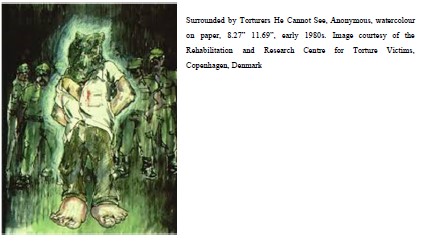
囚人のだらしない服装は、シャツのボタンとズボンのチャックが開いたままで、「文明的」で整った身なりの刑務官とさらに対照的である。囚人が覆面をかぶっていることは、自己同一性の欠如を示している。しかし、そこに想定される恐怖や不安、苦痛の代わりに、熊のようなフードは反抗心と力強さを投影している。
The scruffy clothes of the prisoner with shirt buttons and trouser zip undone are a further contrast to the ‘civilised’ and neat attire of the prison guards. The fact that the prisoner is hooded reveals a lack of self-identity. Though, in place of his assumed fear, worry and pain, the bear-like hood projects defiance and strength.
確かに、ムスリムは、自らの信仰や他のムスリムを中傷する報道に絶えずさらされています。こうした絶え間ない「他者化」は不安を強め、ムスリムとしての自己像そのものを、暴力によって定義される民族として形作っていきます。野蛮さや後進性といったモチーフ、恐怖と未知にまつわる物語に縁取られた、ヒジャーブやブルカを身につけた女性のイメージは、ありふれたものとなっています。バトラーは次のように指摘しています。「他者の生が喪われたもの、あるいは傷つけられたもの(喪失可能なもの、傷つけ得るもの)として私たちが把握し、あるいは、実際には把握しそこねる、その枠組みは政治的に飽和している。それ自体が権力の作用である。それは外観の条件を一方的に決定するわけではないが、その目的はそれでもなお、外観の領域そのものを画定することにある。」19
Undoubtedly, Muslims face a constant barrage of press reports that vilify their faith or other Muslims. This constant othering heightens anxieties and comes to shape the way we see ourselves as a people largely defined through violence. Motifs of barbarity, backwardness, images of women in hijab or burqa framed around narratives of fear and the unknown are commonplace. Butler notes that ‘the frames through which we apprehend or, indeed, fail to apprehend the lives of others as lost or injured (lose-able or injurable) are politically saturated. They are themselves operations of power. They do not unilaterally decide the conditions of appearance, but their aim is nevertheless to delimit the sphere of appearance itself.’19
Tudor(2011)は、他者に対する態度や認識が、同情的または共感的な見方にいかに強く影響するかを示すために、次の例を挙げています。彼は一般化を戒めつつ、次のように書いています。
Tudor (2011) strikes the following example to reflect how attitudes and perceptions of others have a strong bearing on sympathetic or empathic outlooks. Though cautioning against generalisations, he writes:
「拷問者が犠牲者を見るとき、その顔に宿る苦痛や、その姿勢に表れた屈辱を、確かに直接見て取ることができる。しかし問題は、彼がそれをどのような光のもとで見ているかである。拷問者が、相手の状況の『道徳的性質』が明らかになる、もう一段『より内面的な』領域へと、少し推し進めて推察する必要があるというわけではない。問題は、彼が相手の状態をどう見ているかなのだ。拷問者の目の前には、他者の苦しみの現実が、明瞭な光のもとに正面から横たわっている。だが、その光はどこかが誤っている。それは奇妙に冷たく、厳しい光であり、他者を平板にし、暴き出し、切り裂いて開いたまま押さえつけ、いっそう念入りに探り、弄ぶのに都合のよいものにしてしまう。必要なのは、別の光である。」20
“When a torturer looks upon his victim he can certainly directly see agony in his face and humiliation in his posture. The problem, though, is the light in which he sees it. It is not a matter of the torturer needing to infer a little further to another, ‘more inner’ realm in which the ‘moral properties’ of the Other’s situation will be revealed. It is a matter of how he sees the Other’s condition. The torturer has the reality of the Other’s suffering squarely in front of him, under a clear light – but that light is somehow wrong. It is a peculiarly cold and harsh light, one that flattens and exposes the Other, cuts and holds him open, all the better to probe and toy with him. What is needed is a different light.”20
リール・バッド・アラブ
Reel Bad Arabs
レンデンマン(1983)の研究は、『ワシントン・ポスト』『ワシントン・スター』『マイアミ・ニュース』『ボルティモア・サン』などアメリカの新聞に掲載された政治風刺漫画において、アラブ人が繰り返し否定的に描かれてきたことを明らかにした。パーマー(1995)は、1956年、1957年、1973年のイスラエルによる戦争、そしてパレスチナのインティファーダの後に『ワシントン・ポスト』に掲載された政治風刺漫画を分析した。第一次湾岸戦争以前にも、アラブ人、とりわけパレスチナ人を否定的かつ非人間的に描く同じ傾向が見られた。こうした否定的なイメージは、アメリカの戦争を支持するために、あるいはパーマー(1995)の分析の場合には、パレスチナ人に対するイスラエルの軍事作戦を支持するために用いられることが多い。26 ナシル(1979)は、1894年から1960年までのアメリカ映画におけるアラブ人の描かれ方を研究した。
Lendenman’s (1983) research has revealed successive negative portrayals of Arabs in political cartoons in American newspapers such as The Washington Post, The Washington Star, The Miami News, The Baltimore Sun and others. Palmer’s (1995) analysis of political cartoons in The Washington Post following Israel’s wars of 1956, 1957 and 1973, the Palestinian Intifida. Even prior to the first Gulf War, there was reflected the same tendency of negative and dehumanising portrayals of Arabs, and oftentimes specifically Palestinian Arabs. Such negative images are often used to promote American wars, or in the case of Palmer’s (1995) analysis, to promote Israel’s campaigns against Palestinians.26 Nasir’s (1979) study of the portrayal of Arabs in American movies between 1894 and 1960
それは、アラブ人を後進的で邪悪、非人道的とする支配的なイメージを明らかにしました。27 Shaheenによる1896年から2001年に公開された900本以上のハリウッド映画を対象とした包括的研究では、アラブ人を非人間化された悪役として描くメディア表現の支配的な傾向が明白です。28
revealed a predominant image of Arabs as backwards, evil and inhumane.27 In Shaheen’s comprehensive study of over 900 Hollywood movies released between 1896 and 2001, a dominant trend of media presentations of Arabs as the dehumanised villain is evident.28
同様に、Kamalipour(2000)は、ラジオ、テレビ、映画におけるアラブ人の否定的な描写を評価し、アラブ人がアメリカ人に対するテロ行為を起こしやすいとして描かれていることを明らかにした。29 さらに、Ayish(1994)とQazzaz(1975)の研究は、アラブ人を本質的に邪悪で、暴力的で、教養がなく、脅威であるとする神話的なイメージが、小学校、中学校、高等学校の社会科の教科書で顕著であり、アラブ人に対する否定的なステレオタイプを永続させていることを示した。30
Similarly, Kamalipour (2000) assessed the negative portrayal of Arabs in radio, television, and movies, revealing how Arabs are prone to committing acts of terrorism against Americans.29 Further works by Ayish (1994) and Qazzaz (1975) showed how such mythical images of Arabs as inherently evil, violent, uncultured and threatening are prominent in social science textbooks in elementary school, junior high and high school, which perpetuated negative stereotypes about Arabs.30
そこには、敵意によって歪められた想像力を、一枚一枚はがしていくような明らかにする作業が必要である。エドワード・サイードはこう書いている。
There needs to be an unmasking, a successive peeling away of an imagination disfigured by hostility. Edward Said has written:
「アラブ人は、性的に放縦な堕落した人間として描かれている。確かに巧妙で策略に長けた陰謀を企てる能力はあるが、本質的にはサディスティックで、裏切り者で、下劣である……ニュース映画や新聞では、アラブ人は常に大勢の群衆として示される。個性も、個人的な特徴も、個人的な経験もない。写真の大半は集団の怒りや悲惨さ、あるいは非合理的で(それゆえ絶望的に奇矯な)身振りを表している。」31
18 Kahleen McCullough-Zander と Sharyn Larson、『The Fear Is Still Me』 - http://www.nursingcenter.com/upload/static/230543/fear.pdf
18 Kahleen McCullough-Zander and Sharyn Larson, ‘The Fear Is Still Me’ - http://www.nursingcenter.com/upload/static/230543/fear.pdf.
19 Judith Butler (2010) 「Performative Agency」Journal of Cultural Economy, 3:2, p. 1.
19 Judith Butler (2010) ‘Performative Agency’ in Journal of Cultural Economy, 3:2, p. 1.
20 K. Tudor (2011). Understanding Empathy. Transactional Analysis Journal, 41(1), 39–57. Garber: 2004, p. 83.
20 K. Tudor (2011). Understanding Empathy. Transactional Analysis Journal, 41(1), 39–57. Garber: 2004, p. 83.
21 R. Srikanth, 『Constructing the Enemy: Empathy/Antipathy in U.S. Literature and Law』(フィラデルフィア、テンプル大学出版局、2012年)、158ページ。
21 R. Srikanth, Constructing the Enemy: Empathy/Antipathy in U.S. Literature and Law (Philadelphia, Temple University Press: 2012), p. 158.
22 Kayla Williams, *Love My Rifle More Than You* (W.W. Norton, 2006), p. 249.
22 Kayla Williams, Love My Rifle More Than You (W.W. Norton, 2006), p. 249.
23 Herbert Kelman, 「道徳的抑制を欠いた暴力:犠牲者と加害者の非人間化についての考察」, Journal of Social Issues, Vol. 29, No.4, (1973), p. 48.
23 Herbert Kelman, “Violence Without Moral Restraint: Reflections on the Dehumanization of Victims and Victimizers”, Journal of Social Issues, Vol. 29, No.4, (1973), p. 48.
24 Jodi Halpern and Harvey M. Weinstein, Rehumanizing the Other: Empathy and Reconciliation, Human Rights Quarterly, Vol. 26, No. 3 (Aug., 2004), pp. 568-9.
24 Jodi Halpern and Harvey M. Weinstein, Rehumanizing the Other: Empathy and Reconciliation, Human Rights Quarterly, Vol. 26, No. 3 (Aug., 2004), pp. 568-9.
25 Jodi Halpern, From Detached Concern to Empathy: Humanizing Medical Practice 1 7-18 (2001), pp. 130-133;143.
25 Jodi Halpern, From Detached Concern to Empathy: Humanizing Medical Practice 1 7-18 (2001 ), pp. 130-133;143.
26 A. Palmer, (1995). The Arab image in newspaper cartoon. In Y. R. Kamalipour (Ed.), The U.S. media and the Middle East: Image and perception (pp. 139-150). Westport, CT: Greenwood Press. 27 S. Nasir, (1979). The Arabs and the English. New York: Longman.