6.2 Etapas da educação escolar
6.2 School education stages
Ao dividir o ensino em etapas, devemos prestar atenção à realidade do aluno como criança ou como pessoa madura (baaligh) em cada etapa. E devemos nos referir às evidências e regras da Shari'ah que elas denotam em relação à criança ou à pessoa madura, no que diz respeito à forma como seu tutor (waliyy al-amr), e consequentemente o professor e o educador, lidam com ela, pois no Islã, o Criador, o Administrador (Al-Mudabir), o Senhor dos Mundos, estabeleceu um sistema vinculante para regular a forma como os seres humanos lidam uns com os outros.
While dividing teaching into stages, we must pay attention to the student’s reality as a child or mature (baaligh) person at each stage. And we must refer to the Shari’ah evidences and rules they denote as related to the child or mature person with respect to how his guardian (waliyy al-amr), and consequently the teacher and educator deals with him, since in Islam, the Creator the Director (Al-Mudabir), the Lord of the World, has brought a binding system to regulate how humans deal with each other.
Entre as evidências relacionadas a este assunto está o dito de Allah Ta'ala (Surah An-Nur, Ayah 58):
Among the evidences related to this subject is Allah Ta’ala’s saying (Surah An-Nur Ayah 58):
﴿يَا أَيُّهَا الَّذِينَ آمَنُوا لِيَسْتَأْذِنكُمُ الَّذِينَ مَلَكَتْ أَيْمَانُكُمْ وَالَّذِينَ لَمْ يَبْلُغُوا الْحُلُمَ مِنكُمْ ثَلَاثَ مَرَّاتٍ مِّن قَبْلِ صَلَاةِ الْفَجْرِ وَحِينَ تَضَعُونَ ثِيَابَكُم مِّنَ الظَّهِيرَةِ وَمِن بَعْدِ صَلَاةِ الْعِشَاءِ ثَلَاثُ عَوْرَاتٍ لَّكُمْ لَيْسَ عَلَيْكُمْ وَلَا عَلَيْهِمْ جُنَاحٌ بَعْدَهُنَّ طَوَّافُونَ عَلَيْكُم بَعْضُكُمْ عَلَىٰ بَعْضٍ كَذَٰلِكَ يُبَيِّنُ اللَّهُ لَكُمُ الْآيَاتِ وَاللَّهُ عَلِيمٌ حَكِيمٌ﴾ "Ó vós que credes, que vos peçam permissão aqueles que vossas destras possuem e aqueles dentre vós que ainda não atingiram a puberdade, em três ocasiões: antes da oração do alvorecer, quando tirais vossas vestes ao meio-dia e depois da oração da noite. Essas são três momentos de intimidade para vós. Não há culpa sobre vós nem sobre eles fora desses [períodos], pois eles circulam continuamente entre vós - alguns de vós entre outros. Assim Allah vos esclarece os versículos; e Allah é Conhecedor, Sábio." E Ele, o Altíssimo, disse no versículo seguinte:
﴿يََ أَيُّ هَا الَّ ي ذينَ آمَنُوا لييَسْتَأْيذنكُمُ الَّ ي ذينَ مَلَكَتْ أَيَْْانُكُمْ وَالَّ ي ذينَ لََْ يَ بْ لُغُوا الُْْلُمَ يمنكُ مْ ثَلََثَ مَرَّا ت يمِّن قَ بْيل صَلََية الْفَجْير وَي حينَ تَضَعُونَ ثييَابَكُم يمِّنَ الظَّيهيرَية وَيمن بَ عْ ي د صَلََية الْيعشَايء ثَلََثُ عَوْرَا ت لَّكُمْ لَيْسَ عَلَيْكُمْ وَلَا عَلَيْيهمْ جُنَاحٌ بَ عْدَهُنَّ طَوَّافُونَ عَلَيْكُم بَ عْضُكُمْ عَلَىٰ بَ عْ ض كَذَٰليكَ ي بَُييِّنُ اللَّ هُ لَكُمُ الْآيََ ي ت وَاللَّ هُ عَلييمٌ حَ ي كيمٌ ﴾ “O you who have believed, let those whom your right hands possess and those who have not [yet] reached puberty among you ask permission of you [before entering] at three times: before the dawn prayer and when you put aside your clothing [for rest] at noon and after the night prayer. [These are] three times of privacy for you. There is no blame upon you nor upon them beyond these [periods], for they continually circulate among you - some of you, among others. Thus does Allah make clear to you the verses; and Allah is Knowing and Wise.” And He Ta’ala said in the following Ayah:
﴿وَإِذَا بَلَغَ الْأَطْفَالُ مِنْكُمُ الْحُلُمَ فَلْيَسْتَأْذِنُوا كَمَا اسْتَأْذَنَ الَّذِينَ مِنْ قَبْلِهِمْ كَذَٰلِكَ يُبَيِّنُ اللَّهُ لَكُمْ آيَاتِهِ وَاللَّهُ عَلِيمٌ حَكِيمٌ﴾ "E quando as crianças entre vós atingirem a puberdade, que peçam permissão [em todos os momentos], como fizeram aqueles que vieram antes deles. Assim Allah vos esclarece os Seus versículos; e Allah é Conhecedor, Sábio." [An-Nur: 59] E o Profeta ﷺ disse:
﴿وَإيذَا بَ لَغَ الْأَطْفَالُ يمنكُمُ الُْْلُمَ فَ لْيَسْتَأْيذنُوا كَمَا اسْتَأْذَنَ الَّ ي ذينَ يمن قَ بْيليهمْ كَذَٰليكَ ي بَُييِّنُ اللَّ هُ لَكُمْ آيََتييه وَاللَّ هُ عَلييمٌ حَ ي كيمٌ ﴾ “And when the children among you reach puberty, let them ask permission [at all times] as those before them have done. Thus does Allah make clear to you His verses; and Allah is Knowing and Wise.” [An-Nur: 59] And the Prophet (SAW) said:
"A caneta (ou seja, a responsabilidade) é retirada de três pessoas: do louco cuja mente está dominada até que se recupere, do que dorme até que acorde e da criança até que atinja a puberdade." (Narrado por Abu Dawud em seu Sunan). E ele ﷺ disse: « يَ أسماء إن المرأة إذا بلغت المحيض لَ تصلح أن يرى منها إلا هذا وهذا » "Ó Asma, quando a mulher atinge a idade da menstruação, nada deve ser visto dela, exceto isto e isto", e indicou seu rosto e suas palmas. (Narrado por Abu Dawud em seu Sunan). E de 'Atiyya Al-Qurazi, que disse:
رفع القلم عن ثلَثة، عن المجنون المغلوب على عقله حتى يفيق، وعن النائم حتى « » يستيقظ، وعن الصبي حتى يحتلم “The pen (i.e. accountability) is lifted from three persons: The insane whose mind is overcome until he recovers, the sleeper until he awakes and the child until he attains puberty.” (Narrated by Abu Dawud in his Sunan). And he (SAW) said: » يَ أسماء إن المرأة إذا بلغت المحيض لَ تصلح أن يرى منها إلا هذا وهذا « “‘O Asma, when the female reaches the age of menstruation, nothing should be seen of her except this and this’ and he indicated his face and palms.” (Narrated by Abu Dawud in his Sunan). And from ‘Atiya Al-Quradhi who said:
Fomos apresentados ao Profeta ﷺ no dia de Quraydha. Quem já tinha pelos pubianos era morto, e quem não tinha crescimento era libertado. Eu estava entre os que não tinham crescimento, e por isso fui libertado." (Narrado por at-Tirmidhi em sua Sunan). Ele também narrou,
)عُيرضنا على النبي يوم قريظة فكان من أنبت قُتيل، ومن لَ ينبت خُلِّى سبيله، فكنت ممن لَ ينبت فخُلِّى سبيلي( “We (i.e. Bani Quraydha) were shown to the Prophet on the Day of Quradhya. Whoever had grown pubic hairs was killed while the one without growth was released. I was among those without growth so I was released.” (Narrated by Tirmidhi narrated in his Sunan). He also narrated,
Que, quando o Profeta nomeou Sa'd como juiz sobre os Banu Qurayza, ele ordenou que se examinassem suas vestes íntimas (cobrindo suas partes privadas).» E Uthman disse, quando um jovem foi trazido até ele: «Olhem para a sua veste íntima.» Descobriram que ele não tinha pelos púbicos, então não cortaram (sua mão). E nenhum dos Sahaba negou isso. E ele ﷺ disse: «Ordenem às suas crianças que rezem quando completarem sete anos, e batam nelas por causa disso (por não rezar) quando completarem dez anos. E separem-nas nas camas.» (Narrado pelo Imam Ahmad em seu Musnad). Essas evidências indicam que a infância termina quando as crianças atingem a puberdade, ou seja, a idade da maturidade. O Islam estabeleceu marcos tangíveis e distintivos que separam a infância da maturidade: a ocorrência de sonhos molhados ou o surgimento de pelos púbicos nos meninos, e a menstruação ou a gravidez nas meninas. Também indicou que as regras aplicadas aos que atingem a puberdade não se aplicam a eles antes disso. E ele ﷺ disse: «Ordenem às suas crianças que rezem aos sete anos, e batam nelas por causa disso (por não rezar) aos dez anos.» (Narrado pelo Imam Ahmad em seu Musnad). O hadith mostra que a disciplina das crianças se divide em duas etapas: a etapa anterior a a criança completar dez anos, em que não se usa a surra como disciplina, pois o hadith restringe-se a ordenar-lhe a oração sem bater nela. Assim, com maior razão, ela não deve ser espancada por ser ensinada outra coisa além da oração. Sua disciplina limita-se a métodos de exortação e ameaça, sem surras. E a etapa posterior, desde que completa dez anos até a puberdade, em que sua disciplina inclui bater nela, se necessário. Contudo, os hudud e as punições da Shari'ah ('uqubat) não se aplicam a ele até que ele alcance a puberdade, ou seja, o estágio posterior à maturidade, devido à declaração dele ﷺ:
» أنَّ النبي لما حكَّم سعد اً فِ بني قريظة كان يكشف عن مؤتزرهم « “That after S’ad adjudicated regarding Quraydha, the Prophet commanded with exposing their wrappings (covering their private parts).” And Uthman said when a young boy was brought to him: » انظروا إلى مؤتزره، فوجدوه لَ ينبت فلم يقطع « “Look at his wrapper. They found him without pubic hair so they did not cut (his hand)” and no Sahabah denied this. And he (SAW) said: مروا صبيانكم بالصلَة إذا بلغوا سبعاً، واضربوهم عليها إذا بلغوا عش راً، وفرقوا بينهم « » فِ المضاجع “Command your children to pray when they attain seven years, and beat them over it (not praying) when they attain ten years. And separate between them in the beds.” (Narrated by Imam Ahmed in his Musnad). These evidences indicate that childhood ends when children attain puberty i.e. the age of maturity. Islam assigned distinctive tangible milestones separating childhood from maturity: when wet dreams occur or pubic hairs appear in males, and menstruation or pregnancy for females. It also indicated that the rules that are applied upon those attaining puberty do not apply upon them beforehand. And he (SAW) said: » مُ ر وا أبناءكم بالصلَة لسبع سنين واضربوهم عليها لعشر سنين « “Command your children to pray when they attain seven years, and beat them over it (for not praying) when they attain ten years” (Narrated by Imam Ahmed in his Musnad). The hadith shows that disciplining children is divided into two stages: The stage before the child attains ten years where beating is not used to discipline him because the hadith restricts one to command him with prayer without beating him. Thus, by greater reason, he is not beaten for being taught other than the prayer. His discipline is restricted to styles of exhortation and threats without beating. And the stage after he attains ten years until puberty his discipline includes beating him if necessary. However the hudood and Shari’ah punishments (‘uqoobaat) do not apply upon him until after attaining puberty i.e. the stage after maturity due to his (SAW) saying:
"O lápis (isto é, a responsabilidade) é retirado de três pessoas: a criança até atingir a maturidade, quem dorme até acordar e o demente até se recuperar" (narrado por Abu Dawud em seu Sunan). O sentido de « رُفع القلم عن ثلَثة » aqui é a ausência de responsabilidade. Quando as crianças atingem a puberdade, a Shari'ah as considera responsáveis, de modo que são punidas por decisão judicial se cometerem uma transgressão (das regras da Shari'ah) ou um haram. Isso exige a presença de juízes nas escolas de alunos maduros e de ensino superior.
رُفع القلم عن ثلَثة، عن الصبيِّ حتى يبلغ، وعن النائم حتى يستيقظ، وعن المعتوه « » حتى يبرأ “The pen (i.e. accountability) is lifted from three persons: The child until he matures, the sleeper until he awakes and the imbecile until he recovers” (Narrated by Abu Dawud in his Sunan). The meaning of » رُفع القلم عن ثلَثة « “lifting the pen” here is non-accountability. When children attain puberty, the Shar’a deems them accountable so they are punished by judicial decree if they commit a violation (of the Shari’ah rules) or a haram. This requires the presence of judges in schools of mature students and higher level education.
Essas regras referentes à criança e à pessoa madura devem ser observadas ao elaborar as etapas de ensino, visto que a tarbiyyah (criação das crianças) e a disciplina são pré-requisitos da educação. A primeira etapa estende-se desde a entrada da criança na escola até que ela complete dez anos. A segunda etapa estende-se desde que ela atinge dez anos até a puberdade, que normalmente ocorre aos quinze anos em países de clima moderado. E a terceira etapa estende-se dos quinze anos até que ela conclua a educação escolar.
These rules with respect to the child and mature person must be observed when devising teaching stages since tarbiyyah (raising of children) and discipline are prerequisites of education. The primary stage extends from the child’s entry into school until he reaches ten years. The second stage extends from his attaining ten years until puberty which normally occurs at fifteen years of age in countries of moderate climate. And the third stage extends from fifteen years until he completes school education.
Com base nestas evidências e regras, as etapas de ensino escolar no Estado Khilafah são divididas com base na idade dos alunos e não nas disciplinas oferecidas pela escola. As escolas são divididas em três tipos da seguinte forma:
Based upon these evidences and rules, school teaching stages in the Khilafah State are divided upon the basis of student ages and not subjects offered by the school. Schools are divided into three types in the following manner:
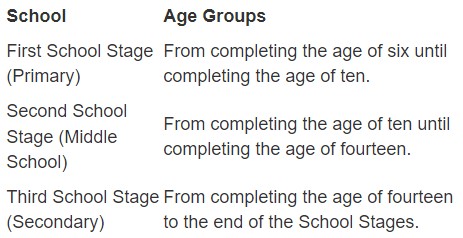
Assim que o estudante completar dez anos de idade, procura-se transferi-lo para a segunda etapa de ensino, independentemente do seu aproveitamento acadêmico. E, quando ele atingir a puberdade, é transferido para a terceira etapa escolar (escolas de estudantes que alcançaram a puberdade), tenha ou não alcançado essa etapa academicamente. Em breve demonstraremos como o sistema de períodos letivos que será implementado pelo Departamento de Educação nas escolas estaduais garante a alocação dos estudantes em escolas de acordo com suas faixas etárias.
Once the student completes ten years of age, care is taken to transfer him to the second stage of schooling irrespective of his academic achievement. And once he attains puberty, he is transferred to the third school stage (schools of students who reached puberty) whether or not he has attained that stage academically. We shall soon demonstrate how the system of school terms that will be implemented by the Education Department in State schools, guarantees the assigning of students to schools according to their age groups.
Quanto à educação antes dos seis anos (berçários e jardins de infância), esta fica a critério das pessoas. Se alguém desejar estabelecer uma escola privada para este fim, é-lhe permitido fazê-lo, desde que o Estado supervisione este ensino no que diz respeito às matérias de estudo e à sua conformidade com a política educativa adotada pelo Khalifah.
As for education before six years, (Nurseries and Kindergarten), this is at the people’s discretion. If one wishes to establish a private school for this purpose, one is allowed to do so provided the State supervises this teaching with respect to study subjects and their conformity to the education policy adopted by the Khalifah.