6.7 Assuntos e etapas de estudo
6.7 Study subjects and stages
Como dissemos anteriormente, a educação escolar está dividida em 36 períodos letivos distribuídos entre 3 etapas, de acordo com as idades dos alunos, de tal forma que cada etapa é regulada pelas regras da Shari'ah correspondentes. No que diz respeito às disciplinas de estudo, cada etapa possui disciplinas específicas, juntamente com regras específicas relacionadas à reprovação e à progressão (passagem de um curso para o seguinte). As disciplinas de estudo em cada etapa são divididas em duas: Disciplinas Básicas e Disciplinas de Habilidades e Atividades.
As we have said before, the school education is divided into 36 school terms distributed between 3 stages according to student ages such that each stage is regulated by the relevant Shari’ah rules. With respect to study subjects, each stage has specific subjects together with specific rules related to failure and progress (transferring from one course to the next). Study subjects in each stage are divided into two: Basic subjects and Skills and Activities Subjects.

No primeiro estágio escolar, dois professores começam a ensinar os alunos desde o primeiro período letivo. O primeiro ensina-lhes cultura islâmica e língua árabe, o segundo ensina-lhes ciências e matemática. Ambos compartilham o ensino de habilidades e atividades. O professor deve permanecer com seus alunos neste estágio por pelo menos três períodos letivos consecutivos.
In the 1st school stage, two teachers begin teaching students from the first term. The first teaches them Islamic culture and Arabic language, the second teaches them sciences and mathematics. Both share in teaching skills and activities. The teacher should remain with his students in this stage for at least three consecutive school terms.
Na disciplina de habilidades, o professor propõe à criança atividades para desenvolver sua capacidade de conexão e de raciocínio, por exemplo, montar e desmontar objetos. Deve-se ter cuidado para relacionar essas atividades e habilidades às matérias básicas adotadas no período letivo.
In the skills subject, the teacher gives the child activities to develop his ability to link and think e.g. building and dismantling of things. Care must be taken to relate these activities and skills to the term’s basic adopted subjects.
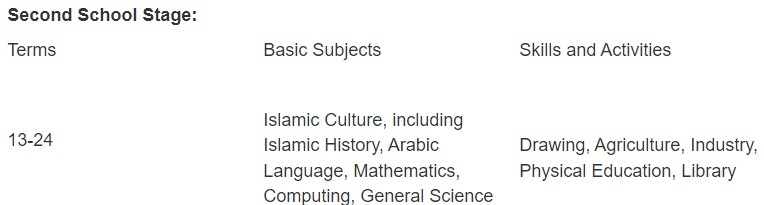
A disciplina de "Ciências Gerais" nesta etapa inclui princípios de química, biologia, física e geografia.
The “General Sciences” subject in this stage includes principles of chemistry, biology, physics and geography.
Terceira Etapa Escolar:
Third School Stage:
Esta etapa abrange os termos 25 a 36. Nesta etapa, todos os alunos participam das mesmas disciplinas de estudo apenas nos termos 25 a 30. Depois disso, nos termos 31 a 36, os alunos ingressam nos ramos opcionais (furoo') que preferirem. Estas são as opções:
This stage covers the terms 25 to 36. In this stage, all students participate in the same study subjects in terms 25 to 30 only. Thereafter, in terms 31 to 36 students join the optional branches (furoo’) they prefer. These options are:
- Opção Cultural - Opção Científica - Opção Industrial ou Técnica (informática, mecânica, elétrica, comunicações, cartografia etc.)
- Cultural Option - Scientific Option - Industrial or Technical Option (computing, mechanics, electrical, communications, cartography etc.)
- Opção Agrícola - Opção Comercial - Opção Doméstica (para mulheres)
- Agricultural Option - Commerce Option - Domestic Option (for females)
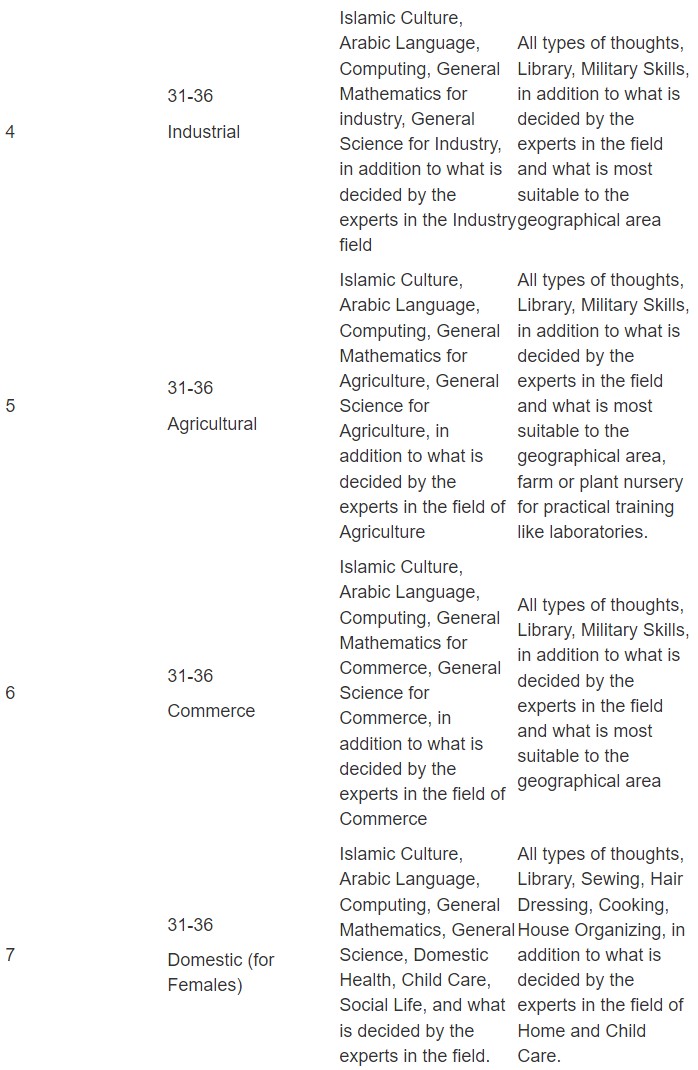
O gráfico a seguir mostra as disciplinas estudadas em cada uma destas opções:
The following chart shows the subjects studied in each of these options:
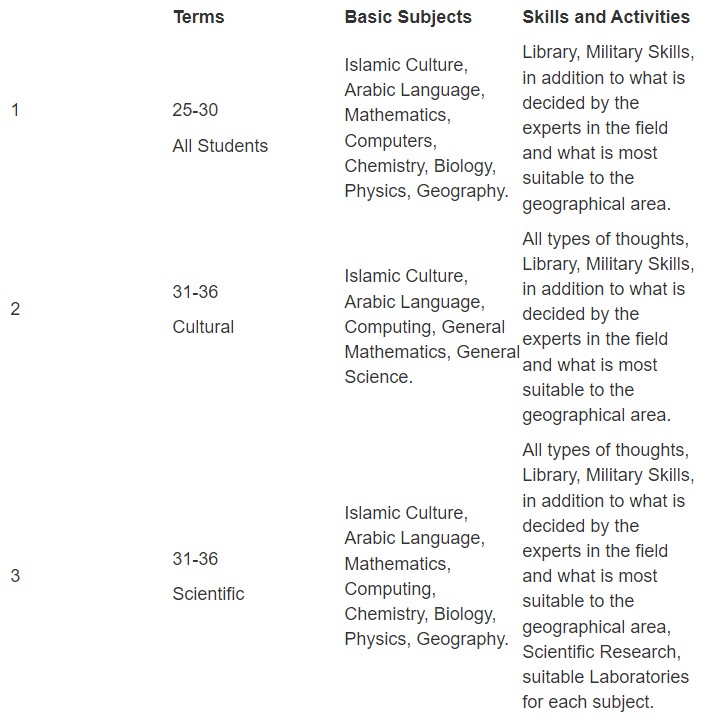
No terceiro estágio escolar, na opção cultural, o aluno cursa tópicos aprofundados tanto em Cultura Islâmica quanto em Língua Árabe. Os especialistas determinam os requisitos nas disciplinas de Fiqh, Usul, Tafsir, 'Ulum Al-Hadith, História e demais opções de cultura islâmica. Da mesma forma, adotam cursos específicos (manāhij) nas opções de língua árabe exigidas para essa etapa, como Eloquência (Balagha), textos literários etc.
In the cultural option of the third school stage, the student takes extended topics in both Islamic Culture and Arabic Language. Experts determine the requirements in the subjects of Fiqh, Usul, Tafseer, '‘Ulum Al-Hadith, History and other Islamic culture options. Likewise, they adopt specific courses (manaahij) in the Arabic language options required for this stage such as Eloquence (Balagha), Literature texts etc.
Nas opções não científicas, o aluno estuda Matemática e Ciências de forma resumida, com foco apenas nos tópicos exigidos pela sua opção. Assim, o aluno da opção Comércio estuda tópicos de Matemática relacionados com o Comércio, por exemplo Contabilidade, Contas de Zakat e Herança, Contas de Lucros e Perdas, juntamente com Escrituração e Contas de Caixa; da mesma forma, estuda tópicos de Estatística. Já o aluno da opção Industrial estuda tópicos específicos da Indústria, como Desenho Geométrico, Formas, Cálculo de Áreas e Volumes, entre outros.
In non-scientific options, the student takes Mathematics and Sciences in a concise form with focus paid only to the topics required for their option. Thus the Commerce option student takes Mathematics topics related to Commerce e.g. Accounting, Zakat and Inheritance Accounts, Profits and Loss Accounts together with Bookkeeping and Cashbook Accounts; likewise he/she takes topics in Statistics. Whereas the Industrial option student takes topics specific to Industry such as Geometrical Drawing, Shapes, Area and Volume Calculation etc.
O estudante de Ciências Gerais da opção não científica estuda tópicos centrados no estudo do Corpo Humano, das Doenças, da Segurança Pública, bem como tópicos científicos relacionados ao homem e seu ambiente. Na opção agrícola, são acrescentados tópicos relacionados à agricultura e à nutrição, tais como métodos de Agricultura Vegetal, suas doenças e tratamento, tipos de solo, fertilizantes, inseticidas etc.
The General Sciences student of the non-scientific option takes topics focusing upon studies of the Human Body, Diseases, Public Safety as well as scientific topics related to man and his environment. In the agricultural option, topics related to agriculture and nutrition are added such as methods of Plant Agriculture, their diseases and treatment, types of soil, fertilisers, insecticides etc.