2.1 Muundo wa Daleel
2.1 Structure of Daleel
Kama ilivyotajwa awali, Dalili ni ushahidi kwa maoni, dhana, hukumu, au fikra kutoka katika Uislamu. Kuna pande mbili zinazohusiana na Dalili yoyote: Riwayah (usimulizi wa habari) na Dalalah (maana).
As mentioned earlier, a Daleel is an evidence for an opinion, concept, ruling, or a thought from Islam. There are two aspects related to any Daleel, Riwayah (reportage) and Dalalah (meaning).
Riwaya inahusu masuala yanayohusu jinsi taarifa hiyo ilivyotufikia, ikiwa ni pamoja na idadi ya wapokezi wake na uadilifu wao.
The Riwayah covers issues related to how the information was relayed to us, which includes the number and the integrity of its reporters.
Dalalah inahusiana na maana ya maandishi katika Daleel. Pia kuna maneno mawili yanayotumiwa kuhusiana na Riwayah na Dalalah: Qata‟i na Dhanni.
The Dalalah is related to the meaning of the text in the Daleel. There are also two terms used in connection with Riwayah and Dalalah; Qata‟i and Dhanni.
Qat'i kinafafanuliwa kuwa ni kitu chenye uhakika au kinachoamua jambo kwa uhakika kamili, ilhali Dhanni ni kinyume cha Qat'i na maana yake ni kisicho cha uhakika, cha kubashiri au kisicho na uamuzi thabiti.
Qata‟i is defined as being conclusive or decisive, while Dhanni is the opposite of Qata‟i and means non-definite, speculative or indecisive.
Riwaya
Riwayah
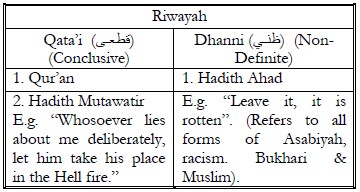
Aya yoyote kutoka Qur'ani au Hadith Mutawatir inachukuliwa kuwa Qat'i (ya uhakika kamili) katika Riwayah yake (usimulizi wake).
Any Ayah from the Qur‟an or Hadith Mutawatir is considered Qata‟i (conclusive) in its Riwayah (report).
Riwayah ya Qat'i inamaanisha kwamba dalili ni sahihi bila kivuli chochote cha shaka. Usahihi huu unathibitishwa kwa kuzingatia mbinu ya usimulizi.
The Qata‟i in Riwayah implies that the evidence is authentic without any shadow of doubt. This authenticity is established based on the methodology of transmission.
Mbinu ambayo Qur'ani imetufikia nayo inazuia kabisa uwezekano wa kutungwa kwake. Ripoti hiyo imepitishwa kizazi baada ya kizazi kwa namna ile ile hasa. Haiwezekani kwa kizazi kizima kutunga, kufuta, au kuongeza maudhui ya Qur'ani. Haiwezekani kuamini kwamba kila mtu mmoja katika kizazi kile alikusanyika pamoja na kukubaliana kuongeza au kufuta sehemu fulani za Qur'ani. Kila mtu katika kizazi kile alikuwa akisoma maudhui yale yale ya Qur'ani, na hivyo kuthibitisha maudhui yake.
The methodology by which the Qur‟an was transmitted to us precludes any possibility of fabrication. The report was transmitted generation by generation in exactly the same manner. It is impossible for an entire generation to fabricate, erase, or add contents to the Qur‟an. It is inconceivable to believe that every single individual in that generation assembled together and agreed to add or delete parts of the Qur‟an. Everyone in that generation was reciting the same contents of the Qur‟an, thus authentifying its contents.
Hadith Mutawatir haikupitishwa kizazi kwa kizazi kwa mtindo wa mtu mmoja mmoja, bali ilipitishwa na idadi kubwa ya watu. Kutokana na wingi wa watu waliosimulia Daleel hii, na utofauti wa makazi yao, pamoja na uaminifu na uhakika wao uliothibitika, haiwezekani kufikiri kwamba Daleel hii inaweza kuwa si sahihi. Taarifa yoyote inayotolewa kupitia njia nyingine isipokuwa Qur'an au Hadith Mutawatir, kama vile Hadith Ahad, inachukuliwa kuwa Dhanni (isiyo ya hakika), yaani kuna uwezekano mdogo sana kwamba Daleel hiyo ina makosa. Kwa muhtasari:
Hadith Mutawatir was not transmitted generation-by-generation, but rather by a large number of people. Due to the large number of people reporting the Daleel, and their diversity of residence, their established reliability and conviction, it is inconceivable that this Daleel could be wrong. Any report of information other than through the Qur‟an or Hadith Mutawatir, such as Hadith Ahad, is considered Dhanni (non-definite), meaning that there is a minute possibility that the Daleel could contain error. To summarise:
Dalalah
Dalalah
Dalili ya pili ni Dalalah (maana). Ikiwa maandishi ya Qur'ani, Hadithi Mutawatir au Hadithi Ahad ni wazi, mahususi, na yana maana moja tu, basi huchukuliwa kuwa Qata'i. Maandishi ya Dalili ya Qata'i lazima yawe na maana moja tu, na hayawezi kukubali tafsiri nyingine yoyote. Ikiwa maandishi yanakubali zaidi ya tafsiri moja, basi huchukuliwa kuwa Dhanni. Kwa kuwa tafsiri hutokana na lugha ya Kiarabu, tafsiri yoyote lazima ihalalishwe kupitia lugha ya Kiarabu. Kwa muhtasari:
The second aspect of the Daleel is the Dalalah (meaning). If the text of Qur‟an, Hadith Mutawatir or Hadith Ahad is clear, specific, and has only one meaning, then it is considered Qata‟i. The text of a Qata‟i Daleel has to have only one meaning and cannot be open to any other interpretation. If the text is open to more than one interpretation, then it is considered Dhanni. Since interpretations are due to the Arabic language, any interpretation has to be justified through the Arabic language. To summarise:
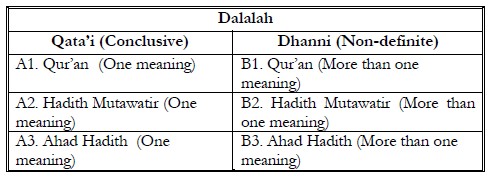
A1. Mfano wa Qur'ani yenye maana ya Qat'i (yenye uhakika usiotiliwa shaka):
A1. Example of Qur‟an with a Qata‟i (conclusive) meaning:
"Nusu ya mali ya wake zenu ni yenu, ikiwa hawana mtoto."
“What your wives leave, your share is a half, if they leave no child”. (TMQ An-Nisa: 12)
"Wale wanaowashutumu wanawake safi kwa zina (uzinzi) kisha wasilete mashahidi wanne (wa kuthibitisha hilo), wapigeni viboko themanini."
“Those who accuse chaste woman of zina (adultery) and fail to bring four witnesses (to prove it) flog them eighty stripes.” (TMQ An-Nur: 4)
Kipimo cha hukumu hizi, yaani nusu na themanini, ni wazi, kwa hiyo haziwezi kuwa wazi kwa tafsiri nyingine yoyote.
The quantitative aspect of these rulings, namely one half and eighty are clear and therefore cannot be open to any other interpretations.
A2. Mfano wa Hadith Mutawatir yenye maana ya Qata‘i (ya hakika isiyo na shaka):
A2. Example of Hadith Mutawatir with Qata‟i (conclusive) meaning:
"Yeyote atakayenisingizia uongo mimi (Mtume Muhammad ﷺ) kwa makusudi, na ajiandalie makazi yake motoni." (Bukhari na Muslim)
“Whosoever lies about me (Prophet Muhammad saw) deliberately let him take his place in the hell-fire.” (Bukhari & Muslim)
Hadith hii ya Mutawatir ni wazi sana katika maudhui yake; kwa hiyo hakuna maana moja tu inayotokana na maandishi hayo, nayo ni kwamba yeyote anayesema uwongo kuhusu alichosema Nabii ﷺ kwa makusudi, ataingia Motoni.
This Mutawatir Hadith is very clear in its subject; thus there is only one understanding from the text that whoever lies about what Prophet (saw) said, intentionally, he will go to hell-fire.
A3. Mfano wa Hadith Ahad yenye maana ya Qat'i (ya uhakika):
A3. Example of Hadith Ahad with Qata‟i (conclusive) meaning:
Imepokewa kutoka kwenye Hadith isiyo Mutawatir kwamba Mtume ﷺ alifunga siku 6 katika mwezi wa Shawwal. Maana zilizo wazi kabisa zinazotokana na Hadith hii ni zifuatazo:
It is reported from a non-Mutawatir Hadith that the Prophet (saw) fasted 6 days in Shawwal. The conclusive meanings from this Hadith are the following:
a) Kuruhusiwa kwa kufunga siku 6 katika mwezi wa Shawwal.
a) Permissibility of fasting 6 days in Shawwal.
b) Isipokuwa siku ya kwanza ya Shawwal, kwani ni siku ya Eid, na ni Haramu kufunga siku ya Eid.
b) Except on the first day of Shawwal, since it is the day of Eid, and it is Haram to fast on Eid.
B1. Mfano wa Aya ya Qur'ani yenye maana ya Dhanniy (isiyo ya uhakika):
B1. Example of Quranic Ayah with a Dhanniy (non-definite) meaning:
Allah (SWT) anasema:
Allah (swt) says:
"Enyi mlioamini! Mnapotaka kusimama kwa ajili ya Sala, osheni nyuso zenu na mikono yenu hadi viwiko, pangusa vichwa vyenu (kwa kupitisha mikono iliyolowa maji juu yake), na osha miguu yenu hadi vifundo vya miguu. Na ikiwa mmejaa janaba, jitakaseni (oga mwili mzima). Lakini mkiwa wagonjwa au safarini, au mmoja wenu amekuja kutoka mahali pa haja, au mmegusana na wanawake na hamkupata maji, basi tayammamu kwa udongo safi, na pangusa nyuso zenu na mikono yenu nao."
“O you who believe! When you intend to offer As-Salat (the prayer), wash your faces and your hands (forearms) up to the elbows, rub (by passing wet hands over) your heads, and (wash) your feet up to ankles. If you are in a state of Janaba (i.e. had a sexual discharge), purify yourself (bathe your whole body). But if you are ill or on a journey or any of you comes from answering the call of nature, or you have been in contact with women and you find no water, then perform Tayammum with clean earth and rub therewith your faces and hands.” (TMQ Al-Maida: 6)
Aya hiyo inasema kwamba ukiwa umemgusa wanawake ("lamastum"), huvunja Wudhu. Neno "lamastum" limefasiriwa kuwa na maana mbili:
The verse says if you „lamastum‟ the women, it breaks the Wudhu. The word „lamastum‟ has been interpreted as having two meanings:
a) Kugusa b) Kujamiiana kimwili Hivyo aya hii ina Dhanni Dalalah, yaani inaweza kumaanisha kwamba kumgusa mwanamke kunavunja Wudhu, au kwamba kujamiiana kimwili na mwanamke kunavunja Wudhu.
a) Touching b) Sexual intercourse Thus the Ayah has a Dhanni Dalalah, i.e. it could mean touching women breaks the Wudhu, or sexual intercourse with a woman breaks the Wudhu.
B2. Mfano wa Hadith Mutawatir yenye maana ya Dhanniy (isiyo ya uhakika):
B2. Example of Hadith Mutawatir with a Dhanniy (non-definite) meaning:
Ilipokewa kwamba Mtume (saw) alikuwa akivua Ihram yake kwa namna maalum. Hata hivyo, Maswahaba (ra) walipomwambia Mtume (saw) kwamba wao walivua kwa namna tofauti na jinsi yeye (saw) alivyovua, Mtume (saw) alikubali matendo yao. Ingawa tukio hili ni Mutawatir, kanuni za kuvua Ihram ya mtu ni nyingi.
It was reported that the Prophet (saw) used to take off his Ihram in a specific manner. However, when the Sahabah (ra) told the Prophet (saw) that they took it off in a manner different from the way he (saw) took it off, the Prophet (saw) approved of their actions. Though this incident is Mutawatir, the rules to take off one‟s Ihram are many.
B3. Mfano wa Hadith Ahad yenye maana ya Dhanniy (isiyo ya uhakika):
B3. Example of a Hadith Ahad with a Dhanniy (non-definite) meaning:
Imepokewa katika Hadith isiyo Mutawatir kwamba Mtume ﷺ alifunga siku 6 katika mwezi wa Shawwal. Maana zisizo za uhakika za Hadith hii ni:
It is reported from a non-Mutawatir Hadith that the Prophet (saw) fasted 6 days in Shawwal. The non-definite meanings of this Hadith are:
a) Je, siku sita za kufunga ni mfululizo au la?
a) Whether the six days of fasting are consecutive or not?
b) Kufunga katika sehemu gani ya mwezi wa Shawwal?
b) Fasting in which part of Shawwal?
Tumezungumzia hadi sasa vipengele vya Qat'i na Dhanni vya Riwayah na Dalalah kila kimoja kivyake. Hata hivyo, njia ya kubaini kama Daleel (katika Riwayah na Dalalah zote mbili) ni Qat'i (yenye uhakika) au Dhanni (isiyo na uhakika kamili) ni ifuatayo:
So far we have discussed the Qata‟i and Dhanni aspects of both Riwayah and Dalalah separately. However, the method to determine whether the Daleel (both in Riwayah and Dalalah) is Qata‟i (conclusive) or Dhanni (non-definite) is the following:
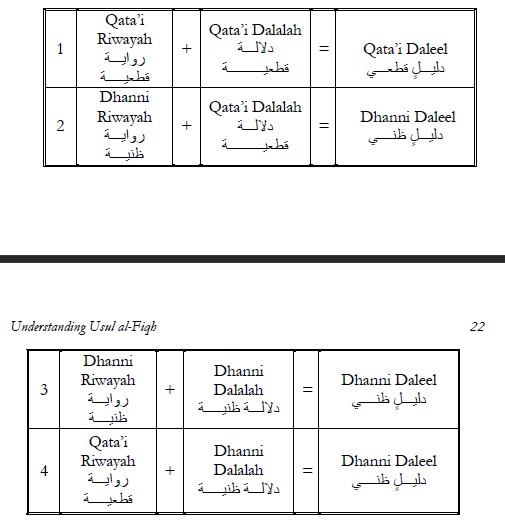
Fikra yoyote, wazo lolote, au dhana yoyote inayohusiana na 'Aqeedah lazima iwe imejengwa juu ya Daleel Qata'i. Kwa mfano, dhana kwamba Malaika wapo imejengwa juu ya Daleel Qata'i, si Dhanni. Vilevile, katika Usul al-Fiqh, ili kuthibitisha chanzo cha kutolea hukumu kwa mujibu wa maoni yenye nguvu zaidi, chanzo hicho lazima pia kijengwe juu ya Daleel Qata'i.
Any idea, thought, or concept related to the „Aqeedah has to be based upon a Qata‟i Daleel. As an example, the concept that Angels exists is based upon a Qata‟i Daleel not Dhanni. Also, in Usul al-Fiqh, to establish a source for extracting rulings according to the strongest view, the source must base upon a Qata‟i Daleel as well.
Kwa mfano, ili kuchukua Ijma‟ as-Sahabah (makubaliano ya Maswahaba) kama chanzo cha hukumu, dalili ya kuthibitisha mamlaka ya Ijma‟ as-Sahabah lazima iwe Qat‟i kwa upande wa Riwayah na Dalalah, ingawa hukumu inaweza kutokana na dalili ya Qat‟i au ya Dhanni.
As an example, to consider Ijma‟ as-Sahabah (consensus of the Companions) as a source of rulings, the Daleel to prove the authority of Ijma‟ as-Sahabah has to be Qata‟i both in Riwayah and Dalalah, though a ruling can be derived from either Qata‟i or Dhanni Daleel.
Mtu anaweza kujiuliza kwa nini kuelewa maandiko ya Qur'ani na Sunnah ni jambo gumu kiasi hiki?
One might wonder why understanding the text of Qur‟an and Sunnah is so complicated?
Kwa kuchunguza matini ya Qur'ani na Sunnah, mtu anaweza kuona kwamba ina kiwango kidogo cha maandishi. Kwa maandishi yake machache, mtu anaweza kutoa hukumu kwa matatizo yoyote yanayotuathiri popote na wakati wowote hadi Siku ya Hukumu.
By examining the text of Qur‟an and Sunnah one can see that it is limited in its volume. With its limited text one can generate rulings to any problems affecting us anywhere and anytime until the Day of Judgment.
Ni muujiza kutoka kwa Allah (SWT) kwamba maandiko ya Qur’ani na Sunnah yana uwezo wa kueleza hukumu nyingi kutokana na Aya moja na Hadithi moja; ilhali uwezo wa kuelewa maana nyingi kutokana na andiko moja haupatikani katika maandiko mengine yoyote ya kisheria duniani! Changamoto kwa Waislamu wa kila kizazi ni kujaribu kuelewa maandiko hayo na kuyahusisha na maisha yao, kwa kuwa Qur’ani na Sunnah zina umuhimu kwa kila zama na kila mahali.
It is a miracle from Allah (swt) that the texts of the Qur‟an and Sunnah have the ability to express numerous rulings from a single Ayah and Hadith; whereas, the ability to understand many meanings from a single text cannot be found in any other legal text in the world! The challenge is for Muslims in each generation to try to understand the text and relate it to their lives since the Qur‟an and Sunnah are relevant to all times and places.
Vyanzo vya Hukmu ya Shar‘i
Sources of Hukm Shar‟i
Kama ilivyofafanuliwa awali, Hukm Shar‟i ni hukumu za Allah (SWT) zinazohusu matendo yetu. Hukumu hizi zinatolewa kutoka vyanzo fulani. Vyanzo vinavyotumika kutoa hukumu lazima vijengwe juu ya Adilla Qata‟iya (ushahidi wa uhakika usio na shaka).
As defined earlier, Hukm Shar‟i are the rulings of Allah (swt) addressing our actions. These rulings are derived from certain sources. The sources, which are used to extract rulings, have to be based on Adilla Qata‟iya (Decisive evidences).
Vyanzo vinne vya uhakika vya Hukm Shar‟i ni: Qur‟ani, Sunnah, Ijma‟ as-Sahabah na Qiyas. Vyanzo hivi vitajadiliwa katika sura zifuatazo. Baada ya hapo kutafuatiwa muhtasari mfupi wa vyanzo vyenye mgogoro ambavyo wanazuoni wametofautiana juu yake.
The four definitive sources of Hukm Shar‟i are; the Qur‟an, Sunnah, Ijma‟ as-Sahabah and Qiyas. These will be discussed in the following chapters. This will be followed by a brief summary of the disputed sources which the scholars disagree on.