Quran Course
All BooksDownloads
All BooksDownloadsSystem Of Islam
Also visitSystem Of Islam
Built with love by StudioToronto.ca
Quran Course
All BooksDownloads
All BooksDownloadsSystem Of Islam
0%
In the Shade of the Qur'an15 min readViewed 7 times

Al-Fatihah (The Opening)
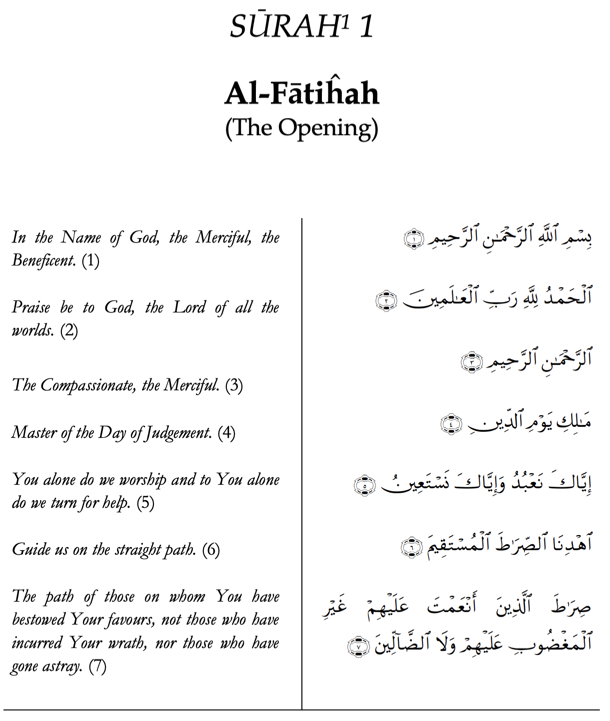

In the Name of God, the Merciful, the Beneficent. (1)

Praise be to God, the Lord of all the worlds. (2)

The Compassionate, the Merciful. (3) Master of the Day of Judgement. (4)

You alone do we worship and to You alone do we turn for help. (5)

Guide us on the straight path. (6)

The path of those on whom You have bestowed Your favours, not those who have incurred Your wrath, nor those who have gone astray. (7)

Overview

1 Sūrah is the name of a unit of the Qur’ān. The nearest English word is ‘chapter’, but since sūrah’ is used in Arabic to denote only units of the Qur’ān, it has been retained in English. The Qur’ān has 114 sūrahs of varying length.

Every Muslim recites this short sūrah of seven verses at least seventeen times a day. An authentic ĥadīth of the Prophet Muĥammad (peace be upon him), says: “A prayer by one who does not read the Fātiĥah is invalid.” This short sūrah contains a great deal of the central basic ideas of Islam, its beliefs and concepts. It outlines many of its essential perceptions and attitudes. All this makes it clear why it is chosen for frequent recitation and why it is essential for the validity of prayer.

The sūrah opens with the phrase:

In the name of God, the Compassionate, the Merciful. (Verse 1)

This is recognized by the majority of scholars as a verse of the sūrah, in its own right, completing its verses into seven. There is, however, a difference of opinion over whether this is so with respect to all other sūrahs of the Qur’ān in which the same words appear as the opening phrase. Some scholars maintain that it is to the Fātiĥah that the following Qur’ānic statement refers: “We have given you seven oft- repeated verses and this sublime Qur’ān.” (15: 87)

The very first verses of the Qur’ān revealed to Prophet Muĥammad, which begin with: “Read in the name of your Lord...” (96: 1) establish the Islamic etiquette of invoking the name of God at the beginning of every action. This is also in line with the fundamental Islamic principle that God is “the first and the last, the outward and the inward.” (57: 3) He is indeed the real being, the origin and the raison d’être of all that exists. In His name, therefore, every movement and action is made, and in His name everything begins.

The divine attributes of the Compassionate, al-Raĥmān, and the Merciful, al-Raĥīm, encompass all aspects and meaning of mercy, and can only be used together with respect to God Almighty. It would be appropriate to use the attribute of al-Raĥīm in reference to a human being, but the Islamic faith requires that use of al-Raĥmān is exclusive to God. As for the debate over which of the two adjectives denotes the wider meaning of mercy and compassion, it does not concern us here. We can conclude, however, that when combined, they encompass all aspects and dimensions of mercy.

As the invocation of God’s name at the beginning of every action constitutes the first fundamental principle of the Muslim faith, the restriction of the use of al-Raĥmān and al-Raĥīm to God alone constitutes the second principle and defines the relationship between God and man. Having invoked God’s name and acknowledged His infinite mercy, one is directed to praise God and recognize His absolute sovereignty over all beings:

Praise be to God, the Lord of all the worlds. (Verse 2)

Praise of God is the first feeling aroused in a believer’s heart at the mention of God. For man’s own existence is an aspect of God’s infinite grace, which engenders gratitude and reverence towards God. The manifestations of God’s munificence and generosity to man and other creatures abound everywhere and can be seen at every moment. To praise God at the beginning and at the end of every action is another fundamental principle of the Islamic faith. The Qur’ān says: “He is God; there is no deity but He. To Him belongs praise in the first and in the last...” (28: 70)

Nevertheless, God’s grace is such that when a believer says, ‘praise be to God,’ it is recorded for him as a good deed outweighing everything. `Umar ibn al-Khaţţāb, the Prophet’s Companion, relates that the Prophet (peace be upon him) told how a man once said, “Lord, I praise You as befits the majesty of Your face and the greatness of Your power.” The two angels accompanying that man could not evaluate the remark and referred to God Almighty, who commanded them: “Register it in his record as he said it, and I shall reward him as he deserves when he returns to Me.” The last part of this verse, “Lord of all the worlds”, expresses the belief in absolute universal Godhead which is at the very core of the Islamic concept of God. God is the sole, absolute and ultimate owner with full independent authority to act in the whole cosmos. He is the overall supreme master who has created the world and continues to watch over it, take care of it, and ensure its stability and well-being. This living and dynamic relationship between the Creator and the created is the perpetual fountain of life for all creation. God has not created the world and abandoned it to its own devices. He continues to be an active living authority over His creation, giving it what it needs for its continued and meaningful life. This applies to all God’s creation.

Acknowledging God’s absolute Lordship makes all the difference between clarity and confusion with regard to God’s absolute oneness. People often combined their acknowledgement of God as the sole creator with belief in multiple deities having authority in their life. It may seem absurd that people should ever hold such a belief, but this was true in the past and is still true today. The Qur’ān speaks of those who claim that they “only worship them [minor gods] so that they may bring us nearer to God.“ (39: 3) It also mentions that some Jewish and Christian groups who “have taken their rabbis and priests as gods alongside God.” (9: 31) Polytheism, or the worship of several deities or demigods besides the perceived ‘Grand Deity’, was widespread when Islam emerged in the 7th century in Arabia.

The affirmation of the absolute sovereignty and active authority of the One God.

over all creation was necessary to ensure man’s rationality and peace of mind, and to relieve him from the cruel bewilderment of polytheism. Man must be reassured that a vigilant and caring God is in charge of this world and will never abandon or forsake it.

At the advent of Islam, the world was full of erroneous beliefs and philosophies, and of false religions based on superstition, legend and mythology. Very little of it was true or even rational. As far as the concept of God and His relationship with man and the world was concerned, there was plenty of miserable confusion. This in turn led to confusion in man’s understanding of the world and of his own position and role within it.

The need for a rational, clear and consistent system of beliefs only becomes apparent when we study those dark periods of human history when there was no such system. We then realize how heavily such great myth and false beliefs weigh on man. There will be more on this when we come to study specific instances in the Qur’ān.

It is in the light of such need that Islam has taken great care to correct man’s beliefs and define very clearly the concept and nature of God and His attributes, and the relationship between Creator and creation.

This is embodied in the Islamic concept of God’s oneness, the essence and most fundamental principle of Islam. Much care has been devoted to establishing and elucidating the affirmation that God is the One, absolute and transcendent Lord and Master of all that exists. The other aspect of this concept to which Islam has given its greatest attention is the definition of God’s attributes, which has been the cause of much confusion, obfuscation and muddled religious and philosophical thinking through the ages.

The intensity, emphasis and detail with which Islam has dealt with the concept of God’s oneness, and all subjects related to it, can only be appreciated against the background of the great mass of erroneous beliefs and confused theologies that had accumulated in the course of history. From this perspective, Islam can readily be seen as a profound and timely act of divine mercy bestowed on humanity — mercy that is given with beauty, simplicity, clarity, harmony and full accordance with human nature.

The Compassionate, the Merciful. (Verse 3)

These are two attributes that encompass all meanings and aspects of mercy and compassion, and epitomize mercy as a property of God Almighty. These two attributes define the link between the Lord as Creator and His creation. It is a link based entirely on love, peace, reassurance and care, and which inspires within man a spontaneous feeling of gratitude and praise towards God.

Unlike Greek mythology or the Old Testament (Genesis, 4: 1112), Islam does not depict God as an enemy who pursues man with relentless vengeance, or plots and schemes against His creation with spite and vindictiveness.

Master of the Day of Judgement. (Verse 4)

This verse states a fundamental Islamic principle that has a most profound influence on human life: belief in the hereafter. The Qur’ān comments on the curious fact that people have often believed in God as Creator but have failed to believe in a Day of Judgement, in a life to come, when reward and punishment are meted out to restore the balance of justice. It is in reference to these that the Qur’ān says: “If you ask them, ‘Who is it that created the heavens and the earth?’ they will surely answer, ‘God’” (31: 25) Elsewhere the Qur’ān says of such people: “They deem it strange that a warner should have come to them from their own midst. Thus, the unbelievers say, A strange thing is this! [Are we to be resurrected] after we have died and become mere dust? Such a return seems far-fetched indeed!’“ (50: 2-3)

Belief in the hereafter is essential because it engages the human soul and mind and concentrates man’s attention on a future existence. This in turn helps to rein in man’s obsession with the present life, and to transcend his immediate earthly desires. He is no longer anxious to reap all his rewards here and now; he can conquer his selfishness and develop altruistic feelings and interests. Man is able to go through life as a motivated, tolerant, confident and optimistic being.

This central Islamic belief distinguishes clearly between aspiring to gain the moral and intellectual freedom that man needs and deserves, and capitulation to worldly and selfish desires and pleasures. It marks the difference between a well-balanced and conscientious humanity and an egotistic, self-seeking one.

Human life can never be balanced and equitable until people believe that what they earn in this transient life is not the be-all and the end- all. Man needs to have the incentive of a confident belief that another life awaits him, which is worth the struggle and the sacrifices and the effort he may have to make here in this short one. This belief brings a fundamental difference in the feelings, attitudes and behaviour of those who uphold it.

You alone do we worship and to You alone do we turn for help. (Verse 5)

This verse expresses another fundamental principle that follows logically from the preceding ones. It is also a decisive and crucial principle that draws a line between the freedom man gains in submitting to God and the abuse and debasement implicit in man’s servitude to man.

Once man has submitted himself to God and sought help and guidance from Him alone, he has achieved total liberation from the tyranny of all religious, intellectual, moral and political powers.

To the believer in Islam, human power falls into two categories: a rightly-guided power that recognizes God and abides by His directions, and an arrogant, rebellious one that does not admit to God’s sovereignty and authority. A Muslim is required to support and endorse the former, no matter how weak or disadvantaged it may be, and to reject and oppose the latter, regardless of its strength or dominance. The Qur’ān says: “Many a small band, by the grace of God, has vanquished a large one.” (2: 249) Such victory of the apparently weaker host could only be achieved when it relies on God, the source of all power.

Towards natural forces, a Muslim’s attitude is one of curiosity and friendliness rather than fear or hostility. The powers of man and the powers of nature are perceived as by-products of God’s own power, and subject to His will. They are, therefore, perfectly complementary and interdependent.

Islam teaches that God has created the physical world and all its forces for man’s own use and benefit. Man is specifically taught and directed to study the world around him, discover its potential and utilize all his environment for his own good and the good of his fellow humans. Any harm that man suffers at the hands of nature is a result only of his ignorance or lack of understanding of it and of the laws governing it. The more man learns about nature, the more peaceful and harmonious his relationship with nature and the environment.

Hence the notion of “conquering nature” can readily be seen as cynical and negative. It is alien to Islamic perceptions and betrays a shameless ignorance of the spirit in which the world has been created and the divine wisdom that underlies it.

Being always aware of God’s hand and role in shaping and running the world, Muslims have a positive, friendly and constructive outlook on man’s relationship with nature. Simply stated, it acknowledges God as the origin and Creator of all these forces, on the basis of the same set of axioms and laws. They are designed to function together, for a common purpose, in harmony, compatibility and mutual support. The forces of nature are essentially subservient to man, who is mentally and physically equipped to discern them, unravel their secrets, comprehend the laws governing them and, subsequently, to harness them to improve the quality of life on earth. The Qur’ān asserts: “He has all that is on the earth subservient to you.” (45: 13)

Such an outlook eliminates all traces of fear or isolation and allows, instead, a profound sense of belonging in which man is seen not only as an integral part of the overall design of the world, but also an essentially effective and influential one. Thus, his world becomes a friendly one. This is best expressed by the Prophet when he once faced Mount Uĥud, the scene of a bitter defeat for Muslims, and said, “How we love this mountain, and how it loves us!” This expresses in a nutshell the affinity the Prophet felt towards nature even in its most rugged forms.

Having established these fundamental principles, the sūrah points the way to certain practical means of responding to them, foremost among which is prayer:

Guide us on the straight path; the path of those on whom You have bestowed Your favours, not those who have incurred Your wrath, nor those who have gone astray. (Verses 6-7)

With these words a believer pleads to be shown the Right Way and to be helped along it, which cannot be achieved without God’s guidance, care and mercy. To acknowledge that is in itself a recognition of God’s sovereignty and dominance over all things and events.

Guidance to the right way of life guarantees man’s happiness in this world and in the hereafter. It comes about, in effect, by guiding human nature and man’s instincts, desires and inspirations towards the recognition and comprehension of the divine will, so bringing human activity into rhythm with the natural order and the physical world.

The sūrah reveals the nature of the “straight path” as being one taken by those whom God has favoured, not the way of those who have earned His displeasure by their deviation from the Truth, nor that of the heedless who have no knowledge of the truth. It is the path of happiness and salvation.

This, then, is al-Fātiĥah, the sūrah selected for frequent daily recitation, without which Islamic prayers are invalid. Despite its brevity, it contains some of the most fundamental principles of the Islamic faith and certain insights that arise from them.

The Prophet Muĥammad is reliably reported to have quoted God as saying that the fruits of prayer are shared equally between Me and My servant, and My servant will be granted what he asks for. As the worshipper recites [in Prayer]: “Praise be to God, the Lord of all the worlds,” God will say: ‘My servant has praised Me.’ As he recites: “The Compassionate, the Merciful,” God will say: ‘My servant has thanked Me.’ As he recites: “Master of the Day of Judgement,” God will say: “My servant has glorified Me.” As he says: “You alone do we worship, and to You alone do we turn for help,” God will say: ‘This is between Me and My servant, and My servant will receive what he asks for.’ And, as he says: “Guide us on the straight path, the path of those on whom You have bestowed Your favours, not those who have incurred Your wrath, nor those who have gone astray,” God will say: ‘This is for My servant, and he will be granted his wish.’“ This ĥadīth explores some of the meanings of al-Fātiĥah. The reader will perhaps find it helpful in understanding why God has chosen this sūrah for recitation by Muslims at least seventeen times a day, as they stand up for their obligatory prayers, spread over the night and day, and even more frequently, whenever they offer voluntary prayers.

← Previous chapterNext chapter →
Chapters (393)
  1. 1Appendix
  2. 2Appendix V
  3. 3Appendix VI
  4. 4Al-Fatihah (The Opening)
  5. 5Al-Baqarah (The Cow)
  6. 6Al-Baqarah (The Message Spelt Out) 1 - 29
  7. 7Al-Baqarah (Man in Charge of the Earth) 30 - 39
  8. 8Al-baqarah ( Glimpses Of Israelite History) 40 - 74
  9. 9Al-baqarah ( Covenants Breached All The Time) 75 - 103
  10. 10Al-baqarah ( Jewish Efforts To Undermine Islam) 104- 123
  11. 11Al-Baqarah ( Universal Faith) 124- 141
  12. 12Al-Baqarah ( Change of Direction) 142- 152
  13. 13Al-Baqarah ( Acquiring Real Strength) 153- 157
  14. 14Al-Baqarah ( Setting The Record Straight) 158- 177
  15. 15Al-Baqarah ( Social Justice And Fasting) 178- 188
  16. 16Al-Baqarah (The Sacred Months, Fighting And Pilgrimage) 189 - 203
  17. 17Al-Baqarah ( The Nature Of Islamic Society) 204 - 214
  18. 18Al-Baqarah ( Worse Than Murder) 215 - 220
  19. 19Al-Baqarah ( The Family: The Foundation Of Human Society) 221 - 242
  20. 20Al-Baqarah ( A Timeless Message) 243 - 252
  21. 21Al-Baqarah ( The Nature Of God And Faith ) 253 - 257
  22. 22Al-Baqarah ( Causing Life And Death ) 258 - 260
  23. 23Al-Baqarah ( An Islamic Model Of Social Security ) 261 - 274
  24. 24Al-Baqarah ( The Evil Of Usury) 275 - 281
  25. 25Al-Baqarah ( Safeguards For Financial Transactions ) 282 - 284
  26. 26Al-Baqarah ( One Divine Message ) 285 - 286
  27. 27Al-Imran ( The House Of Imran)
  28. 28Al-Imran ( Concepts Outlined ) 1 - 17
  29. 29Al-Imran ( Concepts Clarified ) 18 - 32
  30. 30Al-Imran ( The Birth And Prophethood Of Jesus (pbuh) ) 33 - 64
  31. 31Al-Imran ( The Heirs Of Abraham’s Faith ) 65 - 92
  32. 32Al-Imran ( One God, One Faith ) 92 - 120
  33. 33Al-Imran ( Lessons For All Muslim Generations ) 121 - 136
  34. 34Al-Imran (A High Price For Heaven) 137 - 148
  35. 35Al-Imran ( Forgiveness Of A Disastrous Error ) 149 - 158
  36. 36Al-Imran ( The Prophet’s Message Of Compassion ) 159 - 164
  37. 37Al-Imran ( Priorities Defined ) 165 - 179
  38. 38Al-Imran ( Main Issues Re-emphasised ) 180 - 189
  39. 39Al-Imran ( Issues Resolved ) 190 - 200
  40. 40Al-Nisa ( Women)
  41. 41Al-Nisa ( Fair Inheritance For All ) 1 - 14
  42. 42Al-Nisa ( Perfect Social Morality ) 15 - 28
  43. 43Al-Nisa ( Fairness In All Deals) 29 - 35
  44. 44Al-Nisa ( Unfailing Kindness ) 36 - 43
  45. 45Al-Nisa ( Battle Resumed ) 44 - 57
  46. 46Al-Nisa ( Unfailing Kindness ) 58 - 70
  47. 47Al-Nisa ( Fighting for a Noble Purpose ) 71 - 86
  48. 48Al-Nisa ( Organising External Relations ) 87 - 94
  49. 49Al-Nisa ( Fighting For The Oppressed ) 95 - 104
  50. 50Al-Nisa ( Justice For All ) 105 - 113
  51. 51Al-Nisa ( Beliefs That Degrade Mankind ) 114 - 126
  52. 52Al-Nisa ( Watching God In All Dealings ) 127 - 134
  53. 53Al-Nisa ( The Reality Of Hypocrisy ) 135 - 147
  54. 54Al-Nisa ( One Religion For All Mankind ) 148 - 170
  55. 55Al-Nisa ( The Truth About Jesus ) 171 - 176
  56. 56Al-Maidah (The Repast)
  57. 57Al -Maidah ( Contracts And Their Fulfilment ) 1 - 11
  58. 58Al -Maidah ( Broken Pledges ) 12 - 26
  59. 59Al -Maidah ( The First Murder ) 27 - 40
  60. 60Al -Maidah ( The Right Basis for Judgement ) 41 - 50
  61. 61Al -Maidah ( Delineation Of An Essential Relationship ) 51 - 66
  62. 62Al -Maidah ( Who Follows Divine Faith? ) 67 - 81
  63. 63Al -Maidah ( Relations with Other Faiths ) 82 - 86
  64. 64Al -Maidah ( Detailed Legislation For Believers ) 87 - 108
  65. 65Al -Maidah ( About Jesus and the Repast ) 109 - 120
  66. 66Al-An`ām ( Cattle )
  67. 67Al-An`ām ( The Origin of Life ) 1 - 3
  68. 68Al-An`ām ( Stubborn Rejection ) 4 - 11
  69. 69Al-An`ām ( A Commitment To Mercy ) 12 - 19
  70. 70Al-An`ām ( Preference To Remain Blind ) 20 - 32
  71. 71Al-An`ām ( The Dead Cannot Hear ) 33 - 39
  72. 72Al-An`ām ( To Avert Sudden Punishment ) 40 - 49
  73. 73Al-An`ām ( Accountability And Grace ) 50 - 55
  74. 74Al-An`ām ( The Extent Of God's Knowledge ) 56 - 65
  75. 75Al-An`ām ( Point Of Separation ) 66 - 70
  76. 76Al-An`ām ( Sovereign Of All The Worlds ) 71 - 73
  77. 77Al-An`ām ( Guidance For All Nations ) 74 - 94
  78. 78Al-An`ām ( The Miracle Of Creation ) 95 - 111
  79. 79Al-An`ām ( On Permissibility And Prohibition ) 112 - 127
  80. 80Al-An`ām ( Judgement According To Deeds ) 128 - 135
  81. 81Al-An`ām ( Intertwining Laws And Concepts ) 136 - 153
  82. 82Al-an`ām ( The Law Of Divine Retribution) 154 - 165
  83. 83Al-a`rāf (the Heights) | Prologue
  84. 84Al-a`rāf (the Heights) | The Purpose Of The Divine Message 1-9
  85. 85Al-a`rāf (the Heights) | The Start Of Human Life 10- 25
  86. 86Al-a`rāf (the Heights) | Man’s Finest Garment 26 - 34
  87. 87Al-a`rāf (the Heights) | Much Pleading, Little Use 35-53
  88. 88Al-a`rāf (the Heights) | To Whom All Authority Belongs 54-58
  89. 89Al-a`rāf (the Heights) | The Qur’ānic Approach To Faith 59-93
  90. 90Al-a`rāf (the Heights) | Lessons To Learn 94-102
  91. 91Al-a`rāf (the Heights) | A Confrontation With Pharaoh 103-137
  92. 92Al-a`rāf (the Heights) | Relapse Into A State Of Ignorance 138-171
  93. 93Al-a`rāf (the Heights) | Bearing Witness 172-198
  94. 94Al-a`rāf (the Heights) | The Road To Mercy 199-206
  95. 95Al-Anfāl (The Spoils of War) Prologue
  96. 96Al-anfāl (the Spoils Of War) | Different Types Of Victory 1-29
  97. 97Al-anfāl (the Spoils Of War) | In Defiance Of The Truth 30-40
  98. 98Al-anfāl (the Spoils Of War) | God’s Will At Work 41-54
  99. 99Al-anfāl (the Spoils Of War) | Delineation Of Loyalties 55-75
  100. 100Al-Tawbah (The Repentance) Prologue
  101. 101Al-tawbah (the Repentance) | The Basis Of Inter-communal Relations 1-28
  102. 102Al-tawbah (the Repentance) | Relations With Other Religions 29-35
  103. 103Al-tawbah (the Repentance) | A Higher Degree Of Unbelief 36-37
  104. 104Al-tawbah (the Repentance) | The Supreme Word Of God 38-41
  105. 105Al-tawbah (the Repentance) | Manifestations Of Hypocrisy 42-96
  106. 106Al-tawbah (the Repentance) A Mosque For The Hypocrites 97-110
  107. 107Al-tawbah (the Repentance) The Earth’s Suffocating Expanse 111-129
  108. 108Prologue
  109. 109Yūnus (A Book Full of Wisdom) 1-25
  110. 110Yunus Addressing The Human Mind 26-70
  111. 111Yunus Unheeded Warnings 71-103
  112. 112Yunus Clarification Of Issues 104-109
  113. 113Hud
  114. 114Hud (The Message Spelled Out) 1-24
  115. 115Hud (A Historical Perspective) 25-49
  116. 116Hud (The Promise That Never Fails) 50-68
  117. 117Hud (Abraham’s Special Guests) 69-83
  118. 118Hud (Social Perspective) 84-99
  119. 119Hud (Single Message, Different People) 100-123
  120. 120Yūsuf (Joseph)
  121. 121Yusuf (A Favourite Child Is Lost) 1-20
  122. 122Yusuf (Facing Up To Trial) 21-34
  123. 123Yusuf (From Prison To Palace) 35-57
  124. 124Yusuf (Brothers’ Reunion) 58-79
  125. 125Yusuf (A Child’s Dream Comes True) 80-101
  126. 126Yusuf (One Message To Mankind) 102-111
  127. 127Al-Ra ‘d (Thunder)
  128. 128Al-Ra ‘d (A Glance at Wide Horizons) 1-18
  129. 129Al-Ra ‘d (The Nature of Faith and Prophethood) 19-43
  130. 130Ibrāhīm (Abraham)
  131. 131Ibrahim (One Message for All Mankind)1-27
  132. 132Ibrahim (Grace and Gratitude) 28-52
  133. 133Al-Hijr
  134. 134Al-Hijr (Preserving the Qur’ān) 1-15
  135. 135Al-Hijr (Great Universal Expanse) 16-25
  136. 136Al-Hijr (Man and His Sworn Enemy) 26-48
  137. 137Al-Hijr ( Lessons Of History ) 49- 84
  138. 138Al-Hijr ( Keeping to the Path of Truth)85-99
  139. 139Al-Nahl (The Bees)
  140. 140Al-Nahl ( God the Creator of All ) 1-21
  141. 141Al-Nahl (Divergent Outlooks and Attitudes) 22-50
  142. 142Al-Nahl (The One and Only God) 51-76
  143. 143Al-Nahl (Denying the Undeniable) 77-89
  144. 144Al-Nahl (Absolute Justice ) 90-111
  145. 145Al-Nahl (Advocacy by Example ) 112-128
  146. 146Al-Isra ( The Night Journey)
  147. 147Al-Isra ( God’s Infinite Power) 1-21
  148. 148Al-Isra ( A Code Based on Justice) 22-39
  149. 149Al-Isra ( God: The One And Glorious) 40-57
  150. 150Al-Isra (Honour Granted to Mankind) 58-72
  151. 151Al-Isra (why People Reject The Divine Message) 73-111
  152. 152Al-Kahf (The Cave)
  153. 153Al-Kahf (A Distinctive System of Values) 1-27
  154. 154Al-Kahf The Cave ( F AITH BASED ON F REE CHOICE) 28-46
  155. 155Al-Kahf The Cave ( Heedless Of Divine Warnings) 47-59
  156. 156Al-Kahf The Cave (A Special Lesson for Moses) 60-82
  157. 157Al-Kahf The Cave (Accurate Historical Accounts) 83-110
  158. 158Maryam (Mary)
  159. 159Maryam Mary (God’s Unbridled Will) 1-40
  160. 160Maryam Mary ( A Long Line Of Prophets) 41-65
  161. 161Maryam Mary ( Two Interlinked Lives) 66-98
  162. 162Ta Ha
  163. 163Ta Ha (The Purpose of Revelation) 1-98
  164. 164Ta Ha (Man’s Long Drawn Battle) 99-135
  165. 165Al-Anbiya (The Prophets)
  166. 166Al-Anbiya The Prophets (Clear Solid Evidence) 1-35
  167. 167Al-Anbiya The Prophets ( A Warning Not To Be Ignored ) 36-47
  168. 168Al-Anbiya The Prophets ( One Community Of Believers ) 48-92
  169. 169Al-Anbiya The Prophets ( A Mercy For Mankind ) 93-112
  170. 170Al-Hajj (The Pilgrimage)
  171. 171Al-Hajj (The Pilgrimage) 1-24
  172. 172Al-Hajj The Pilgrimage (The Ka`bah and Pilgrimage) 25-41
  173. 173Al-Hajj The Pilgrimage (The Sights, Blind Hearts) 42-57
  174. 174Al-Hajj The Pilgrimage (Abraham’s Choice Of Name) 58-78
  175. 175Al-Muminun (The Believers)
  176. 176Al-Muminun The Believers(Man, Faith And the Universe) 1-22
  177. 177Al-Muminun The Believers(One Message For All Mankind) 23-52
  178. 178Al-Muminun The Believers(A Book Stating The Truth) 53-98
  179. 179Al-Muminun The Believers(Justice And Grace) 99-118
  180. 180Al-Nur (Light)
  181. 181Al-Nur Light (The Mandatory Punishment For Adultery) 1-26
  182. 182Al-Nur Light (Measures To Preserve Decency) 27-34
  183. 183Al-Nur Light (The Light Of Heaven And Earth) 35-45
  184. 184Al-Nur Light (Guidance To The Straight Path) 46-57
  185. 185Al-Nur Light (Perfect Manners) 58-64
  186. 186Al-Furqan (The Criterion)
  187. 187Al-Furqan The Criterion(To Distinguish Right from False) 1-20
  188. 188Al-Furqan The Criterion(Below Animal Level) 21-44
  189. 189Al-Furqan The Criterion(Raising Support Against God) 45-62
  190. 190Al-Furqan The Criterion(God’s True Servants) 63-77
  191. 191Al-Shuara (The Poets)
  192. 192Al-Shuara The Poets ( If People Would Only Reflect) 1-9
  193. 193Al-Shuara The Poets ( A Debate With Pharaoh) 10-68
  194. 194Al-Shuara The Poets ( No End To God’s Blessings) 69-104
  195. 195Al-Shuara The Poets ( Judgement Belongs To God) 105-122
  196. 196Al-Shuara The Poets ( How the Mighty Fall) 123-140
  197. 197Al-Shuara The Poets ( A Blatant Challenge To God) 141-159
  198. 198Al-Shuara The Poets ( Perversion Leading To Ruin) 160-175
  199. 199Al-Shuara The Poets ( Fair Dealings For All) 176-191
  200. 200Al-Shuara The Poets ( The Qur’ān: A Definitive Description) 192-227
  201. 201Al-Naml (The Ants)
  202. 202Al-Naml The Ants ( Revelations Bringing Happy News) 1-6
  203. 203Al-Naml The Ants ( Nine Miracles For Most) 7-14
  204. 204Al-Naml The Ants ( Solomon And The Queen Of Sheba) 15-44
  205. 205Al-Naml The Ants ( Plotting To Kill A Prophet) 45-53
  206. 206Al-Naml The Ants ( Perversion Leading To Ruin) 54-58
  207. 207Al-Naml The Ants ( Of God’s Own Making) 59-93
  208. 208Al-Qasas (The Story)
  209. 209Al-Qasas The Story ( security At The Height Of Danger) 1-43
  210. 210Al-Qasas The Story ( The Truth Clear For All) 44-75
  211. 211Al-Qasas The Story (Ungrateful For God’s Blessings) 76-84
  212. 212Al-Qasas The Story ( The Ultimate Return) 85-88
  213. 213Al- Ankabut (The Spider)
  214. 214Al- Ankabut The Spider (The Inevitable Test) 1-13
  215. 215Al- Ankabut The Spider (Like A Spider’s Web) 14-45
  216. 216Al- Ankabut The Spider (Confused Concepts) 46-69
  217. 217Al-Rum (The Byzantines)
  218. 218Al-Rum The Byzantines( Signs To Reflect Upon) 1-32
  219. 219Al-Rum The Byzantines ( Bringing Life Out Of The Dead) 33-60
  220. 220Luqman
  221. 221Luqman ( A Sage’s Admonition) 1-19
  222. 222Luqman ( God’s Absolute Knowledge ) 20-34
  223. 223Al-Sajdah (The Prostration)
  224. 224Al-Sajdah The Prostration ( The Main Issues Of Faith) 1-30
  225. 225Al-Ahzab (The Confederates)
  226. 226Al-Ahzab The Confederates ( False Relations Abolished ) 1-8
  227. 227Al-Ahzab The Confederates( Rallying All Hostile Forces) 9-27
  228. 228Al-Ahzab The Confederates ( Unlike All Women) 28-35
  229. 229Al-Ahzab The Confederates ( Fearing Social Reaction) 36-48
  230. 230Al-Ahzab The Confederates ( Detailed Legal Provisions) 49-62
  231. 231Al-Ahzab The Confederates ( Too Heavy For Mountains) 63-73
  232. 232Saba (Sheba)
  233. 233Saba Sheba ( Infinite And Accurate Knowledge ) 1-9
  234. 234Saba Sheba ( Contrasting Attitudes ) 10-21
  235. 235Saba Sheba ( Distinct Ways, Different Ends) 22-27
  236. 236Saba Sheba ( Futile Argument) 28-42
  237. 237Saba Sheba (Final Warning) 43-54
  238. 238Fatir (The Originator)
  239. 239Fatir The Originator ( Giving All Grace ) 1-3
  240. 240Fatir The Originator ( The Lurking Enemy ) 4-8
  241. 241Fatir The Originator ( Fashioning All Creation ) 9-14
  242. 242Fatir The Originator ( Individual Responsibility ) 15-26
  243. 243Fatir The Originator ( Reciters Of God’s Revelations ) 27-38
  244. 244Fatir The Originator ( The Fate Of Evil Design ) 39-45
  245. 245Ya Sin
  246. 246Ya Sin ( Appeal To Reason ) 1-29
  247. 247Ya Sin ( Signs Galore ) 30-68
  248. 248Ya Sin ( What Prevents Resurrection? ) 69-83
  249. 249Al-Saffat (Ranged in Ranks)
  250. 250Al-Saffat Ranged in Ranks ( Will You Have A Look? ) 1-68
  251. 251Al-Saffat Ranged in Ranks ( Abraham’s Sacrifice ) 69-148
  252. 252Al-Saffat Ranged in Ranks ( To Whom Victory Is Guaranteed ) 149-182
  253. 253Sad
  254. 254Sad ( Unjustifiable Reaction ) 1-16
  255. 255Sad ( Tests For Prophets ) 17-48
  256. 256Sad ( Contrasting Ends ) 49-64
  257. 257Sad ( Man’s First Creation ) 65-88
  258. 258Al-Zumar (The Throngs)
  259. 259Al-Zumar The Throngs ( The Diversity Of God’s Creation ) 1-7
  260. 260Al-Zumar The Throngs ( As Comfort Replaces Affliction ) 8-10
  261. 261Al-Zumar The Throngs ( The Losers ) 11-20
  262. 262Al-Zumar The Throngs ( The Best Of All Discourses ) 21-29
  263. 263Al-Zumar The Throngs ( The People Of The Truth ) 30-35
  264. 264Al-Zumar The Throngs ( Signs To Reflect Upon ) 36-52
  265. 265Al-Zumar The Throngs ( The Gates Of Mercy ) 53-61
  266. 266Al-Zumar The Throngs ( Driven In Throngs) 62-75
  267. 267Ghafir (The Forgiver)
  268. 268Ghafir The Forgiver ( A Prayer by Angels ) 1-20
  269. 269GHAFIR The Forgiver ( A Believer In Pharaoh’s House ) 21-55
  270. 270GHAFIR The Forgiver ( Always Responding to Prayers ) 56-77
  271. 271Ghafir The Forgiver ( When It Is Too Late To Believe ) 78-85
  272. 272Fussilat (Clearly Expounded)
  273. 273Fussilat Clearly Expounded ( Testimony Of One’s Own Senses ) 1-36
  274. 274Fussilat Clearly Expounded ( No Concealment From God ) 37-54
  275. 275Al-Shura (Consultation)
  276. 276AL-SHURA Consultation ( A Message Revealed By God ) 1-24
  277. 277AL-SHURA Consultation ( God’s Signs In The Created World ) 25-53
  278. 278Al-Zukhruf (Gold)
  279. 279AL-ZUKHRUF Gold ( Ignorance Based On Superstition ) 1-25
  280. 280AL-ZUKHRUF Gold (Blindness Out of Choice) 26-56
  281. 281AL-ZUKHRUF Gold (When Friends Turn Enemies) 57-89
  282. 282Al-Dukhan (Smoke)
  283. 283Al-Dukhan Smoke (Smoke That Ushers Clarity) 1-59
  284. 284Al-Jathiyah (Kneeling Down)
  285. 285Al-Jathiyah Kneeling Down (A Clear Way of Religion) 1-23
  286. 286AL-jATHIYAH Kneeling Down (To Whom Supremacy Belongs) 24-37
  287. 287Al-Ahqaf (Sand Dunes)
  288. 288Al-Ahqaf Sand Dunes (One Universe, One Creator) 1-14
  289. 289AL'AHQAF Sand Dunes (Two Types of Offspring) 15-20
  290. 290AL-AHQAF Sand Dunes (When Prophets Are Challenged) 21-28
  291. 291AL-AHQAF Sand Dunes (Jinn Listening to the Qur’an) 29-35
  292. 292Muhammad
  293. 293MUHAMMAD (Captives of War) 1-15
  294. 294MUHAMMAD(What Fate for Sealed Hearts) 16-31
  295. 296MUHAMMAD (An Invitation to Sacrifice) 32-38
  296. 312Al-Fath (Victory)
  297. 313AL-FATH Victory ( A Victory In The Making ) 1-17
  298. 314Al-Fath Victory ( People’s Pledges And God’s Promises ) 18-29
  299. 315Al-Hujurat (Compartments)
  300. 316Al-Hujurat Compartments 1-18
  301. 317Qaf
  302. 318Qaf 1-45
  303. 319Al-Dhariyat (The Scattering Winds)
  304. 320Al-Dhariyat (The Scattering Winds) 1-60
  305. 321Al-Tur (Mount Sinai)
  306. 322Al-Tur (Mount Sinai) 1-49
  307. 323Al-Najm (The Star)
  308. 324Al-Najm (The Star) 1-62
  309. 325Al-Qamar (The Moon)
  310. 326Al-Qamar (The Moon) 1-55
  311. 327Al-Rahman (The Lord Of Grace)
  312. 328Al-Rahman (The Lord Of Grace) 1-78
  313. 329Al-Waqi ‘ah (The Inevitable Event)
  314. 330Al-Waqi'ah (The Inevitable Event) 1-96
  315. 331Al-Hadid (Iron)
  316. 332Al-Hadld Iron ( Who Gives God a Loan? ) 1-15
  317. 333AL-HADiD Iron ( A Race To Forgiveness ) 16-29
  318. 334Al-Mujadalah (The Pleading)
  319. 335Al-Mujadalah (The Pleading) 1-22
  320. 336Al-Hashr (The Gathering)
  321. 337Al-Hashr (The Gathering) 1-24
  322. 338Al-Mumtahanah (Women Tested)
  323. 339Al-Mumtahanah (Women Tested) 1-13
  324. 340Al-Saff (The Ranks)
  325. 341Al-Saff (The Ranks) 1-14
  326. 342Al-Jumuah (The Congregation)
  327. 343Al-Jumuah (The Congregation) 1-11
  328. 344Al-Munafiqun (The Hypocrites)
  329. 345Al-Munafiqun (The Hypocrites) 1-11
  330. 346Al-Taghabun (Mutual Loss And Gain)
  331. 347Al-Taghabun (Mutual Loss and Gain) 1-18
  332. 348Al-Talaq (Divorce)
  333. 349Al-Talaq (Divorce) 1-12
  334. 350Al-Tahrim (Prohibition)
  335. 351Al-Tahrim (Prohibition) 1-12
  336. 352Al-Mulk (Dominion)
  337. 353Al-Mulk Dominion( The Sovereign Of The Universe ) 1-30
  338. 354Al-Qalam (The Pen)
  339. 355Al-Qalam (The Pen) 1-52
  340. 356Al-Haqqah (The Inevitable Truth)
  341. 357Al-Haqqah (The Inevitable Truth) 1-52
  342. 358Al-Ma carij (Ways of Ascent)
  343. 359Al-Maarij (Ways Of Ascent) 1-44
  344. 360Nuh (Noah)
  345. 361Nuh (Noah) 1-28
  346. 362Al-Jinn (The Jinn)
  347. 363Al-Jinn (The Jinn) 1-28
  348. 364Al-Muzzammil (The Enfolded One)
  349. 365Al-Muzzammil (The Enfolded One) 1-20
  350. 366Al-Muddaththir (Wrapped In Cloak)
  351. 367Al-Muddaththir (Wrapped in Cloak) 1-56
  352. 368Al-Qiyamah (The Resurrection)
  353. 369Al-Qiyamah (The Resurrection) 1-40
  354. 371Al-Insan (Man) 1-31
  355. 371Al-Insan (Man)
  356. 372Al-Mursalat (Sent Forth)
  357. 373Al-Mursalat (Sent Forth) 1-50
  358. 374Al-Naba’ (The Tiding) 1-40
  359. 375Al-Nāzi`āt (The Pluckers) 1-46
  360. 376`Abasa (The Frowning) 1-42
  361. 377Al-Takwīr (The Darkening) 1-29
  362. 378Al-Infiţār (Cleaving Asunder) 1-19
  363. 379Al-Muţaffifīn (The Stinters) 1-36
  364. 380Al-Inshiqāq (The Rending) 1-25
  365. 381Al-Burūj (The Constellations) 1-22
  366. 382Al-Ţāriq (The Night Visitor) 1-17
  367. 383Al-A`lā (The Most High) 1-19
  368. 384Al-Ghāshiyah (The Enveloper)
  369. 385Al-Fajr (The Dawn)
  370. 386Al-Balad (The City)
  371. 387Al-Shams (The Sun)
  372. 388Al-Đuĥā (The Morning Hours)
  373. 389Al-Sharĥ (Solace)
  374. 390Al-Tīn (The Fig)
  375. 391Al-`Alaq (The Germ-Cell)
  376. 392Al-Qadr (Power)
  377. 393Al-Bayyinah (The Clear Proof)
  378. 394Al-Zalzalah (The Earthquake)
  379. 395Al-`Ādiyāt (The Coursers)
  380. 396Al-Qāri`ah (The Striker)
  381. 397Al-Takāthur (Rivalry for Worldly Gain)
  382. 398Al-`Aşr (The Declining Day)
  383. 399Al-Humazah (The Slanderer)
  384. 400Al-Fīl (The Elephant)
  385. 401Al-Quraysh The Quraysh
  386. 402Al-Mā`ūn (Small Kindness)
  387. 403Al-Kawthar (Abundance)
  388. 404Al-Kāfirūn (The Unbelievers)
  389. 405Al-Naşr (Divine Help)
  390. 406Al-Masad (Fire Flames)
  391. 407Al-Ikhlāş (Purity of Faith)
  392. 408Al-Falaq (The Daybreak)
  393. 409Al-Nās (Mankind)