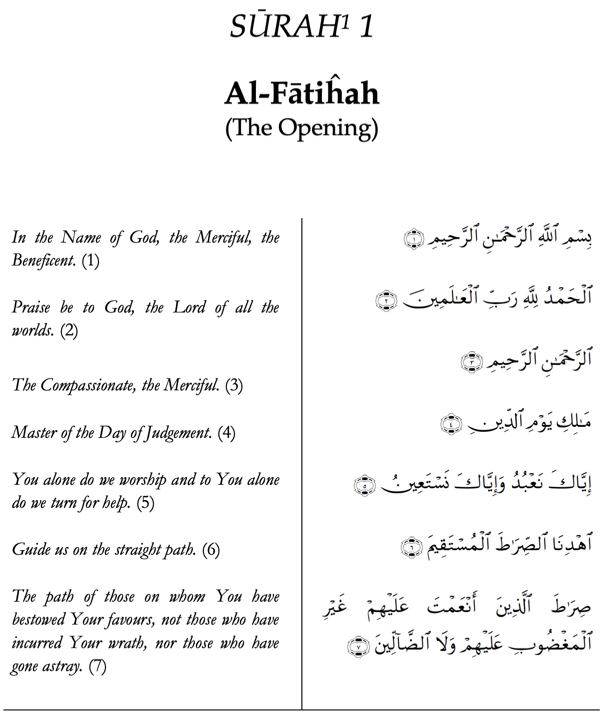
Kila Mwislamu husoma sura hii fupi ya aya saba angalau mara kumi na saba kwa siku. Hadith sahihi ya Mtume Muhammad ﷺ inasema: "Sala ya mtu asiyesoma Al-Fatiha si sahihi." Sura hii fupi ina mengi ya misingi mikuu ya Uislamu, imani zake na dhana zake. Inaeleza mitazamo na misimamo yake mingi ya msingi. Haya yote yanaonyesha wazi kwa nini sura hii imechaguliwa kusomwa mara kwa mara na kwa nini ni ya lazima kwa kusihi kwa sala.
Every Muslim recites this short sūrah of seven verses at least seventeen times a day. An authentic ĥadīth of the Prophet Muĥammad (peace be upon him), says: “A prayer by one who does not read the Fātiĥah is invalid.” This short sūrah contains a great deal of the central basic ideas of Islam, its beliefs and concepts. It outlines many of its essential perceptions and attitudes. All this makes it clear why it is chosen for frequent recitation and why it is essential for the validity of prayer.
Sura hii inaanza kwa kauli:
The sūrah opens with the phrase:
Kwa jina la Mungu, Mwingi wa Rehema, Mwenye Kurehemu. (Aya ya 1)
In the name of God, the Compassionate, the Merciful. (Verse 1)
Hili linakubaliwa na wanazuoni wengi kuwa ni aya ya sūrah yenyewe, inayokamilisha aya zake kuwa saba. Hata hivyo, kuna tofauti ya maoni kuhusu kama hilo ni kweli kwa sūrah nyingine zote za Qur’ani ambazo maneno hayo hayo yanatokea kama kifungu cha mwanzo. Baadhi ya wanazuoni wanashikilia kwamba kauli ifuatayo ya Qur’ani inamrejelea Al-Fātiĥah: “Tumekupa aya saba zinazorudiwa-rudiwa na Qur’ani hii tukufu.” (15: 87)
This is recognized by the majority of scholars as a verse of the sūrah, in its own right, completing its verses into seven. There is, however, a difference of opinion over whether this is so with respect to all other sūrahs of the Qur’ān in which the same words appear as the opening phrase. Some scholars maintain that it is to the Fātiĥah that the following Qur’ānic statement refers: “We have given you seven oft- repeated verses and this sublime Qur’ān.” (15: 87)
Aya za kwanza kabisa za Qur'ani zilizoteremshwa kwa Mtume Muhammad ﷺ, zinazoanza kwa maneno: "Soma kwa jina la Mola wako..." (96: 1), zinaweka adabu ya Kiislamu ya kutaja jina la Mungu mwanzoni mwa kila tendo. Hili pia linaendana na msingi wa kimsingi wa Kiislamu kwamba Mungu ni "wa kwanza na wa mwisho, wa dhahiri na wa siri." (57: 3) Kwa hakika Yeye ndiye hakika ya kuwepo, chanzo na sababu ya kuwepo kwa vyote vilivyopo. Kwa hiyo, kila harakati na kila tendo hufanywa kwa jina Lake, na kila kitu huanzia kwa jina Lake.
The very first verses of the Qur’ān revealed to Prophet Muĥammad, which begin with: “Read in the name of your Lord...” (96: 1) establish the Islamic etiquette of invoking the name of God at the beginning of every action. This is also in line with the fundamental Islamic principle that God is “the first and the last, the outward and the inward.” (57: 3) He is indeed the real being, the origin and the raison d’être of all that exists. In His name, therefore, every movement and action is made, and in His name everything begins.
Sifa za Mungu Mwenye Huruma, al-Raĥmān, na Mwenye Rehema, al-Raĥīm, zinajumuisha kila upande na maana ya huruma, na zinaweza kutumika pamoja kwa Mungu Mtukufu pekee. Ingefaa kutumia sifa ya al-Raĥīm kwa kumrejelea binadamu, lakini imani ya Kiislamu inahitaji kwamba matumizi ya al-Raĥmān yawe ya Mungu pekee. Kuhusu mjadala wa ni ipi kati ya sifa hizi mbili inayobeba maana pana zaidi ya huruma na rehema, hilo halituhusu hapa. Hata hivyo, tunaweza kuhitimisha kwamba zinapounganishwa, zinajumuisha kila upande na kila kipimo cha huruma.
The divine attributes of the Compassionate, al-Raĥmān, and the Merciful, al-Raĥīm, encompass all aspects and meaning of mercy, and can only be used together with respect to God Almighty. It would be appropriate to use the attribute of al-Raĥīm in reference to a human being, but the Islamic faith requires that use of al-Raĥmān is exclusive to God. As for the debate over which of the two adjectives denotes the wider meaning of mercy and compassion, it does not concern us here. We can conclude, however, that when combined, they encompass all aspects and dimensions of mercy.
Kwa kuwa kutaja jina la Mwenyezi Mungu mwanzoni mwa kila tendo ni kanuni ya kwanza ya msingi ya imani ya Kiislamu, kizuizi cha matumizi ya al-Raĥmān na al-Raĥīm kwa Mwenyezi Mungu peke yake ni kanuni ya pili, na hufafanua uhusiano kati ya Mwenyezi Mungu na mwanadamu. Baada ya kutaja jina la Mwenyezi Mungu na kukiri rehema Yake isiyo na mwisho, mtu anaelekezwa kumsifu Mwenyezi Mungu na kutambua utawala Wake kamili juu ya viumbe vyote:
As the invocation of God’s name at the beginning of every action constitutes the first fundamental principle of the Muslim faith, the restriction of the use of al-Raĥmān and al-Raĥīm to God alone constitutes the second principle and defines the relationship between God and man. Having invoked God’s name and acknowledged His infinite mercy, one is directed to praise God and recognize His absolute sovereignty over all beings:
Sifa zote njema ni za Mwenyezi Mungu, Mola wa viumbe vyote. (Aya ya 2)
Praise be to God, the Lord of all the worlds. (Verse 2)
Sifa za Mungu ndizo hisia ya kwanza inayoamshwa moyoni mwa muumini anapotajwa Mungu. Kwani kuwepo kwa mwanadamu mwenyewe ni sehemu ya neema isiyo na mwisho ya Mungu, jambo linalozaa shukrani na heshima kwa Mungu. Dhihirisho za ukarimu na wema wa Mungu kwa mwanadamu na viumbe wengine zimeenea kila mahali na zinaweza kuonekana kila wakati. Kumsifu Mungu mwanzoni na mwishoni mwa kila tendo ni kanuni nyingine ya msingi ya imani ya Kiislamu. Qur'ani inasema: {Yeye ndiye Mungu; hakuna mungu isipokuwa Yeye. Sifa zote ni Zake, duniani na Akhera...} (28: 70)
Praise of God is the first feeling aroused in a believer’s heart at the mention of God. For man’s own existence is an aspect of God’s infinite grace, which engenders gratitude and reverence towards God. The manifestations of God’s munificence and generosity to man and other creatures abound everywhere and can be seen at every moment. To praise God at the beginning and at the end of every action is another fundamental principle of the Islamic faith. The Qur’ān says: “He is God; there is no deity but He. To Him belongs praise in the first and in the last...” (28: 70)
Hata hivyo, neema ya Mwenyezi Mungu ni kubwa kiasi kwamba mja wa Mwenyezi Mungu anapomsema, "Himidi ni za Mwenyezi Mungu," hilo huandikwa kwake kuwa tendo jema linalozidi kila kitu. `Umar ibn al-Khaţţāb, Maswahaba wa Mtume ﷺ, anasimulia kwamba Mtume ﷺ alieleza jinsi mtu mmoja alivyosema: "Ee Mola wangu, nakusifu kama inavyostahiki utukufu wa uso wako na ukuu wa uwezo wako." Malaika wawili waliokuwa pamoja na mtu huyo hawakuweza kupima kauli hiyo, wakamrejea Mwenyezi Mungu Mtukufu, ambaye aliwaamuru: "Mwandikieni katika daftari lake kama alivyosema, nami nitamlipa kama inavyostahiki atakaporejea kwangu."
Sehemu ya mwisho ya aya hii, "Mola wa viumbe vyote", inaeleza imani ya Uungu kamili wa ulimwengu wote ambao ndio kiini cha dhana ya Kiislamu ya Mungu. Mwenyezi Mungu ndiye Mmiliki pekee, kamili na wa mwisho, mwenye mamlaka huru kamili ya kutenda katika ulimwengu wote. Yeye ndiye Bwana Mkuu wa kila kitu aliyeuumba ulimwengu na anaendelea kuutazama, kuutunza, na kuhakikisha uthabiti na ustawi wake. Uhusiano huu hai na wenye nguvu kati ya Muumba na viumbe ndio chemchemi ya kudumu ya uhai kwa viumbe vyote. Mwenyezi Mungu hakuuumba ulimwengu kisha akauacha ujiendeshe wenyewe. Yeye anaendelea kuwa mamlaka hai inayoshughulika na viumbe vyake, akiwapa kile wanachohitaji kwa maisha yao yanayoendelea na yenye maana. Hili linawahusu viumbe vyote vya Mwenyezi Mungu.
Nevertheless, God’s grace is such that when a believer says, ‘praise be to God,’ it is recorded for him as a good deed outweighing everything. `Umar ibn al-Khaţţāb, the Prophet’s Companion, relates that the Prophet (peace be upon him) told how a man once said, “Lord, I praise You as befits the majesty of Your face and the greatness of Your power.” The two angels accompanying that man could not evaluate the remark and referred to God Almighty, who commanded them: “Register it in his record as he said it, and I shall reward him as he deserves when he returns to Me.” The last part of this verse, “Lord of all the worlds”, expresses the belief in absolute universal Godhead which is at the very core of the Islamic concept of God. God is the sole, absolute and ultimate owner with full independent authority to act in the whole cosmos. He is the overall supreme master who has created the world and continues to watch over it, take care of it, and ensure its stability and well-being. This living and dynamic relationship between the Creator and the created is the perpetual fountain of life for all creation. God has not created the world and abandoned it to its own devices. He continues to be an active living authority over His creation, giving it what it needs for its continued and meaningful life. This applies to all God’s creation.
Kukiri uungu wa Mwenyezi Mungu usiogawanyika kikamilifu ndiko kunakotofautisha kati ya uwazi na mkanganyiko kuhusu umoja wake wa kipekee. Watu mara nyingi walichanganya kukiri kwao kwamba Mungu ndiye muumbaji pekee na imani kwamba miungu mingi ina mamlaka katika maisha yao. Inaweza kuonekana si ya kawaida kabisa kwamba watu wawe na imani kama hiyo, lakini hali hii ilikuwepo zamani na bado ipo hadi leo. Qur’ani inawataja wale wanaodai kwamba, "Hatuwaabudu [miungu hiyo midogo] ila ili itusogeze karibu na Mungu." (39: 3) Pia inataja kwamba baadhi ya makundi ya Wayahudi na Wakristo "wamewafanya maraabi wao na makasisi wao kuwa miungu badala ya Mungu." (9: 31) Ushirikina, yaani kuabudu miungu kadhaa au nusu-miungu mbali na 'Mungu Mkuu' anayedhaniwa, ulienea sana wakati Uislamu ulipojitokeza Arabia katika karne ya saba.
Acknowledging God’s absolute Lordship makes all the difference between clarity and confusion with regard to God’s absolute oneness. People often combined their acknowledgement of God as the sole creator with belief in multiple deities having authority in their life. It may seem absurd that people should ever hold such a belief, but this was true in the past and is still true today. The Qur’ān speaks of those who claim that they “only worship them [minor gods] so that they may bring us nearer to God.“ (39: 3) It also mentions that some Jewish and Christian groups who “have taken their rabbis and priests as gods alongside God.” (9: 31) Polytheism, or the worship of several deities or demigods besides the perceived ‘Grand Deity’, was widespread when Islam emerged in the 7th century in Arabia.
Uthibitisho wa utawala kamili wa Mungu Mmoja na mamlaka yake yanayofanya kazi.
The affirmation of the absolute sovereignty and active authority of the One God.
juu ya uumbaji wote kulikuwa na umuhimu wa kuhakikisha akili ya mwanadamu inabaki yenye mantiki na amani ya moyo, na kumwondolea mshangao mkali na wa kuumiza wa ushirikina. Mwanadamu lazima ahakikishiwe kwamba Mungu mwenye macho ya kulinda na mwenye kujali ndiye anayesimamia dunia hii, na kwamba hatawahi kuiacha wala kuitelekeza.
over all creation was necessary to ensure man’s rationality and peace of mind, and to relieve him from the cruel bewilderment of polytheism. Man must be reassured that a vigilant and caring God is in charge of this world and will never abandon or forsake it.
Wakati Uislamu ulipoanza, dunia ilijaa imani na falsafa potofu, pamoja na dini za uongo zilizojengwa juu ya ushirikina, hadithi za kale na hekaya. Sehemu ndogo sana kati ya hizo ilikuwa kweli, au hata yenye mantiki. Kuhusu dhana ya Mungu na uhusiano wake na mwanadamu na ulimwengu, kulikuwa na mkanganyiko mwingi wa kusikitisha. Hali hiyo nayo ilisababisha mkanganyiko katika ufahamu wa mwanadamu kuhusu ulimwengu, na kuhusu nafasi yake mwenyewe na wajibu wake ndani yake.
At the advent of Islam, the world was full of erroneous beliefs and philosophies, and of false religions based on superstition, legend and mythology. Very little of it was true or even rational. As far as the concept of God and His relationship with man and the world was concerned, there was plenty of miserable confusion. This in turn led to confusion in man’s understanding of the world and of his own position and role within it.
Hitaji la mfumo wa imani wenye busara, ulio wazi na thabiti hudhihirika tu tunapojifunza zile kurasa za giza za historia ya binadamu ambazo hazikuwa na mfumo kama huo. Ndipo tunapotambua jinsi hadithi kuu za kubuni na imani potofu zinavyomlemea mwanadamu kwa uzito mkubwa. Kutakuwa na maelezo zaidi juu ya jambo hili tutakapofikia kujifunza mifano mahususi katika Qur’ān.
The need for a rational, clear and consistent system of beliefs only becomes apparent when we study those dark periods of human history when there was no such system. We then realize how heavily such great myth and false beliefs weigh on man. There will be more on this when we come to study specific instances in the Qur’ān.
Ni kwa kuzingatia hitaji kama hilo ndipo Uislamu umechukua tahadhari kubwa katika kurekebisha imani za mwanadamu, na kufafanua kwa uwazi mkubwa dhana na asili ya Mungu na sifa zake, pamoja na uhusiano kati ya Muumba na viumbe.
It is in the light of such need that Islam has taken great care to correct man’s beliefs and define very clearly the concept and nature of God and His attributes, and the relationship between Creator and creation.
Hili ni jambo lililojumuishwa katika dhana ya Kiislamu ya umoja wa Mwenyezi Mungu, ambayo ndiyo kiini na kanuni ya msingi kabisa ya Uislamu. Juhudi kubwa zimetolewa katika kuthibitisha na kufafanua kauli kwamba Mwenyezi Mungu ni Mmoja, Bwana na Mola pekee, asiye na mipaka wala mfano, wa kila kitu kilichopo. Upande mwingine wa dhana hii ambao Uislamu umeupa umakini mkubwa zaidi ni ufafanuzi wa sifa za Mwenyezi Mungu, ambao umekuwa chanzo cha mkanganyiko mkubwa, upotoshaji, na fikra zilizochanganyikana za kidini na kifalsafa kwa karne nyingi.
This is embodied in the Islamic concept of God’s oneness, the essence and most fundamental principle of Islam. Much care has been devoted to establishing and elucidating the affirmation that God is the One, absolute and transcendent Lord and Master of all that exists. The other aspect of this concept to which Islam has given its greatest attention is the definition of God’s attributes, which has been the cause of much confusion, obfuscation and muddled religious and philosophical thinking through the ages.
Uzito, msisitizo na undani ambao Uislamu umeshughulikia dhana ya umoja wa Mungu, pamoja na mambo yote yanayohusiana nayo, unaweza kueleweka vizuri tu ukizingatia mandhari ya wingi mkubwa wa imani potofu na itikadi zilizochanganyikana zilizokusanyika katika historia. Kwa mtazamo huu, Uislamu unaweza kuonekana kwa urahisi kuwa ni tendo la kina na lenye wakati muafaka la rehema ya Mungu aliyowapa wanadamu, rehema inayotolewa kwa uzuri, unyenyekevu, uwazi, mshikamano na kupatana kikamilifu na maumbile ya binadamu.
The intensity, emphasis and detail with which Islam has dealt with the concept of God’s oneness, and all subjects related to it, can only be appreciated against the background of the great mass of erroneous beliefs and confused theologies that had accumulated in the course of history. From this perspective, Islam can readily be seen as a profound and timely act of divine mercy bestowed on humanity — mercy that is given with beauty, simplicity, clarity, harmony and full accordance with human nature.
Mwenye Kurehemu, Mwenye Rehema. (Aya ya 3)
The Compassionate, the Merciful. (Verse 3)
Hizi ni sifa mbili zinazojumuisha maana na pande zote za rehema na huruma, na zinaonyesha kwa ukamilifu rehema kama sifa ya Mwenyezi Mungu Mtukufu. Sifa hizi mbili zinabainisha uhusiano kati ya Mola Muumba na viumbe vyake. Ni uhusiano unaojengwa kabisa juu ya mapenzi, amani, kutuliza moyo na kujali, na unamzalishia mwanadamu hisia ya shukrani na sifa kwa Mungu kwa hiari yake mwenyewe.
These are two attributes that encompass all meanings and aspects of mercy and compassion, and epitomize mercy as a property of God Almighty. These two attributes define the link between the Lord as Creator and His creation. It is a link based entirely on love, peace, reassurance and care, and which inspires within man a spontaneous feeling of gratitude and praise towards God.
Tofauti na hadithi za Kigiriki au Agano la Kale (Mwanzo, 4: 11-12), Uislamu hauonyeshi Mungu kama adui anayemfuatia mwanadamu kwa kisasi kisichokoma, wala kama mtu anayepanga njama na kufanya hila dhidi ya viumbe vyake kwa chuki na kinyongo.
Unlike Greek mythology or the Old Testament (Genesis, 4: 1112), Islam does not depict God as an enemy who pursues man with relentless vengeance, or plots and schemes against His creation with spite and vindictiveness.
Mfalme wa Siku ya Hukumu. (Aya ya 4)
Master of the Day of Judgement. (Verse 4)
Aya hii inaeleza kanuni ya msingi ya Kiislamu yenye athari kubwa sana katika maisha ya binadamu: imani katika Akhera. Qur'ani inatoa maoni kuhusu jambo la kushangaza kwamba watu mara nyingi wamemwamini Mungu kama Muumbaji lakini wameshindwa kuamini Siku ya Hukumu, katika maisha ya baadaye, ambapo malipo na adhabu hutolewa ili kurejesha usawa wa haki. Ni kuhusiana na watu hao ambapo Qur'ani inasema: "Na ukiwauliza: Ni nani aliyeumba mbingu na ardhi? Bila shaka watasema: Mwenyezi Mungu." (31: 25) Mahali pengine Qur'ani inasema kuhusu watu kama hao: "Wanashangaa kwamba mwonyaji amewajia kutoka miongoni mwao wenyewe. Basi makafiri husema: Hili ni jambo la ajabu! [Je, tutafufuliwa] baada ya kufa na kuwa mavumbi tu? Kurejea huko kunaonekana mbali sana!" (50: 2-3)
This verse states a fundamental Islamic principle that has a most profound influence on human life: belief in the hereafter. The Qur’ān comments on the curious fact that people have often believed in God as Creator but have failed to believe in a Day of Judgement, in a life to come, when reward and punishment are meted out to restore the balance of justice. It is in reference to these that the Qur’ān says: “If you ask them, ‘Who is it that created the heavens and the earth?’ they will surely answer, ‘God’” (31: 25) Elsewhere the Qur’ān says of such people: “They deem it strange that a warner should have come to them from their own midst. Thus, the unbelievers say, A strange thing is this! [Are we to be resurrected] after we have died and become mere dust? Such a return seems far-fetched indeed!’“ (50: 2-3)
Imani katika Akhera ni ya lazima kwa sababu inaiteka nafsi na akili ya binadamu na kuelekeza umakini wake kwenye maisha yajayo. Hili nalo husaidia kudhibiti upendo wake kupita kiasi kwa maisha ya sasa, na kumwezesha kuvuka matamanio yake ya mara moja ya kidunia. Hasumbuki tena kutaka kupata malipo yake yote hapa na sasa; anaweza kuushinda ubinafsi wake na kukuza hisia na maslahi ya kujitolea kwa wengine. Binadamu anaweza kuishi maisha yake akiwa mtu mwenye msukumo, mvumilivu, mwenye kujiamini na mwenye matumaini.
Belief in the hereafter is essential because it engages the human soul and mind and concentrates man’s attention on a future existence. This in turn helps to rein in man’s obsession with the present life, and to transcend his immediate earthly desires. He is no longer anxious to reap all his rewards here and now; he can conquer his selfishness and develop altruistic feelings and interests. Man is able to go through life as a motivated, tolerant, confident and optimistic being.
Imani hii kuu ya Kiislamu inatofautisha wazi kati ya kutamani kupata uhuru wa kimaadili na kiakili ambao mwanadamu anauhitaji na anastahili, na kujisalimisha kwa tamaa na starehe za kidunia na za kibinafsi. Inaonyesha tofauti iliyopo kati ya ubinadamu uliosawazika na wenye dhamiri, na ubinadamu wa kujitakia wenyewe na wenye kujitafutia manufaa binafsi.
This central Islamic belief distinguishes clearly between aspiring to gain the moral and intellectual freedom that man needs and deserves, and capitulation to worldly and selfish desires and pleasures. It marks the difference between a well-balanced and conscientious humanity and an egotistic, self-seeking one.
Maisha ya binadamu hayawezi kuwa na usawa wala haki hadi watu waamini kwamba kile wanachokipata katika maisha haya ya muda si kila kitu wala mwisho wa yote. Mwanadamu anahitaji kuwa na msukumo wa imani thabiti kwamba maisha mengine yanamngoja, yenye thamani ya kupigania, ya kutoa dhabihu na ya kujitahidi anayoweza kulazimika kuyafanya hapa katika maisha haya mafupi. Imani hii huleta tofauti ya msingi katika hisia, mitazamo na tabia za wale wanaoishikilia.
Human life can never be balanced and equitable until people believe that what they earn in this transient life is not the be-all and the end- all. Man needs to have the incentive of a confident belief that another life awaits him, which is worth the struggle and the sacrifices and the effort he may have to make here in this short one. This belief brings a fundamental difference in the feelings, attitudes and behaviour of those who uphold it.
Wewe peke yako tunakuabudu, na kwako wewe peke yako tunaomba msaada. (Aya ya 5)
You alone do we worship and to You alone do we turn for help. (Verse 5)
Aya hii inaeleza kanuni nyingine ya msingi inayofuata kimantiki kutokana na zile zilizotangulia. Pia ni kanuni yenye uamuzi na yenye umuhimu mkubwa, inayoweka mstari wa kutofautisha kati ya uhuru ambao mwanadamu anaupata kwa kujisalimisha kwa Mungu, na unyanyasaji na udhalilishaji uliomo katika utumwa wa mwanadamu kwa mwanadamu.
This verse expresses another fundamental principle that follows logically from the preceding ones. It is also a decisive and crucial principle that draws a line between the freedom man gains in submitting to God and the abuse and debasement implicit in man’s servitude to man.
Mara mtu anapojisalimisha kwa Mungu na kutafuta msaada na uongozi kutoka Kwake Peke Yake, amepata ukombozi kamili kutoka katika dhulma ya mamlaka zote za kidini, kiakili, kimaadili na kisiasa.
Once man has submitted himself to God and sought help and guidance from Him alone, he has achieved total liberation from the tyranny of all religious, intellectual, moral and political powers.
Kwa muumini wa Uislamu, nguvu ya kibinadamu inagawanyika katika makundi mawili: nguvu iliyoongozwa kwa uongofu ambayo inamtambua Mungu na kufuata maelekezo yake, na nguvu ya kiburi na uasi ambayo haikubali mamlaka wala utawala wa Mungu. Muislamu anapaswa kuiunga mkono na kuithibitisha nguvu ya kwanza, bila kujali ni dhaifu au imenyimwa kiasi gani, na kuikataa na kuipinga nguvu ya pili, bila kujali ni imara au inatawala kiasi gani. Qur'ani inasema: {Makundi madogo mengi, kwa idhini ya Mungu, yameshinda makundi makubwa.} (2: 249) Ushindi wa kundi linaloonekana dhaifu zaidi kama huu unaweza kupatikana tu pale linapomtegemea Mungu, chanzo cha nguvu zote.
To the believer in Islam, human power falls into two categories: a rightly-guided power that recognizes God and abides by His directions, and an arrogant, rebellious one that does not admit to God’s sovereignty and authority. A Muslim is required to support and endorse the former, no matter how weak or disadvantaged it may be, and to reject and oppose the latter, regardless of its strength or dominance. The Qur’ān says: “Many a small band, by the grace of God, has vanquished a large one.” (2: 249) Such victory of the apparently weaker host could only be achieved when it relies on God, the source of all power.
Kuhusu nguvu za asili, mtazamo wa Mwislamu ni wa udadisi na urafiki, badala ya woga au uadui. Nguvu za binadamu na nguvu za maumbile zinatazamwa kama mazao ya nguvu ya Mungu mwenyewe, na zinatii mapenzi Yake. Kwa hiyo, ziko katika ukamilishano kamili na kutegemeana.
Towards natural forces, a Muslim’s attitude is one of curiosity and friendliness rather than fear or hostility. The powers of man and the powers of nature are perceived as by-products of God’s own power, and subject to His will. They are, therefore, perfectly complementary and interdependent.
Uislamu unafundisha kwamba Mwenyezi Mungu ameuumba ulimwengu wa kimwili pamoja na nguvu zake zote kwa matumizi na manufaa ya mwanadamu mwenyewe. Mwanadamu anafundishwa na kuelekezwa hasa kuchunguza ulimwengu unaomzunguka, kugundua uwezo wake na kutumia mazingira yake yote kwa manufaa yake mwenyewe na kwa manufaa ya wenzake wanadamu. Madhara yoyote ambayo mwanadamu anayapata kutoka kwa maumbile yanatokana tu na ujinga wake au kukosa kwake ufahamu wa maumbile hayo na wa sheria zinazoyatawala. Kadiri mwanadamu anavyojifunza zaidi kuhusu maumbile, ndivyo uhusiano wake na maumbile na mazingira unavyokuwa wa amani na wa usawaziko zaidi.
Islam teaches that God has created the physical world and all its forces for man’s own use and benefit. Man is specifically taught and directed to study the world around him, discover its potential and utilize all his environment for his own good and the good of his fellow humans. Any harm that man suffers at the hands of nature is a result only of his ignorance or lack of understanding of it and of the laws governing it. The more man learns about nature, the more peaceful and harmonious his relationship with nature and the environment.
Kwa hiyo, dhana ya "kuushinda maumbile" inaweza kwa urahisi kuonekana kuwa ya kejeli na hasi. Ni geni kwa mitazamo ya Kiislamu na inadhihirisha ujinga usio na haya kuhusu roho ambayo dunia imeumbwa nayo, na hekima ya Mwenyezi Mungu iliyo msingi wake.
Hence the notion of “conquering nature” can readily be seen as cynical and negative. It is alien to Islamic perceptions and betrays a shameless ignorance of the spirit in which the world has been created and the divine wisdom that underlies it.
Kwa kuwa Waislamu daima wanafahamu mkono wa Mwenyezi Mungu na nafasi yake katika kuumba na kuendesha ulimwengu, wana mtazamo chanya, wa kirafiki na wa kujenga kuhusu uhusiano wa mwanadamu na maumbile. Kwa ufupi, mtazamo huu unamtambua Mwenyezi Mungu kuwa chanzo na Muumba wa nguvu zote hizi, kwa kuzingatia kanuni na sheria zilezile. Nguvu hizi zimebuniwa kufanya kazi pamoja, kwa lengo moja la pamoja, katika upatanifu, ulinganifu na kuungana kwa kusaidiana. Nguvu za maumbile kwa msingi wake ni watumishi wa mwanadamu, ambaye ametiwa uwezo wa kiakili na kimwili wa kuzitambua, kuzifumbua siri zake, kuelewa sheria zinazozitawala na, baadaye, kuzitumia ili kuboresha ubora wa maisha duniani. Qur’ani inasema: “Ameweka chini yenu vyote vilivyomo ardhini.” (45: 13)
Being always aware of God’s hand and role in shaping and running the world, Muslims have a positive, friendly and constructive outlook on man’s relationship with nature. Simply stated, it acknowledges God as the origin and Creator of all these forces, on the basis of the same set of axioms and laws. They are designed to function together, for a common purpose, in harmony, compatibility and mutual support. The forces of nature are essentially subservient to man, who is mentally and physically equipped to discern them, unravel their secrets, comprehend the laws governing them and, subsequently, to harness them to improve the quality of life on earth. The Qur’ān asserts: “He has all that is on the earth subservient to you.” (45: 13)
Mtazamo wa namna hii huondoa kabisa dalili zote za hofu au upweke, na badala yake huleta hisia kuu ya kuwa mali ya mahali fulani, ambamo mwanadamu anaonekana si tu kuwa sehemu muhimu ya mpango wa jumla wa ulimwengu, bali pia kiumbe mwenye athari na ushawishi wa kweli. Hivyo, ulimwengu wake unakuwa mahali pa urafiki. Hili linaonyeshwa vyema zaidi na Nabii ﷺ alipowahi kukabiliana na Mlima Uhud, uwanja wa kushindwa vibaya kwa Waislamu, akasema: "Jinsi tunavyoupenda mlima huu, na jinsi unavyotupenda!" Kauli hii inaeleza kwa ufupi mapenzi aliyokuwa nayo Nabii ﷺ kwa maumbile, hata katika sura zake mbaya zaidi na zenye ukali.
Such an outlook eliminates all traces of fear or isolation and allows, instead, a profound sense of belonging in which man is seen not only as an integral part of the overall design of the world, but also an essentially effective and influential one. Thus, his world becomes a friendly one. This is best expressed by the Prophet when he once faced Mount Uĥud, the scene of a bitter defeat for Muslims, and said, “How we love this mountain, and how it loves us!” This expresses in a nutshell the affinity the Prophet felt towards nature even in its most rugged forms.
Baada ya kuweka kanuni hizi za msingi, sūrah inaelekeza njia fulani za vitendo za kuzikabili, ambazo kuu kati yake ni sala:
Having established these fundamental principles, the sūrah points the way to certain practical means of responding to them, foremost among which is prayer:
Tuongoze katika njia iliyonyooka; njia ya wale Uliowaneemesha, si ya wale waliostahiki ghadhabu Yako, wala ya wale waliopotea. (Aya 6-7)
Guide us on the straight path; the path of those on whom You have bestowed Your favours, not those who have incurred Your wrath, nor those who have gone astray. (Verses 6-7)
Kwa maneno haya, muumini anaomba aonyeshwe Njia iliyo sawa na asaidiwe kuifuata, jambo ambalo haliwezekani bila mwongozo, uangalizi na rehema ya Mungu. Kukiri hilo ni, kwa yenyewe, kutambua enzi kuu ya Mungu na utawala wake juu ya mambo yote na matukio yote.
With these words a believer pleads to be shown the Right Way and to be helped along it, which cannot be achieved without God’s guidance, care and mercy. To acknowledge that is in itself a recognition of God’s sovereignty and dominance over all things and events.
Mwongozo wa kuishi maisha sahihi huhakikisha furaha ya mwanadamu katika dunia hii na katika Akhera. Hujitokeza, kwa hakika, kwa kuielekeza tabia ya kibinadamu na silika, matamanio na misukumo ya mwanadamu kuelekea kutambua na kuelewa mapenzi ya Mwenyezi Mungu, na hivyo kuifanya shughuli ya binadamu iende sambamba na mpangilio wa kimaumbile na ulimwengu wa kimwili.
Guidance to the right way of life guarantees man’s happiness in this world and in the hereafter. It comes about, in effect, by guiding human nature and man’s instincts, desires and inspirations towards the recognition and comprehension of the divine will, so bringing human activity into rhythm with the natural order and the physical world.
Sūra hii inaonyesha kwamba "njia iliyonyooka" ni ile inayofuatwa na wale ambao Mwenyezi Mungu amewaneemesha, si njia ya wale waliopata ghadhabu yake kwa kupotoka kutoka kwenye Haki, wala ya wazembe ambao hawana elimu ya ukweli. Ni njia ya furaha na wokovu.
The sūrah reveals the nature of the “straight path” as being one taken by those whom God has favoured, not the way of those who have earned His displeasure by their deviation from the Truth, nor that of the heedless who have no knowledge of the truth. It is the path of happiness and salvation.
Hii basi ni Al-Fātiĥah, sura iliyochaguliwa kwa kusomwa mara kwa mara kila siku, ambayo bila hiyo sala za Kiislamu hazisihi. Licha ya ufupi wake, ina baadhi ya kanuni za msingi kabisa za imani ya Kiislamu na mafunzo fulani yanayotokana nazo.
This, then, is al-Fātiĥah, the sūrah selected for frequent daily recitation, without which Islamic prayers are invalid. Despite its brevity, it contains some of the most fundamental principles of the Islamic faith and certain insights that arise from them.
Mtume Muhammad ﷺ amepokewa akisema kwa usahihi kwamba Mwenyezi Mungu amesema: "Malipo ya Sala yanagawanywa sawa baina Yangu na mja Wangu, na mja Wangu atapewa kile anachoomba." Mtu anaposoma katika Sala: "Sifa zote njema ni za Mwenyezi Mungu, Mola wa viumbe vyote," Mwenyezi Mungu husema: "Mja Wangu amenisifu." Anaposoma: "Mwenye Rehema, Mwenye Kurehemu," Mwenyezi Mungu husema: "Mja Wangu amenishukuru." Anaposoma: "Mfalme wa Siku ya Malipo," Mwenyezi Mungu husema: "Mja Wangu amenitukuza." Anaposema: "Ni Wewe tu tunayekuabudu, na ni Wewe tu tunayekuomba msaada," Mwenyezi Mungu husema: "Hili ni baina Yangu na mja Wangu, na mja Wangu atapokea anachoomba." Na anaposema: "Tuongoze njia iliyonyooka, njia ya wale Uliowaneemesha, si ya wale waliokasirikiwa, wala ya wale waliopotea," Mwenyezi Mungu husema: "Hii ni kwa mja Wangu, naye atapewa anachotaka."
Hadithi hii inaeleza baadhi ya maana za Al-Fatiha. Msomaji huenda akaona ni jambo la kusaidia kuelewa kwa nini Mwenyezi Mungu amechagua sura hii isomwe na Waislamu angalau mara kumi na saba kwa siku, wanaposimama kwa Sala zao za lazima zilizoenea usiku na mchana, na hata mara nyingi zaidi wakati wanapofanya Sala za hiari.
The Prophet Muĥammad is reliably reported to have quoted God as saying that the fruits of prayer are shared equally between Me and My servant, and My servant will be granted what he asks for. As the worshipper recites [in Prayer]: “Praise be to God, the Lord of all the worlds,” God will say: ‘My servant has praised Me.’ As he recites: “The Compassionate, the Merciful,” God will say: ‘My servant has thanked Me.’ As he recites: “Master of the Day of Judgement,” God will say: “My servant has glorified Me.” As he says: “You alone do we worship, and to You alone do we turn for help,” God will say: ‘This is between Me and My servant, and My servant will receive what he asks for.’ And, as he says: “Guide us on the straight path, the path of those on whom You have bestowed Your favours, not those who have incurred Your wrath, nor those who have gone astray,” God will say: ‘This is for My servant, and he will be granted his wish.’“ This ĥadīth explores some of the meanings of al-Fātiĥah. The reader will perhaps find it helpful in understanding why God has chosen this sūrah for recitation by Muslims at least seventeen times a day, as they stand up for their obligatory prayers, spread over the night and day, and even more frequently, whenever they offer voluntary prayers.