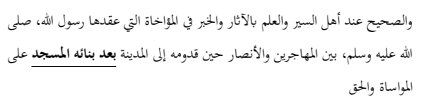
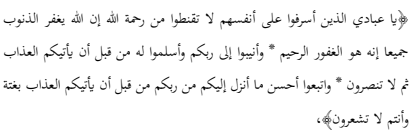
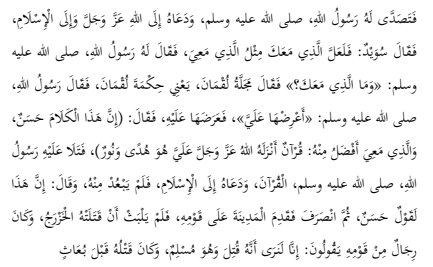
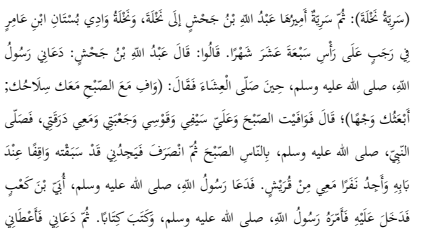
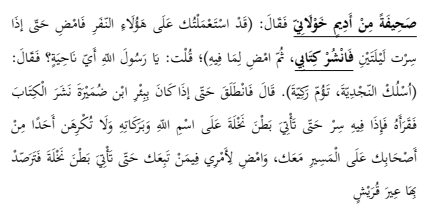
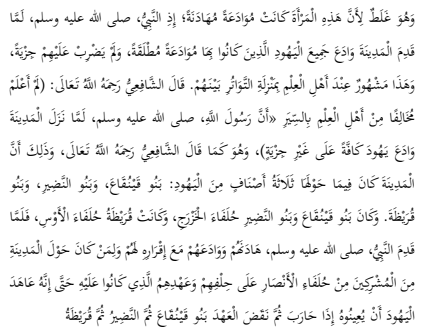
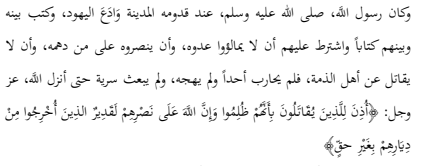
そこで、ムハージルーンとアンサールの間のサヒーファ(文書)、あるいは血の代償(ディヤ)の権利、戦争や和平に関する記述が見られる箇所については、必然的に、この「ムアーハーア(兄弟契約)」とは関係がないと分かります。それらは「アル=マディーナのサヒーファ」に関係するか、そこで述べられたものより(ずっと)後に書かれたり生じたりしたものです。また、アフマド・アブー・ザイドの『アス=スィーラ・アン=ナバウィーヤ』(71頁)に、「ユダヤ人との条約(ムアーハダ)の文書が書かれた日付」という見出しの下で伝えられている次の記述にも妥当性はありません。「ある現代の研究者は、その文書は元来二つの文書であり、歴史家がそれを一つにまとめたのだと、より有力だと判断した。一方は、預言者ムハンマド(彼に平安あれ)とユダヤ人との条約を扱っており、大バドルの戦いの前に書かれた。もう一方は、ムハージルーンとアンサールのムスリムの義務、彼らの権利と責務を明らかにしている。私の見解では、ユダヤ人との和平協定(ムワーダア)の文書は大バドルの戦いの前に書かれたというのがより有力である。二つ目の文書は、その後に書かれた」。古典的な典拠も、このより有力な見解を支持する内容を述べている。アブー・ウバイド・アル=カースィム・ブン・サッラームは言った。「その文書(ワスィーカ)は二度の機会に書かれた。預言者(彼に平安あれ)がマディーナに到着した時、そしてイスラームが優勢となり強固になる前、またアフル・アル=キターブ(啓典の民)からジズヤを取るよう命じられる前である」。アル=バラーズリーは言った。「神の使徒(彼に平安あれ)がマディーナに到着すると、ユダヤ人と条約(ムワーダア)を結び、自分と彼らの間で文書を作成した。彼はユダヤ人に、彼の敵を支援したり味方したりしないこと、彼を攻撃する者に対して彼を支援すること、そして彼がアフル・アル=ズィンマ(保護民)を守るために戦うことはないことを定めた」。 彼はその後、誰かに対して戦争を仕掛けることもなく、人々が彼を誹謗することもなく、軍隊を派遣することもなかった。アッラー、アッザ・ワ・ジャッルがこう啓示なさるまでは。「戦うことを許された者たちには、不当に攻撃されたがゆえに、今や(戦うことが)許された。まことに、アッラーは彼らに勝利を授けることがおできになる。彼らは、正当な理由もなく自分たちの家から追放された者たちである」(TMQ 22:39-40)。
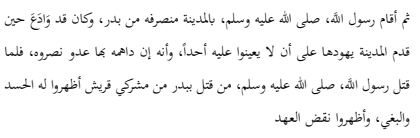
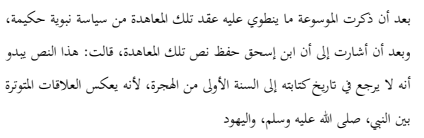
Wherever we find a narration about a Sahifah or a written document between the Muhajirin and the Ansar, or concerning blood money rights, war or peace, we know, by necessity, that it bears no relation to this “Mu’akhaah” (formation of brotherhood). It would either be related to the Sahifah of Al-Madinah or something that came or was written (much) later than it. There is also no validity in what came related in “As-Seera An- Nabawiyah” by Ahmad Abu Zaid (p. 71) under the heading “The date of the writing of the treaty (Mu’ahadah) with the Jews”: “One of the contemporary researchers found preponderant that the document was actually two documents in origin and then the historians combined them into one. One of them dealt with the treaty of the Messenger of Allah (peace be upon him) with the Jews and was written prior to the great battle of Badr. That is whilst the second clarified the commitments (duties) of the Muslims from the Muhajirin and the Ansar, their rights and obligations. He said: “It is preponderant in my view that the peace agreement (Muwada’ah) document with the Jews was written before the great battle of Badr. As for the second document, then it was written after it”. The classical sources have expressed that which supports this preponderance. Abu ‘Ubaid Al-Qasim bin Salam said: “The Wathiqa (document) was written on two occurrences, when the Prophet (peace be upon him) arrived in Al-Madinah, prior to the dominance of Islam and its becoming strong and before he was commanded to take the Jizyah from Ahl ul-Kitab (the people of the book)”. Al-Baladhari said: “When the Messenger of Allah (peace be upon him) arrived in Al-Madinah he made a treaty (Muwada’ah) with the Jews and wrote between himself and them a document. He stipulated upon them that they should not support or side with his enemies, to support him against those who attack him and that he would not fight in defence of the Ahl udh-Dhimmah. He did not then wage war against anyone, they did not defame him and he did not dispatch a military expedition, until Allah ‘Azza Wa Jalla revealed: “Permission [to fight] has been given to those who are being fought, because they were wronged. And indeed, Allah is capable of providing them victory. [They are] those who have been evicted from their homes without right” (TMQ 22:39- 40)”.
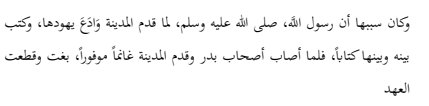
このようにして、アル=バラーズリーは、ユダヤ教徒との和平協定(ムワーダア)が、最初の派遣隊(サラーヤー)が送られる前に書かれたことを明らかにしている。すなわち、ハムザの派遣隊(サリーヤ)がヒジュラの元年のラマダーンに、バドルの戦いの一年と数日前に行われたことは知られている。ハムザの部隊は、預言者ﷺが編成した最初の部隊であった。アル=バラーズリーは別の箇所で、バヌ・カイヌカーア遠征について述べる際にこう記している。「その理由は、アッラーの使徒ﷺがマディーナに到着した時、そこのユダヤ教徒と和平協定を結び、自分と彼らとの間で文書を作成したことにある。その後、ムスリムがバドルで勝利し、多くの戦利品を携えてマディーナに戻ると、ユダヤ教徒は反乱を起こし、協定を破った」。このように、アル=バラーズリーは、ユダヤ教徒との和平協定がバドルより前に行われたと主張している。アット=タバリーは言った。「その後、アッラーの使徒ﷺはバドルから帰還した後もマディーナに留まった。マディーナに到着すると、彼はそこのユダヤ教徒と、彼に対して誰にも加担しないこと、そしてマディーナで敵に攻撃された場合には彼を支援することを条件として和平協定を結んだ。ところが、アッラーの使徒ﷺがクライシュの多神教徒のうち殺した者たちを殺すと、彼らは彼に対する妬みと反抗を示し、協定違反を露わにした」。これら多数の伝承による証言には、その和平協定文書がヒジュラの元年に書かれたと結論づけるのに十分な優位性を確立する根拠がある。さらに、その条項と本文を分析すると、預言者ﷺとユダヤ教徒との間の緊張を示すものではないことがわかる。 したがって、これらすべてを理由として、そのイスラム百科事典の主張は崩れ去り、その疑念は論破される。」[引用終わり]
In this way Al-Baladhari clarifies that the peace agreement (Muwada’ah) with the Jews was written before the sending of the first raiding party (Saraya). That is whilst it is known that the Sariya (raiding party) of Hamza took place in Ramadan of the first year of Hijrah i.e. a year and some days before the battle of Badr. The battalion of Hamza was the first battalion formed by the Prophet (peace be upon him). Al-Baladhari stated in another place when talking about the expedition of Bani Qainuqaa’: “The reason for it was that the Messenger of Allah (peace be upon him), when he arrived in Al-Madinah, made a peace agreement with its Jews and wrote a document between himself and them. Then, when the Muslims were victorious at Badr and came back to Al-Madinah with abundant booty, the Jews rebelled and broke the covenant”. In this manner, Al- Baladhari asserted that the peace agreement with the Jews took place prior to Badr. At-Tabari said: “Then the Messenger of Allah (peace be upon him) remained in Al-Madinah after his return from Badr. When he had arrived in Al-Madinah he had made a peace agreement with its Jews upon the stipulation that they do not assist anyone against him and that if he was attacked in Al-Madinah by an enemy they would support him. Then when the Messenger of Allah (peace be upon him) killed those whom he had killed from the Mushrikin (polytheists) of Quraish, they demonstrated envy and rebelliousness towards him and demonstrated the breaching of the covenant”. In these Mutawatir (concurrent transmissions indicating decisiveness) testimonies, there is enough to establish preponderance to conclude that the peace agreement document with the Jews was written in the first year of the Hijrah. In addition, an analysis of its articles and texts indicate that they are not indicative of any tension between the Prophet (peace be upon him) and the Jews. As such, due to all of this, the claims of the Islamic encyclopaedia fall down and their doubts are refuted” [End of Quote].
このように、名前が明かされていないこの研究者は、出来事の時系列を逆にしてしまっており、「ムアーハー」(兄弟の契り)をバドルの後に置き、サヒーファをバドルより前に置いています。そのため、彼は客観的に事柄を混同しているのです。
As such, we find that this researcher, who has not been named, reversing the timing of the issues, placing the “Mu’akhaah” (formation of brotherhood) after Badr and the Sahifah prior to Badr, just as he has confused the issues objectively:
1) それゆえ彼は、「ムアーハー」(兄弟の契約)を、根拠のない想像によって独立した文書であるとみなしたが、これは、そのような文書について一切言及していないムタワーティル(確実な伝承の一致)の伝承に反している。
2) 彼はさらに、この想像上の文書を、歴史家たちが彼の主張によれば一つの文書へとまとめたという二つの文書のうちの一つであるとみなした。もし彼が、信徒たち(すなわちムハージルーンとアンサール)に関する「サヒーファ」の本文だけでも読んでいたなら、「ムアーハー」、彼らの間の相続、またはそれに類する個人的な事柄に関わる文字は一つも見つけられなかっただろう。むしろ彼は、それが部族間の憲法的な関係の規制、一般の(公的な)安全保障の問題、血の代償(ディーヤ)の問題、捕虜の解放、そしてこれらに類する事柄に関するものであることを知っただろう。
3) また彼は、ユダヤ教徒やその他の者たち、すなわち世界の全ての国家、民族、当局、集団、社会、部族を含む者たちとの、本来の和平と休戦(ムワダーアH)の状況の事例と、「サヒーファ」から生じた、ユダヤ部族との「連合」とを混同した。彼はいかなる根拠もなしにこの混同を生み出したのである。
1) He, therefore took the “Mu’akhaah” (formation of brotherhood), through pure imagination, to be an independent document, which is contrary to the Mutawatir (decisive concurrent) transmissions which do not make any mention of a written document at all. 2) He then took this imaginary written document to be one of the two documents which the historians, according to his claim, forged into one single document. If he had only read the texts of the “Sahifah” related to the believers (i.e. the Muhajirin and the Ansar) he would not have found a single letter related to the “Mu’akhaah”, the inheritance between them or what resembles that in terms of individual affairs. Rather, he would have that it related to the regulation of the constitutional tribal relationships, general (public) security affairs, issues of blood money, the freeing of captives and what is similar to these. 3) He also mixed between the case of the original situation of peace and truce (Muwada’ah) with the Jews and others including all of states, nations, authorities, collectives, societies and tribes of the worlds and between the “confederal union” with the Jewish tribes which arose from the Sahifah. He came up with this mixing up without any basis.
「ムワーダア」(平和と停戦)は、預言者ﷺとその教友たちが、ムハージルとしてアル=マディーナに到着した時点で、そして次のアッラーのお言葉が下される以前に、全世界、すなわち犯罪的で敵対的なクライシュを含む世界との間に置かれていた元の状況を表している。
The “Muwada’ah” (peace and truce) represents the original situation that the Prophet (peace be upon him) and his companions were upon with the whole world, including the criminal and hostile Quraish, when he arrived at Al-Madinah and prior to the revelation the statement of Allah ‘Azza Wa Jalla: