5.5 Fairness gegenüber Kathir bin Abdullah bin ‘Amr bin ‘Awf Al-Muzani
5.5 Fairness to Kathir bin Abdullah bin ‘Amr bin ‘Awf Al- Muzani
- Folgendes wird in „Taqrib At-Tahdhib“ [Ibn Hajar] (1/460/5617) angeführt: [Kathir bin Abdullah bin ‘Amr bin ‘Awf Al-Muzani Al-Madani ist Da’if (schwach). Diejenigen, die ihm Lügen zuschrieben, waren übertrieben. (Er gehörte) zur siebten (d. h. Generation bzw. Überlieferungslinie).]
- The following came stated in in “Taqrib At-Tahdhib” [Ibn Hajar] (1/460/5617): [Kathir bin Abdullah bin ‘Amr bin ‘Awf Al-Muzani Al- Madani is Da’if (weak). Those who attributed lying to him were excessive. (He was from) the seventh (i.e. generation or line of transmission)].
– Doch in „Irwaa’ Al-Ghalil“ von Al-Albani (5/155) wird Folgendes angeführt: [Al-Hafiz (d. h. Ibn Hadschar) sagte [in Al-Fath – (4/371)]: [Und Kathir bin Abdullah ist nach Ansicht der Mehrheit schwach (da’if), jedoch stärken Al-Bukhari und diejenigen, die ihm folgten, wie At-Tirmidhi und Ibn Khuzaimah, seine Angelegenheit (bzw. seinen Status)].
- However, in “Irwaa’ Al-Ghalil”, by Al-Albani (5/155), the following was stated: [Al-Hafizh (i.e. ibn Hajar) said [in Al-Fat’h – (4/371)]: [And Kathir bin Abdullah is Da’if in the view of the majority however Al- Bukahri and those who followed him like At-Tirmidhi and Ibn Khuzaimah strengthen his affair (or status)].
- Das folgende wurde in „At-Tarikh Al-Kabir“ [Al-Bukhari] (7/217/945) überliefert: [Kathir bin Abdullah bin ‘Amr bin ‘Awf Al-Muzani Al-Madani hörte (bzw. empfing) von seinem Vater, während Marwan bin Mu’awiyah, Isma’il bin Abu Uwais und Yahya Al-Ansari von ihm überlieferten]. Es wird in einer anderen Ausgabe von „At-Tarikh Al-Kabir“ von Al-Bukhari (7/96/945) erwähnt. Al-Bukhari hat ihn nicht als Da’if (schwach) eingestuft, und er hat nicht einmal ein einziges Wort über ihn gesagt! - Das folgende wurde in „Al-Jarh Wa At-Ta’dil“ [Ibn Abu Hatim] (7/154/858) angeführt: [Kathir bin Abdullah bin ‘Amr bin ‘Awf Al-Muzani überlieferte von seinem Vater sowie von Muhammad bin Ka’b und Rubaih bin Abdur Rahman, während Abdul ‘Aziz bin Muhammad, Marwan bin Mu’awiyah, Ma’n bin ‘Eisa, Abdullah bin Wahb, Abdullah bin Nafi’ As-Sa’igh, Muhammad bin Khalid bin ‘Athma, Abu ‘Amir Al-‘Aqadiy, Khalid bin Makhlad, Ibn Qa’nab und Ibn Abu Uwais von ihm überlieferten. Ich hörte meinen Vater das sagen. Abdur Rahman überlieferte uns von Muhammad bin Hamawaih bin Al-Hasan, der sagte: Ich hörte Abu Talib sagen: Ich fragte Ahmad (gemeint ist Ahmad bin Hanbal) über Kathir bin Abdullah bin ‘Amr bin ‘Awf, und er sagte: „Munkar (d. h. zurückzuweisen wegen eines Mangels hinsichtlich des Hadith), ohne Wert“. Abdur Rahman überlieferte uns: Er sagte: Es wurde Al-‘Abbas bin Muhammad Ad-Dawri von Yahya bin Ma’een vorgelesen, dass er sagte: „Kathir bin Abdullah Al-Muzani ist Da’if (schwach) im Hadith“. Abdur Rahman überlieferte uns. Er sagte: Ich fragte Abu Zur’ah über Kathir bin Abdullah bin ‘Amr bin ‘Awf. Er sagte: „Schwach im Hadith und nicht stark“. Ich sagte zu ihm: Von Bahz bin Hakim, Abdul Muhaimin und Kathir bin Abdullah, wer von ihnen ist dir am liebsten? Er sagte: „Bahz und Abdul Muhaiman sind mir lieber als er“. Abdur Rahman überlieferte uns: Er sagte: Mein Vater wurde über Kathir bin Abdullah bin ‘Amr bin ‘Awf befragt, und er sagte: „Er ist nicht fest/stark (Matin)“.
- The following came recorded in “At-Tarikh Al-Kabir” [Al-Bukhari] (7/217/945): [Kathir bin Abdullah bin ‘Amr bin ‘Awf Al-Muzani Al- Madani listened to (or received from) his father, while Marwan bin Mu’awiyah, Isma’il bin Abu Uwais and Yahya Al-Ansari related from him]. It is recorded in another edition of “At-Tarikh Al-Kabir” by Al- Bukhari (7/96/945). Al-Bukhari did not classify him as Da’if (weak) and he did not speak about him, not even a single letter! - The following came stated in “Al-Jarh Wa At-Ta’dil” [Ibn Abu Hatim] (7/154/858): [Kathir bin Abdullah bin ‘Amr bin ‘Awf Al-Muzani related from his father in addition to Muhammad bin Ka’b and Rubaih bin Abdur Rahman, while Abdul ‘Aziz bin Muhammad, Marwan bin Mu’awiyah, Ma’n bin ‘Eisa, Abdullah bin Wahb, Abdullah bin Nafi’ As-Sa’igh, Muhammad bin Khalid bin ‘Athma, Abu ‘Amir Al-‘Aqadiy. Khalid bin Makhlad, Ibn Qa’nab and Ibn Abu Uwais related from him. I heard my father saying that. Abdur Rahman related to us from Muhammad bin Hamawaih bin Al-Hasan who said: I heard Abu Talib who said: I asked Ahmad (meaning Ahmad bin Hanbal) concerning Kathir bin Abdullah bin ‘Amr bin ‘Awf and he said: “Munkar (i.e. rejectable due to defectiveness in respect to) Al-Hadith, of no worth”. Abdur Rahman related to us: He said: It was read to Al-‘Abbas bin Muhammad Ad- Dawri from Yahya bin Ma’een That he said: “Kathir bin Abdullah Al- Muzani is Da’if (weak) in Hadith”. Abdur Rahman related to us. He said: I asked Abu Zur’ah about Kathir bin Abdullah bin ‘Amr bin ‘Awf. He said: “Feeble/weak in Hadith and not strong”. I said to him: Out of Bahz bin Hakim, Abdul Muhaimin and Kathir bin Abdullah, which of them is the most beloved to you? He said: “Bahz and Abdul Muhaiman are more beloved to me than him”. Abdur Rahman related to us: He said: My father was asked about Kathir bin Abdullah bin ‘Amr bin ‘Awf and he said: “He is not solid/strong (Matin)”.
Dieser Ausspruch „Er ist nicht fest/stark (Matin)“ ist nicht gleichbedeutend mit der Aussage „Er ist nicht Qawiy (stark)“, und er entspricht auch nicht dem Ausdruck „Da’if“ (schwach). Das liegt daran, dass der Überlieferer „Matin“ denjenigen darstellt, der in Bezug auf Stärke und Verlässlichkeit den Gipfel erreicht hat. – Widersprüchliche Aussagen finden sich in „Tarikh ul-Islam“ (10/224/330): [Kathir bin Abdullah bin ‘Amr bin ‘Awf bin Zaid bin Talha Al-Yashkuri Al-Muzani Al-Madani … Er überlieferte von seinem Vater und von seinem Großvater (per Abschrift), außerdem von Nafi’ und Muhammad bin Ka’b Al-Qurazhi. Und folgende überlieferten von ihm: Ibn Wahb, Abdullah bin Nafi’, Al-Qa’nabi, Isma’il bin Abi Uwais und Khalq.
I say: This statement “He is not solid/strong (Matin)” is not like the statement “He is not Qawiy (strong))” and it is not synonymous with the statement “Da’if” (weak). That is because the “Matin” narrator is the one who has reached the pinnacle in respect to strength and reliability. - Contradictory statements came stated in “Tarikh ul-Islam” (10/224/330): [Kathir bin Abdullah bin ‘Amr bin ‘Awf bin Zaid bin Talha Al-Yashkuri Al-Muzani Al-Madani … He related from his father and from his grandfather (by transcript), in addition to Nafi’ and Muhammad bin Ka’b Al-Qurazhi. And the following related from him: Ibn Wahb, Abdullah bin Nafi’, Al-Qa’nabi, Isma’il bin Abi Uwais and Khalq.
Sie waren sich über seine Einstufung als schwach einig, und Ahmad bin Hanbal lehnte seine Überlieferungen ab.
They agreed upon his classification of weakness and Ahmad bin Hanbal rejected his Hadith.
Asch-Schafiʿiy sagte: Er ist einer der Pfeiler der Lüge (Al-Kadhib). Abu Dawud sagte Ähnliches.
Ash-Shafi’iy said: He is a pillar from among the pillars of Al-Kadhib (deceit/untruth). Abu Dawud said similar to that.
„Abbas berichtete von Ibn Ma'een (dass er, d.h. Kathir, sei): „Da'if (schwach)". Ad-Darimiy berichtete von Ibn Ma'een: Er hat keinen Wert.
‘Abbas related from Ibn Ma’een (that he i.e. Kathir is): “Da’if (weak)”. Ad-Darimiy related from Ibn Ma’een: He has no worth.
An-Nasa’i sagte: „Er wird verlassen oder ignoriert (d. h. man überliefert nicht von ihm).“ Und ad-Daraqutnī sagte dasselbe.
An-Nasa’i said: “He is left or disregarded (i.e. not related from)” and Ad-Daraqutniy said the same.
Was At-Tirmidhi betrifft: Er begann zu diktieren und sagte: „Ich sagte zu Muhammad: Es gibt das Hadith von Kathir bin Abdullah, von seinem Vater, von seinem Großvater, bezüglich des (Themenbereichs) der Zeit des Freitagsgebets. Er sagte: Es ist ein Hasan-Hadith; jedoch stuft Ahmad bin Hanbal Kathir als Da'if (schwach) ein.“
As for At-Tirmidhi, then he began to dictate and said: “I said to Muhammad: There is the Hadith of Kathir bin Abdullah, from his father, from his grandfather, related to the (subject area) of the time of the Jumu’ah prayer. He said: It is a Hasan Hadith, however Ahmad bin Hanbal classifies Kathir as being Da’if (weak)”.
Ibn Hibban sagte: „Kathir überliefert von seinem Vater, von seinem Großvater eine erfundene Schrift. Es ist nicht erlaubt, ihn zu erwähnen außer im Sinne des Erstaunens." Ich sage: Er starb im Jahr 163 n. H.] [Ende des Zitats].
Ibn Hibban said: “Kathir relates from his father, from his grandfather a fabricated transcript. It is not permissible to mention him except from the angle of astonishment”. I said: He died in the year 163 AH] [End of quote].
Ich sage: Die Aussage „Man ist sich über seine Einstufung als schwach einig“ hat keine Bedeutung (oder Gewicht), wenn es eine Glaubwürdigkeitsbestätigung vom Oberhaupt der Gerechtigkeit und Mäßigung, Imam Al-Bukhari, gibt, dazu die belanglose Aussage von Abu Hatim, der zu Extremismus und Starrsinn neigt! Die Wahrheit ist, dass Ad-Daraqutni ihn nur als Teil einer Liste erwähnt hat, ohne Kommentar, unter einer Gruppe von Überlieferern, in seinem Buch „Die Schwachen und Verworfenen“ (Ad-Du'afa' Wa Al-Matrukin). Die Aussage, die Abu Dawud zugeschrieben wird, widerspricht der Tatsache, dass er einige Hadithe von Kathir bin Abdullah veröffentlicht hat und keine Meinungsverschiedenheit über sie entstand, als er mit ihnen an die Leute von Makkah schrieb. Die meines Erachtens wahrscheinlichste Erklärung ist, dass er die Aussage des Imam Ash-Shafi'i überlieferte und ihr am Anfang folgte, wie es in „Tahdhib Al-Kamal“ (24/136/4948) und in „Tahdhib At-Tahdhib“ (8/377/753) ersichtlich ist; deren Texte werden in Kürze vorgestellt. Dann (danach) wurde ihm die Unrichtigkeit der Anschuldigung offenbar, und so verzeichnete er seine Überlieferungen in seinen Sunan. Al-Hafiz bin Hajar selbst scheint zwiespältig zu sein, da seine Aussage in „Al-Fath“ nicht mit dem übereinstimmt, was er in seiner Zusammenfassung in „At-Taqrib“ festgestellt hat. Die Angelegenheit ist daher mehrdeutig, und deshalb ist es notwendig, eine genaue Untersuchung der Umstände oder des Status dieses Mannes vorzunehmen.
I say: There is no meaning (or significance) to the statement: “They agreed upon his classification of weakness” when there exists an attestation of credibility from the chief of fairness and moderation Imam Al-Bukhari, in addition to the insignificant speech of Abu Hatim, who is from the prone to extremity and stubbornness! The truth is that Ad-Daraqutni only mentioned him as part of a list, without commentary, amongst a group of narrators, in his book “The weak and disregarded” (Ad-Du’afa’ Wa Al-Matrukin”. The speech attributed to Abu Dawud contradicts the fact that he published some of the Hadith of Kathir bin Abdullah and no disagreement resulted over them, when he wrote with them to the people of Makkah. The most likely explanation in my view, is that he related the speech of Imam Ash-Shafi’iy and followed it in the beginning, as is evident in “Tahdhib Al-Kamal” (24/136/4948) and in “Tahdhib At-Tahdhib” (8/377/753); the texts of which will be presented soon. Then (after that), it the incorrectness of the accusation became evident to him and so he recorded his relations within his Sunan. Al-Hafizh bin Hajar himself appears to be of two minds as his speech in “Al-Fat’h” is not consistent with what he stated in his summary in “At-Taqrib”. The matter is therefore ambiguous and as such it is necessary to undertake a precise study of the circumstances or status of this man.
Folgendes wurde in „Ad-Du’afaa’ Al-Kabir“ von Al-‘Uqailiy (4/4/1555) überliefert: [Kathir bin Abdullah bin ‘Amr bin ‘Awf Al-Muzani. Ahmad bin Zukair Al-Hadrami berichtete uns von Ahmad bin Sa’id Al-Fihriy, von Ibrahim bin Al-Mundhir, von Mutarrif bin Abdullah, der sagte: „Ich sah Kathir bin Abdullah bin ‘Amr bin ‘Awf Al-Muzani. Er war sehr streitsüchtig, und keiner unserer Gefährten wollte etwas von ihm annehmen.“ Da sagte Ibn ‘Imran Al-Qadi zu ihm: „O Kathir, du bist ein törichter Mensch, du streitest über das, was wir nicht kennen. Du erhebst Ansprüche auf das, was du nicht hast, und du hast keinen Beweis für das, was du suchst. Komm also nicht zu mir, es sei denn, du siehst mich mit Leuten der Torheit oder Müßiggang Zeit verbringen. Wenn du Leute der Torheit in meiner Gesellschaft siehst, dann komm herüber.“ Ibrahim sagte: Mutarrif sagte zu mir: Ibn ‘Imran war eines Tages bei uns, als Kathir bin Abdullah zu ihm kam, und so sagte er: „Habe ich dir nicht gesagt, du sollst nicht zu mir kommen, es sei denn, du siehst mich mit den törichten (oder müßigen) Leuten?“ Kathir sagte daraufhin zu ihm: „Du hast die Wahrheit gesagt, möge Allah die Angelegenheit des Qadi zum Guten wenden. Tatsächlich kam ich nur zu dir, als die Leute der Torheit zu dir kamen. Soundso und soundso kamen zu dir. Beide gehören zu den Leuten der Torheit (oder des Müßiggangs), und so kam ich mit ihnen beiden.“ Abdullah bin Ahmad berichtete uns: Er sagte: Ich hörte meinen Vater sagen: „Hussein bin Abdullah bin Dumairah und Kathir bin Abdullah bin ‘Amr bin ‘Awf ergeben zusammen nichts, sie sind einander ähnlich, nichts wert.“ Mein Vater verwarf die Ahadith des Kathir bin Abdullah bin ‘Amr bin ‘Awf und überlieferte sie daher nicht an uns. Muhammad bin ‘Eisa berichtete uns von ‘Abbas, der sagte: Ich hörte Yahya sagen: Kathir bin Abdullah bin ‘Amr bin ‘Awf Al-Muzani, sein Großvater hatte die Gefährtenschaft (Suhbah, d. h. mit dem Propheten ﷺ), (doch) Kathir ist schwach (Da’if) in Bezug auf das Hadith.] Ahmad bin Mahmud berichtete uns von Uthman bin Sa'id: Ich sagte zu Yahya bin Ma'een: „Kathir bin Abdullah Al-Muzani, (den) Ma'n überliefert, wie steht es um ihn (d. h. seine Verfassung)?“ Er sagte: „Er ist nichts oder ohne Wert“.
- The following came recorded in “Ad-Du’afaa’ Al-Kabir” by Al- ‘Uqailiy (4/4/1555): [Kathir bin Abdullah bin ‘Amr bin ‘Awf Al-Muzani. Ahmad bin Zukair Al-Hadrami related to us from Ahmad bin Sa’id Al-Fihriy, from Ibrahim bin Al-Mundhir, from Mutarrif bin Abdullah, who said: “I saw Kathir bin Abdullah bin ‘Amr bin Awf Al-Muzani. He was very quarrelsome and none of our companions would take from him”. So, Ibn ‘Imran Al-Qadi said to him: “O Kathir, you are a foolish person, you quarrel in respect to that which we don’t know. You make claims to that which you don’t have and you don’t have evidence for what you seek. So, don’t approach me unless you see me making time for the people of foolishness or idleness. If you see the people of foolishness in my company then come on over”. Ibrahim said: Mutarrif said to me: Ibn ‘Imran was among us one day, when Kathir bin Abdullah came to him and so he said: “Did I not say to you, don’t approach me unless you see me with the foolish (or idle) people?” Kathir then said to him: “You have said the truth, may Allah make good the affair of the Qadi. Indeed, I only came to you when the people of foolishness came to you. So and so and so and so came to you. They are both from the people of foolishness (or idleness) and so I came along with them both”. Abdullah bin Ahmad related to us: He said: I heard my father saying: “Hussein bin Abdullah bin Dumairah and Kathir bin Abdullah bin ‘Amr bin ‘Awf do not add up to anything together, they are similar, not worth anything”. My father rejected the Ahadeeth of Kathir bin Abdullah bin ‘Amr bin ‘Awf and as such, he did not relate them to us. Muhammad bin ‘Eisa related to us from ‘Abbas who said: I heard Yahya saying: Kathir bin Abdullah bin ‘Amr bin ‘Awf Al-Muzani, his grandfather had companionship (Suhbah i.e. with the Prophet), (but) Kathir is weak (Da’if) in respect to the Hadith”. Ahmad bin Mahmud related to us from Uthman bin Sa’id: I said to Yahya bin Ma’een: “Kathir bin Abdullah Al-Muzani, (the one) who Ma’n relates from, how is he (i.e. his condition)?” He said: “He is nothing or of no worth”].
Im „Tahdhib Al-Kamal“ [Al-Mizzi] (24/136/4948) wird Folgendes angeführt: [Kathir bin Abdullah bin ‘Amr bin ‘Awf bin Zaid bin Milhah Al-Muzani Al-Madani überlieferte von Bakr bin Abdur Rahman Al-Muzani Al-Basari, Rabih bin Abdur Rahman bin Abu Sa’id Al-Khudri, seinem Vater Abdullah bin ‘Amr bin ‘Awf Al-Muzani, Muhammad bin Ka’b Al-Qurazhi und Nafi’, dem Mawla von Ibn ‘Umar. Von ihm überlieferten alle folgenden: Ibrahim bin ‘Ali Ar-Rafi’iy, Abu Ishaq Ibrahim bin Muhammad Al-Farazi, Ishaq bin Ibrahim Al-Hanini, Ishaq bin Ja’far Al-‘Alawiy, Isma’il bin Abu Uwais, Khalid bin Makhlad Al-Qatawani, Zaid bin Al-Habbab, Al-‘Abbas bin Abu Shamla At-Taimi, Abu Uwais Abdullah bin Al-Madani, Abdullah bin Kathir bin Ja’far bin Akhi (Bruder von) Isma’il bin Ja’far, Abdullah bin Maslamah Al-Qa’nabi, Abdullah bin Nafi’ As-Sa’igh, Abdullah bin Wahb Al-Misriy, Abu Al-Ja’d Abdur Rahman bin Abdullah As-Silmiy, Abdul ‘Aziz bin Abu Thabit Az-Zuriy, Abdul ‘Aziz bin Muhammad Ad-Darawardi, Abu ‘Amir Abdul Malik bin ‘Amr Al-‘Aqadiy, ‘Attaf bin Khalid Al-Makhzumi, Al-Qasim bin Abdullah bin ‘Umar Al-‘Umariy, Muhammad bin Isma’il bin Abu Fudaik, Muhammad bin Khalid bin ‘Athma, Muhammad bin ‘Umar Al-Waqidi, Muhammad bin Fulaih bin Sulaiman, Abu Ghaziya Muhammad bin Musa Al-Ansari (der Qadi von Al-Madinah), Marwan bin Mu’awiyah Al-Fazari, Al-Mu’afi bin ‘Imran Al-Musuli, Ma’n bin ‘Eisa Al-Qazzaz, Yahya bin Sa’id Al-Ansari (und dieser war älter als er). Abu Talib sagte: Ich fragte Ahmad bin Hanbal nach ihm, und er sagte: „Munkar Al-Hadith (d. h. seine Hadithe werden zurückgewiesen); nicht von irgendeinem Wert“. Abdullah bin Ahmad bin Hanbal sagte: „Mein Vater verwarf die Hadithe von Kathir bin Abdullah im Musnad und überlieferte nicht von ihm“. Abu Khaithamah sagte: Ahmad bin Hanbal sagte zu mir: „Überliefere nichts von ihm“. ‘Abbas Ad-Dawri berichtete, dass Yahya bin Ma’een zu seinem Großvater sagte: „Kathir ist schwach (Da’if) im Hadith“. An einer anderen Stelle sagte er: „Er ist nicht von irgendeinem Wert“. Uthman bin Sa’id Ad-Darimi überlieferte von Yahya bin Ma’een, dass er sagte: „Er ist keinen Wert.“ Abu ‘Ubaid Al-Aajiri sagte: Abu Dawud wurde nach Kathir bin Abdullah bin ‘Amr bin ‘Awf Al-Muzani gefragt, und er sagte: „Er gehörte zu den Lügnern. Ich hörte Muhammad bin Al-Wazir Al-Misriy sagen: Ich hörte Ash-Shafi’iy, als Kathir bin ‘Amr bin ‘Awf erwähnt wurde, sagen: ‚Das ist einer der Lügner oder einer der Pfeiler der Lüge/Täuschung.‘“ Abdur Rahman bin Abu Hatim sagte: Ich fragte Abu Zur’ah nach ihm, und er sagte: „Er ist schwach im Hadith und nicht stark.“ Ich sagte zu ihm: „Bahz bin Hakim, Abdul Muhaiman und Kathir bin Abdullah: Wer von ihnen ist dir am liebsten?“ Er sagte: „Bahz und Abdul Muhaiman sind mir lieber als er.“ Abu Hatim sagte: „Er ist nicht Matin (zuverlässig/sehr stark).“ At-Tirmidhi sagte: Ich fragte Muhammad hinsichtlich des Hadiths von Kathir bin Abdullah, von seinem Vater, von seinem Großvater, bezüglich der Zeit, die am Freitag erhofft wird: Wie ist er (d. h. Kathir)? Er sagte: „Das Hadith ist Hasan, jedoch stuft Ahmad bin Hanbal Kathir als Da’if (schwach) ein.“ Yahya ibn Sa’id Al-Ansari (obwohl er ein Imam war) überlieferte von Kathir bin Abdullah. An-Nasa’i und Ad-Daraqutni sagten, er sei Matruk (verworfen) hinsichtlich des Hadiths. An-Nasa’i sagte an anderer Stelle: „Er ist nicht Thiqah (vertrauenswürdig, verlässlich).“ Abu Hatim bin Hibban sagte: „Er (d. h. Kathir) überlieferte von seinem Vater, von seinem Großvater ein erfundenes Manuskript. Es ist nicht erlaubt, sie (d. h. seine Ahadith) in den Büchern zu erwähnen oder von ihm zu überliefern, außer aus Gründen des Erstaunens.“ Ibn ‘Adi sagte: „Das meiste von dem, was er überliefert, wird nicht bestätigt.“ Ibrahim bin Al-Mundhir Al-Hizami überlieferte von Mutarrif bin Abdullah Al-Madani, der sagte: „Ich sah ihn; er war sehr streitsüchtig, und keiner unserer Gefährten nahm von ihm.“ Da sagte Ibn ‘Imran Al-Qadi zu ihm: „O Kathir, du bist ein törichter Mensch, du streitest über das, was du nicht kennst.“ „Du machst Ansprüche geltend, die du nicht hast, und du hast keinen Beweis für das, was du suchst. Komm also nicht zu mir, es sei denn, du siehst, dass ich mir Zeit für Menschen der Torheit oder Müßiggänger nehme. Wenn du die Menschen der Torheit in meiner Gesellschaft siehst, dann komm herüber.“ Mutarrif sagte: Ibn ʿImran war eines Tages bei uns, als Kathir bin Abdullah zu ihm kam, und da sagte er: „Habe ich dir nicht gesagt: Komm nicht zu mir, es sei denn, du siehst mich bei den Torheit (oder Müßiggang) treibenden Leuten?“ Kathir erwiderte ihm darauf: „Du hast die Wahrheit gesagt, möge Allah die Angelegenheit des Richters zum Guten wenden. Ich bin nur zu dir gekommen, als die Menschen der Torheit (oder des Müßiggangs) zu dir kamen. So und so und so und so kamen zu dir. Beide gehören zu den Menschen der Torheit (oder des Müßiggangs), und so kam ich mit ihnen beiden.“ Al-Bukhari hat von ihm überliefert im Kapitel „Die Rezitation hinter dem Imam“ und in „Die Handlungen der Diener“, ebenso haben Abu Dawud, At-Tirmidhi und Ibn Madscha von ihm überliefert. [Ende des Zitats]
- Das Folgende wurde in „Tahdhib At-Tahdhib“ (8/377/753) angegeben:
- The following came stated in “Tahdhib At-Tahdhib” (8/377/753):
[Al-Bukhari im Teil über die Rezitation, zusätzlich zu Abu Dawud, At-Tirmidhi und Ibn Majah: Kathir bin Abdullah bin ‘Amr bin ‘Awf bin Zaid bin Milhah Al-Yashkuri Al-Muzani Al-Madani überlieferte von seinem Vater, Muhammad bin Ka’b Al-Qurazhi, Nafi’, dem Mawla von Ibn ‘Umar, Rabih bin Abdur Rahman bin Abu Sa’id Al-Khudri und Bukair bin Abdur Rahman Al-Muzani. Und eine Gruppe überlieferte von ihm (darunter): Yahya bin Sa’id Al-Ansari, Abu Uwais, Zaid bin Al-Habbab, Abdullah bin Wahb, Abdullah bin Nafi’, Ibrahim bin ‘Ali Ar-Rafi’, Ishaq bin Ja’far Al-‘Alawiy bin Ishaq bin Ishaq Al-Hanini, Abu ‘Amir Al-‘Aqadiy, Marwan bin Mu’awiyah, Abu Al-Ja’d Abdur Rahman bin Abdullah As-Salmi, Muhammad bin Khalid bin ‘Athamah, Khalid bin Makhlad bin Abu Uwais, Al-Qa’nabi und andere. Abu Talib überlieferte von Ahmad, dass er über Kathir sagte: „Er ist Munkar Al-Hadith (d. h. seine Hadithe werden zurückgewiesen) und er hat keinen Wert.“ Abdullah bin Ahmad sagte: „Mein Vater hat die Hadithe von Kathir bin Abdullah in seinem Musnad abgelehnt, und er hat uns nicht von ihm berichtet.“ Abu Khaithamah sagte: Ahmad sagte zu mir: „Überliefere nichts von ihm.“ Ad-Dawriy überlieferte von Ibn Ma’een: „Sein Großvater hatte Suhbah (Gefährtenschaft mit dem Propheten ﷺ), und er ist schwach im Hadith.“ Er sagte einmal: „Er ist nichts wert.“ Ad-Darimi überlieferte ebenfalls von Yahya bin Ma’een, dass er sagte: „Er ist nicht von irgendeinem Wert.“ Abu ‘Ubaid Al-Aajiri sagte: Abu Dawud wurde über ihn gefragt, und da sagte er: „Er gehörte zu den Lügnern. Ich hörte Muhammad bin Al-Wazir Al-Misriy, der sagte: Ich hörte Ash-Shafi’iy, als Kathir bin ‘Amr bin ‘Awf erwähnt wurde, sagen: ‚Das ist einer der Lügner oder einer der Säulen der Lüge/Täuschung.‘“ Ibn Abu Hatim sagte: Ich fragte Abu Zur’ah über ihn, und er sagte: „Er ist schwach im Hadith und nicht stark.“ Ich sagte zu ihm: „Bahz bin Hakim, Abdul Muhaiman und Kathir bin Abdullah: Wer von ihnen ist dir am liebsten?“ Er sagte: „Bahz und Abdul Muhaiman sind mir lieber als er.“] Abu Hatim sagte: „Er ist nicht Matin (fest/sehr stark)“. At-Tirmidhi sagte: Ich fragte Muhammad hinsichtlich des Hadith von Kathir bin Abdullah, von seinem Vater, von seinem Großvater, über die Zeit, die am Freitag erstrebt wird: Wie ist er? (d. h. Kathir). Er sagte: „Das Hadith ist Hasan, jedoch stuft Ahmad bin Hanbal Kathir als Da’if (schwach) ein“. Yahya bin Sa’id Al-Ansari überlieferte von Kathir bin Abdullah. An-Nasa’i und Ad-Daraqutni sagten, er sei Matruk (verworfen) hinsichtlich des Hadith. An-Nasa’i sagte an anderer Stelle: „Er ist nicht Thiqah (vertrauenswürdig, zuverlässig)“. Ibn Hibban sagte: „Er (d. h. Kathir) überlieferte von seinem Vater, von seinem Großvater ein erfundenes Manuskript. Es ist nicht erlaubt, sie (d. h. seine Ahadith) in den Büchern zu erwähnen oder von ihm zu überliefern, außer aus Gründen des Erstaunens“. Abu Ahmad bin ‘Adi sagte: „Das meiste, was er überliefert, wird nicht bestätigt“. Ibrahim bin Al-Mundhir Al-Hizami überlieferte von Mutarrif bin Abdullah Al-Madani, der sagte: „Ich sah Kathir bin Abdullah bin ‘Amr bin Awf Al-Muzani. Er war sehr streitsüchtig, und keiner unserer Gefährten nahm von ihm“. Daraufhin sagte Ibn ‘Imran Al-Qadi zu ihm: „O Kathir, du bist ein törichter Mensch, du streitest über das, was du nicht weißt. Du erhebst Ansprüche auf das, was du nicht hast, und du besitzt nicht das, was gesucht wird“. Ich sage: Und Abu Na’eem sagte: „‘Ali bin Al-Madini stufte ihn als Da’if (schwach) ein“. Ibn Sa’d sagte: „Er hatte wenige Hadith, die als schwach eingestuft wurden“. Ibn As-Sakan sagte: „Er überliefert Ahadith von seinem Vater, von seinem Großvater, die einer Prüfung/Überprüfung bedürfen“. Al-Hakim sagte: „Er überlieferte von seinem Vater, von seinem Großvater ein Manuskript, das Manakir enthielt (d. h. zurückgewiesene Hadith aufgrund von Mängeln oder Widersprüchen zu authentischen Hadith)“. Und As-Sajiy, Ya’qub bin Sufyan und Ibn Al-Barqiy stuften ihn als Da’if (schwach) ein. Ibn Abdul Barr sagte: „Über seine Schwäche herrscht Konsens“. Die Aussage des Ibn Hazam enthält eine Vorrangstellung gegenüber Kathir bin Zaid, während Al-Bukhari ihn im Kapitel (oder Thema) „Al-Awsat“ unter denjenigen erwähnt, die zwischen 150 und 160 n. H. verstarben. [Ende des Zitats]
- Ibn Hibban ging in seiner Aussage über ihn zu weit, wie er in seinem „Al-Majroohin“ (Die wegen Mängeln Geprüften) (2/221/893) angab: [Kathir bin Abdullah bin ‘Amr bin ‘Awf Al-Muzani überliefert von seinem Vater, von seinem Großvater. Marwan bin Mu’awiyah und Isma’il bin Abu Uwais überlieferten von ihm. Er ist sehr munkar al-hadith (d. h. seine Überlieferungen werden aufgrund von Mängeln zurückgewiesen). Er überliefert von seinem Vater, von seinem Großvater eine erfundene Schrift. Es ist nicht erlaubt, sie in den Büchern zu erwähnen, noch von ihm zu überliefern].
- Ibn Hibban was excessive in his speech concerning him as he stated in his “Al-Majroohin” (Those examined for defects) (2/221/893): [Kathir bin Abdullah bin ‘Amr bin ‘Awf Al-Muzani relates from his father from his grandfather. Marwan bin Mu’awiyah, Isma’il bin Abu Uwais related from him. He is very Munkar Al-Hadith (i.e. his Hadith are rejected due to defects). He relates from his father from his grandfather a fabricated manuscript. It is not permissible to mention it in the books nor to narrate from him].
- Jedoch wird in „Al-Kamil Fee Du’afaa’ Ar- Rijal“ [Ibn ‘Adiy] (7/187/1599) Folgendes überliefert: [Kathir bin Abdullah bin ‘Amr bin ‘Awf Al-Muzani Al-Madani: Yahya bin Zakariya bin Hawawaih berichtete uns von Ayub bin Sulaiman bin Safiri, der sagte: Abu Khaithama sagte zu mir: „Ahmad bin Hanbal überliefert nichts von Kathir bin Abdullah Al-Muzani“.
- However, the following came stated in “Al-Kamil Fee Du’afaa’ Ar- Rijal” [Ibn ‘Adiy] (7/187/1599): [Kathir bin Abdullah bin ‘Amr bin ‘Awf Al-Muzani Al-Madani: Yahya bin Zakariya bin Hawawaih related to us from Ayub bin Sulaiman bin Safiri who said: Abu Khaithama said to me: “Ahmad bin Hanbal does not narrate anything from Kathir bin Abdullah Al-Muzani”.
Ibn Abu ‘Usmah berichtete von Abu Talib, dass Ahmad bin Humaid sagte: Ich fragte Ahmad bin Hanbal nach Kathir bin Abdullah bin ‘Amr bin ‘Awf, und er sagte: (Er ist) „Munkar al-Hadith“ (d. h., seine Ḥadīthe werden aufgrund von Mängeln zurückgewiesen). Er ist keinerlei Beachtung wert.
Ibn Abu ‘Usmah related from Abu Talib Ahmad bin Humaid who said: I asked Ahmad bin Hanbal about Kathir bin Abdullah bin ‘Amr bin ‘Awf and he said: (He is) “Munkar Al-Hadith (i.e. his Hadith are rejected due to defects). He is not of any worth”.
Und ich fragte ihn nach Kathir bin Abdullah bin ‘Amr bin ‘Awf Al-Muzani, von seinem Vater, von seinem Großvater, der sagte: „Ich hörte den Propheten ﷺ sagen: ‚Wer ein Schwert (oder eine Waffe) gegen uns zieht, gehört nicht zu uns.‘“ Er sagte: „(Er ist) Munkar Al-Hadith“ (d. h. seine Überlieferungen werden aufgrund von Mängeln zurückgewiesen).
And I asked him about Kathir bin Abdullah bin ‘Amr bin ‘Awf Al- Muzani, from his father, from his grandfather who said: “I heard the Prophet (peace be upon him) saying: “Whoever draws a sword (or weapon) against us, he is not from us”. He said: “(He is) Munkar Al- Hadith” (i.e. his Hadith are rejected due to defects).
Ibn Hammad berichtete von Abdullah, von seinem Vater, der sagte: „Kathir bin Abdullah bin ‘Amr bin ‘Awf ist nichts wert (oder zählt nicht).“ Abdullah sagte: „Mein Vater verwarf die Überlieferungen des Kathir bin Abdullah in seinem Musnad und überlieferte sie nicht.“
Ibn Hammad related from Abdullah, from his father who said: “Kathir bin Abdullah bin ‘Amr bin ‘Awf does not equal (or add up to) anything”. Abdullah said: “My father rejected the Hadith of Kathir bin Abdullah in his Musnad and he did not relate them”.
‘Alaan hat uns berichtet von Ibn Abu Maryam, der sagte: Ich hörte Yahya bin Ma’een sagen: „Kathir bin Abdullah Al-Muzani; seine Ahadith sind nichts wert/von keiner Bedeutung, und sie werden nicht niedergeschrieben (oder aufgezeichnet)“. Muhammad bin ‘Ali hat uns berichtet von Uthman bin Sa’id (der sagte): Ich sagte zu Yahya bin Ma’een: „Und Kathir bin Abdullah Al-Muzani; wie steht es um ihn (d. h. seinen Status/Zustand)?“ Er sagte: „Er ist nichts wert.“
‘Alaan related to us from Ibn Abu Maryam who said: I heard Yahya bin Ma’een saying: “Kathir bin Abdullah Al-Muzani; his Hadith are not of any worth/significance and they are not written (or recorded)”. Muhammad bin ‘Ali related to us from Uthman bin Sa’id (who said): I said to Yahya bin Ma’een: “And Kathir bin Abdullah Al-Muzani; how is he (i.e. his status/condition)?” He said: “He is not of any worth”.
Ibn Hammad berichtete von Mu’awiyah, von Yahya (der sagte): Ich hörte Yahya bin Ma’een sagen: „Kathir bin Abdullah Al-Madani ist Da’if (schwach)“. Abdur Rahman bin Abu Bakr und Ibn Hammad berichteten uns: Sie sagten: ‘Abbas berichtete uns von Yahya, der sagte: „Kathir bin Abdullah bin ‘Amr bin ‘Awf; sein Großvater hatte Suhbah (d. h. Gefährtschaft mit dem Propheten ﷺ), und Kathir (d. h. er selbst) ist Da’if (schwach)“.
Ibn Hammad related from Mu’awiyah from Yahya (who said): I heard Yahya bin Ma’een saying: “Kathir bin Abdullah Al-Madani is Da’if (weak)”. Abdur Rahman bin Abu Bakr and Ibn Hammad related to us: They said: ‘Abbas related to us from Yahya, who said: “Kathir bin Abdullah bin ‘Amr bin ‘Awf; his grandfather had Suhbah (i.e. companionship to the Prophet) and Kathir (i.e. himself) is Da’if (weak)”.
Al-Junaidi berichtete uns von Al-Bukhari, der sagte: Isma'il bin Abu Uwais berichtete uns. Er sagte: „Ich hörte (oder empfing von) Kathir bin Abdullah bin 'Amr bin 'Awf bin Yazid bin Milhah Al-Muzani im Jahre 158, dann im Jahre 161 oder 162. Yahya bin Sa'id Al-Ansari überlieferte von Kathir bin Abdullah." An-Nasa'i sagte: „Kathir bin Abdullah bin 'Amr bin 'Awf ist Matruk Al-Hadith (d. h. seine Überlieferungen werden verlassen und verworfen)."
Al-Junaidi related to us from Al-Bukhari, who said: Isma’il bin Abu Uwais related to us. He said: “I heard (or received from) Kathir bin Abdullah bin ‘Amr bin ‘Awf bin Yazid bin Milhah Al-Muzani in the year 158 then the year 161 or 162. Yahya bin Sa’id Al-Ansari related from Kathir bin Abdullah. An-Nasa’i said: “Kathir bin Abdullah bin ‘Amr bin ‘Awf is Matruk Al-Hadith (i.e. his Hadith are left and discarded)”.
- Bahlul bin Ishaq bin Bahlul berichtete uns von Muhammad bin Ja’far Al-Imam, von Isma’il bin Abu Uwais, von Kathir bin Abdullah bin ‘Amr bin ‘Awf bin Zaid bin Milhah Al-Mazina, von seinem Vater, von seinem Großvater, der sagte:
- Bahlul bin Ishaq bin Bahlul related to us from Muhammad bin Ja’far Al-Imam, from Isma’il bin Abu Uwais, from Kathir bin Abdullah bin ‘Amr bin ‘Awf bin Zaid bin Milhah Al-Mazina, from his father, from his grandfather, who said:

Wir zogen mit dem Gesandten Allahs ﷺ auf einem Feldzug aus, dem ersten Feldzug nach al-Abwaa’ (einem Berg zwischen Makkah und al-Madinah), bis wir ar-Rawhaa’ erreichten. Er ließ sich bei ‘Araq az-Zhibya nieder und betete dann. Anschließend sagte er: „Wisst ihr, wie dieser Berg heißt?“ Sie sagten: „Allah und Sein Gesandter wissen es am besten.“ Er sagte: „Dies ist Hamn. Er ist ein Berg von den Bergen des Paradieses. O Allah, segne ihn und segne seine Bewohner darin!“ Dann sagte er: „Diese ar-Rawhaa’ hat gemäßigtes Land, und ihr Tal gehört zu den Tälern des Paradieses. Siebzig Propheten haben vor ihm in dieser Moschee gebetet. Musa (Friede sei mit ihm) ging an ihr vorbei, gekleidet in zwei Gewänder aus grobem Stoff, auf einer grauen Stute reitend, zusammen mit siebzigtausend Kindern Israels, auf dem Weg zum Hajj zum heiligen Haus. Und die Stunde (d. h. der Tag des Gerichts) wird nicht kommen, bis ‘Isa ibn Maryam, der Diener Allahs und Sein Gesandter, auf dem Weg zum Hajj oder zur ‘Umrah an ihr vorbeikommen wird, oder Allah wird beides für ihn vereinen.“
We went out on a military expedition with the Messenger of Allah (peace be upon him), the first expedition of the Abwaa’ (mountain between Makkah and Al-Madinah), until we reached Ar-Rawhaa’. He set down at ‘Araq Azh-Zhibya and then prayed. He then said: “Do you know the name of this mountain?” They said: “Allah and his Messenger know best”. He said: “This is Hamn. It is a mountain from among the mountains of Jannah (paradise). O Allah, bless it and bless its people in it”. He then said: “This Rawhaa’ (place) has moderate land, it’s valley is from the valleys of paradise. Seventy Prophets have prayed in this Masjid before him. Musa (peace be upon him) passed by it, wearing two cloaks with short fibres upon a grey she-camel, with seventy thousand from the children of Israel, going to perform Hajj to the sacred house. And the hour (i.e. Day of Judgement) will not come until ‘Eisa bin Maryam the slave of Allah and his Messenger will pass by it on the way to Hajj or ‘Umrah or Allah will combine that for him”..
- Bahlul berichtete uns von Isma'il bin Abu Uwais, von Kathir Al-Muzani, von seinem Vater, von seinem Großvater, der sagte:
- Bahlul related to us from Isma’il bin Abu Uwais, from Kathir Al- Muzani, from his father, from his grandfather, who said:

Ich hörte den Gesandten Allahs ﷺ sagen: „Ich fürchte für meine Umma (Gemeinschaft) nach meinem Tod drei Dinge (oder Angelegenheiten)“. Sie fragten: „Was sind sie, o Gesandter Allahs?“ Er sagte: „Der Fehltritt (oder Irrtum) des ‚Alim (Gelehrten), oder die ungerechte Herrschaft, oder die Begierden, denen man folgt.“
I heard the Messenger of Allah (peace be upon him) saying: “I fear three actions (or matters) for my Ummah (nation) after my passing”. They asked: “What are they, O Messenger of Allah?” He said: “The slip (or error) of the ‘Alim (scholar), or the oppressive rule, or the desires which are followed”.
Mit derselben Isnad (Überlieferungskette) von seinem Großvater, dass der Gesandte Allahs ﷺ sagte:
- With the same Isnad (chain of transmission) from his grandfather, that the Messenger of Allah (peace be upon him) said:

„Wer ein totes Land belebt, ohne dabei das Recht eines Muslims zu verletzen, dem gehört es, und einem ungerechten Adern (oder Wurzel) gehört es nicht [d. h. demjenigen, der sich unrechtmäßig etwas aneignet, das ihm nicht gehört].“
“Whoever revives a dead land without taking the right of a Muslim, then it is his and not to the unjust vein (or root) [i.e. the one who unlawfully takes possession of that which isn’t his]”.
– Mit derselben Isnad, von seinem Großvater, vom Propheten ﷺ, der sagte:
- With the same Isnad, from his grandfather, from the Prophet (peace be upon him), who said:

„Es besteht keine Haftung (oder Blutgeld) für den Brunnen (d. h. für denjenigen, der durch ihn unabsichtlich zu Tode kommt), es besteht keine Haftung für die Verletzungen durch Tiere und für die Bergwerke, und ein Fünftel ist vom Rikaz (verborgenem Schatz) abzuführen.“ . – Mit derselben Überlieferungskette (Isnad) von seinem Großvater:
“There is no liability (or blood money) for the well (i.e. the one who dies accidentally), there is no liability for the wounds of beasts and for the mines, and a fifth is due from the Rikaz (buried treasure)”. . - With the same Isnad (chain of transmission) from his grandfather:

„Dass der Gesandte Allahs ﷺ in den beiden ʿĪd-Gebeten in der ersten Rakʿa sieben Takbīre und in der zweiten Rakʿa fünf Takbīre sprach, und zwar vor der Rezitation.“
“That the Messenger of Allah (peace be upon him) used to make Takbir in the two ‘Eid prayers with seven Takbirs in the first Rak’ah and with five Takbirs in the second Rak’ah, before the recital”.
Mit derselben Isnad (Überlieferungskette) von seinem Großvater, dass der Gesandte Allahs ﷺ sagte:
- With the same Isnad (chain of transmission) from his grandfather, that the Messenger of Allah (peace be upon him) said:

„Es gibt kein Jalab und kein Janab (das heißt, dass Tiere nicht von ihrem Weideplatz zum Einsammler der Zakah gebracht werden sollen), es gibt kein Abfangen (von Karawanen) und es gibt keinen Handel eines Städters mit einem Beduinen.“
“There is no Jalab and no Janab (meaning that animals should not be moved away from their place of grazing to the collector of Zakah), there is no obstruction and there is no trade of a townsperson for a Bedouin”.
– Mit derselben Überlieferungskette von seinem Großvater, der sagte:
- With the same Isnad from his grandfather who said:


Ich habe den Gesandten Allahs ﷺ sagen hören: „Eine Seele wird nicht sterben, bevor es einen Bund der Muslime gibt.“ Sie sagten: „O ʿAlī!“ (Al-Muzanni sagte: Gemeint ist ʿAlī bin Abī Tālib.) Er sagte: „Zu deinen Diensten, o Gesandter Allahs ﷺ!“ Er sagte: „Ich weiß, dass du gegen die Söhne des gelben Volkes kämpfen wirst und dass nach dir Gläubige aus den Leuten des Hidschāz gegen sie kämpfen werden; sie unternehmen den Dschihad auf dem Weg Allahs und achten nicht auf den Tadel des Tadelnden auf dem Weg Allahs. So geschieht es, bis sie Konstantinopel und Rom erobern, begleitet von Tasbīḥ und Takbīr. Sie werden deren Festung niederreißen und große Reichtümer erlangen, wie sie nie zuvor erlangt wurden. So geschieht es, bis ihr mit der Verteilung der Schilde (d. h. der Waffen) beschäftigt seid, dann wird ein Rufer ausrufen: »O Leute des Islam, der Dajjāl ist in euren Ländern und unter euren Lieben (oder Verwandten)!« Die Leute werden dann die Reichtümer hinter sich lassen. Unter ihnen werden welche sein, die (etwas von der Beute) nehmen, und andere, die sie zurücklassen. Sowohl derjenige, der nahm, als auch derjenige, der zurückließ, werden bereuen. Sie werden dann fragen: Wer ist dieser, der gerufen hat? Und sie werden nicht wissen, wer es war. Sie werden dann sagen: Entsendet eine Abteilung in das Land; und wenn der Masīḥ (Dajjāl) hervorgekommen ist, wird er mit seinem Wissen (oder Zeichen) zu euch kommen. Sie werden ankommen und der Sache nachgehen, aber sie werden nichts sehen. Sie werden die Menschen in Stille sehen. Sie werden dann sagen: Der Rufer hat nur wegen einer großen Nachricht gerufen. So werden sie sich entschließen und dann zufrieden sein. Und so beschlossen sie, dass wir alle hinausziehen zu Allah, dem Mächtigen und Erhabenen. Wenn dann der Masīḥ Dajjāl hervorgekommen ist, werden wir gegen ihn kämpfen, bis Allah zwischen uns und ihm entscheidet, und Er ist der Beste der Richter. Wenn es aber der andere ist (d. h. er ist nicht hervorgekommen), dann sind es eure Länder, Familien und euer Heer, wenn ihr zu ihnen zurückkehrt.“
I heard the Messenger of Allah (peace be upon him) saying: “A soul will not depart until there is a confederation of Muslim”. They said: “O ‘Ali” (Al-Muzanni said: Meaning ‘Ali bin Abu Talib). He said: “At your service O Messenger of Allah”. He said: “I know that you will fight the sons of the yellow people and that after you believers from the people of the Hijaz will fight them; undertaking Jihad in the way of Allah and not paying any regard of the blame of the blamer in Allah’s way. That is until they conquer Constantinople and Rome accompanied by Tasbih and Takbir. They will bring down their fortress and gain great wealth, the like of which has never been gained. That is until you will be dealing with the (distribution) of the shields (i.e. weaponry) and then a caller will cry out “O people of Islam, the Dajjal is in your lands and among your loved ones (or kinfolk). The people will then disperse from the wealth. From among them will be those who take (some of the spoils) and from them will be some who leave (the spoils). Both the one who took and the one who left will be in regret. They will then ask: Who is this one who cried out? And they won’t know who it was. They will then say: Dispatch a detachment to the land and then if the Masih (Dajjal) has come out, then he will come to you with his knowledge (or sign). They will arrive and look into the matter but they will not see anything. They will see the people in silence. They will then say: The one who called out did not do so except due to great news. So, they will be resolved and then become satisfied. And so they resolved that we would go out altogether to Allah ‘Azza Wa Jalla. Then if the Masih Dajjal had come out, we would fight against him until Allah decides between us and him, and He is the best of judges. If, however it is the other (i.e. he has not come out), then they are your lands, families and army, if you return to them”..

„Wir waren beim Propheten ﷺ, als er nach Al-Madinah kam. Er betete 16 Monate lang in Richtung Bait ul-Maqdis.“
“We were with the Prophet (peace be upon him) when he came to Al- Madinah. He prayed towards Bait ul-Maqdis for 16 months”.
– Mit derselben Überlieferungskette,
- With the same Isnad,

dass der Gesandte Allahs ﷺ es erlaubte, die Palmfasern abzuschneiden, und zwei Qaamah (etwa 12 Fuß) sowie das Hochland (oder Plateau) der Stock des Reittiers sei.
that the Messenger of Allah (peace be upon him) permitted cutting the palm fibres and two Qaamah (about 12 foot) and the highlands (or plateau) is the stick of the riding animal.
Mit derselben Überlieferungskette, von seinem Großvater, der sagte: Der Gesandte Allahs ﷺ sagte:
- With the same Isnad, from his grandfather, who said: The Messenger of Allah (peace be upon him) said:

„Wahrlich, die Religion wird sich in den Hidschaz zurückziehen, wie sich eine Schlange in ihr Loch zurückzieht, und die Religion wird im Hidschaz Zuflucht suchen, wie die Bergziege auf dem Gipfel des Berges Zuflucht sucht. Die Religion begann als etwas Fremdes und wird in den Zustand zurückkehren, in dem sie begann. Gesegnet sind die Fremden, und sie sind jene, die das wieder in Ordnung bringen werden, was die Menschen nach mir von meiner Sunnah verdorben haben.“
“Verily, the Deen will retreat back to the Hijaz as a snake retreats back to its hole, and the Deen will seek refuge in the Hijaz as the mountain goat seeks refuge in the mountain top. The Deen began as something strange and will return to the state it began. Blessed are the strangers and they are those who will rectify what the people after me have corrupted from my Sunnah”.
– Mit derselben Überlieferungskette sagte er:
- With the same Isnad, he said:
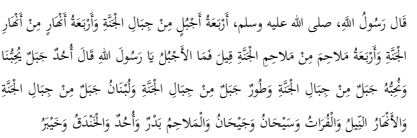
Der Gesandte Allahs ﷺ sagte: „Vier Berge gehören zu den Bergen des Paradieses, vier Flüsse gehören zu den Flüssen des Paradieses, und vier heftige große Schlachten werden zu den Schlachten des Paradieses gehören.“ Es wurde gefragt: „Welche Berge, o Gesandter Allahs?“ Er sagte: „Uhud, ein Berg, der uns liebt und den wir lieben, ist ein Berg aus den Bergen des Paradieses. Tur ist ein Berg aus den Bergen des Paradieses, und Lubnan ist ein Berg unter den Bergen des Paradieses. Und die Flüsse sind der Nil, der Euphrat, Saihan (Oxus) und Jaihan (Jaxartes), während die heftigen großen Schlachten Badr, Uhud, Khandaq und Khaibar sind.“ ﷺ
The Messenger of Allah (peace be upon him) said: “Four mountains are from the mountains of Jannah (paradise) and four rivers are from the rivers of paradise and four fierce great battles will be from the battles of paradise” It was asked: “Which mountains O Messenger of Allah?” He said: “Uhud, a mountain that loves us and we love it, is a mountain from the mountains of paradise, Tur is a mountain from the mountains of paradise and Lubnan is a mountain from among the mountains of paradise. And the rivers are the Nile, Euphrates, Saihan (Oxus) and Jaihan (Jaxartes), while the fierce great battles are Badr, Uhud, Khandaq and Khaibar”.
- Muhammad bin ‘Ali bin Mu’aim Al-Baladi überlieferte uns von Muhammad bin Abdullah bin ‘Umar, von Ma’afa bin ‘Imran, von Kathir bin Abdullah bin ‘Amr, von seinem Vater, von seinem Großvater: Dass der Prophet ﷺ sagte:
- Muhammad bin ‘Ali bin Mu’aim Al-Baladi related to us from Muhammad bin Abdullah bin ‘Umar, from Ma’afa bin ‘Imran, from Kathir bin Abdullah bin ‘Amr, from his father, from his grandfather: That the Prophet (peace be upon him) said:

„O Versammlung der Quraisch, gedenkt meiner in Bezug auf meine Gefährten, ihre Söhne und die Söhne ihrer Söhne!“
“O gathering of the Quraish, keep me in mind in respect to my companions, their sons and the sons of their sons”.
Muhammad bin Rabi' bin Sulaiman Al-Jiziy berichtete uns von Abu Umayyah At-Tarsusiy, von Mu'awiyah bin 'Amr, von Abu Ishaq Al-Fazariy, von Ibn Kathir bin Abdullah, von seinem Vater, von seinem Großvater, der sagte:
- Muhammad bin Rabi’ bin Sulaiman Al-Jiziy related to us from Abu Umayyah At-Tarsusiy, from Mu’awiyah bin ‘Amr, from Abu Ishaq Al- Fazariy, from Ibn Kathir bin Abdullah, from his father, from his grandfather, who said:

Der Gesandte Allahs ﷺ sagte: „Es gibt keine Plünderung, keine Raubzüge und keinen Diebstahl von der Beute, und wer von der Beute stiehlt, wird am Tag des Gerichts mit dem kommen, was er gestohlen hat.“
The Messenger of Allah (peace be upon him) said: “There is no plundering, no looting and no stealing from the spoils and whoever steals from the spoils will come on the Day of Judgement with that which he stole”.
- Muhammad bin Ahmad bin Al-Hussein Al-Ahwaziy überlieferte uns von ‘Amr bin ‘Ali, von Muhammad bin Khalid bin ‘Athmah, von Kathir bin Abdullah Al-Muzani, von seinem Vater, von seinem Großvater, der sagte:
- Muhammad bin Ahmad Bin Al-Hussein Al-Ahwaziy related to us from ‘Amr bin ‘Ali, from Muhammad bin Khalid bin ‘Athmah, from Kathir bin Abdullah Al-Muzani, from his father, from his grandfather, who said:

Der Gesandte Allahs ﷺ sagte: „Die letzte Stunde wird nicht kommen, bevor Allah Konstantinopel und Rom erobert, begleitet von Tasbih und Takbir.“
The Messenger of Allah (peace be upon him) said: “The final hour will not come until Allah conquers Constantinople and Rome accompanied by Tasbih and Takbir”.
- Ahmad bin Muhammad bin Abdul ‘Aziz bin Al-Ja’d überlieferte uns von Muhammad bin Ishaq Al-Masibi, von Abdullah bin Muhammad bin Salm, von Abdur Rahman bin Ibrahim, von Abdullah bin Nafi’, von Kathir bin Abdullah, von seinem Vater, von seinem Großvater, vom Propheten ﷺ:
- Ahmad bin Muhammad bin Abdul ‘Aziz bin Al-Ja’d related to us from Muhammad bin Ishaq Al-Masibi, from Abdullah bin Muhammad bin Salm, from Abdur Rahman bin Ibrahim, from Abdullah bin Nafi’, from Kathir bin Abdullah, from his father, from his grandfather, from the Prophet (peace be upon him):

„Derjenige, der Zakah gibt, hat Erfolg erlangt.“ Er sagte: Zakat ul-Fitr.
“The one who gives Zakah has attained success” He said: Zakat ul-Fitr.
- Ibn Salm berichtete uns von Abdur Rahman, von Abdullah bin Nafi', von Kathir bin Abdullah, von seinem Vater, von seinem Großvater, dass der Prophet ﷺ sagte:
- Ibn Salm related to us from Abdur Rahman, from Abdullah bin Nafi’, from Kathir bin Abdullah, from his father , from his grandfather, that the Prophet (peace be upon him) said:

„Hüte dich vor dem Ausrutscher oder Fehltritt des ‘Aalim (Gelehrten) und erwarte daher dessen Wiederkehr nicht.“ Ahmad bin Hafs überlieferte uns von Az-Zubair bin Bakkar, von Abdullah bin Nafi’, dasselbe wie oben. Ahmad bin ‘Ali Al-Mada’ini überlieferte uns von Ahmad bin Muhammad Abu Bakr Al-Hatibi, von Ishaq Al-Janbiy, der sagte: Kathir bin Abdullah Al-Muzani erwähnte es von seinem Vater, von seinem Großvater, der sagte: Der Gesandte Allahs ﷺ sagte: Dasselbe wie oben (d. h. „Hüte dich vor dem Fehltritt des ‘Aalim“).
“Take guard from the slip or lapse of the ‘Aalim (scholar) and so await its recurrence”. Ahmad bin Hafs related to us from Az-Zubair bin Bakkar, from Abdullah bin Nafi’ the same as above. Ahmad bin ‘Ali Al-Mada’ini related to us, from Ahmad bin Muhammad Abu Bakr Al-Hatibi, from Ishaq Al-Janbiy who said: Kathir bin Abdullah Al-Muzani mentioned it from his father, from his grandfather, who said: The Messenger of Allah (peace be upon him) said: The same as above (i.e. “Take guard from the lapse of the ‘Aalim”).
- Ahmad bin ‘Ali berichtete uns von Muhammad bin Khuraim Al-Qazzaz, von Hisham bin Khalid, von Marwan bin Mu’awiyah, von Kathir bin Abdullah Al-Muzani, von seinem Vater, von seinem Großvater:
- Ahmad bin ‘Ali related to us from Muhammad bin Khuraim Al- Qazzaz, from Hisham bin Khalid, from Marwan bin Mu’awiyah, from Kathir bin Abdullah Al-Muzani, from his father, from his grandfather:

Dass der Prophet (Friede sei mit ihm) zu Bilal bin Al-Harith sagte: „O Bilal, wisse!“ Er sagte: „Ich bin bereit zu wissen, o Gesandter Allahs!“ Er sagte (erneut): „O Bilal, wisse!“ Er sagte: „Ich bin bereit zu wissen, o Gesandter Allahs!“ Er sagte: „O Bilal, wisse, dass wahrlich, wer eine Sunnah von meiner Sunnah belebt, die nach mir in Vergessenheit geraten ist, für ihn eine Belohnung gleich der dessen ist, der danach handelt, ohne dass dies etwas von ihren Belohnungen mindert. Und wer eine irrige Neuerung einführt, mit der Allah nicht zufrieden ist, noch Sein Gesandter, dann wird er Sünden gleich denen dessen auf sich laden, der danach handelt, ohne dass dies etwas von den Sünden der Menschen mindert.“
“That the Prophet (peace be upon him) said to Bilal bin Al-Harith: “O Bilal, Know!”. He said: “I am ready to know O Messenger of Allah!” He said (again) “O Bilal, know!” He said: “I am ready to know O Messenger of Allah!” He said: “O Bilal, know that indeed whoever revives a Sunnah from my Sunnah which has died out after me, then for him is a reward similar to whoever acts upon it without diminishing anything from their rewards. And whoever introduces an erroneous innovation which Allah is not pleased with, nor His Messenger, then he shall receive sins similar to whoever acts upon it, without that diminishing anything from the sins of the people”.
Mit derselben Überlieferungskette von seinem Großvater, der sagte:
- With the same Isnad from his grandfather, who said:

„Ich habe vom Gesandten Allahs ﷺ 16 Grundlagen der Religion auswendig gelernt“. Er sagte: Der Gesandte Allahs ﷺ sagte:
“I memorised from the Messenger of Allah (peace be upon him) 16 foundations from the foundations of the Deen”. He said: The Messenger of Allah (peace be upon him) said:

„Für Schäden durch Tiere (d. h. wenn sie angreifen) besteht keine Haftung (Blutgeld), für Brunnen (d. h. Unfälle, die damit zusammenhängen) besteht keine Haftung, und vom vergrabenen Schatz (Rikaz) ist ein Fünftel zu entrichten.“
“There is no liability (blood money) for beasts (i.e. from being attacked), there is no liability for wells (i.e. accidents related to them) and a fifth is due from the buried treasure (Rikaz)”.

Er sagte: „Es gibt kein Jalab und kein Janab (das heißt, Tiere sollen nicht von ihrem Weideplatz zum Einsammler der Zakah gebracht werden), es gibt kein Najsh und kein Handel eines Städters."
He said: “There is no Jalab and no Janab (meaning that animals should not be moved away from their place of grazing to the collector of Zakah), there is no obstruction and there is no trade of a townsperson
„für einen Beduinen. Und es gibt keine unrechtmäßige Inbesitznahme, keine Plünderung, keine Beutenahme und keinen Diebstahl aus der Kriegsbeute; und wer aus der Beute stiehlt, wird am Tag des Gerichts mit dem erscheinen, was er gestohlen hat.“
for a Bedouin. And there is no unlawful taking of possession, no plundering, no looting and no stealing from the spoils and whoever steals from the spoils will come with that which he stole on the Day of Judgement”.

Er sagte: „Wer sich als Mawla von anderen als seinen Mawali in Anspruch nimmt, auf dem lastet der Fluch Allahs und Sein Zorn, und nichts davon wird von ihm angenommen.“
He said: “Whoever takes charge of a Mawla from other than his Mawali, then the curse of Allah and His anger will be upon him, and nothing will be accepted from him”.

Er sagte: „Wer ein Vergehen begeht (d. h. die Rechte anderer oder den Bund verletzt), auf dem wird der Fluch Allahs und Sein Zorn lasten, und es wird nichts von ihm angenommen werden.“
He said: “Whoever commits a crime (i.e. breaching the rights of others or the covenant), then the curse of Allah and His anger will be upon him, and nothing will be accepted from him”.
Mit derselben Überlieferungskette von seinem Großvater sagte er: Der Gesandte Allahs ﷺ sagte:
- With the same Isnad from his grandfather, he said: The Messenger of Allah (peace be upon him) said:

Die Muslime halten sich an ihre Bedingungen, mit Ausnahme einer Bedingung, die das Erlaubte (Halal) unerlaubt (Haram) macht, oder einer Bedingung, die das Unerlaubte (Haram) erlaubt (Halal) macht.
“The Muslims are upon their conditions apart from the condition which makes the Halal (lawful) Haram (unlawful) or a condition that makes the Haram (unlawful) Halal (lawful)”.
- Abdul Wahhab bin Abu ‘Usmah überlieferte uns von Isma’il bin Yazid Al-Asbahani, von Ma’n bin ‘Eisa, von Kathir bin Abdullah Al-Muzani, von seinem Vater, von seinem Großvater, der sagte:
- Abdul Wahhab bin Abu ‘Usmah related to us from Isma’il bin Yazid Al-Asbahani, from Ma’n bin ‘Eisa, from Kathir bin Abdullah Al- Muzani, from his father, from his grandfather who said:

Ich hörte den Gesandten Allahs ﷺ sagen: „Er stand auf, pries Allah und rühmte Ihn. Dann sprach er: O Leute, wer von denjenigen, die das Hadsch und die ʿUmra vollziehen, und von denjenigen, die auf unbewohntem Land reisen, hat mehr Anrecht auf Wasser und Schatten, also haltet die Menschen nicht vom Land fern (d. h. vom Zugang dazu)."
I heard the Messenger of Allah (peace be upon him): “He stood, praised Allah and extolled Him. He then said: O people, whoever from those undertaking Hajj and ‘Umrah and those who are travelling are upon deserted land have more right to water and shade and so do not prevent the people from the land (i.e. access)”.
Im Anschluss daran folgten in dieser gedruckten Ausgabe eine Reihe unzusammenhängender Ahadith, die überhaupt nichts mit Kathir bin Abdullah zu tun hatten. Es scheint, dass der Ursprung des Fehlers in der Handschrift selbst liegt, und andere Handschriften könnten überarbeitet und mit dieser verglichen werden, falls sie aufzufinden sind … (Nach der Erwähnung jener unzusammenhängenden Ahadith fährt Ibn Adiy fort):
Following this, there came, in this printed edition, a number of unconnected Ahadeeth which had no relationship with Kathir bin Abdullah at all. It appears that the origin of the error is the manuscript itself and other manuscripts can be revised and compared to this one if they can be found … (Following the mention of those unrelated Ahadeeth Ibn Adiy continues):
– Er (Ibn ‘Adiy) sagte: Ahmad bin Hafs As-Sa’diy überlieferte uns von Ahmad bin Ibrahim Ad-Duraqiy, von Abdullah bin Nafi’, von Kathir bin Abdullah Al-Muzani, von seinem Vater, von seinem Großvater, der sagte:
- He (Ibn ‘Adiy) said: Ahmad bin Hafs As-Sa’diy related to us from Ahmad bin Ibrahim Ad-Duraqiy, from Abdullah bin Nafi’, from Kathir bin Abdullah Al-Muzani, from his father, from his grandfather, who said:

Der Gesandte Allahs ﷺ sagte: „Lasst jene Abessinier in Ruhe, solange sie euch in Ruhe lassen.“
The Messenger of Allah (peace be upon him) said: “Leave be those Abyssinians as long as they leave you be”.
Muhammad bin Al-Hasan Al-Basriy überlieferte von Muhammad bin Bakkar Al-‘Aishi, von Muhammad bin Isma’il bin Abu Fadaik, von Kathir bin Abdullah Al-Muzani, von seinem Vater, von seinem Großvater, der sagte:
- Muhammad bin Al-Hasan Al-Basriy related from Muhammad bin Bakkar Al-‘Aishi, from Muhammad bin Isma’il bin Abu Fadaik, from Kathir bin Abdullah Al-Muzani, from his father, from his grandfather, who said:

Der Prophet ﷺ hörte einen Mann es als „grün“ (üppig) bezeichnen, und so sprach er: „Wir stehen dir zu Diensten. Wir haben genommen, und du hast von dem, was unter euch ist.“
“The Prophet (peace be upon him) heard a man calling it green (luscious) and so he said: We are at your service. We have taken and you have from what is among you” .
Muhammad bin Al-Hasan Al-Basriy überlieferte von Al-‘Abbas bin Abdul ‘Azhim, von Abdullah bin Ja’far bin Abu Kathir Al-Ansari, von Kathir bin Abdullah bin ‘Amr bin ‘Awf Al-Muzani, von seinem Vater, von seinem Großvater, von Bilal bin Al-Harith Al-Muzani:
- Muhammad bin Al-Hasan Al-Basriy related from Al-‘Abbas bin Abdul ‘Azhim, from Abdullah bin Ja’far bin Abu Kathir Al-Ansari, from Kathir bin Abdullah bin ‘Amr bin ‘Awf Al-Muzani, from his father, from his grandfather, from Bilal bin Al-Harith Al-Muzani:

Dass der Prophet ﷺ, wenn er seine Notdurft verrichten wollte, sich in einen weiten Abstand entfernte.
“That when the Prophet (peace be upon him) wanted to relive himself, he would move away at a distance”.
– Abdullah bin Abdul Hamid Al-Wasitiy überlieferte von An-Nadr bin Salamah, von Abu ‘Uziyyah Muhammad bin Musa Al-Ansari, dem Richter (Qadi) von Al-Madinah, von Kathir bin Abdullah, von dessen Vater, von dessen Großvater ‘Amr bin ‘Awf, der sagte:
- Abdullah bin Abdul Hamid Al-Wasitiy related from An-Nadr bin Salamah, from Abu ‘Uziyyah Muhammad bin Musa Al-Ansari, the Qadi (Judge) of Al-Madinah, from Kathir bin Abdullah, from his father, from his grandfather ‘Amr bin ‘Awf, who said:

„Ich sah den Gesandten Allahs ﷺ auf dem Maqam stehen, und er sagte: O Menschen, diese Qiblah, sie ist die Qiblah der Moschee, und die Moschee ist die Qiblah der Dunyaa (Welt).“
“I saw the Messenger of Allah (peace be upon him) standing upon the Maqam and he was saying: O people, this Qiblah, it is the Qiblah of the Masjid and the Masjid is the Qiblah of the Dunyaa (world)”.
- Muhammad bin Yusuf bin ‘Asim Al-Bukhari überlieferte uns von Ahmad bin Isma’il Al-Qurashi, von Abdullah bin Nafi’, von Kathir bin Abdullah, von seinem Vater, von seinem Großvater:
- Muhammad bin Yusuf bin ‘Asim Al-Bukhari related to us from Ahmad bin Isma’il Al-Qurashi, from Abdullah bin Nafi’, from Kathir bin Abdullah, from his father, from his grandfather:

„Dass der Gesandte Allahs ﷺ in der Moschee war. Er hörte hinter sich eine Stimme, und derjenige, der sprach, sagte: „O Allah, hilf mir mit dem, was mich vor dem bewahrt, wovor du mich ängstlich gemacht hast.“ Da sagte der Gesandte Allahs ﷺ, als er das hörte: „Willst du nicht auch seine Schwester dazu nennen?“ Der Mann sagte dann: „O Allah, gewähre mir die Sehnsucht der Aufrichtigen nach dem, was du ihnen begehrenswert gemacht hast.“ Der Gesandte Allahs ﷺ sagte dann zu Anas bin Malik, der bei ihm war: „Geh zu ihm, o Anas, und sag ihm, dass der Gesandte Allahs ﷺ zu dir sagt: ‚Bitte Allah um Vergebung für mich.‘“ Anas ging zu ihm und richtete ihm dies aus. Der Mann sagte: „O Anas, du bist der Bote des Gesandten Allahs ﷺ zu mir?“ Er antwortete: „So wie du es bist.“ Der Mann kehrte zurück, um es zu überprüfen. Da sagte der Gesandte Allahs ﷺ: „Sag ihm: Ja.“ Also sagte er (der Mann) zu ihm: „Geh und sag ihm, dass Allah dich vor den Propheten ausgezeichnet hat, so wie Er den Monat Ramadan vor den anderen Monaten ausgezeichnet hat, und dass Er deine Umma (Gemeinschaft) vor den Völkern ausgezeichnet hat, so wie Er den Tag des Freitagsgebets vor allen anderen Tagen ausgezeichnet hat.“ Sie gingen suchen, und siehe, es war Khadir, Friede sei auf ihm.“
“That the Messenger of Allah (peace be upon him) was in the Masjid. He heard speech behind him and the one saying it was saying: “O Allah assist me with which will save me from that which you have made me fearful of”. So, the Messenger of Allah (peace be upon him) said when he heard that: “Will you not include its sister alongside it?” The man then said: “O Allah bestow upon me the longing of the truthful to that which you have made desirable for them”. The Messenger of Allah (peace be upon him) then said to Anas bin Malik who was in his company: “Go to him O Anas and say to him that the Messenger of Allah (peace be upon him) says to you: “Seek forgiveness for me”. So, Anas went to him and conveyed that to him. The man then said: “O Anas, you are the messenger of the Messenger of Allah (peace be upon him), to me. He replied: “Just as you are”. He returned to verify it. The Messenger of Allah (peace be upon him) then said: “Say to him yes”. So, he (the man) said to him: “Go and say to him that Allah has favoured you over the Prophets like He has favoured the month of Ramadan over other months and that He has favoured your Ummah (nation) over the nations like He has favoured the day of Jumu’ah over all of the other days”. They went looking and behold it was Khadir, peace be upon him”.
– Ahmad bin Ja’far berichtete uns von Ya’qub bin Ibrahim Ad-Duraqi, von Ibrahim bin Abdullah Ar-Rafa’iy, von Kathir bin Abdullah, von seinem Vater, von seinem Großvater:
- Ahmad bin Ja’far related to us from Ya’qub bin Ibrahim Ad-Duraqi, from Ibrahim bin Abdullah Ar-Rafa’iy, from Kathir bin Abdullah, from his father, from his grandfather:

„Dass der Gesandte Allahs ﷺ über dem Negus (Najashi) von Abessinien das Totengebet verrichtete und fünf Takbir sprach“.
“That the Messenger of Allah (peace be upon him) prayed over the Najashi (Negus of Abyssinia) and did five Takbirs”.
„Imran bin Musa berichtete uns von Ibrahim bin Al-Mundhir, von Abu Al-Ja'd Abdur Rahman bin Abdullah As-Salmiy, von Kathir bin Abdullah Al-Muzani, von seinem Vater, von seinem Großvater, der sagte:
- ‘Imran bin Musa related to us from Ibrahim bin Al-Mundhir, from Abu Al-Ja’d Abdur Rahman bin Abdullah As-Salmiy, from Kathir bin Abdullah Al-Muzani, from his father, from his grandfather, who said:

Der Gesandte Allahs ﷺ sagte: „Das Pferd wird am Tag seiner Tränkung dargeboten.“
“The Messenger of Allah (peace be upon him) said: “the horse is offered the day of its watering”.
Es verbleiben noch einige wenige Überlieferungen, die Kathir bin Abdullah von seinem Vater, von seinem Großvater überliefert hat, und das meiste von dem, was ich erwähnt habe und das er überliefert hat, hat nichts, was sie bestätigt oder stützt (d. h. er ist alleine in ihrer Überlieferung). - Bahlul bin Ishaq hat uns überliefert von Isma'il bin Abu Uwais, von Kathir bin Abdullah Al-Muzani, von Rubaih bin Abdur Rahman bin Abu Sa'id Al-Kudri, von seinem Vater, von seinem Großvater, der sagte:
There are still a small number of Ahadeeth related by Kathir bin Abdullah from his father, from his grandfather remaining and most of his Ahadeeth which I mentioned and most of what he related, does not have that which conforms (or supports) them (i.e. he is alone in narrating them). - Bahlul bin Ishaq related to us from Isma’il bin Abu Uwais, from Kathir bin Abdullah Al-Muzani, from Rubaih bin Abdur Rahman bin Abu Sa’id Al-Kudri, from his father, from his grandfather, who said:

„Ich sah Männer von den Arabern (d. h. Beduinen), die auf den Gesandten Allahs ﷺ zukamen. Sie sagten: „O Gesandter Allahs, wir sind Leute, die Vieh besitzen, und wir entrichten davon unser Sadaqah (d. h. Zakat). Deckt das auch für uns die Zakat des Ramadan?“ Der Gesandte Allahs ﷺ sagte: „Nein, sie wird vom Kind und vom Erwachsenen entrichtet, vom Freien und vom Sklaven. Sie ist eine Reinigung für euch.“ Abu Sa’id Al-Khudri sagte: Ich sah in dem Jahr, in dem die Herden zahlreich waren und die weißen Feldfrüchte weniger wurden als die schwarzen, und dann sah ich im folgenden Jahr, dass die Feldfrüchte zahlreich waren und die schwarzen Herden weniger wurden als die weißen.“ Ich kenne niemanden, der diesen Hadith von Rubaih überliefert, außer Kathir bin Abdullah. [Ende des Zitats von Ibn ʿAdiy]
“I saw men from the Arabs (i.e. Bedouins) approaching the Messenger of Allah (peace be upon him). They said: “O Messenger of Allah, we are people possessing livestock and we take out from them our Sadaqah (i.e. Zakat) and so does that also cover for us the Zakat of Ramadan?” The Messenger of Allah (peace be upon him) said: “No, it is taken from the child and the adult, from the free and the slave. It is a purification for you”. Abu Sa’id Al-Khudri said: I saw in the year that the herds were plentiful and that the white crops diminished more than the black. I then saw in the year following that the crops were plentiful and that the black herds were diminished more than the white”. I do not know anyone relating this Hadith from Rubaih apart from Kathir bin Abdullah] [End of quote of Ibn ‘Adiy].
Was die Aussage des Ibn ‘Adiy betrifft: „Es gibt noch eine kleine Anzahl von Ahadeeth, die Kathir bin Abdullah von seinem Vater, von seinem Großvater überliefert hat, übrig, und das meiste von seinen Ahadeeth, die ich erwähnt habe, und das meiste von dem, was er überliefert hat, hat nichts, was sie bestätigt oder stützt (d. h. er ist allein in der Überlieferung derselben)“, so bedeutet dies nicht die Erklärung der Unzuverlässigkeit oder die Einstufung als schwach. Denn das bloße Alleinstehen in der Überlieferung von Ahadeeth – „das meiste von dem, was er überliefert hat, hat nichts, was es bestätigt oder stützt“ – begründet, besonders bei jemandem aus der berüchtigten Nachkommenschaft der Sahabah (wie etwa im Fall von Bahz bin Hakim), keine Schwäche und keine Unzuverlässigkeit. Es scheint, als habe Ibn ‘Adiy es vorgezogen, sich abzusichern, und sich davor bewahrt, ein Urteil über den Mann zu fällen. Denn wenn er die Unzuverlässigkeit oder Mangelhaftigkeit eines Mannes zum Ausdruck bringen will, sagt er gewöhnlich: „Und die Schwäche ist in seinem Hadith offensichtlich“ oder Worte, die dem ähnlich sind. Wenn er hingegen die Verlässlichkeit und Glaubwürdigkeit eines Überlieferers feststellen will, sagt er: „Ich habe nichts Munkar (Verwerfliches) in Bezug auf ihn gefunden“ oder „Ich habe nichts Munkar von ihm gefunden, wenn ein Thiqah (verlässlicher und vertrauenswürdiger Überlieferer) von ihm überliefert hat“. Offensichtlich ist, dass von al-Bukhari nichts zu ihm gelangte außer dem, was sein Scheich Isma’il bin Abu Uwais ihm überlieferte: „Ich habe von Kathir bin Abdullah bin ‘Amr bin ‘Awf bin Yazid bin Milhah al-Muzani gehört (bzw. von ihm empfangen) im Jahr 158, dann im Jahr 161 oder 162.“


„Dass der Gesandte Allahs ﷺ in der Moschee war. Er hörte hinter sich eine Stimme, und derjenige, der sprach, sagte: „O Allah, hilf mir mit dem, was mich vor dem bewahrt, wovor du mich ängstlich gemacht hast.“ Da sagte der Gesandte Allahs ﷺ, als er das hörte: „Willst du nicht auch seine Schwester dazu nennen?“ Der Mann sagte dann: „O Allah, gewähre mir die Sehnsucht der Aufrichtigen nach dem, was du ihnen begehrenswert gemacht hast.“ Der Gesandte Allahs ﷺ sagte dann zu Anas bin Malik, der bei ihm war: „Geh zu ihm, o Anas, und sag ihm, dass der Gesandte Allahs ﷺ zu dir sagt: ‚Bitte Allah um Vergebung für mich.‘“ Anas ging zu ihm und richtete ihm dies aus. Der Mann sagte: „O Anas, du bist der Bote des Gesandten Allahs ﷺ zu mir?“ Er antwortete: „So wie du es bist.“ Der Mann kehrte zurück, um es zu überprüfen. Da sagte der Gesandte Allahs ﷺ: „Sag ihm: Ja.“ Also sagte er (der Mann) zu ihm: „Geh und sag ihm, dass Allah dich vor den Propheten ausgezeichnet hat, so wie Er den Monat Ramadan vor den anderen Monaten ausgezeichnet hat, und dass Er deine Umma (Gemeinschaft) vor den Völkern ausgezeichnet hat, so wie Er den Tag des Freitagsgebets vor allen anderen Tagen ausgezeichnet hat.“ Sie gingen suchen, und siehe, es war Khadir, Friede sei auf ihm.“
“That the Messenger of Allah (peace be upon him) was in the Masjid. He heard speech behind him and the one saying it was saying: “O Allah assist me with which will save me from that which you have made me fearful of”. So, the Messenger of Allah (peace be upon him) said when he heard that: “Will you not include its sister alongside it?” The man then said: “O Allah bestow upon me the longing of the truthful to that which you have made desirable for them”. The Messenger of Allah (peace be upon him) then said to Anas bin Malik who was in his company: “Go to him O Anas and say to him that the Messenger of Allah (peace be upon him) says to you: “Seek forgiveness for me”. So, Anas went to him and conveyed that to him. The man then said: “O Anas, you are the messenger of the Messenger of Allah (peace be upon him), to me. He replied: “Just as you are”. He returned to verify it. The Messenger of Allah (peace be upon him) then said: “Say to him yes”. So, he (the man) said to him: “Go and say to him that Allah has favoured you over the Prophets like He has favoured the month of Ramadan over other months and that He has favoured your Ummah (nation) over the nations like He has favoured the day of Jumu’ah over all of the other days”. They went looking and behold it was Khadir, peace be upon him”.
Wir haben diese Überlieferung an allen nur denkbaren Orten gesucht, konnten sie aber nur auf diesem Weg von Imam Ibn ʿAdiy finden. Die Überlieferung wird ihm auch im Buch „Unais As-Saari Fee Takhrij Ahadeeth Fat’h ul-Baari“ (9/6578/4610) zugeschrieben.
We searched for this narration in every conceivable place but we were unable to find it except from this path of Imam Ibn ‘Adiy. The narration is also attributed to him in the book “Unais As-Saari Fee Takhrij Ahadeeth Fat’h ul-Baari” (9/6578/4610):

[‘Amr bin ‘Awf überliefert: „Dass der Prophet ﷺ Rede hörte, während er sich in der Moschee befand, und dann sagte: ‚O Anas, geh zu dem, der dies gesagt hat, und bitte ihn, um Vergebung für mich zu bitten.‘ Anas ging zu dem Mann, und dieser sagte zu ihm: ‚Sag ihm, dass Allah ihn vor den Propheten bevorzugt hat, durch das, womit Er Ramadan vor den übrigen Monaten bevorzugt hat.‘ Er sagte: Sie gingen dann, um nachzusehen, und siehe, es war Khadir.“ Al-Hafizh (Ibn Hajar) sagte: „Es ist ein schwacher Hadith, den Ibn ‘Adiy über den Weg von Kathir bin ‘Amr bin ‘Awf, von seinem Vater, von seinem Großvater überliefert hat, und es ist eine schwache Isnad (Überlieferungskette).“ Ibn ‘Asakir überlieferte Ähnliches davon aus dem Hadith des Anas, mit einer Überlieferungskette, die schwächer ist als diese.“ (7/245 – Das Buch der Ahadith der Propheten – Kapitel: Der Hadith von Al-Khadir mit Musa, Friede sei mit ihm) Er ist sehr schwach. Er überlieferte aus dem Hadith des ‘Amr bin ‘Awf und dem Hadith des Anas. Was den Hadith des ‘Amr bin ‘Awf betrifft, so hat Ibn ‘Adiy ihn (6/2083) über den Weg von Abdullah bin Nafi’ As-Sa’igh von Kathir bin Abdullah, von seinem Vater, von seinem Großvater überliefert: „Dass der Gesandte Allahs ﷺ sich in der Moschee befand und dann Rede hörte … usw. …“]
[‘Amr bin ‘Awf related: “That the Prophet (peace be upon him) heard speech whilst he was in the Masjid and then said: “O Anas, go to the one who said that and ask him to seek forgiveness for me”. Anas went to the man and he (the man) said to him: “Say (to him i.e. the Prophet) that verily Allah has favoured you over the Prophets by that which he has favoured Ramadan over the remaining months”. He said: They then went to see and behold it was Khadir”. Al-Hafizh (Ibn Hajar) said: “It is a weak Hadith which Ibn ‘Adiy extracted via the path of Kathir bin ‘Amr bin ‘Awf, from his father, from his grandfather, and it is a weak Isnad (chain of transmission)”. Ibn ‘Asakir related similar to it from the Hadith of Anas, with a chain of transmission which is weaker than it” (7/245 – The book of the Ahadeeth of the Prophets – Chapter: The Hadith of Al-Khadir with Musa, peace be upon him). It is very weak. He related from the Hadith of ‘Amr bin ‘Awf and the Hadith of Anas. As for the Hsdith of ‘Amr bin ‘Awf, then Ibn ‘Adiy extracted it (6/2083) via the path of Abdullah bin Nafi’ As-Sa’igh from Kathir bin Abdullah, from his father, from his grandfather: “That the Messenger of Allah (peace be upon him) was in the Masjid and then he heard speech … etc …].
Wie zu sehen ist, führte Al-Hafizh (Ibn Hajar) die Überlieferung auf Kathir bin Abdullah zurück, während Abu Hudhaifah Nabil bin Mansur bin Ya'qub bin Sultan Al-Bisarah Al-Kuwitiy, der Verfasser von „Unais As-Saari“, sie auf Abdullah bin Nafi' As-Sa'igh von Kathir bin Abdullah zurückführte. Doch beide machen sich in dieser Hinsicht eines schweren Versäumnisses schuldig.
As can be seen, Al-Hafizh (Ibn Hajar) attributed the narration to Kathir bin Abdullah whilst Abu Hudhaifah Nabil bin Mansur bin Ya’qub bin Sultan Al-Bisarah Al-Kuwitiy, the author of “Unais As- Saari”, attributed it to Abdullah bin Nafi’ As-Sa’igh from Kathir bin Abdullah. However, both of them are guilty of an obscene shortcoming in respect to this.

Dass der Gesandte Allahs ﷺ sagte: „Wahrlich, die Religion wird sich in das Hidschaz zurückziehen, so wie sich eine Schlange in ihr Loch zurückzieht, und die Religion wird im Hidschaz Zuflucht suchen, so wie die Bergziege auf dem Gipfel des Berges Zuflucht sucht. Die Religion begann als etwas Fremdes und wird als etwas Fremdes zurückkehren. Gesegnet sind die Fremden, jene, die das wiederherstellen werden, was die Menschen nach mir an meiner Sunna verdorben haben.“
That the Messenger of Allah (peace be upon him) said: “Verily, the Deen will retreat back to the Hijaz as a snake retreats back to its hole, and the Deen will seek refuge in the Hijaz as the mountain goat seeks refuge in the mountain top. The Deen began as something strange and will return as something strange. Blessed are the strangers; those who will rectify what the people after me have corrupted from my Sunnah”.
Einige haben über Kathir gesprochen. Hätten sie über ihn geschwiegen, wäre es nützlicher gewesen. Tatsächlich haben nur die Unwissenden über ihn und seine Beweggründe (oder Beziehungen) gesprochen. Ich hörte Ibn Uwais sagen: Malik fragte mich nach seinem Hadith, und Yahya bin Sa'id Al-Ansari überlieferte von ihm. Ich zweifle nicht daran, dass ich von Ibrahim bin Al-Mundhir gehört habe (und falls ich es nicht von ihm gehört habe, so hat ein Thiqah es mir überliefert), dass er sagte: „Kathir pflegte zu behaupten, dass der Prophet ﷺ seinem Großvater Land gewährt habe, und er stritt sich deswegen mit den Leuten in jener Gegend. Er zankte sich sehr häufig. Er ging zu Ibn 'Imran, um zu streiten, und 'Imran sagte zu ihm: „O Kathir, du bist tatsächlich ein müßiger Mensch, der sich viel streitet über das, was du nicht kennst. Du beanspruchst, was dir nicht gehört, und du hast keinen Beweis für das, was du forderst. Komm also nicht zu mir, und ich werde dich nicht sehen lassen, es sei denn, du siehst, dass ich meine Zeit für die Leute der Falschheit freigemacht habe. Wenn du das siehst, dann komm." Eines Tages war Ibn 'Imran bei uns, und siehe da, Kathir bin Abdullah näherte sich ihm. Er (Ibn 'Imran) sagte: „Habe ich dir nicht gesagt, du sollst nicht zu mir kommen, es sei denn, du siehst, dass ich meine Zeit für die Leute der Falschheit freigemacht habe?" Kathir antwortete darauf: „Du hast die Wahrheit gesagt, möge Allah die Angelegenheit des Richters zum Guten wenden. Ich kam nur zu dir, als die Leute der Falschheit zu dir kamen. Der und der kamen zu dir. Sie beide sind Leute der Falschheit, und so kam ich zusammen mit ihnen beiden." Es war eine Anweisung Ibn 'Imrans an ihn. Abu Yusuf sagte: „Er befahl, sich fest an die Säule zu halten, bis er von den gerichtlichen Verhandlungen aufgestanden sei." Abu Yusuf sagte: „Sie gehörten zu denen, die Ibn 'Imran ergeben waren." Dies wurde auch in der Abschrift von „Ash-Shamela Lil-Ma'rifah Wa At-Tarikh" überliefert (S. 62 – nach der Nummerierung der Shamela E-Bibliothek).
Some have spoken about Kathir who had they been silent about him it would have been more beneficial. Indeed, only the ignorant have spoken about him and his motives (or relations). I heard Ibn Uwais saying: Malik asked me about his Hadith and Yahya bin Sa’id Al-Ansari related from him. I have no doubt that I heard Ibrahim bin Al- Mundhir (And if I didn’t hear it from him, then a Thiqah related it to me) that he said: “Kathir used to claim that the Prophet (peace be upon him) had granted his grandfather land and he used to dispute with those in that area. He used to quarrel a lot. He went to Ibn ‘Imran to quarrel and so ‘Imran said to him: “O Kathir, indeed you are an idle man who quarrels a lot in respect to that which you don’t know, you claim that which does not belong to you and you have no evidence from what you demand. So, don’t approach me and I will not let me see you unless you see that I have freed my time for the people of falsehood. If you see that, then come”. One day Ibn ‘Imran was with us and then behold Kathir bin Abdullah had approached him. He (Ibn ‘Imran) said: “Did I not tell you to not come to me unless you see me having freed my time for the people of falsehood?” Kathir then replied: ““You have said the truth, may Allah make good the affair of the Qadi. Indeed, I only came to you when the people of falsehood came to you. So and so and so and so person came to you. They are both people of falsehood and so I came along with them both”. It was from the command of Ibn ‘Imran to him. Abu Yusuf said: “He commanded to remain fast to the column until he had stood from judicial proceedings”. Abu Yusuf said: “They were from those devoted to Ibn ‘Imran]. This has also been recorded in the transcript of “Ash-Shamela Lil- Ma’rifah Wa At-Tarikh” (p. 62 – by the numbering of the Shamela E- library).