6.3 学期の用語
6.3 School terms
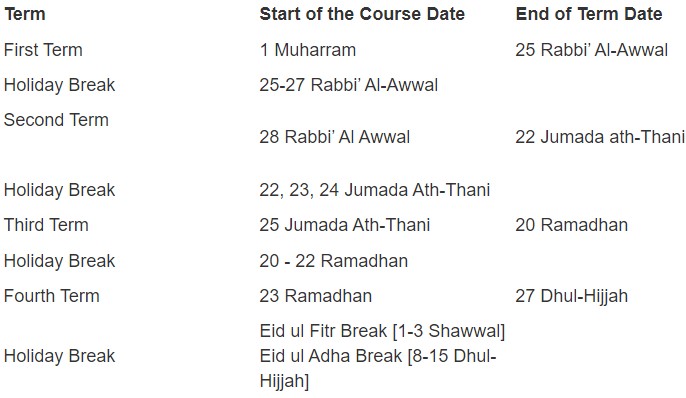
学校の課程は、それぞれ83日間の36の連続した学期から構成される。各学期には一群の教科単位が割り当てられる。生徒は第1学期から課程を始める。ある課程に合格すると次の課程へ進級し、36のすべての学期を無事に修了して学校の課程を終えるまで続ける。ヒジュラ暦の一年は、同じ長さの4つの学期に周期的に区分され、各学期の間には生徒の休暇期間として3日間の休みが入る。次の表は、各学期の開始日と終了日、および課程を区切る休暇期間を示している。
School stages are composed of thirty-six (36) consecutive terms, each being eighty-three (83) days. Each term is assigned a group of teaching units. The student commences school stages with the first term. He is promoted upon succeeding in a course to the next one until he completes the school stages by successfully completing all thirty-six terms. The Hijri year is divided into four periodically equal terms, with a student holiday break interval of three (3) days between each term. The following chart demonstrates the commencement and completion dates of each term, and the break intervals separating the courses:
チャート:年間の学校の課程と休暇
CHART: ANNUAL SCHOOL Courses and HOLIDAYS
子どもは、ヒジュラ暦で六歳を満たすとすぐに学校に入学します。それに従い、公立学校は一年の四学期それぞれの学期の初めに、つまりおよそ三か月ごとに新入生を受け入れます。子どもは、ヒジュラ暦で六歳に達するのに最も近い、一年にある四学期のうち最初の学期に入学することができます。
The child enters school immediately upon completing six years of age according to the Hijri calendar. Accordingly, State schools will accept new students at the beginning of each school term of the four terms of each year i.e. approximately every three months. The child is able to enter the first school term (of the four available in the year) nearest to his attaining six years of age according to the Hijri calendar.
生徒は、少なくとも連続する三学期ごとに、一学期だけ休むことができますが、そのような休みを取らずに勉強を続けることもできます。こうして、この制度は、真剣に学ぶ生徒が休暇を取らず、あるいは休暇を減らし、学期内で順調に勉強を続けることによって、同年代の生徒よりも短い期間で学校の段階を修了することを可能にします。学習の時間単位は年ではなく学期であり、学期は83日で構成されます。各学期にはそれぞれ独自の科目のカリキュラムと生徒がいます。
The student can rest one school term only after every three consecutive terms at the least, but he can also continue his study without any such rest. Thus the system enables the serious student to complete the school stages in a shorter time than his contemporaries by continuing his studies within the school terms successfully without taking the rest periods or reducing them. The study time unit is the school term which is composed of 83 days and not the annual year; each term has its own subject curriculum and students.
休学をせず、順調に学期を続けた学生は、36学期を9年(36÷4=9年)で修了できます。そのため、15歳になった時点で学校課程を修了することになります。また、1年に平均3学期のみ、すなわち通常は3学期続けて履修するごとに1学期休み、かつすべての学期を順調に修了した場合には、36学期の学校課程を12年(36÷3=12年)で修了することになります。その場合、18歳になった時点で学校課程を修了することになります。
The student who continues his school terms successfully without taking any leave can complete thirty-six terms in nine years (36/4=9 years) whereupon he would have completed the school stages upon completing 15 years of age. If he studies the thirty-six terms at an average of only three school terms every year i.e. by usually resting one school term after every three consecutive terms, together with successfully completing all terms, he would complete the school stages in twelve years (36/3=12 years) whereupon he would complete the school stages upon attaining 18 years of age.
一部の生徒は、18歳に達した後、三つの学校段階を修了するのに一年か二年を要する場合があります。20歳に達しても学校段階の公開試験に合格できなかった場合、通常の課程での学習は免除され、職業訓練機関に進むか、公開試験を再度受験して合格すれば大学教育に進むかを選択することができます。
Some students may need a year or two after attaining 18 years to complete the three school stages. If they attain 20 years without passing the school stages’ public examinations, they are excused from regular study and choose between joining vocational institutes or retaking the public examinations again so as to join university education if successful.
この学期制度は、生徒一人ひとりの個人差を考慮するだけでなく、時間の大切さと学業の成果にも大きな配慮を払っています。
This system of school terms, apart from taking into account individual differences between students, also takes great care over the importance of time and their academic achievement.
本書の末尾に添付された図表は、36の学期が生徒の年齢層にどのように配分されているかを示しています。また、各学校段階を修了した時点での生徒の最低年齢と平均年齢も示しています。
The chart attached at the end of this book demonstrates the distribution of the 36 school terms among student age groups. It also demonstrates the lowest as well as the average age of students upon graduation and completion of school stages.
「総合学校」の施設が、この学期制を実施するために小さな村々の間に設けられ、生徒たちが家から学校へ、また学校から家へ通うための交通手段も確保される。
A “Comprehensive school” complex is established between small villages to implement this term system, and transportation of students from their homes to and from school will be secured.