6.7 学習の科目と段階
6.7 Study subjects and stages
前述のとおり、学校教育は36の学期に分けられ、生徒の年齢に応じて3つの段階に配分されています。各段階は、それぞれに関連するシャリーアの規則によって規律されています。履修科目に関しては、各段階に特定の科目があり、それに加えて落第や進級(ある課程から次の課程への移行)に関する特定の規則があります。各段階の履修科目は、基礎科目と技能・活動科目の2つに分けられます。
As we have said before, the school education is divided into 36 school terms distributed between 3 stages according to student ages such that each stage is regulated by the relevant Shari’ah rules. With respect to study subjects, each stage has specific subjects together with specific rules related to failure and progress (transferring from one course to the next). Study subjects in each stage are divided into two: Basic subjects and Skills and Activities Subjects.

第一段階(初等段階)では、二人の教師が第一学期から生徒の指導を始めます。一人目はイスラム文化とアラビア語を教え、二人目は理科と数学を教えます。両者は技能および活動の指導を分担します。教師は、この段階において少なくとも連続する三学期の間、生徒とともに残るべきです。
In the 1st school stage, two teachers begin teaching students from the first term. The first teaches them Islamic culture and Arabic language, the second teaches them sciences and mathematics. Both share in teaching skills and activities. The teacher should remain with his students in this stage for at least three consecutive school terms.
スキル科目では、教師は子どもの結びつける力と思考力を伸ばすために、物を組み立てたり分解したりするような活動を与えます。これらの活動やスキルを、その学期に採用されている基本科目と関連づけることに注意を払う必要があります。
In the skills subject, the teacher gives the child activities to develop his ability to link and think e.g. building and dismantling of things. Care must be taken to relate these activities and skills to the term’s basic adopted subjects.
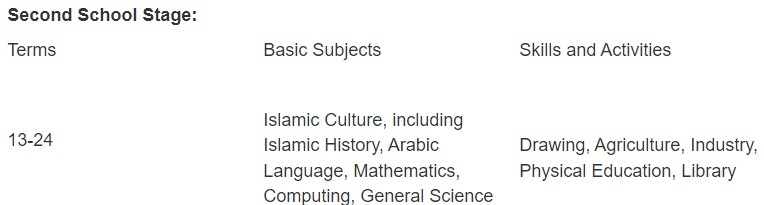
この段階の「一般科学」の科目には、化学、生物学、物理学、地理学の基礎が含まれています。
The “General Sciences” subject in this stage includes principles of chemistry, biology, physics and geography.
第三学習段階:
Third School Stage:
この段階では、第25期から第36期までを対象とします。第25期から第30期までは、すべての学生が同じ学習科目に参加します。その後、第31期から第36期までは、学生が希望する選択科目(フルー)のコースに参加します。選択肢は次のとおりです。
This stage covers the terms 25 to 36. In this stage, all students participate in the same study subjects in terms 25 to 30 only. Thereafter, in terms 31 to 36 students join the optional branches (furoo’) they prefer. These options are:
- 文化的な選択肢 - 科学的な選択肢 - 産業または技術的な選択肢(コンピューティング、力学、電気、通信、地図製作など)
- Cultural Option - Scientific Option - Industrial or Technical Option (computing, mechanics, electrical, communications, cartography etc.)
- 農業コース - 商業コース - 家政コース(女子向け)
- Agricultural Option - Commerce Option - Domestic Option (for females)
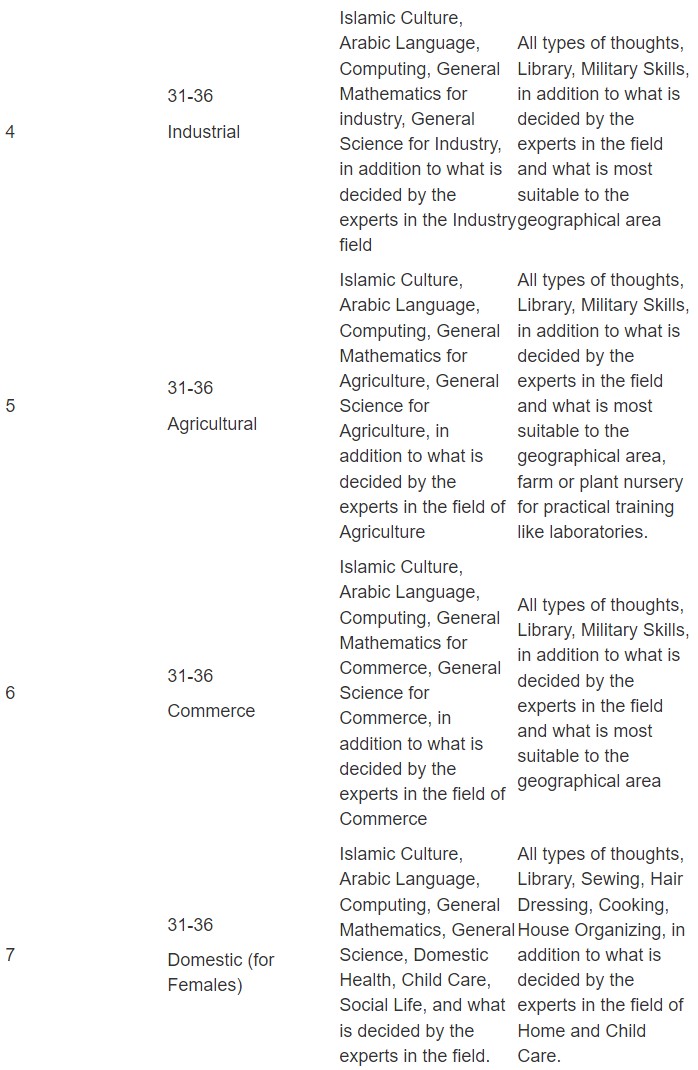
以下の図表は、これらの各選択肢で学ぶ科目を示しています。
The following chart shows the subjects studied in each of these options:
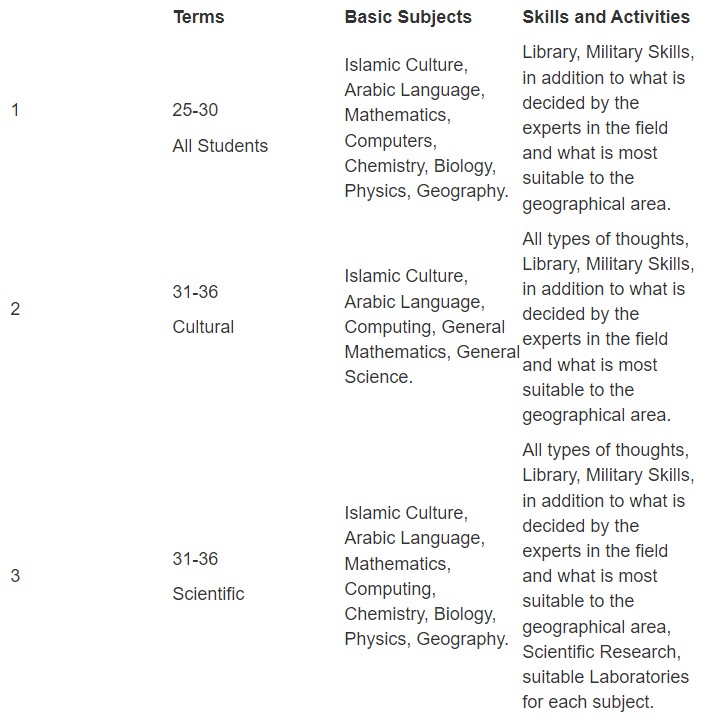
第三学年の文化コースでは、学生はイスラーム文化とアラビア語の両方について発展的な科目を履修します。専門家がフィクフ、ウスール、タフスィール、ウルーム・アル=ハディース、歴史、その他のイスラーム文化の選択科目について必要な要件を定めます。同様に、この段階で必要とされるアラビア語の選択科目、例えば修辞学(バラーガ)、文学作品などについても、特定の課程(マナーヒジュ)を採用します。
In the cultural option of the third school stage, the student takes extended topics in both Islamic Culture and Arabic Language. Experts determine the requirements in the subjects of Fiqh, Usul, Tafseer, '‘Ulum Al-Hadith, History and other Islamic culture options. Likewise, they adopt specific courses (manaahij) in the Arabic language options required for this stage such as Eloquence (Balagha), Literature texts etc.
非科学系の選択課目では、学生は数学と理科を簡潔な形で履修し、その選択に必要な分野だけに重点を置きます。たとえば商業系の選択を行う学生は、会計、ザカート(喜捨)と相続の会計、損益計算書などの商業に関連する数学の分野を、簿記や現金出納帳の会計とあわせて履修します。同様に統計の分野も履修します。一方、工業系の選択を行う学生は、製図、図形、面積と体積の計算など、工業に特有の分野を履修します。
In non-scientific options, the student takes Mathematics and Sciences in a concise form with focus paid only to the topics required for their option. Thus the Commerce option student takes Mathematics topics related to Commerce e.g. Accounting, Zakat and Inheritance Accounts, Profits and Loss Accounts together with Bookkeeping and Cashbook Accounts; likewise he/she takes topics in Statistics. Whereas the Industrial option student takes topics specific to Industry such as Geometrical Drawing, Shapes, Area and Volume Calculation etc.
非科学系の選択肢を取る一般科学の生徒は、人体、病気、公共の安全に関する研究、ならびに人間とその環境に関連する科学的なテーマを学びます。農業系の選択肢では、植物栽培の方法、その病気と治療法、土壌の種類、肥料、殺虫剤など, 農業と栄養に関連するテーマが加わります。
The General Sciences student of the non-scientific option takes topics focusing upon studies of the Human Body, Diseases, Public Safety as well as scientific topics related to man and his environment. In the agricultural option, topics related to agriculture and nutrition are added such as methods of Plant Agriculture, their diseases and treatment, types of soil, fertilisers, insecticides etc.
工業専攻の学生は、密度や質量といった材料の性質と材料科学に関する科目を、機械力学および公共安全の原理とともに履修します。
The Industrial option student takes subjects related to the science of materials and their attributes such as Density and Mass, together with the principles of Mechanical Dynamics and Public Safety.
専門家は、各学校段階および第三学校段階の各選択肢において、生徒に必要とされるものを採用する。
Experts adopt what the student requires in each school stage and each option of the third school stage.