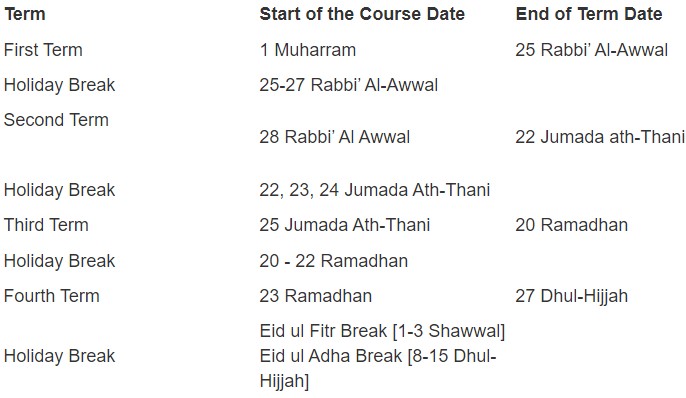
Kanak-kanak memasuki sekolah sebaik sahaja genap berumur enam tahun mengikut kalendar Hijrah. Oleh itu, sekolah-sekolah kerajaan akan menerima pelajar baharu pada permulaan setiap penggal persekolahan daripada empat penggal dalam setiap tahun, iaitu kira-kira setiap tiga bulan. Kanak-kanak boleh memasuki penggal persekolahan pertama (daripada empat penggal yang ada dalam tahun itu) yang paling hampir dengan tarikh dia genap berumur enam tahun mengikut kalendar Hijrah.
The child enters school immediately upon completing six years of age according to the Hijri calendar. Accordingly, State schools will accept new students at the beginning of each school term of the four terms of each year i.e. approximately every three months. The child is able to enter the first school term (of the four available in the year) nearest to his attaining six years of age according to the Hijri calendar.
Pelajar boleh berehat hanya selepas sekurang-kurangnya setiap tiga penggal berturut-turut, tetapi dia juga boleh meneruskan pengajiannya tanpa sebarang rehat seperti itu. Dengan itu, sistem ini membolehkan pelajar yang bersungguh-sungguh menamatkan peringkat persekolahan dalam masa yang lebih singkat daripada rakan-rakan sebayanya, dengan meneruskan pengajian dalam penggal-penggal persekolahan secara berjaya tanpa mengambil tempoh rehat atau mengurangkannya. Unit masa pengajian ialah penggal persekolahan yang terdiri daripada 83 hari, dan bukan tahun kalendar; setiap penggal mempunyai kurikulum pelajarannya sendiri dan pelajarnya tersendiri.
The student can rest one school term only after every three consecutive terms at the least, but he can also continue his study without any such rest. Thus the system enables the serious student to complete the school stages in a shorter time than his contemporaries by continuing his studies within the school terms successfully without taking the rest periods or reducing them. The study time unit is the school term which is composed of 83 days and not the annual year; each term has its own subject curriculum and students.
Pelajar yang meneruskan penggal persekolahannya dengan jayanya tanpa mengambil sebarang cuti boleh menamatkan tiga puluh enam penggal dalam masa sembilan tahun (36/4=9 tahun), dan dengan itu dia akan telah menamatkan peringkat persekolahan apabila genap berumur 15 tahun. Jika dia mempelajari tiga puluh enam penggal itu pada purata hanya tiga penggal setahun, iaitu dengan biasanya berehat satu penggal persekolahan selepas setiap tiga penggal berturut-turut, serta menamatkan semua penggal dengan jayanya, maka dia akan menamatkan peringkat persekolahan dalam masa dua belas tahun (36/3=12 tahun), dan dengan itu dia akan menamatkan peringkat persekolahan apabila mencapai umur 18 tahun.
The student who continues his school terms successfully without taking any leave can complete thirty-six terms in nine years (36/4=9 years) whereupon he would have completed the school stages upon completing 15 years of age. If he studies the thirty-six terms at an average of only three school terms every year i.e. by usually resting one school term after every three consecutive terms, together with successfully completing all terms, he would complete the school stages in twelve years (36/3=12 years) whereupon he would complete the school stages upon attaining 18 years of age.
Sebahagian pelajar mungkin memerlukan setahun atau dua tahun selepas mencapai umur 18 tahun untuk menamatkan ketiga-tiga peringkat persekolahan. Jika mereka mencapai umur 20 tahun tanpa lulus peperiksaan awam peringkat persekolahan, mereka dibebaskan daripada pengajian biasa dan memilih sama ada menyertai institut vokasional atau mengambil semula peperiksaan awam tersebut supaya dapat menyertai pendidikan universiti jika berjaya.
Some students may need a year or two after attaining 18 years to complete the three school stages. If they attain 20 years without passing the school stages’ public examinations, they are excused from regular study and choose between joining vocational institutes or retaking the public examinations again so as to join university education if successful.
Sistem penggal persekolahan ini, selain mengambil kira perbezaan individu antara pelajar, juga sangat memberi perhatian terhadap kepentingan masa serta pencapaian akademik mereka.
This system of school terms, apart from taking into account individual differences between students, also takes great care over the importance of time and their academic achievement.
Carta yang dilampirkan di akhir buku ini menunjukkan taburan 36 penggal persekolahan mengikut kumpulan umur pelajar. Ia juga menunjukkan umur terendah serta purata umur pelajar semasa tamat pengajian dan apabila menamatkan peringkat persekolahan.
The chart attached at the end of this book demonstrates the distribution of the 36 school terms among student age groups. It also demonstrates the lowest as well as the average age of students upon graduation and completion of school stages.
Kompleks sekolah "Comprehensive" ditubuhkan di antara kampung-kampung kecil untuk melaksanakan sistem penggal ini, dan pengangkutan pelajar dari rumah mereka ke sekolah serta pulang semula akan dijamin.
A “Comprehensive school” complex is established between small villages to implement this term system, and transportation of students from their homes to and from school will be secured.