1.4 Quando foi concluída a "Mu'akhaah" (pacto de fraternidade) e quando foi escrita a Sahifah (de Al-Madinah)?
1.4 When was the “Mu’akhaah” (brotherhood pact) concluded and when was the Sahifah (of Al-Madinah) written?
Os textos que já foram apresentados devem ser suficientes, e a partir deles deduzimos o seguinte:
The texts that have already been presented should be sufficient and from them we deduce the following:
1) A visão correta é que esta fraternidade entre os Muhajirin e os Ansar não pôde ter ocorrido antes da morte de As’ad bin Zurarah (que Allah esteja satisfeito com ele), durante a construção da Masjid, cerca de sete meses após a chegada do Profeta ﷺ. Não é concebível que tenha ocorrido em sua vida sem que ele tivesse sido mencionado nela, pois era o chefe dos Ansar e um dos Naqeebs (líderes escolhidos dos Ansar no segundo juramento de ‘Aqabah). Portanto, a afirmação de Abu ‘Umar ibn Abd AlBarr:
1) The correct view is that this brotherhood between the Muhajirin and the Ansar could not possibly have taken place prior to the death of As’ad bin Zurarah (May Allah be pleased with him), during the building of the Masjid, about seven months following the arrival of the Prophet (peace be upon him). It is not conceivable that it took place in his lifetime without him having been mentioned in it, as he was chief of the Ansar and one of the Naqeebs (selected leaders of the Ansar at the second pledge of ‘Aqabah). Therefore, the statement of Abu ‘Umar ibn Abd AlBarr:
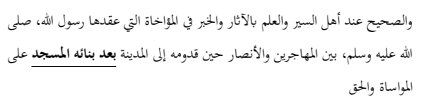
“A visão correta, segundo os estudiosos da Sīrah e as narrações a respeito da “Mu’ākhāh” (fraternidade) que o Mensageiro de Allah ﷺ estabeleceu entre os Muhājirīn (emigrantes) e os Anṣār (auxiliares), quando chegou a Al-Madīnah, é que ela ocorreu depois da construção da Mesquita por ele, e que se baseava na prestação de auxílio e apoio e no Ḥaqq (direito/verdade) …”
“The correct view as held by the scholars of Seera and reports in respect to the “Mu’akhaah” (brotherhood) which the Messenger of Allah (peace be upon him) concluded between the Muhajirin (emigrants) and the Ansar (helpers), when he came to Al-Madinah, was that it took place after his building of the Masjid and it was upon the basis of the provision of assistance/support and the Haqq (truth) …” .
é muito concebível, e particularmente porque a conclusão da construção da Masjid e a celebração de sua inauguração representaram uma boa ocasião para que tal passo fosse dado. Além disso, deve ter ocorrido antes da batalha de Badr, pois Ubaida bin Al-Harith (bin Al-Muttalib bin Abd Manaf bin Qusayy Al-Qurashi Al-Muttalibi) é mencionado nela juntamente com seu irmão ‘Umair bin Al-Humam (bin Al-Jamuh bin Zaid bin Haram bin Ka’b), e ambos foram martirizados na batalha de Badr, que Allah esteja satisfeito com eles. Foram irmãos em vida e na morte, e esperamos de Allah que sejam assim também no Dia do Julgamento. 2) A visão correta é que essa fraternidade entre os Muhajirin e os Ansar não foi originalmente escrita, pois sua natureza era incompatível com isso. Isso porque todas as narrações, sem exceção, não mencionam nenhum documento escrito. Um exame dos livros de Seera, história e Hadith revela a ausência de qualquer menção a carta, documento escrito ou código anterior à Sahifah de Al-Madinah. A exceção a isso incluiu:
is very conceivable, and particularly as the completion of the building of the Masjid and the celebration for its opening, represented a good occasion for such a step to be undertaken. I addition, it must have been undertaken prior to the battle of Badr because Ubaida bin Al- Harith (bin Al-Muttalib bin Abd Manaf bin Qusayy Al-Qurashi Al-Muttalibi) is mentioned in it along with his brother ‘Umair bin Al- Humam (bin Al-Jamuh bin Zaid bin Haram bin Ka’b) and they were both martyred at the battle of Badr, may Allah be pleased with them. They were brothers in life and at death, and we hope from Allah that they be like that also, on the Day of Judgement. 2) The correct view is that this brotherhood between the Muhajirin and the Ansar was not written in origin as its nature was incompatible with that. That is because all of the narrations, without exception, do not mention a written document at all. An examination of the books of Seera, history and Hadith reveal the absence of the mention of any charter, written document or code prior to the Sahifah of Al-Madinah. The exception to that included:
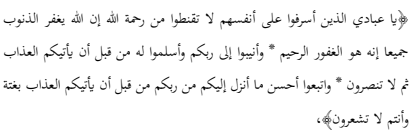
“Diga: ‘Ó meus servos que pecaram contra si mesmos [cometendo pecados], não desespereis da misericórdia de Allah. Allah perdoa todos os pecados. Ele é, de fato, o Perdoador, o Misericordioso’. E volvei [arrependidos] ao vosso Senhor e submetei-vos a Ele antes que o castigo vos alcance; então não sereis socorridos. E segui o melhor do que foi revelado a vós por vosso Senhor, antes que o castigo vos surpreenda de repente, sem que percebais”’ [TMQ 39:53-55].
“Say, “O My servants who have transgressed against themselves [by sinning], do not despair of the mercy of Allah. Indeed, Allah forgives all sins. Indeed, it is He who is the Forgiving, the Merciful”. And return [in repentance] to your Lord and submit to Him before the punishment comes upon you; then you will not be helped. And follow the best of what was revealed to you from your Lord before the punishment comes upon you suddenly while you do not perceive” [TMQ 39:53-55].
b) A Majallah de Luqman: Al-Majallah, assim como As-Sijli, são um Sahifah (documento escrito) que é virado ou (suas páginas) viradas. Isso é como o que foi mencionado no “Dala’il An-Nubuwwah” de Al-Baihaqi (2/419). (Após mencionar a cadeia completa de transmissão) ‘Asim bin ‘Umar bin Qatadah Al-Ansaariy relatou dos Shuyukh (anciãos) de seu povo, que disseram:
b) The Majallah of Luqman: Al-Majallah and likewise As-Sijli are a Sahifah (written document) that is turned or (its pages) turned over. That is like what came mentioned in “Dala’il An-Nubuwwah” of Al- Baihaqi (2/419). (After mentioning the full line of transmission) ‘Asim bin ‘Umar bin Qatadah Al-Ansaariy related from the Shuyukh (elders) of his people, that they said:
“Suwaid bin As-Samit, irmão dos Bani ‘Amr bin ‘Awf, chegou a Makkah como peregrino para o Hajj ou a ‘Umrah. Seu povo o descrevia como o modelo de perfeição entre eles, por causa de sua idade, de sua pele e de seu cabelo. Ele (o narrador) disse:
“Suwaid bin As-Samit, the brother of Bani ‘Amr bin ‘Awf, came to Makkah as a pilgrim for Hajj of ‘Umrah. Suwaid was described by his people as being the model of perfection among them, due to his age, skin and hair. He (the narrator) said:
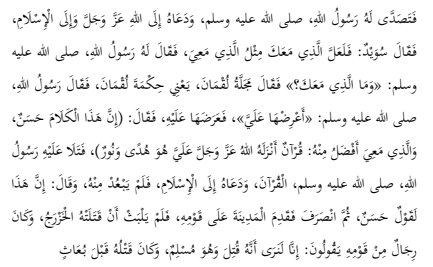
Então, o Mensageiro de Allah ﷺ aproximou-se dele e convidou-o a Allah ‘Azza Wa Jalla e ao Islam. Suwaid disse: “Pode ser que o que tens seja como aquilo que eu tenho”. Então, o Mensageiro de Allah ﷺ perguntou: “E o que tens tu?” Ele respondeu que tinha o Majallah de Luqman, ou seja, a Hikmah (sabedoria) de Luqman. O Mensageiro de Allah ﷺ disse então: “Mostra-mo”, e ele assim o fez. Ele ﷺ disse: “Este discurso é bom, mas o que eu tenho é melhor do que ele. É o Alcorão que Allah ‘Azza Wa Jalla revelou, e é orientação e luz”. O Mensageiro de Allah ﷺ recitou então o Alcorão para ele e convidou-o ao Islam. Ele não se afastou e disse: “Em verdade, este é um bom discurso”. Depois partiu e, pouco depois, chegou a Al-Madinah, junto do seu povo. Não passou muito tempo até que foi morto pelos Khazraj. Havia homens do seu povo que diziam: “Consideramos que ele foi morto estando como muçulmano”, e a sua morte ocorreu antes da guerra de Bu’ath.” [Fim da citação]. c) A Sahifah (documento escrito) do Boicote (opressivo e amaldiçoado) que os Quraysh penduraram dentro da Ka’bah; a sua história, a história das térmitas que a comeram, e a sua conhecida história mutawatir relativa à sua anulação. d) As folhas (Suhuf) que o Mensageiro de Allah ﷺ entregou aos comandantes das expedições militares, contendo instruções, e que estavam seladas ou remendadas. Um exemplo disso é o que vem mencionado no “Kitab ul-Maghazi” de Al-Waqidi (1/13):
Then, the Messenger of Allah (peace be upon him) approached him and invited him to Allah ‘Azza Wa Jalla and to Islam. Suwaid said: “It may be that what you have is like that which I have”. So, the Messenger of Allah (peace be upon him) asked: “And what do you have?” He responded by saying that he had the Majallah of Luqman, meaning the Hikmah (wisdom) of Luqman. The Messenger of Allah (peace be upon him) then said: “Show it to me” and so he did. He (peace be upon him) said: “This speech is good but what I have is better than it. It is a Qur’an that Allah ‘Azza Wa Jalla has revealed and it is guidance and light”. The Messenger of Allah (peace be upon him) then recited the Qur’an to him and invited him to Islam. He didn’t distance himself from it and said: “Verily, this is a good speech”. He then left and later arrived to Al-Madinah to his people. It was not long thereafter that he was killed by the Khazraj. There were men from his people who would say: “We view that he was killed whilst he was a Muslim” and his killing occurred before the war of Bu’ath” [End of Quote]. c) The Sahifah (written document) of the (oppressive and accursed) Boycott which the Quraish hung inside the Ka’ba along; its story, the story of the termites eating it and then its well-known Mutawatir story concerning its nullification. d) The pages (Suhuf) which the Messenger of Allah (peace be upon him) gave to the commanders of the military expeditions, containing instructions, and they were sealed or patched together. And example of that is what came stated in Al-Waqidi’s “Kitab ul-Maghazi” (1/13):
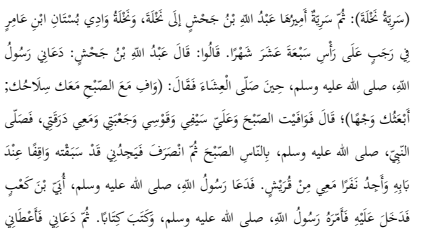
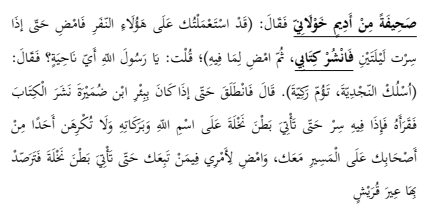
A expedição a Nakhla, comandada por Abdullah bin Jahsh (Nakhla é um vale no Bustan (Pomar) de Ibn ‘Amir), ocorreu no mês de Rajab, o décimo sétimo mês após a Hégira.
“The expedition to Nakhla commanded by Abdullah bin Jahsh (Nakhla is a valley in the Bustan (Orchard) of Ibn ‘Amir) took place in the month of Rajab, the seventeenth month AH.
Eles disseram: Abdullah bin Jahsh disse: O Mensageiro de Allah ﷺ chamou por mim quando rezou o Ishaa', e disse: "Venha até mim ao amanhecer com as suas armas, pois vou enviá-lo em uma missão". Ele disse: Então, eu me apresentei ao amanhecer com a minha espada, o meu arco, a minha aljava e o meu escudo. O Profeta ﷺ rezou o Subh (isto é, Fajr) com as pessoas, e depois saiu e me encontrou. Ele me encontrou já tendo chegado antes dele e estando de pé à sua porta, enquanto eu encontrei comigo ali um grupo dos Quraysh (isto é, Muhajirun). O Mensageiro de Allah ﷺ chamou por Ubayy bin Ka'b e ordenou que ele escrevesse um documento. Então me chamou e me entregou a folha de couro de Khawlan, dizendo: "Nomeei você sobre este grupo. Prossiga até ter viajado por duas noites. Então abra a minha carta e faça o que ela diz". Eu disse: "Ó Mensageiro de Deus, em qual direção?". Ele respondeu: "Vá em direção a Najdiyya até chegar a um pequeno poço". O narrador disse: Abdullah bin Jahsh apressou-se, até chegar ao poço de Ibn Dumayra. Ele então abriu a carta e a leu. Dizia: "Vá, em nome de Allah e com as Suas bênçãos, até chegar ao vale de Nakhla, mas não force nenhum dos seus companheiros a ir com você. Prossiga de acordo com as minhas ordens com quem o seguir, até chegar ao vale de Nakhla e emboscar a caravana dos Quraysh a partir dali" [Fim da citação].
They said: Abdullah bin Jahsh said: The Messenger of Allah (peace be upon him) called for me when he prayed Ishaa’, and said: “Come to me at dawn with your weapons, as I will send you on a mission”. He said: So, I approached at dawn with my sword, my bow, my quiver and my shield. The Prophet prayed Subh (i.e. Fajr) with the people, and then he left and found me. He found me having preceded him already standing at his door whilst I found a group of the Quraysh (i.e. Muhajirun) with me there. The Messenger of Allah (peace be upon him) called for Ubayy bin Ka’b and commanded him to write a document. Then he called me and gave me the sheet of leather from Khawlan, saying: “I have appointed you over this group. Proceed until you have travelled for two nights. Then open my letter and do as it says”. I said: “O Messenger of God, in which direction?” He replied, “Go towards Najdiyya until you reach a small well”. The narrator said: Abdullah bin Jahsh hastened, until he reached the well of Ibn Dumayra. He then opened the letter and read it. It said: “Go, in the name of Allah and with His blessings, until you come to the valley of Nakhla, but do not force any one of your companions to go with you. Proceed according to my commands with whoever follows you, until you reach the valley of Nakhla and lie in wait for the caravan of Quraysh from there” [End of Quote].
Conclusão Resumida
Summary Conclusion
Sempre que encontrarmos uma narração sobre uma Sahifah ou um documento escrito entre os Muhajirin e os Ansar, ou que trate de direitos de diyah (preço do sangue), de guerra ou de paz, sabemos, por necessidade, que isso não tem relação com esta “Mu’akhaah” (formação da fraternidade). Ou se relacionaria com a Sahifah de Al-Madinah, ou seria algo que surgiu ou foi escrito bem depois dela. Também não tem validade o que foi relatado em “As-Seera An-Nabawiyah”, de Ahmad Abu Zaid (p. 71), sob o título “A data da redação do tratado (Mu’ahadah) com os judeus”: “Um dos pesquisadores contemporâneos considerou preponderante que o documento era, na origem, dois documentos, e que os historiadores depois os combinaram em um só. Um deles tratava do tratado do Mensageiro de Allah ﷺ com os judeus e foi escrito antes da grande batalha de Badr. Já o segundo esclarecia os deveres dos muçulmanos, dos Muhajirin e dos Ansar, seus direitos e obrigações. Ele disse: ‘É preponderante, em minha opinião, que o documento do acordo de paz (Muwada’ah) com os judeus foi escrito antes da grande batalha de Badr. Quanto ao segundo documento, foi escrito depois dela’”. As fontes clássicas expressaram aquilo que sustenta essa preponderância. Abu ‘Ubaid Al-Qasim bin Salam disse: “O Wathiqa (documento) foi escrito em duas ocasiões: quando o Profeta ﷺ chegou a Al-Madinah, antes da predominância do Islã e de seu fortalecimento, e antes de ser ordenado a cobrar a Jizyah dos Ahl ul-Kitab (o povo do Livro)”. Al-Baladhari disse: “Quando o Mensageiro de Allah ﷺ chegou a Al-Madinah, fez um tratado (Muwada’ah) com os judeus e escreveu entre ele e eles um documento. Estipulou sobre eles que não apoiariam nem se aliariam a seus inimigos, que o ajudariam contra os que o atacassem, e que ele não lutaria em defesa dos Ahl udh-Dhimmah”. Ele não travou guerra contra ninguém, eles não o difamaram e ele não enviou nenhuma expedição militar, até que Allah ‘Azza Wa Jalla revelou: “Foi concedida permissão [para combater] àqueles que estão sendo combatidos, porque foram oprimidos. E, em verdade, Allah é capaz de conceder-lhes a vitória. [São eles] aqueles que foram expulsos de seus lares sem justo motivo” (TMQ 22:39-40)”.
Wherever we find a narration about a Sahifah or a written document between the Muhajirin and the Ansar, or concerning blood money rights, war or peace, we know, by necessity, that it bears no relation to this “Mu’akhaah” (formation of brotherhood). It would either be related to the Sahifah of Al-Madinah or something that came or was written (much) later than it. There is also no validity in what came related in “As-Seera An- Nabawiyah” by Ahmad Abu Zaid (p. 71) under the heading “The date of the writing of the treaty (Mu’ahadah) with the Jews”: “One of the contemporary researchers found preponderant that the document was actually two documents in origin and then the historians combined them into one. One of them dealt with the treaty of the Messenger of Allah (peace be upon him) with the Jews and was written prior to the great battle of Badr. That is whilst the second clarified the commitments (duties) of the Muslims from the Muhajirin and the Ansar, their rights and obligations. He said: “It is preponderant in my view that the peace agreement (Muwada’ah) document with the Jews was written before the great battle of Badr. As for the second document, then it was written after it”. The classical sources have expressed that which supports this preponderance. Abu ‘Ubaid Al-Qasim bin Salam said: “The Wathiqa (document) was written on two occurrences, when the Prophet (peace be upon him) arrived in Al-Madinah, prior to the dominance of Islam and its becoming strong and before he was commanded to take the Jizyah from Ahl ul-Kitab (the people of the book)”. Al-Baladhari said: “When the Messenger of Allah (peace be upon him) arrived in Al-Madinah he made a treaty (Muwada’ah) with the Jews and wrote between himself and them a document. He stipulated upon them that they should not support or side with his enemies, to support him against those who attack him and that he would not fight in defence of the Ahl udh-Dhimmah. He did not then wage war against anyone, they did not defame him and he did not dispatch a military expedition, until Allah ‘Azza Wa Jalla revealed: “Permission [to fight] has been given to those who are being fought, because they were wronged. And indeed, Allah is capable of providing them victory. [They are] those who have been evicted from their homes without right” (TMQ 22:39- 40)”.

"Foi concedida permissão [para combater] àqueles que estão sendo combatidos, porque foram oprimidos. E, de fato, Allah é capaz de lhes conceder a vitória."
“Permission [to fight] has been given to those who are being fought, because they were wronged. And indeed, Allah is capable of providing them victory.
“[Eles são] aqueles que foram expulsos de suas casas sem justa causa” [TMQ 22:39-40]
[They are] those who have been evicted from their homes without right” [TMQ 22:39-40]
Isso se deve ao fato de que a "Muwada'ah" (paz e trégua) é a situação natural e original, e não precisa ser convocada para ser estabelecida. Então, se houvesse guerra, a "Muwada'ah" cessaria e não retornaria até que a guerra terminasse por meio de uma trégua, tratado ou acordo de paz.
That is because the “Muwada’ah” (peace and truce) is the natural and original situation and is not in need of being convened in order to establish it. Then, if war was to take place, the “Muwada’ah” would cease and it would not return until the war ends by way of a truce, treaty or peace agreement.
Consequentemente, a "Muwada'ah" representa um estado que pode estar presente ou ausente. Portanto, a afirmação do Mensageiro de Allah ﷺ: "Deixai os abissínios em paz enquanto eles vos deixarem em paz" significa necessariamente: manter e continuar no status quo da Muwada'ah (paz e trégua) enquanto a Abissínia o fizer. Assim, quanto à expressão usada pelos estudiosos da Sira e às narrações sobre o Profeta ﷺ, como: "Quando ele chegou a Al-Madinah, fez a paz com todos os judeus que lá residiam", não é permissível entendê-la como significando que ele estabeleceu uma Muwada'ah oficial ou firmou um pacto (tratado oficial). Antes, significa que ele afirmou e deu continuidade ao status quo original de trégua e paz existente entre eles.
Consequently, the “Muwada’ah” represents a status that could be present or absent. Therefore, the statement of the Messenger of Allah (peace be upon him): “Leave the Abyssinians be as long as they leave you be” means by necessity: Affirm and continue upon the status quo of the Muwada’ah (peace and truce) as long as Abyssinia does so. As such, in respect to the statement used by the scholars of Seera and reports concerning the Prophet (peace be upon him) like: “When he arrived in Al-Madinah he made peace with all of the Jews who were residing there”, it is not permissible to be understood to mean that he established an official “Muwada’ah” or contracted a covenant (official treaty). Rather, it means that he affirmed and continued upon the original status quo of the truce and peace existing between them.
Se prestarmos atenção ao que foi relatado dele (que a paz esteja com ele): "Se ele tivesse se mantido naquilo a que se manteve outro que compartilhava sua opinião, não teria sido assassinado. Contudo, ele nos insultou e ridicularizou por meio de poesia, e nenhum de vocês teria feito isso a não ser que tivesse uma espada", veremos que isso confirma perfeitamente essa nossa opinião. Isso porque nada é mencionado nele a respeito de um pacto ou tratado que tivesse sido violado por Ka'b bin Al-Ashraf. Pelo contrário, ele não continuou a manter e a afirmar a paz (muwada'ah) à qual outros haviam se mantido. O Imam Ibn ul-Qayyim (que a misericórdia de Allah esteja sobre ele) tinha conhecimento de parte disso. Ele afirmou em seu livro "Ahkam Ahl adh-Dhimmah" (3/1404):
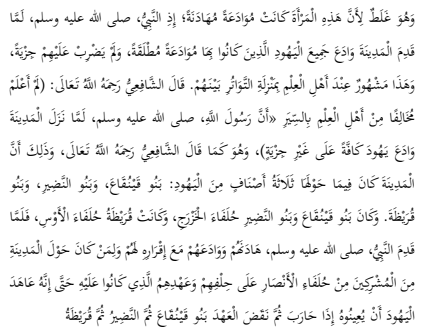
“E isto é um erro, porque esta mulher estava em paz e sob uma trégua (Muhadanah). Isso porque, quando o Profeta ﷺ chegou a Al-Madinah, fez a paz com todos os judeus que lá residiam, de maneira irrestrita, e não lhes impôs a Jizyah. Isto é bem conhecido pelos eruditos ao nível de Tawatur (transmissão concorrente decisiva) entre eles. Ash-Shafi'iy (que a misericórdia de Allah esteja sobre ele) disse: 'Não conheço nenhum dos eruditos da Seera que discorde quanto ao ponto de que, quando o Mensageiro de Allah ﷺ se estabeleceu em Al-Madinah, fez a paz com todos os judeus sem a imposição da Jizyah'. É como afirmou Ash-Shafi'iy (que a misericórdia de Allah esteja sobre ele). Isso porque Al-Madinah tinha três grupos de judeus ao seu redor: Banu Qainuqaa', Banu An-Nadir e Banu Quraizha. Banu Qainuqaa' e Banu An-Nadir eram aliados dos Khazraj, enquanto Banu Quraizha eram aliados dos Aws. Então, quando o Mensageiro de Allah ﷺ chegou a Al-Madinah, fez uma trégua e paz com eles, com a sua aprovação, juntamente com aqueles que estavam ao redor de Al-Madinah dentre os politeístas, que eram aliados dos Ansar, com base na aliança e no pacto que tinham anteriormente. Ele chegou a tomar um pacto dos judeus de que o apoiariam caso fosse atacado. Depois, Banu Qainuqaa' quebrou o pacto, seguidos por An-Nadir e depois Quraizha.” [Fim da citação].
“And it is a mistake because this woman was at peace and under a truce (Muhadanah). That is because when the Prophet (peace be upon him) came to Al-Madinah he made peace with all of the Jews residing there an unrestricted manner and he did not impose Jizyah upon them. This is well-known by the people of knowledge to the level of Tawatur (decisive concurrent transmission) among them. Ash- Shafi’iy (may Allah’s mercy be upon him) said: “I do not of any from the people of knowledge of Seera who disagree upon the point “That when the Messenger of Allah (peace be upon him) settled in Al- Madinah, he made peace with all of the Jews without the imposition of the Jizyah”. It is as Ash-Shafi’iy (May Allah’s mercy be upon him) stated. That is because Al-Madinah had three groups of Jews surrounding it: Banu Qainuqaa’, Banu An-Nadir and Banu Quraizha. Banu Qainuqaa’ and Banu An-Nadir were allies of the Khazraj, while Banu Quraizha were allies of the Aws. Then when the Messenger of Allah (peace be upon him) came to Al-Madinah, he made a truce and peace with them with his approval of them, alongside those who were around Al-Madinah from the polytheists who were allies of the Ansar, upon the basis of their alliance and covenant that they had previously been upon. He even took a covenant from the Jews that they would support him if he was fought against. Then, Banu Qainuqaa’ broke the covenant, followed by An-Nadir and then Quraizha” [End of Quote].
Mesmo que algumas das expressões usadas aqui não tenham sido possivelmente as mais precisas, como sua afirmação de que a mulher judia estava sob uma "trégua" (Muhadanah), quando nem sequer houvera qualquer combate para que uma trégua viesse a vigorar logo depois, pode ser que isso tenha sido apenas um deslize de expressão.

“A Wathiqa (documento) foi redigida em duas ocasiões (Hadathani), quando o Profeta ﷺ chegou a Al-Madinah, antes da predominância do Islã e de sua consolidação, e antes que lhe fosse ordenado cobrar a Jizyah dos Ahl ul-Kitab (o povo do Livro).”
“The Wathiqa (document) was written on two occurrences (Hadathani), when the Prophet (peace be upon him) arrived in Al- Madinah, prior to the dominance of Islam and its becoming strong and before he was commanded to take the Jizyah from Ahl ul-Kitab (the people of the book)” .
é vago porque a palavra "Hadathani" não nos estabelece um período de tempo determinado que possa ser levado em consideração. O Islã só se manifestou de forma predominante e realmente se tornou poderoso após a derrota dos confederados (Ahzab, isto é, a batalha da trincheira). Isso porque o Profeta ﷺ começou a tomar a ofensiva contra o povo, e eles não estavam mais na ofensiva contra ele. Além disso, não sabemos quando ele recebeu a ordem de cobrar a Jizyah das pessoas. Enquanto isso, sua afirmação "cobrem a Jizyah dos Ahl ul-Kitab (o povo do Livro)" é a repetição de um erro bem conhecido, pois a verdade é que a Jizyah era cobrada até mesmo dos politeístas, incluindo os Majus, como consta no Hadith de An-Nu'man bin Muqarrin, registrado no Sahih Muslim e em outras coletâneas. 2) Quanto à afirmação de Al-Baladhari
is vague because the word “Hadathani” does not establish for us a determined time frame that can be taken into consideration. Islam only manifested in a prevalent manner and truly became powerful following the defeat of the confederates (Ahzab i.e. battle of the trench). That is because the Prophet (peace be upon him) began to go on the offensive against the people and they were no longer on the offensive against him. In addition, we do not know when he was commanded to take the Jizyah from the people. That is whilst his statement “take the Jizyah from Ahl ul-Kitab (the people of the book)” is a repetition of a well-known error, as the truth is that the Jizyah was taken even from the polytheists, including the Majus, as has come stated in the Hadith of An-Nu’man bin Muqarrin, recorded in Sahih Muslim and other collections. 2) As for the statement of Al-Baladhari
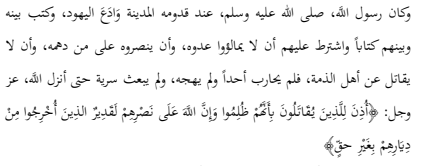
“Quando o Mensageiro de Allah ﷺ chegou a Al-Madinah, fez um tratado (Muwada’ah) com os judeus e redigiu entre ele e eles um documento. Estipulou sobre eles que não apoiariam nem se aliariam aos seus inimigos, que o apoiariam contra aqueles que o atacassem, e que ele não lutaria em defesa dos Ahl udh-Dhimmah. Então ele não travou guerra contra ninguém, eles não o difamaram e ele não enviou nenhuma expedição militar, até que Allah ‘Azza Wa Jalla revelou: “Foi permitido [combater] àqueles que estão sendo combatidos, porque foram injustiçados. E, certamente, Allah é capaz de lhes conceder a vitória. [São] aqueles que foram expulsos de suas casas sem justa causa” (TMQ 22:39-40)”.
“When the Messenger of Allah (peace be upon him) arrived in Al- Madinah he made a treaty (Muwada’ah) with the Jews and wrote between himself and them a document. He stipulated upon them that they should not support or side with his enemies, to support him against those who attack him and that he would not fight in defence of the Ahl udh-Dhimmah. He did not then wage war against anyone, they did not defame him and he did not dispatch a military expedition, until Allah ‘Azza Wa Jalla revealed: “Permission [to fight] has been given to those who are being fought, because they were wronged. And indeed, Allah is capable of providing them victory. [They are] those who have been evicted from their homes without right” (TMQ 22:39-40)”.
Este discurso é contraditório, pois ele ﷺ não havia recebido permissão, na origem, para se engajar em combate antes da revelação do versículo, e não estava em estado de guerra com ninguém. Também não havia expectativa de que Al-Madinah fosse atacada. Portanto, a frase de seu discurso: "Ele estipulou com eles que não apoiariam nem se aliariam aos seus inimigos, para apoiá-lo contra aqueles que o atacassem", que resumiu parte do que foi declarado na "Sahifah", é inconcebível e não tem realidade naquele período de tempo. Ainda mais atroz é a afirmação: "E que ele não lutaria em defesa dos Ahl udh-Dhimmah", supondo que não tenha havido erro na impressão. Em primeiro lugar, não havia "Ahl udh-Dhimmah" ali na origem. Em segundo lugar, como pode ser que eles estejam obrigados a apoiá-lo contra aqueles que o atacam, enquanto ele não está obrigado a apoiá-los contra aqueles que os atacam?! 3) A declaração de Al-Baladhariy sobre Banu Qainuqaa':
This speech is contradictory because he (peace be upon him) had not been permitted in origin to engage in fighting prior to the revelation of the Aayah and was not in a state of war with anyone. There was also no expectation for Al-Madinah to be attacked. Therefore, the sentence from his speech: “He stipulated upon them that they should not support or side with his enemies, to support him against those who attack him”, which summarized some of what came stated in the “Sahifah”, is inconceivable and has no reality to it during that time period. Even more atrocious is the statement: “And that he would not fight in defence of the Ahl udh-Dhimmah”, assuming there was no error in the printing. Firstly, there were no “Ahl udh-Dhimmah” there in origin. Secondly, how could it be that they are obliged to support him against those who attack him, whilst he is not obliged to support them against those who attack them?! 3) The statement of Al-Baladhariy concerning Banu Qainuqaa’:
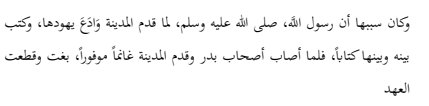
“A razão disso foi que o Mensageiro de Allah ﷺ, quando chegou a Al-Madinah, firmou um acordo de paz com os seus judeus e redigiu um documento entre ele e eles. Depois, quando os muçulmanos saíram vitoriosos em Badr e regressaram a Al-Madinah com abundante butim, os judeus se rebelaram e quebraram o pacto”, então isso também não tem sentido. Isso porque a “Muwada’ah” (estado de paz) é a origem e não precisa ser contratada oficialmente de forma mútua nem ser escrita. Enquanto isso, Ka’b bin Al-Ashraf foi o primeiro a transgredir, a guerrear e a romper a “Muwada’ah” (estado de paz ou trégua), que, como mencionado anteriormente, foi estabelecida por meio de transmissões Mutawatir (decisivas e concorrentes), e então ele redigiu a “Sahifah”, que não tinha como propósito estabelecer uma “Muwada’ah”, mas sim estabelecer uma “União Confederal (Ittihad Confedarali)”. Depois disso, Bani Qainuqaa’ saiu da “união” e fez guerra, seguido por Banu An-Nadir, e então Quraizhah traiu-a. 4) Quanto à afirmação de At-Tabari:
“The reason for it was that the Messenger of Allah (peace be upon him), when he arrived in Al-Madinah, made a peace agreement with its Jews and wrote a document between himself and them. Then, when the Muslims were victorious at Badr and came back to Al- Madinah with abundant booty, the Jews rebelled and broke the covenant”, then this also has no meaning to it. That is because the “Muwada’ah” (state of peace) is the origin and does not need to be officially mutually contracted or write. That is while Ka’b bin Al-Ashraf was the first to transgress, war and cut the “Muwada’ah” (state of peace or truce) which, as previously mentioned, has been established via Mutawatir (decisive concurrent) transmissions and he then wrote the “Sahifah” which was not the purpose of establishing a “Muwada’ah” but rather to establish a “Confederal Union (Ittihad Confedarali)”. Thereafter, Bani Qainuqaa’ exited from the “union” and waged war, followed by Banu An-Nadir and then Quraizhah betrayed it. 4) Concerning the statement of At-Tabari:
“Então o Mensageiro de Allah ﷺ permaneceu em Al-Madinah após seu retorno de Badr. Quando chegou a Al-Madinah, havia feito um acordo de paz com seus judeus, sob a condição de que não prestassem auxílio a ninguém contra ele e que, se fosse atacado em Al-Madinah por algum inimigo, eles o apoiariam. Então, quando o Mensageiro de Allah ﷺ matou aqueles dos Mushrikin (politeístas) de Quraysh que ele matou, eles demonstraram inveja e rebeldia contra ele e manifestaram a quebra da aliança.”
“Then the Messenger of Allah (peace be upon him) remained in Al- Madinah after his return from Badr. When he had arrived in Al- Madinah he had made a peace agreement with its Jews upon the stipulation that they do not assist anyone against him and that if he was attacked in Al-Madinah by an enemy, they would support him. Then when the Messenger of Allah (peace be upon him) killed those whom he had killed from the Mushrikin (polytheists) of Quraish, they demonstrated envy and rebelliousness towards him and demonstrated the breaching of the covenant”,
então está em conformidade com o discurso de Al-Baladhariy acima, e a refutação a ele é a mesma, embora seja muito melhor. Isso porque ele não afirmou que a antiga "Muwada'ah" (acordo de paz/trégua), anterior a Badr, era um documento escrito, como Al-Baladhariy escorregou ao afirmar, assim como seu texto não inclui nada equivalente à frase atroz "E que ele não lutaria em defesa dos Ahl udh-Dhimmah". Apesar disso, a afirmação de At-Tabari "violação do pacto (Naqdh Al'Ahd)" não é algo que se ajuste à realidade. Isso porque não havia um "Ahd" (pacto) prévio em sua origem, mas sim uma "Muwada'ah" sobre seu estado original. Isso a menos que considerássemos sua aceitação e adesão a ele como sendo um "Ahd" (Pacto/tratado) implicitamente?! Como a afirmação de Ahmad Abu Zaid:
then it is in line with the speech of Al-Baladhariy above and the refutation to it is the same, although it is much better. That is because he did not assert that the old “Muwada’ah” (agreement of peace/truce), prior to Badr, was a written document, as Al-Baladhariy slipped up in, just as his text does not include something equal to the atrocious sentence “And that he would not fight in defence of the Ahl udh-Dhimmah”. Despite that, the statement of At-Tabari “breaching of the covenant (Naqdh Al‘Ahd)” is not something that fits with reality. That is because there was no prior “Ahd” (covenant) in origin but rather a “Muwada’ah” upon its original state. That is unless we were to consider its acceptance and adherence to it as being an “Ahd” (Covenant/treaty) implicitly?! As the statement of Ahmad Abu Zaid:

Nestes testemunhos mutawatir (transmissões concorrentes que indicam decisividade), há o suficiente para estabelecer a predominância e concluir que o documento do acordo de paz com os judeus foi redigido no primeiro ano da Hégira. Além disso, uma análise de seus artigos e textos indica que eles não revelam qualquer tensão entre o Profeta ﷺ e os judeus. Assim, por tudo isso, as afirmações da enciclopédia islâmica caem por terra e suas dúvidas ficam refutadas, pois há erros significativos, aliás fatais, nela.
“In these Mutawatir (concurrent transmissions indicating decisiveness) testimonies, there is enough to establish preponderance to conclude that the peace agreement document with the Jews was written in the first year of the Hijrah. In addition, an analysis of its articles and texts indicate that they are not indicative of any tension between the Prophet (peace be upon him) and the Jews. As such, due to all of this, the claims of the Islamic encyclopaedia fall down and their doubts are refuted”, then there are significant, indeed fatal errors in it.
1) As afirmações ou opiniões dos historiadores não são chamadas de testemunhos (shahada), a menos que provenham de uma testemunha contemporânea (de primeira mão). Caso contrário, tal opinião é apenas uma opinião baseada em informações ou premissas corretas ou incorretas. Um grande número de opiniões coincidentes ou semelhantes não é chamado de Tawatur (isto é, estabelecido de forma definitiva por transmissão concorrente), nem possui o valor de testemunhos decisivos (Tawatur) de afirmação.
1) The statements or views of the historians are not called testimonies (shahada) unless it is from a contemporary (first-hand) witness. Otherwise, such a view is merely an opinion based upon correct or incorrect information or premises. A large number of conforming or similar opinions is not called Tawatur (i.e. established definitely by concurrent transmission) and they do not hold the value of Tawatur (decisive) testimonies of affirmation.
2) Algumas constituições podem ter sido redigidas após uma guerra civil e, no entanto, os seus textos não refletem a existência de qualquer tensão entre as partes envolvidas. Isso acontece porque o propósito da constituição é estabelecer a regulamentação do Estado (isto é, se é de forma unitária ou federal, etc.). Assim, a data da tensão ou do conflito que ocorreu antes dela não está escrita nem mencionada no seu interior. Consequentemente, em relação à afirmação "Eles (isto é, os textos) não são indicativos de qualquer tensão entre o Profeta ﷺ e os judeus", o oposto também é correto. Isso porque a redação de uma constituição confederal ou de um tratado internacional, por si só, não é prova da existência de uma tensão, de um conflito ou de uma guerra que lhe tenha antecedido. Pode ter havido, assim como pode não ter havido. Isso só se saberia por meio de outros indícios históricos, analisados independentemente do documento em exame, ou pelos próprios textos do documento, que indicam o fim de um conflito, a cessação dos combates ou a solução de questões de compensações e de preços de sangue, etc. O Ustadh Ahmad Abu Zaid deseja refutar as afirmações da "Enciclopédia Islâmica", que ele próprio havia formulado pouco antes em "As-Seera An-Nabawiyah", de Ahmad Abu Zaid (p. 70), da seguinte forma:
“Depois que a enciclopédia mencionou o que a celebração daquele tratado (Mu’ahadah) continha em termos de política profética sábia, e depois que indicou que Ibn Ishaq havia preservado o texto daquele tratado, afirmou: Parece que este texto não remonta, quanto à data de sua redação, ao primeiro ano da Hijrah, porque reflete as relações tensas entre o Profeta ﷺ e os judeus”.
“After the encyclopaedia mentioned what the contracting of that treaty (Mu’ahadah) contained in terms of wise prophetic policy making and after it indicated to Ibn Ishaq having preserved the text of that treaty, it stated: It appears that this text does not go back, in respect to the date of its writing, to the first year of the Hijrah, because it reflects the tense relations between the Prophet (peace be upon him) and the Jews”.
A verdade é que a Sahifah de Al-Madinah foi redigida no início do terceiro ano da Hégira, com base nas evidências dos textos históricos transmitidos que apresentamos anteriormente. Assim, a enciclopédia estava correta quanto a esta questão. Quanto à dedução dos orientalistas, autores da enciclopédia, de que o texto (ou seja, a Sahifah)
The truth is that the Sahifah of Al-Madinah was written at the beginning of the third year of Hijrah based upon the evidence of the historical transmitted texts that we have presented earlier. As such, the encyclopaedia was correct regarding this matter. As for the deduction of the orientalists, who are the authors of the encyclopaedia, that the text (i.e. Sahifah)

refletiam relações tensas entre o Profeta ﷺ e os judeus
“reflected tense relations between the Prophet (peace be upon him) and the Jews”, .
Então isto não é convincente e está fora de lugar. As pessoas deram rédea solta à sua imaginação aqui. Ora, a história é meramente uma sucessão de acontecimentos e realidades que já passaram, e os seus relatos devem ser tomados de testemunhas oculares e de registos de quem vivia na época, não de imaginações ou mesmo de deduções lógicas. É verdade que as circunstâncias que rodeiam a redação da Sahifah revelam que ela foi escrita devido à ocorrência de uma tensão nas relações com alguns dos judeus (Ka'b ibn al-Ashraf, em especial). No entanto, o seu texto não inclui nada que indique qualquer tensão ou conflito prévio, nem sequer remotamente!
then this is not convincing and out of place. People have given free reign to their imaginations here. That is whilst history is merely events and realities that have passed by and its reports must be taken from first-hand witnesses and records of those living at the time, not from imaginations or even logical deductions. Yes, it is true that the circumstances surrounding the writing of the Sahifah reveal that it was written due to the occurrence of a tension in the relations with some of the Jews (Ka’b in Al-Ashraf specifically). However, its text does not include anything indicating to any prior tension or conflict and not even remotely!