6.7 Çalışma konuları ve aşamaları
6.7 Study subjects and stages
Daha önce de belirttiğimiz gibi, okul eğitimi, öğrencilerin yaşlarına göre 3 aşamaya dağıtılmış 36 dönemden oluşmakta olup her aşama ilgili Şer'i kurallarla düzenlenmektedir. Ders konularına gelince, her aşamanın kendine özgü dersleri ile başarısızlık ve ilerleme (bir kurstan diğerine geçiş) ile ilgili kendine özgü kuralları vardır. Her aşamadaki ders konuları ikiye ayrılır: Temel dersler ve Beceri ve Etkinlik dersleri.
As we have said before, the school education is divided into 36 school terms distributed between 3 stages according to student ages such that each stage is regulated by the relevant Shari’ah rules. With respect to study subjects, each stage has specific subjects together with specific rules related to failure and progress (transferring from one course to the next). Study subjects in each stage are divided into two: Basic subjects and Skills and Activities Subjects.

Birinci okul kademesinde, iki öğretmen öğrencilere birinci dönemden itibaren ders vermeye başlar. Birincisi onlara İslam kültürü ve Arapça öğretir, ikincisi ise fen bilimleri ve matematik öğretir. İkisi de beceri ve etkinlik öğretiminde ortak sorumluluk paylaşır. Öğretmen, bu kademede en az üç ardışık okul dönemi boyunca öğrencileriyle birlikte kalmalıdır.
In the 1st school stage, two teachers begin teaching students from the first term. The first teaches them Islamic culture and Arabic language, the second teaches them sciences and mathematics. Both share in teaching skills and activities. The teacher should remain with his students in this stage for at least three consecutive school terms.
Beceri dersinde öğretmen, çocuğun bağlantı kurma ve düşünme becerisini geliştirmek için, örneğin şeyleri kurma ve sökme gibi etkinlikler verir. Bu etkinlikleri ve becerileri, dönemin temel işlenen konularıyla ilişkilendirmeye özen gösterilmelidir.
In the skills subject, the teacher gives the child activities to develop his ability to link and think e.g. building and dismantling of things. Care must be taken to relate these activities and skills to the term’s basic adopted subjects.
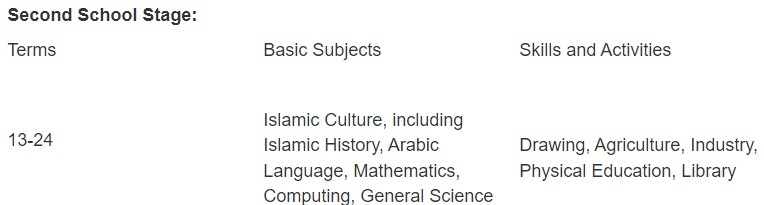
“Genel Bilimler” dersi bu aşamada kimya, biyoloji, fizik ve coğrafya ilkelerini kapsar.
The “General Sciences” subject in this stage includes principles of chemistry, biology, physics and geography.
Üçüncü Okul Aşaması:
Third School Stage:
Bu aşama 25 ile 36. dönemleri kapsar. Bu aşamada tüm öğrenciler yalnızca 25 ile 30. dönemlerde aynı çalışma konularına katılır. Bundan sonra, 31 ile 36. dönemlerde öğrenciler tercih ettikleri seçmeli dallara (furoo') katılırlar. Bu seçenekler şunlardır:
This stage covers the terms 25 to 36. In this stage, all students participate in the same study subjects in terms 25 to 30 only. Thereafter, in terms 31 to 36 students join the optional branches (furoo’) they prefer. These options are:
- Kültürel Seçenek - Bilimsel Seçenek - Endüstriyel veya Teknik Seçenek (bilgisayar, mekanik, elektrik, iletişim, haritacılık vb.)
- Cultural Option - Scientific Option - Industrial or Technical Option (computing, mechanics, electrical, communications, cartography etc.)
- Tarımsal Seçenek - Ticaret Seçenek - Ev İçi Seçenek (kadınlar için)
- Agricultural Option - Commerce Option - Domestic Option (for females)
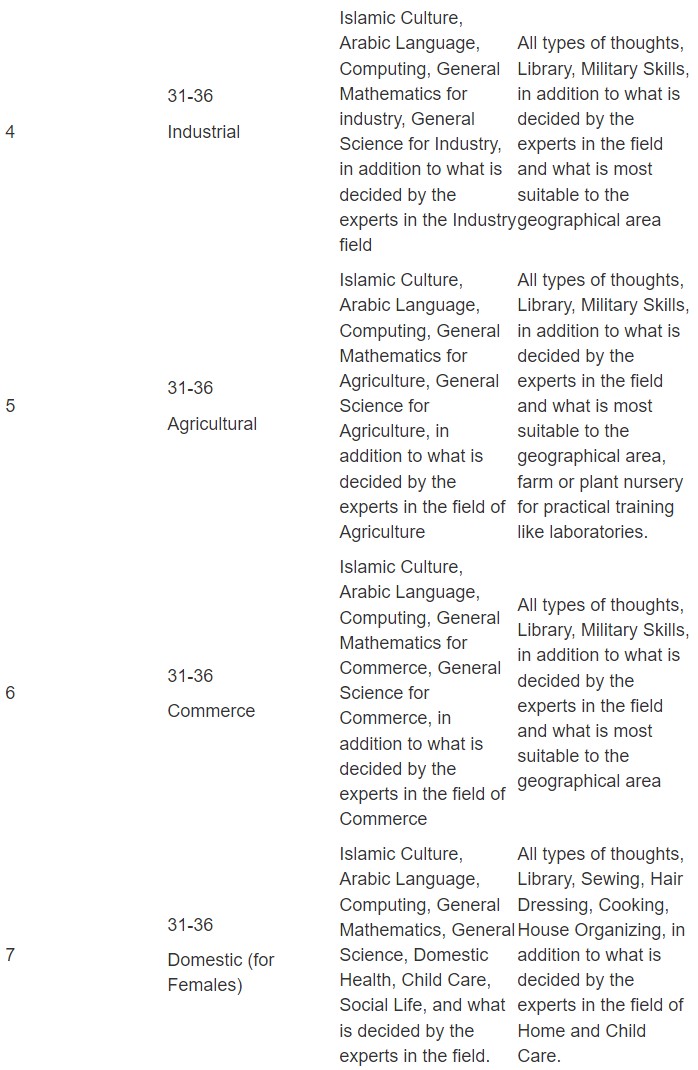
Aşağıdaki tablo, bu seçeneklerin her birinde incelenen konuları göstermektedir:
The following chart shows the subjects studied in each of these options:
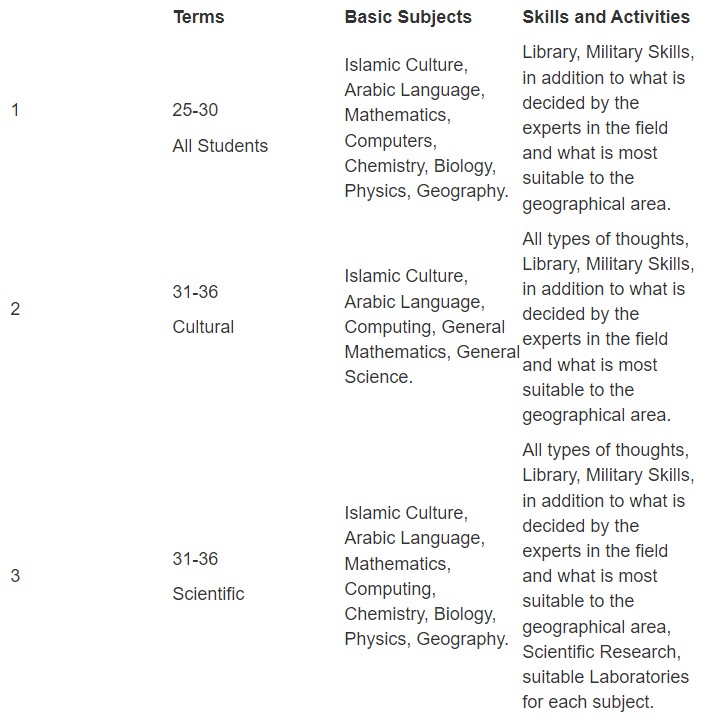
Üçüncü kademenin kültür seçeneğinde öğrenci, hem İslam Kültürü hem de Arapça Dili alanlarında genişletilmiş konuları alır. Uzmanlar, Fıkıh, Usul, Tefsir, Hadis İlimleri, Tarih ve diğer İslam kültürü seçeneklerindeki gereksinimleri belirler. Benzer şekilde, bu kademe için gerekli olan Belagat (Balagha), Edebi metinler vb. gibi Arapça dili seçeneklerinde de belirli dersler (menhicler) benimserler.
In the cultural option of the third school stage, the student takes extended topics in both Islamic Culture and Arabic Language. Experts determine the requirements in the subjects of Fiqh, Usul, Tafseer, '‘Ulum Al-Hadith, History and other Islamic culture options. Likewise, they adopt specific courses (manaahij) in the Arabic language options required for this stage such as Eloquence (Balagha), Literature texts etc.
Seçmeli olmayan alanlarda öğrenci Matematik ve Fen derslerini özet bir biçimde alır; yalnızca seçtiği alan için gerekli konulara odaklanılır. Böylece Ticaret alanındaki öğrenci, Muhasebe, Zekât ve Miras Hesapları, Kâr ve Zarar Hesapları gibi Ticaretle ilgili Matematik konularını Muhasebe Defteri ve Kasa Hesapları ile birlikte alır; benzer şekilde İstatistik konularını da alır. Buna karşılık Sanayi alanındaki öğrenci Geometrik Çizim, Şekiller, Alan ve Hacim Hesaplamaları gibi Sanayiye özgü konuları alır.
In non-scientific options, the student takes Mathematics and Sciences in a concise form with focus paid only to the topics required for their option. Thus the Commerce option student takes Mathematics topics related to Commerce e.g. Accounting, Zakat and Inheritance Accounts, Profits and Loss Accounts together with Bookkeeping and Cashbook Accounts; likewise he/she takes topics in Statistics. Whereas the Industrial option student takes topics specific to Industry such as Geometrical Drawing, Shapes, Area and Volume Calculation etc.
Fen dışı seçeneğin Genel Bilimler öğrencisi, İnsan Vücudu, Hastalıklar, Kamu Güvenliği ile insan ve çevresiyle ilgili bilimsel konulara odaklanan konuları alır. Tarımsal seçenekte ise bitkisel tarım yöntemleri, bitki hastalıkları ve tedavisi, toprak türleri, gübreler, böcek ilaçları gibi tarım ve beslenmeyle ilgili konular eklenir.
The General Sciences student of the non-scientific option takes topics focusing upon studies of the Human Body, Diseases, Public Safety as well as scientific topics related to man and his environment. In the agricultural option, topics related to agriculture and nutrition are added such as methods of Plant Agriculture, their diseases and treatment, types of soil, fertilisers, insecticides etc.
Endüstri seçeneği öğrencisi, Yoğunluk ve Kütle gibi malzemelerin bilimi ve özellikleriyle ilgili dersleri, Mekanik Dinamik ilkeleri ve Kamu Güvenliği ile birlikte alır.