6.7 Materias de estudio y etapas
6.7 Study subjects and stages
Como hemos dicho antes, la educación escolar se divide en 36 períodos lectivos distribuidos entre 3 etapas según la edad de los alumnos, de modo que cada etapa se rige por las normas correspondientes de la Sharía. En cuanto a las asignaturas de estudio, cada etapa tiene asignaturas específicas junto con normas específicas relativas al suspenso y al progreso (el paso de un curso al siguiente). Las asignaturas de estudio de cada etapa se dividen en dos: asignaturas básicas y asignaturas de habilidades y actividades.
As we have said before, the school education is divided into 36 school terms distributed between 3 stages according to student ages such that each stage is regulated by the relevant Shari’ah rules. With respect to study subjects, each stage has specific subjects together with specific rules related to failure and progress (transferring from one course to the next). Study subjects in each stage are divided into two: Basic subjects and Skills and Activities Subjects.

En la primera etapa escolar, dos maestros comienzan a enseñar a los estudiantes desde el primer trimestre. El primero les enseña cultura islámica y lengua árabe, y el segundo les enseña ciencias y matemáticas. Ambos comparten la enseñanza de habilidades y actividades. El maestro debe permanecer con sus estudiantes en esta etapa durante al menos tres trimestres escolares consecutivos.
In the 1st school stage, two teachers begin teaching students from the first term. The first teaches them Islamic culture and Arabic language, the second teaches them sciences and mathematics. Both share in teaching skills and activities. The teacher should remain with his students in this stage for at least three consecutive school terms.
En la asignatura de habilidades, el maestro le da al niño actividades para desarrollar su capacidad de relacionar y pensar, por ejemplo, armar y desarmar objetos. Hay que tener cuidado de relacionar estas actividades y habilidades con las asignaturas básicas adoptadas para el trimestre.
In the skills subject, the teacher gives the child activities to develop his ability to link and think e.g. building and dismantling of things. Care must be taken to relate these activities and skills to the term’s basic adopted subjects.
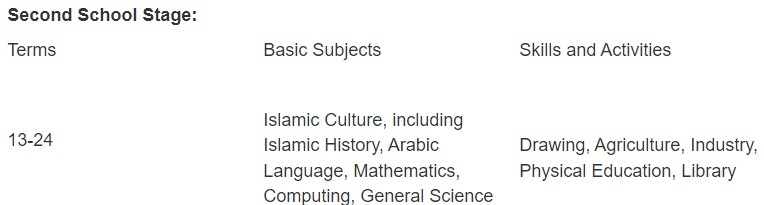
La asignatura de «Ciencias Generales» en esta etapa incluye nociones de química, biología, física y geografía.
The “General Sciences” subject in this stage includes principles of chemistry, biology, physics and geography.
Tercera etapa escolar:
Third School Stage:
Esta etapa abarca los términos 25 a 36. En esta etapa, todos los estudiantes cursan las mismas materias solo en los términos 25 a 30. Después, en los términos 31 a 36, los estudiantes se incorporan a las ramas optativas (furoo’) que prefieran. Estas opciones son:
This stage covers the terms 25 to 36. In this stage, all students participate in the same study subjects in terms 25 to 30 only. Thereafter, in terms 31 to 36 students join the optional branches (furoo’) they prefer. These options are:
- Opción cultural - Opción científica - Opción industrial o técnica (informática, mecánica, electricidad, comunicaciones, cartografía, etc.)
- Cultural Option - Scientific Option - Industrial or Technical Option (computing, mechanics, electrical, communications, cartography etc.)
- Opción Agrícola - Opción Comercial - Opción Doméstica (para mujeres)
- Agricultural Option - Commerce Option - Domestic Option (for females)
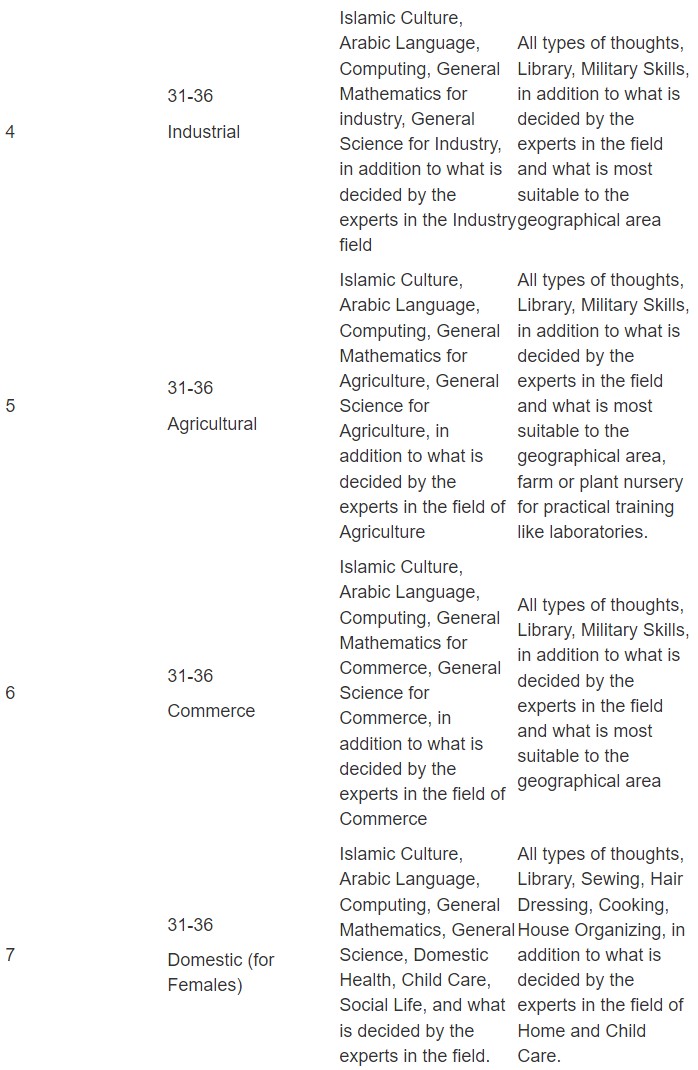
El siguiente cuadro muestra las materias estudiadas en cada una de estas opciones:
The following chart shows the subjects studied in each of these options:
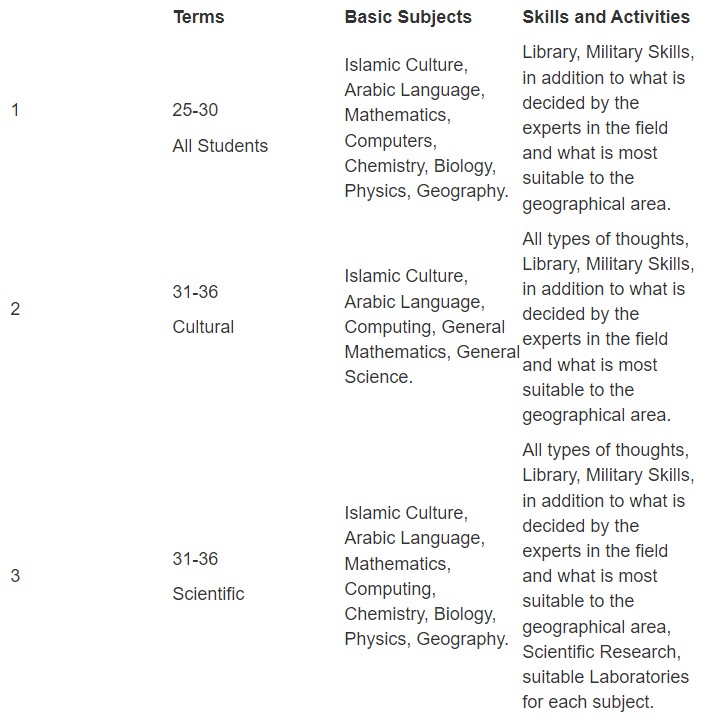
En la opción cultural del tercer ciclo de estudios, el alumno cursa temas ampliados tanto en Cultura Islámica como en Lengua Árabe. Los expertos determinan los requisitos en las materias de Fiqh, Usul, Tafsir, 'Ulum Al-Hadiz, Historia y otras opciones de cultura islámica. Asimismo, adoptan cursos específicos (manāhij) en las opciones de lengua árabe requeridas para esta etapa, como la Elocuencia (Balagha), los textos literarios, etc.
In the cultural option of the third school stage, the student takes extended topics in both Islamic Culture and Arabic Language. Experts determine the requirements in the subjects of Fiqh, Usul, Tafseer, '‘Ulum Al-Hadith, History and other Islamic culture options. Likewise, they adopt specific courses (manaahij) in the Arabic language options required for this stage such as Eloquence (Balagha), Literature texts etc.
En las opciones no científicas, el estudiante cursa Matemáticas y Ciencias en una forma concisa, centrándose únicamente en los temas requeridos por su opción. Así, el estudiante de la opción de Comercio cursa temas de Matemáticas relacionados con el Comercio, por ejemplo Contabilidad, cuentas de Zakat y Herencia, cuentas de Pérdidas y Ganancias, junto con Teneduría de Libros y cuentas de Caja; de igual manera, cursa temas de Estadística. En cambio, el estudiante de la opción Industrial cursa temas específicos de la Industria, tales como Dibujo Geométrico, Formas, Cálculo de Áreas y Volúmenes, etc.
In non-scientific options, the student takes Mathematics and Sciences in a concise form with focus paid only to the topics required for their option. Thus the Commerce option student takes Mathematics topics related to Commerce e.g. Accounting, Zakat and Inheritance Accounts, Profits and Loss Accounts together with Bookkeeping and Cashbook Accounts; likewise he/she takes topics in Statistics. Whereas the Industrial option student takes topics specific to Industry such as Geometrical Drawing, Shapes, Area and Volume Calculation etc.
El estudiante de Ciencias Generales de la opción no científica cursa temas centrados en el estudio del cuerpo humano, las enfermedades, la seguridad pública, así como temas científicos relacionados con el hombre y su entorno. En la opción agrícola, se añaden temas relacionados con la agricultura y la nutrición, como los métodos de la agricultura vegetal, sus enfermedades y tratamiento, los tipos de suelo, los fertilizantes, los insecticidas, etc.
The General Sciences student of the non-scientific option takes topics focusing upon studies of the Human Body, Diseases, Public Safety as well as scientific topics related to man and his environment. In the agricultural option, topics related to agriculture and nutrition are added such as methods of Plant Agriculture, their diseases and treatment, types of soil, fertilisers, insecticides etc.