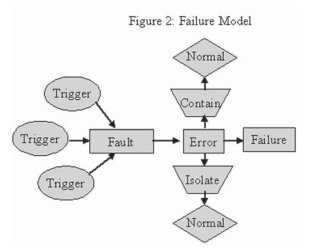
Denk als voorbeeld aan een zwak punt in het ontwerp van een huiskelder als het gebrek of de fout. Het zwakke punt is de plek waar overmatig water door regen of overstromingen het huis kan binnendringen. De voorwaarde die deze fout uitlokt, is te veel regen in een korte periode. De stroom van water het huis binnen via de kelder is de fout, omdat onder normale omstandigheden water niet het huis in zou moeten komen. Deze fout (water in het huis) kan worden gedetecteerd door de mensen die in het huis wonen of door een monitoringsapparaat. Zo wordt de fout geïdentificeerd en geïsoleerd. Om de fout te beheersen, zodat deze niet tot schade leidt, wordt een waterpomp gebruikt om het overtollige water uit de kelder te verwijderen en naar buiten te pompen. Als er geen waterpomp is, of als de pomp om een of andere reden niet aanslaat, zal de fout niet worden beheerst en blijft het overstromingswater in het huis aanwezig. Dit kan leiden tot ernstige schade, waaronder de instorting van het huis.
As an example, think of a weak spot in the design of a house basement as the defect or fault. The weak spot is where excessive water due to rain or floods can penetrate the house. The triggering condition for this fault is too much rain in a short period of time. The flow of water into the house through the basement is the error, because in normal circumstances water should not come into the house. This error (water in the house) can be detected by people living in the house or some monitoring device. This is how the error is identified and isolated. To contain the error such that it does not lead to damage, a water pump is used to remove the excess water from the basement and push it outside. If there is no water pump, or the pump fails to kick in for some reason, the error will not be contained and the floodwater persists in the house. This may lead to serious damages, including the collapse of the house.
Dit falenmodel komt zeer vaak voor in ons leven. Een zwak hart, gedeeltelijk geblokkeerde slagaders, defecte longen of ongezonde nieren veroorzaken alle soorten ziekten en pijnen, die, indien niet tijdig behandeld en ingedamd, kunnen leiden tot de dood. Mechanische defecten in onze auto's (lekke onderdelen, ongebalanceerde wielen, onregelmatige elektrische spanning) kunnen alle soorten problemen in de auto veroorzaken, wat kan leiden tot totale schade aan het voertuig of zelfs tot catastrofale ongelukken.
This failure model is very common in our life. A weak heart or partially blocked arteries or defective lungs or unhealthy kidneys cause all types of sicknesses and pains, which if not treated and contained in due time may lead to death. Mechanical defects in our cars (leaky parts, unbalanced wheels, irregular electric voltage) can cause all types of problems in the car which can lead to total damage of the vehicle or even to catastrophic accidents.
De politieke, economische en sociale systemen verschillen niet veel van elkaar. Alle systemen kunnen gebreken en sluimerende fouten hebben. Het is moeilijker om deze fouten te diagnosticeren, te definiëren en te detecteren dan in fysieke systemen. Een deel van het probleem van de analyse is het feit dat politieke, economische en sociale systemen meestal worden ondersteund door mensen met sterke overtuigingen en soms door mensen met macht en gezag. Hoewel de Sovjet-Unie welvarend en machtig was, was het bijna onmogelijk om een enkel gebrek binnen het socialistische systeem aan te wijzen, laat staan fouten en problemen die voortvloeiden uit deze gebreken. Dit dogmatische standpunt liet de fouten zich voortplanten zonder adequate beheersing, wat uiteindelijk leidde tot het volledige falen van het systeem. De casus van de Sovjet-Unie en het socialisme is een interessante casus en een uitstekend voorbeeld voor het begrijpen van het fout-fout-falen-model in socio-politiek-economische systemen.
The political, economic, and social systems are not much different. All systems may have defects and dormant faults. It is more difficult to diagnose and define these faults and detect than it is in physical systems. Part of the problem of the analysis is the fact that political, economic, and social systems are usually supported by people with strong convictions and sometimes by people with power and authority. While the Soviet Union was well and powerful, it was almost impossible to point to any defect within the socialist system, leave alone to errors and problems arising from these faults. This dogmatic view allowed the errors to propagate without proper containment, which eventually led to the failure of the system altogether. The case of the Soviet Union and socialism is an interesting case and an excellent example for understanding the fault-error-failure model in socio-politico-economic systems.
Wat echter interessanter is, is de toepassing van dit model op het kapitalisme. Het socialisme heeft alle stadia van het model doorlopen en heeft uiteindelijk een grote ineenstorting en mislukking ervaren. Het is een interessante casus vanuit historisch perspectief. Het kapitalisme bevindt zich in de tweede fase van het model. Slapende gebreken hebben geleid tot foutief financieel en economisch gedrag. Beleid en strategieën zoals reddingsoperaties (bailouts) en overheidsinterventie zijn toegepast om de fouten te isoleren en te beheersen; er worden pogingen ondernomen om het systeem terug te brengen naar de normaliteit of normale functionaliteit. Daarom is de casus van het kapitalisme belangrijk vanuit een praktisch perspectief.
What is more interesting, however, is the application of this model to capitalism. Socialism has passed through all the stages of the model and finally experienced a major collapse and failure. It is an interesting case from the historical perspective. Capitalism is going through the second stage of the model. Dormant faults have produced erroneous financial and economic behavior. Policies and strategies such as bailout and government intervention have been exercised to isolate and contain the errors; attempts are being made to return the system to normalcy or normal functionality. Hence, the case of capitalism is important from a practical perspective.
In de discussie die volgt, zullen we de volgende vragen behandelen: Wat zijn de gebreken of sluimerende fouten van het kapitalistische systeem? Wat zijn de omstandigheden die deze fouten hebben getriggerd? Wat zijn de fouten die voortvloeiden uit het triggeren van deze gebreken? Werden de fouten binnen een redelijke tijdspanne correct geïdentificeerd? Konden deze fouten worden opgelost? Worden de gebreken uit de kern van het systeem geëlimineerd? Is het falen onvermijdelijk? Wat is de impact van de fouten op het leven van mensen? Wat is de impact van het falen van het kapitalisme?
In the discussion to follow, we will address the following questions: What are the defects or dormant faults of the capitalist system? What are the conditions that triggered these faults? What are the errors that resulted from triggering the faults? Were the errors correctly identified within a reasonable time frame? Could these errors be resolved? Are the faults being eliminated from the core of the system? Is failure imminent? What is the impact of the errors on the life of people? What is the impact of the failure of capitalism?.