2.3 Los Masahif de los Compañeros
2.3 The Masahif Of The Companions
Hay numerosas indicaciones en la literatura del hadiz de que varios de los Compañeros del Profeta ﷺ habían preparado sus propias colecciones escritas de las revelaciones. [Suyuti. Itqan, I, p. 62] Las más conocidas entre ellas son las de Ibn Mas'ud, Ubay bin Ka'b y Zaid bin Zabit. [Véase Dodge, B, The Fihrist of al-Nadim, Nueva York, 1970 (abrev. fihrist), pp. 53-63.] Una lista de Compañeros de quienes se relata que tenían sus propias colecciones escritas incluye a los siguientes: Ibn Mas'ud, Ubay bin Ka'b, 'Ali, Ibn 'Abbas, Abu Musa, Hafsa, Anas bin Malik, 'Umar, Zaid bin Zabit, Ibn al-Zubair, 'Abdullah ibn 'Amr, 'A'isha, Salim, Umm Salama, 'Ubaid bin 'Umar. [Véase Ibn Abi Dawud: Masahif, p. 14] Ansari, M.: The Qur'anic Foundations and Structure of Muslim Society; Karachi, 1973, basándose en diversas fuentes, afirma (I, p. 76, nota 2) que existían al menos 15 copias escritas del Corán en vida del Profeta ﷺ. Además de la lista de 15 nombres citada arriba, incluye a Abu Bakr, 'Uthman, Mu'adh b. Jabal, Abu Darda', Abu Ayyub Ansari, 'Ubada b. al-Samit y Tamim Dari. Esto sumaría 23 copias escritas del Corán que existían mientras el Profeta ﷺ estaba vivo. También se sabe que 'A'isha y Hafsa tenían sus propios escritos redactados después de que el Profeta ﷺ falleciera. [Rahimuddin, M. (trad.):
There are numerous indications in the literature of hadith that several of the Companions of the Prophet had prepared their own written collections of the revelations. [Suyuti. Itqan, I, p 62] The best-known among these are from Ibn Mas'ud, Ubay bin Ka'b and Zaid bin Thabit. [See Dodge, B, The Fihrist of al-Nadim, New York, 1970 (abbr. as fihrist), pp 53-63.] A list of Companions of whom it is related that they had their own written collections included the following: Ibn Mas'ud, Ubay bin Ka'b, 'All, Ibn 'Abbas, Abu Musa, Hafsa, Anas bin Malik, 'Umar, Zaid bin Thabit, Ibn Al-Zubair, 'Abdullah ibn 'Amr, 'A'isha, Salim, Umm Salama, 'Ubaid bin 'Umar. [See Ibn Abi Dawud: Masahif, p 14 Ansari, M.: The qura'nic Foundations and Structure of Muslim Society; Karachi, 1973, drawing upon various sources, says (1, p.76, note 2) that there existed at least 15 written copies of the Qur'an in the Prophet's lifetime. In addition to the list of 15 names quoted above, he includes Abu Bakr, 'Uthman, Mu'adh b. Jabal, Abu Darda', Abu Ayyub Ansari, 'Ubada b. al-Samit, Tamim Dari. This would add up to 23 written copies of the Qur'an, which existed while the Prophet was alive.] It is also known that 'A'isha and Hafsa had their own scripts written after the Prophet had died. [Rahimuddin, M. (transl.):
Muwatta) Imam Malik, Lahore, 1980, No. 307, 308; Malik b. Anas: al-muwatta', Cairo, n.d., p. 105.] A continuación se ofrece una descripción muy breve de algunos de los masahif que se atribuyen a los Compañeros del Profeta ﷺ.
Muwatta) Imam Malik, Lahore, 1980, No. 307, 308; Malik b. Anas: al-muwatta', Cairo, n.d., p. 105.] The following is a very brief description of some of the masdhif, which are attributed to the Companions of the Prophet.
Toda la información se basa en fuentes clásicas. [For details see Ibn Abi Dawud, also fihrist and Itqan]
All the information is based on classical sources. [For details see Ibn Abi Dawud, also fihrist and Itqan]
El Mushaf de Ibn Mas'ud (m. 33/653)
The Mushaf Of Ibn Mas'ud (d. 33/653)
Escribió un mushaf en el que no se incluyeron las suras 1, 113 y 114. Sin embargo, Ibn al-Nadim [Fihrist, I, pp. 57-8.] afirma haber visto una copia del Corán de Ibn Mas'ud que no contenía al-Fatiha (sura 1). El orden de las suras difería del texto de 'Uthman. El siguiente es el orden atribuido a la copia de Ibn Mas'ud: [Fihrist, I, pp. 53-7.] 2, 4, 3, 7, 6, 5, 10, 9, 16, 11, 12, 17, 21, 23, 26, 37, 33, 28, 24, 8, 19, 29, 30, 36, 25, 22, 13, 34, 35, 14, 38, 47, 31, 35, 40, 43, 41, 46, 45, 44, 48, 57, 59, 32, 50, 65, 49, 67, 64, 63, 62, 61, 72, 71, 58, 60, 66, 55, 53, 51, 52, 54, 69, 56, 68, 79, 70, 73, 74, 83, 80, 76, 75, 77, 78, 81, 82, 88, 87, 92, 89, 85, 84, 96, 90, 93, 94, 86, 100, 107, 101, 98, 91, 95, 104, 105, 106, 102, 97, 110, 108, 109, 111, 112.
He wrote a mushaf, in which sudras 1, 113 and 114 were not included. Ibn al-Nadim [Fihrist, I, pp. 57-8.] however said he had seen a copy of the Qur'an from Ibn Mas'ud which did not contain al-fatiha (Sura 1). The arrangement of the suras differed from the 'Uthmanic text. The following is the order attributed to Ibn Mas'ud's copy: [Fihrist, I, pp. 53-7.] 2, 4, 3, 7, 6, 5, 10, 9, 16, 11, 12, 17, 21, 23, 26, 37, 33, 28, 24, 8, 19, 29, 30, 36, 25, 22, 13, 34, 35, 14, 38, 47, 31, 35, 40, 43, 41, 46, 45, 44, 48, 57, 59, 32, 50, 65, 49, 67, 64, 63, 62, 61, 72, 71, 58, 60, 66, 55, 53, 51, 52, 54, 69, 56, 68, 79, 70, 73, 74, 83, 80, 76, 75, 77, 78, 81, 82, 88, 87, 92, 89, 85, 84, 96, 90, 93, 94, 86, 100, 107, 101, 98, 91, 95, 104, 105, 106, 102, 97, 110, 108, 109, 111, 112.
Esta lista es evidentemente incompleta. Contiene solo 106 suras y no 110, como escribió Ibn Nadim.
This list is obviously incomplete. It contains only 106 suras and not 110, as Ibn Nadim wrote.
En la sura al-Baqara, que tomo como ejemplo, hay un total de 101 variantes. La mayoría de ellas se refieren a la ortografía; algunas también a la elección de palabras (sinónimos), al uso de partículas, etc.
In Sura al-baqara, which I take as an example, there are a total of 101 variants. Most of them concern spelling, some also choice of words (synonyms), use of particles, etc.
Ejemplos:
Examples:
Pronunciación:
Pronunciation:
2:70 Ibn Mas'ud lee "al-baqira" en lugar de "al-baqara". Ortografía:
2:70 Ibn Mas'ud reads al-baqira in place of al-baqara Spelling:
2:19 Él lee kulla ma en lugar de kullama. Sinónimos:
2:19 He reads kulla ma in place of kullama Synonyms:
El Mushaf de Ubay bin Ka'b (m. 29 H/649)
The Mushaf Of Ubay Bin Ka'b (d. 29 H/649)
Escribió un mushaf, en el que se dice que se encontraron dos suras adicionales y otro aleya adicional.
He wrote a mushaf, in which two 'additional suras and another 'additional aya' were reportedly found.
[Itqan, I, p. 65; Ibn Abi Dawud, masahif, pp. 18S1; también Noldeke, T. et al.: Geschichte des Qorans, Leipzig, 1909-38 (abrev. GdQ), II, pp. 33-8.
[Itqan, I, p. 65; Ibn Abi Dawud, masahif, pp. 18S1; also Noldeke, T. et al.: Ceschichte des Qorans, Leipzig, 1909-38 (abbr. as GdQ), 11, pp. 33-8.
La primera llamada sura titulada al-jal' (separación), se traduce como sigue: "¡Oh Allah!, Te buscamos para que nos ayudes y pedimos Tu perdón, Te alabamos y no Te negamos. Nos apartamos y abandonamos a quien Te desobedece." La segunda llamada sura, titulada al-hafd (prisa), se traduce como sigue: "¡Oh Allah!, Te adoramos, a Ti oramos y nos postramos, y hacia Ti corremos y nos apresuramos a servirte. Esperamos Tu misericordia y tememos Tu castigo. Tu castigo alcanzará ciertamente a los incrédulos." Evidentemente, estos dos fragmentos constituyen el llamado "qunut", es decir, súplicas que el Profeta ﷺ a veces recitaba en la oración del alba o en la oración del witr, después de la recitación de suras del Corán. De hecho, son idénticos a algunas partes del qunut transmitido en las colecciones de hadices. Véase: Nawawi, al-Adhkar, El Cairo, 1955, pp. 57-8.
The first so called sura entitled al-khal' (separation), translates as follows: 'O Allah, we seek your help and ask your forgiveness, and we praise you and we do not disbelieve in you. We separate from and leave who sins against you.' The second so-called sura, entitled al-hafd (haste) translates as follows: 'O Allah, we worship You and to You we pray and prostrate and to You we run and hasten to serve You. We hope for Your mercy and we fear Your punishment. Your punishment will certainly reach the disbelievers.' Obviously these two pieces constitute so-called 'qunut', i.e. supplications which the Prophet sometimes said in the morning prayer or witr prayer after recitation of suras from the Qur'an. They are in fact identical to some parts of qunut reported in the collections of hadith. See: Nawawi, al-adhkar, Cairo, 1955, pp. 57-8.
En cuanto a la supuesta aleya adicional, su traducción es la siguiente: "Si al hijo de Adán se le diera un valle lleno de riquezas, desearía un segundo, y si se le dieran dos valles llenos de riquezas, ciertamente pediría un tercero. Nada llenará el vientre del hijo de Adán excepto el polvo, y Allah perdona a quien se arrepiente". Nuevamente, este texto es conocido como un hadiz del Profeta ﷺ. Véase Bujari, VIII, n.º 444-47. Según Ibn 'Abbas (n.º 445) y 'Ubay (n.º 446), este texto en ocasiones se consideró parte del Corán. Sin embargo, el propio Ubay aclara que, después de la sura 102: "Os ha distraído la rivalidad en la acumulación", (es decir, los sahaba) no consideraron lo anterior parte del Corán. Véase Bujari, VIII, n.º 446. Esta explicación de Ubay también deja muy claro que los Compañeros no discreparon en absoluto sobre qué formaba parte del Corán y qué no, una vez que la revelación había cesado. Y si, por ejemplo, este hadiz apareció en el mushaf de Ubay, se trataba de un mushaf para su uso personal, es decir, su cuaderno privado, donde no siempre distinguía entre material coránico y hadiz, pues no estaba destinado al uso general y él mismo sabía bien qué hacer con sus propias notas. Lo mismo ocurre con las demás copias del Corán que algunos de los Compañeros tenían para su uso personal. Asimismo, quienes nos transmitieron los informes sobre estas copias del Corán de los Compañeros solo nos han narrado las diversas diferencias que se dieron en ellas, según los informes que llegaron hasta ellos (por ejemplo, el hadiz de Bujari, VIII, n.º 446).
El Mushaf de Ibn 'Abbas (m. 68 H/687)
The Mushaf of Ibn 'Abbas (d. 68H/687)
Ibn 'Abbas también escribió un mushaf, el cual, según el Itqan [I, p. 65; Ibn Abi Dawud, masahif, p. 193.], incluía también las dos suras adicionales que tenía Ubay. Una vez más, su ordenación de las suras difería de las otras copias. En la sura Al-Baqara, presenta un total de 21 variantes, algunas de ellas idénticas a las de Ibn Mas'ud y Ubay, así como a las de otros Compañeros.
Ibn 'Abbas also wrote a mushaf, which according to the Itqan [I, p. 65; Ibn Abi Dawud, masahif, p. 193.] also included the two additional suras which Ubay had. Again his arrangement of the suras differed from the other copies. In Sura albaqara, he has a total of 21 variants, some of them identical with Ibn Mas'ud and Ubay as well as other Companions.
Otros Compañeros
Some Other Companions
Según el Itqan [I, p. 65; Ibn Abi Dawud, masahif, p. 210.], el mushaf de Abu Musa al-Ash'ari (m. 44H/664)
According to the Itqan [I, p. 65; Ibn Abi Dawud, masahif, p. 210.] the mushaf of Abu Musa al-Ash'ari (d. 44H/664)
contenía el mismo material que tenía Ubay.
contained the same material as Ubay had.
Solo se ha transmitido de él una variante en la sura al-Baqara, a saber, que leía "Ibraham" en lugar de "Ibrahim".
There is only one variant reported from him in Sura al- baqara, namely that he read Ibraham in place of Ibrahim.
Hafsa (m. 45 H/665) tenía tres variantes en la misma sura, y Anas b. Malik (m. 91 H/709) tenía cinco.
Hafsa (d. 45H/665) had three variants in the same sura, and Anas b. Malik (d. 91H/709) had five.
Ejemplos:
Examples:
Para ilustrar mejor, aquí hay varios ejemplos. Han sido tomados, en la medida de lo posible, de suras bien conocidas.
To further illustrate, here are a number of examples. They have been taken, as far as possible, from well-known suras.
Si bien quizá existan mejores ejemplos para ilustrar los puntos que se tratan, es posible que no resulten tan fáciles de entender para los lectores menos familiarizados con el texto coránico.
While perhaps better examples exist to illustrate the points under discussion, they might not be understood as easily by readers less familiar with the Qur'anic text.
Diferencia en la vocalización:
Difference in vowelling:
Ibn 'Abbas [I, p. 65; Ibn Abi Dawud, masahif, p. 208.] es citado como que recitó en la sura 111:4
Ibn 'Abbas [I, p. 65; Ibn Abi Dawud, masahif, p. 208.] is reported to have read in sura 111:4
hamilatun al-hatab, en lugar de hammalata-l-hatab, que no podían distinguirse sobre la base del texto escrito temprano, el cual omitía tanto la harakah como la alif.
hamilatun al-hatab, in place of hammalata-l-hatab which could not be distinguished on the basis of the early written text, which omitted both haraka and alif.
Diferencia en la ortografía:
Difference In Spelling:
Ibn 'Abbas [I, p. 65; Ibn Abi Dawud, masahif, p. 195.] según se relata, escribió en la sura 1:6, así como en todos los demás lugares, la palabra alsirat como al-sirat.
Ibn 'Abbas [I, p. 65; Ibn Abi Dawud, masahif, p. 195.] reportedly wrote in sura 1:6 as well as all other places the word alsirat as al-sirat.
Algunas variantes atribuidas a Ibn Mas'ud: [I, p. 65; Ibn Abi Dawud, masahif, p. 25.]
Some variants attributed to Ibn Mas'ud: [I, p. 65; Ibn Abi Dawud, masahif, p. 25.]
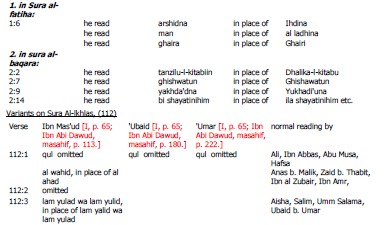
Incluso hoy en día, las variantes y los sinónimos se encuentran en aquellas copias del texto que se atribuyen a los Compañeros, y tienen cierto valor para nosotros en el sentido de que pueden haber servido como una forma primitiva y rudimentaria de tafsir. Por ejemplo, según algunos relatos, las palabras "salat al-wusta" (la oración intermedia) fueron leídas y escritas por Hafsa, [Muwatta' Malik; Jeffery, p. 214.] Ubay [Jeffery, p. 122.] e Ibn 'Abbas [Jeffery, p. 196.] como "salat al-'asr" (es decir, la oración de la tarde).
Even today the variants and synonyms are found in such copies of the text as are attributed to the Companions and are of some value to us in the sense that they may have served as an early rudimentary form of tafsir. For example, according to some reports the words 'salat al-wusta' (middle prayer) were read and written by Hafsa, [Muwatta' Malik; Jeffery, p. 214.] Ubay [Jeffery, p. 122.] and Ibn 'Abbas [Jeffery, p. 196.] as 'salat al-'asr' (i.e. afternoon prayer).
Mientras los sahaba escribieron sus propias copias solo para uso personal, no había nada malo en que no siguieran estrictamente el orden de las suras, que era el orden del Corán. Más tarde, cuando la copia de 'Uthman se convirtió en la versión estándar, los Compañeros adoptaron el orden de esta copia, incluido Ibn Mas'ud, quien quizás fue el que más discrepó. [Ibn Abi Dawud, p. 12; Salih, S.: Mabahith fi 'ulum al-qura'n, Beirut, 1964] También había, como se ha indicado, algunas lecturas variantes en estas copias, [Véase también más abajo, siete lecturas y qira'at.] en las que algunas palabras se pronunciaban y escribían de maneras ligeramente diferentes, etc. Sin embargo, debe tenerse en cuenta que las lecturas variantes suelen ser transmitidas por una sola persona, y ocasionalmente por dos o tres, mientras que la versión llamada texto 'uzmání es mutawatir, es decir, transmitida por numerosas personas, y sin duda es auténtica.
As long as the sahaba wrote their own copies for personal use only, there was nothing wrong, if they did not strictly adhere to the order of suras which was the order of the Qur'an. Later on, when 'Uthman's copy became the standard version, the Companions adopted the order of this copy including Ibn Mas'ud who perhaps differed most. [Ibn Abi Dawud, p. 12; Salih, S.: Mabahith fi 'ulum al-qura'n, Beirut, 1964,] There were also, as indicated, some variant readings in these copies, [See also below, seven readings and qira'at.] when some words were pronounced and spelt in slightly different ways, etc. However, it should be noted that variant readings are usually reported by a single person only, and occasionally by perhaps two or three while the version called the 'Uthmanic text is mutawatir, i.e. transmitted by numerous people and is without doubt authentic.