4.1 Divisiones del texto
4.1 Divisions Of The Text
Aleya y sura
Aya And Sura
Aya (pl. ayat) significa en realidad "signo". En el lenguaje técnico, es la división más corta del texto coránico, es decir, una frase u oración. La revelación es una guía de Dios para la humanidad, por lo que no resulta en absoluto sorprendente que sus divisiones más pequeñas se llamen "signos" (que guían). El término "verso" no es apropiado, ya que el Corán no es poesía.
Aya (pl. ayat) actually means 'sign'. In technical language it is the shortest division of the Qur'anic text, i.e. a phrase or sentence. The revelation is guidance from God to mankind and it is therefore not at all surprising to find that its smallest divisions are called (guiding) 'signs'. The term 'verse' is not appropriate since the Qur'an is not poetry.
Sura (pl. Suwar) significa literalmente "hilera" o "cerca". En el lenguaje técnico, es la división del texto coránico por pasajes, es decir, un capítulo o parte, separada del texto que la precede y del que la sigue.
Sura (pl. Suwar) means literally 'row' or 'fence'. In technical language, it is the passage-wise division of the Qur'anic text,i.e. a chapter or part, set apart from the preceding and following text.
El Corán tiene 114 suras de longitud desigual: la más corta consta de cuatro aleyas y la más larga de 286.
The Qur'an has 114 suras of unequal length, the shortest consisting of four and the longest of 286 ayat.
Todas las suras (con la excepción de la Sura 9) comienzan con las palabras bismillahir rahmanir rahim. Esto no es una adición posterior al texto, sino que ya se utilizaba incluso antes de la llamada de Muhammad ﷺ al profetismo. [Véase la Sura 27: 30.] Las 114 suras del Corán tienen nombres, que sirven como una especie de título. Los nombres se derivan a menudo de una palabra importante o distintiva del propio texto, como, por ejemplo, al-anfal (8) o al-baqara (2). En otros casos se trata de una de las primeras palabras con las que comienza la sura, por ejemplo ta-ha (20) o al-furqan (25).
All suras (with the exception of Sura 9) begin with the words bismillahir rahmanir rahim. This is not a later addition to the text, but was already used, even before Muhammad's call to prophethood. ' [See Sura 27: 30.] All 114 suras in the Qur'an have names, which serve as a sort of heading. The names are often derived from an important or distinguishing word in the text itself, such as e.g. al-anfal (8) or al-baqara (2). In other cases it is one of the first few words with which the sSra begins e.g. ta-ha (20) or al-furqan (25).
Orden y disposición
Order And Arrangement
Tanto el orden de los aleyas dentro de cada sura como la disposición de las suras fueron finalmente determinados por el Profeta ﷺ bajo la guía del Ángel Gabriel en el año de su muerte, cuando Gabriel vino dos veces a revisar el texto con él. [Véase más arriba. transmisión de la revelación coránica, p. 31.] Los eruditos también han agrupado las suras en cuatro tipos.
Both the order of the ayat within each sura and the arrangement of the suras were finally determined by the Prophet under guidance from the Angel Gabriel in the year of his death, when Gabriel twice came to revise the text with him. [See above. transmission of the Qur'anic revelation, p. 31.] Scholars have also grouped the suras into four kinds:
al-tiwal (las largas): 2-10.
al-tiwal (long ones): 2-10.
al-Mi'un: suras con aproximadamente 100 aleyas: 10-35.
al-mi'un: suras with approximately 100 ayat: 10-35.
al-mathani: suras con menos de 100 aleyas: 36-49.
al-mathani: suras with less than 100 ayat: 36-49.
Al-Mufassal: la última sección del Corán, que comienza con la sura Qaf: 50-114.
al-mufassal: the last section of the Qur'an beginning with Sura qaf: 50-114.
Otras divisiones del texto
Other Divisions Of The Text
Juz' (pl. ajza') significa literalmente parte, porción. El Corán está dividido en 30 porciones de longitud aproximadamente igual para facilitar su recitación durante las treinta noches de un mes, especialmente del mes de Ramadán. Habitualmente se indican con la palabra juz' y el número correspondiente junto a ella (p. ej., juz' 30, que comienza con la sura 78).
Juz' (pl. ajza') literally means part, portion. The Qur'an is divided into 30 portions of approximately equal length for easy recitation during the thirty nights of a month, especially of the month of Ramadan. Usually they are indicated by the word and the number of it given alongside, (e.g. juz' 30 beginning with Sura 78).
Algunos ejemplares del Corán dividen las suras en párrafos llamados rukū‘. Se indican con el símbolo, y la explicación de los números arábigos escritos junto a cada uno es la siguiente, por ejemplo 2:20:
Some copies of the Qur'an have the suras divided into paragraphs called ruku'. They are indicated by the symbol and the explanation of the Arabic numerals written with each is as follows, e.g. 2:20:
La cifra superior (2) indica que este es el segundo ruku' completo de la respectiva sura (aquí, la sura Al-Baqara).
The top figure (2) indicates that this is the second completed ruku ' in the respective sura (here Sura albaqara)
.
.
La cifra del centro (13) indica que este ruku' completo contiene 13 aleyas.
The middle figure (13) indicates that this completed ruku' contains 13 ayat.
La cifra inferior (2) indica que este es el segundo ruku' en el respectivo juz' (aquí, el primer juz').
The lower figure (2) indicates that this is the second ruku' in the respective juz' (here first juz').
Los ejemplares del Corán impresos en Oriente Medio, en particular, tienen cada yuz' subdividido en cuatro hizb, indicados mediante el signo, por ejemplo, 2:74 es el comienzo del segundo hizb del Corán, indicado por la cifra 2:
Copies of the Qur'an printed in the Middle East in particular have each juz' subdivided into four hizb indicated by the sign e.g. 2:74 is the beginning of the second hizb of the Qur'an, indicated by the figure 2:
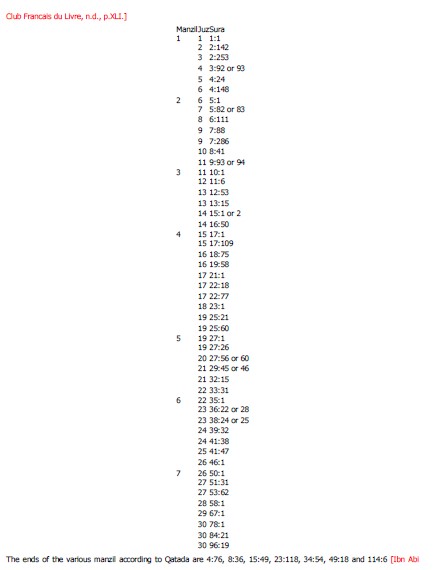
Cada hizb se subdivide a su vez en cuartos. El texto coránico también se divide en siete partes de longitud aproximadamente igual, llamadas manzil, para su recitación a lo largo de siete días, indicadas en algunos ejemplares mediante la palabra manzil y el número correspondiente en el margen. La siguiente tabla muestra la división del texto en juz' y manzil: [Hamidullah, Muhammad: Le Saint Coran. Traduction integraleetnores. Paris: