1.4 Quand la « Mu’akhaah » (le pacte de fraternité) a-t-elle été conclue et quand la Sahifah (d'Al-Madinah) a-t-elle été rédigée ?
1.4 When was the “Mu’akhaah” (brotherhood pact) concluded and when was the Sahifah (of Al-Madinah) written?
Les textes qui ont déjà été présentés devraient être suffisants et, à partir d'eux, nous déduisons ce qui suit :
The texts that have already been presented should be sufficient and from them we deduce the following:
1) L'avis correct est que cette fraternité entre les émigrés (Muhajirun) et les auxiliaires (Ansar) n'a pu avoir lieu avant la mort d'As’ad bin Zurarah (qu’Allah l’agrée), lors de la construction de la mosquée, environ sept mois après l'arrivée du Prophète ﷺ. Il est inconcevable qu'elle ait eu lieu de son vivant sans qu'il y ait été mentionné, car il était le chef des auxiliaires (Ansar) et l'un des Naqeebs (dirigeants choisis parmi les auxiliaires (Ansar) lors du second pacte d'‘Aqabah). Par conséquent, la déclaration d'Abu ‘Umar ibn Abd AlBarr :
1) The correct view is that this brotherhood between the Muhajirin and the Ansar could not possibly have taken place prior to the death of As’ad bin Zurarah (May Allah be pleased with him), during the building of the Masjid, about seven months following the arrival of the Prophet (peace be upon him). It is not conceivable that it took place in his lifetime without him having been mentioned in it, as he was chief of the Ansar and one of the Naqeebs (selected leaders of the Ansar at the second pledge of ‘Aqabah). Therefore, the statement of Abu ‘Umar ibn Abd AlBarr:
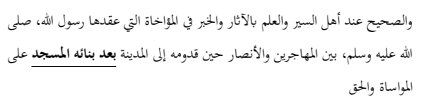
« La vue correcte, telle que soutenue par les savants de la Seera et les rapports concernant la "Mu’akhaah" (fraternité) que le Messager d'Allah ﷺ a établie entre les émigrés (Muhajirun) et les auxiliaires (Ansar), lorsqu'il est arrivé à Al-Madinah, était qu'elle a eu lieu après la construction de la mosquée par ses soins et qu'elle reposait sur la base de l'assistance/du soutien et du Haqq (la vérité) ... »
“The correct view as held by the scholars of Seera and reports in respect to the “Mu’akhaah” (brotherhood) which the Messenger of Allah (peace be upon him) concluded between the Muhajirin (emigrants) and the Ansar (helpers), when he came to Al-Madinah, was that it took place after his building of the Masjid and it was upon the basis of the provision of assistance/support and the Haqq (truth) …” .
est tout à fait concevable, d'autant plus que l'achèvement de la construction de la mosquée et la célébration de son inauguration représentaient une bonne occasion pour entreprendre une telle démarche. De plus, elle a dû être entreprise avant la bataille de Badr car ‘Ubaida bin Al-Harith (bin Al-Muttalib bin ‘Abd Manaf bin Qusayy Al-Qurashi Al-Muttalibi) y est mentionné aux côtés de son frère ‘Umair bin Al-Humam (bin Al-Jamuh bin Zaid bin Haram bin Ka’b) et ils furent tous deux martyrisés lors de la bataille de Badr, qu’Allah les agrée. Ils furent frères dans la vie et dans la mort, et nous espérons d'Allah qu'ils en soient ainsi également au Jour du Jugement. 2) L'avis correct est que cette fraternité entre les émigrés (Muhajirun) et les auxiliaires (Ansar) n'était pas écrite à l'origine, car sa nature était incompatible avec cela. En effet, tous les récits, sans exception, ne mentionnent aucun document écrit. Un examen des livres de Seera, d'histoire et de hadith révèle l'absence de mention de toute charte, document écrit ou code avant la Sahifah d'Al-Madinah. Les exceptions à cela incluent :
is very conceivable, and particularly as the completion of the building of the Masjid and the celebration for its opening, represented a good occasion for such a step to be undertaken. I addition, it must have been undertaken prior to the battle of Badr because Ubaida bin Al- Harith (bin Al-Muttalib bin Abd Manaf bin Qusayy Al-Qurashi Al-Muttalibi) is mentioned in it along with his brother ‘Umair bin Al- Humam (bin Al-Jamuh bin Zaid bin Haram bin Ka’b) and they were both martyred at the battle of Badr, may Allah be pleased with them. They were brothers in life and at death, and we hope from Allah that they be like that also, on the Day of Judgement. 2) The correct view is that this brotherhood between the Muhajirin and the Ansar was not written in origin as its nature was incompatible with that. That is because all of the narrations, without exception, do not mention a written document at all. An examination of the books of Seera, history and Hadith reveal the absence of the mention of any charter, written document or code prior to the Sahifah of Al-Madinah. The exception to that included:
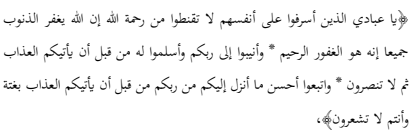
« Dis : "Ô Mes serviteurs qui avez commis des excès à votre propre détriment, ne désespérez pas de la miséricorde d'Allah. Car, certes, Allah pardonne tous les péchés. Car, certes, c'est Lui le Pardonneur, le Miséricordieux". Et revenez [en repentant] vers votre Seigneur et soumettez-vous à Lui avant que le châtiment ne vienne sur vous ; alors vous ne serez pas secourus. Et suivez le meilleur de ce qui vous a été révélé par votre Seigneur avant que le châtiment ne vous atteigne soudainement alors que vous n'en avez pas conscience" [TMQ 39:53-55].
“Say, “O My servants who have transgressed against themselves [by sinning], do not despair of the mercy of Allah. Indeed, Allah forgives all sins. Indeed, it is He who is the Forgiving, the Merciful”. And return [in repentance] to your Lord and submit to Him before the punishment comes upon you; then you will not be helped. And follow the best of what was revealed to you from your Lord before the punishment comes upon you suddenly while you do not perceive” [TMQ 39:53-55].
b) La Majallah de Luqman : Al-Majallah et de même As-Sijli sont une Sahifah (un document écrit) que l'on tourne ou (dont les pages sont) tournées. Cela ressemble à ce qui a été mentionné dans « Dala’il An-Nubuwwah » d'Al-Baihaqi (2/419). (Après avoir mentionné la chaîne de transmission complète) ‘Asim bin ‘Umar bin Qatadah Al-Ansaariy a rapporté des Shuyukh (anciens) de son peuple, qu'ils ont dit :
b) The Majallah of Luqman: Al-Majallah and likewise As-Sijli are a Sahifah (written document) that is turned or (its pages) turned over. That is like what came mentioned in “Dala’il An-Nubuwwah” of Al- Baihaqi (2/419). (After mentioning the full line of transmission) ‘Asim bin ‘Umar bin Qatadah Al-Ansaariy related from the Shuyukh (elders) of his people, that they said:
« Suwaid bin As-Samit, le frère des Bani ‘Amr bin ‘Awf, vint à Makkah en tant que pèlerin pour le pèlerinage (Hajj) et le petit pèlerinage (Umrah). Suwaid était décrit par son peuple comme étant le modèle de perfection parmi eux, en raison de son âge, de sa peau et de ses cheveux. Il (le narrateur) a dit :
“Suwaid bin As-Samit, the brother of Bani ‘Amr bin ‘Awf, came to Makkah as a pilgrim for Hajj of ‘Umrah. Suwaid was described by his people as being the model of perfection among them, due to his age, skin and hair. He (the narrator) said:
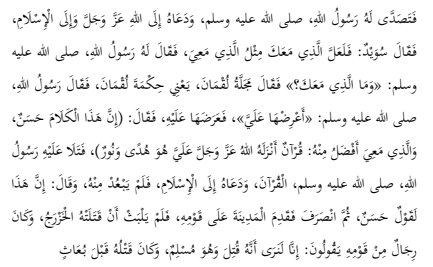
Ensuite, le Messager d'Allah ﷺ s'approcha de lui et l'invita vers Allah ‘Azza Wa Jalla et vers l'Islam. Suwaid dit : « Il se peut que ce que tu possèdes soit semblable à ce que je possède ». Alors, le Messager d'Allah ﷺ demanda : « Et qu'as-tu donc ? » Il répondit qu'il possédait la Majallah de Luqman, signifiant la Hikmah (sagesse) de Luqman. Le Messager d'Allah ﷺ dit alors : « Montre-le-moi », et il le fit. Il ﷺ dit : « Ce discours est bon, mais ce que j'ai est meilleur que cela. C'est un Coran qu'Allah ‘Azza Wa Jalla a révélé, et c'est une guidance et une lumière ». Le Messager d'Allah ﷺ lui récita ensuite le Coran et l'invita à l'Islam. Il ne s'en éloigna pas et dit : « Certes, c'est un bon discours ». Il partit ensuite et arriva plus tard à Al-Madinah auprès de son peuple. Peu de temps après, il fut tué par les Khazraj. Il y avait des hommes de son peuple qui disaient : « Nous estimons qu'il a été tué alors qu'il était musulman » et son assassinat eut lieu avant la guerre de Bu’ath » [Fin de la citation]. c) La Sahifah (document écrit) du Boycott (oppressif et maudit) que les Quraish avaient suspendue à l'intérieur de la Ka’ba ; son histoire, l'histoire des termites qui la dévorèrent, puis son histoire bien connue, transmise par de multiples voies (Mutawatir), concernant son annulation. d) Les pages (Suhuf) que le Messager d'Allah ﷺ remit aux commandants des expéditions militaires, contenant des instructions, et elles étaient scellées ou assemblées. Et un exemple de cela est ce qui est mentionné dans le « Kitab ul-Maghazi » d'Al-Waqidi (1/13) :
Then, the Messenger of Allah (peace be upon him) approached him and invited him to Allah ‘Azza Wa Jalla and to Islam. Suwaid said: “It may be that what you have is like that which I have”. So, the Messenger of Allah (peace be upon him) asked: “And what do you have?” He responded by saying that he had the Majallah of Luqman, meaning the Hikmah (wisdom) of Luqman. The Messenger of Allah (peace be upon him) then said: “Show it to me” and so he did. He (peace be upon him) said: “This speech is good but what I have is better than it. It is a Qur’an that Allah ‘Azza Wa Jalla has revealed and it is guidance and light”. The Messenger of Allah (peace be upon him) then recited the Qur’an to him and invited him to Islam. He didn’t distance himself from it and said: “Verily, this is a good speech”. He then left and later arrived to Al-Madinah to his people. It was not long thereafter that he was killed by the Khazraj. There were men from his people who would say: “We view that he was killed whilst he was a Muslim” and his killing occurred before the war of Bu’ath” [End of Quote]. c) The Sahifah (written document) of the (oppressive and accursed) Boycott which the Quraish hung inside the Ka’ba along; its story, the story of the termites eating it and then its well-known Mutawatir story concerning its nullification. d) The pages (Suhuf) which the Messenger of Allah (peace be upon him) gave to the commanders of the military expeditions, containing instructions, and they were sealed or patched together. And example of that is what came stated in Al-Waqidi’s “Kitab ul-Maghazi” (1/13):
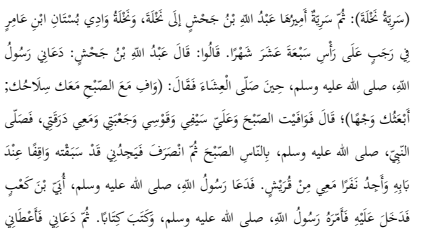
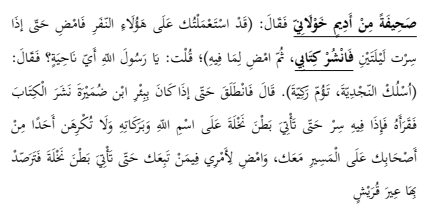
« L'expédition vers Nakhla commandée par Abdullah bin Jahsh (Nakhla est une vallée dans le Bustan (Verger) d'Ibn ‘Amir) a eu lieu au mois de Rajab, le dix-septième mois AH. »
“The expedition to Nakhla commanded by Abdullah bin Jahsh (Nakhla is a valley in the Bustan (Orchard) of Ibn ‘Amir) took place in the month of Rajab, the seventeenth month AH.
Ils ont dit : Abdullah bin Jahsh a dit : Le Messager d'Allah ﷺ m'a appelé lorsqu'il a prié l'Isha', et a dit : « Viens à moi à l'aube avec tes armes, car je t'enverrai en mission ». Il a dit : Ainsi, je me suis approché à l'aube avec mon épée, mon arc, mon carquois et mon bouclier. Le Prophète ﷺ a prié le Subh avec les gens, puis il est parti et m'a trouvé. Il m'a trouvé ayant déjà devancé sa présence, debout à sa porte, tandis que je trouvais un groupe des Quraysh (c'est-à-dire des émigrés (Muhajirun)) avec moi là. Le Messager d'Allah ﷺ a appelé Ubayy bin Ka’b et lui a ordonné d'écrire un document. Puis il m'a appelé et m'a donné la peau de Khawlan, en disant : « Je t'ai nommé sur ce groupe. Procède jusqu'à ce que tu aies voyagé pendant deux nuits. Ensuite, ouvre ma lettre et fais ce qu'elle dit ». J'ai dit : « Ô Messager de Dieu, dans quelle direction ? » Il a répondu : « Va vers Najdiyya jusqu'à ce que tu atteignes un petit puits ». Le narrateur a dit : Abdullah bin Jahsh s'est hâté, jusqu'à ce qu'il atteigne le puits d'Ibn Dumayra. Il a ensuite ouvert la lettre et l'a lue. Elle disait : « Va, au nom d'Allah et avec Ses bénédictions, jusqu'à ce que tu arrives à la vallée de Nakhla, mais ne force aucun de tes compagnons à partir avec toi. Procède selon mes commandements avec quiconque te suit, jusqu'à ce que tu atteignes la vallée de Nakhla et que tu attendes en embuscade la caravane des Quraysh à partir de là » [Fin de la citation].
They said: Abdullah bin Jahsh said: The Messenger of Allah (peace be upon him) called for me when he prayed Ishaa’, and said: “Come to me at dawn with your weapons, as I will send you on a mission”. He said: So, I approached at dawn with my sword, my bow, my quiver and my shield. The Prophet prayed Subh (i.e. Fajr) with the people, and then he left and found me. He found me having preceded him already standing at his door whilst I found a group of the Quraysh (i.e. Muhajirun) with me there. The Messenger of Allah (peace be upon him) called for Ubayy bin Ka’b and commanded him to write a document. Then he called me and gave me the sheet of leather from Khawlan, saying: “I have appointed you over this group. Proceed until you have travelled for two nights. Then open my letter and do as it says”. I said: “O Messenger of God, in which direction?” He replied, “Go towards Najdiyya until you reach a small well”. The narrator said: Abdullah bin Jahsh hastened, until he reached the well of Ibn Dumayra. He then opened the letter and read it. It said: “Go, in the name of Allah and with His blessings, until you come to the valley of Nakhla, but do not force any one of your companions to go with you. Proceed according to my commands with whoever follows you, until you reach the valley of Nakhla and lie in wait for the caravan of Quraysh from there” [End of Quote].
Résumé de la conclusion
Summary Conclusion
Chaque fois que nous trouvons un récit concernant une Sahifah ou un document écrit entre les émigrés (Muhajirun) et les auxiliaires (Ansar), ou concernant les droits de prix du sang, la guerre ou la paix, nous savons, par nécessité, que cela n'a aucun rapport avec cette « Mu’akhaah » (formation de fraternité). Soit cela se rapporte à la Sahifah d'Al-Madinah, soit à quelque chose qui fut écrit (bien) plus tard qu'elle. Il n'y a également aucune validité dans ce qui est rapporté dans « As-Seera An-Nabawiyah » par Ahmad Abu Zaid (p. 71) sous le titre « La date de la rédaction du traité (Mu’ahadah) avec les Juifs » : « L'un des chercheurs contemporains a trouvé prépondérant que le document était en réalité deux documents à l'origine, puis que les historiens les ont combinés en un seul. L'un d'eux traitait du traité du Messager d'Allah ﷺ avec les Juifs et fut écrit avant la grande bataille de Badr. Tandis que le second clarifiait les engagements (devoirs) des musulmans parmi les émigrés (Muhajirun) et les auxiliaires (Ansar), leurs droits et obligations. Il a dit : "Il est prépondérant selon mon avis que le document de l'accord de paix (Muwada’ah) avec les Juifs fut écrit avant la grande bataille de Badr. Quant au second document, il fut écrit après celle-ci". Les sources classiques ont exprimé ce qui soutient cette prépondérance. Abu ‘Ubaid Al-Qasim bin Salam a dit : "La Wathiqa (document) fut écrite en deux occasions, lorsque le Prophète ﷺ arriva à Al-Madinah, avant la dominance de l'Islam et son renforcement, et avant qu'il ne reçoive l'ordre de prélever la capitation (Jizyah) auprès des Ahl ul-Kitab (les gens du livre)". Al-Baladhari a dit : "Lorsque le Messager d'Allah ﷺ arriva à Al-Madinah, il conclut un traité (Muwada’ah) avec les Juifs et écrivit entre lui et eux un document. Il stipula qu'ils ne devraient ni soutenir ni prendre parti pour ses ennemis, qu'ils devraient le soutenir contre ceux qui l'attaqueraient, et qu'il ne combattrait pas pour la défense des Ahl udh-Dhimmah". Il ne fit alors la guerre à personne, ils ne le calumnièrent pas et il ne dépêcha aucune expédition militaire, jusqu'à ce qu'Allah ‘Azza Wa Jalla révèle : « La permission [de combattre] a été donnée à ceux qui sont combattus parce qu'ils ont été injustement traités. Et certes, Allah est capable de leur donner la victoire. [Ce sont] ceux qui ont été expulsés de leurs demeures sans droit » (TMQ 22:39-40).
Wherever we find a narration about a Sahifah or a written document between the Muhajirin and the Ansar, or concerning blood money rights, war or peace, we know, by necessity, that it bears no relation to this “Mu’akhaah” (formation of brotherhood). It would either be related to the Sahifah of Al-Madinah or something that came or was written (much) later than it. There is also no validity in what came related in “As-Seera An- Nabawiyah” by Ahmad Abu Zaid (p. 71) under the heading “The date of the writing of the treaty (Mu’ahadah) with the Jews”: “One of the contemporary researchers found preponderant that the document was actually two documents in origin and then the historians combined them into one. One of them dealt with the treaty of the Messenger of Allah (peace be upon him) with the Jews and was written prior to the great battle of Badr. That is whilst the second clarified the commitments (duties) of the Muslims from the Muhajirin and the Ansar, their rights and obligations. He said: “It is preponderant in my view that the peace agreement (Muwada’ah) document with the Jews was written before the great battle of Badr. As for the second document, then it was written after it”. The classical sources have expressed that which supports this preponderance. Abu ‘Ubaid Al-Qasim bin Salam said: “The Wathiqa (document) was written on two occurrences, when the Prophet (peace be upon him) arrived in Al-Madinah, prior to the dominance of Islam and its becoming strong and before he was commanded to take the Jizyah from Ahl ul-Kitab (the people of the book)”. Al-Baladhari said: “When the Messenger of Allah (peace be upon him) arrived in Al-Madinah he made a treaty (Muwada’ah) with the Jews and wrote between himself and them a document. He stipulated upon them that they should not support or side with his enemies, to support him against those who attack him and that he would not fight in defence of the Ahl udh-Dhimmah. He did not then wage war against anyone, they did not defame him and he did not dispatch a military expedition, until Allah ‘Azza Wa Jalla revealed: “Permission [to fight] has been given to those who are being fought, because they were wronged. And indeed, Allah is capable of providing them victory. [They are] those who have been evicted from their homes without right” (TMQ 22:39- 40)”.

« La permission [de combattre] a été donnée à ceux qui sont combattus, parce qu'ils ont été victimes d'injustice. Et certes, Allah est capable de leur donner la victoire. »
“Permission [to fight] has been given to those who are being fought, because they were wronged. And indeed, Allah is capable of providing them victory.
« [Ce sont] ceux qui ont été expulsés de leurs demeures sans droit » [TMQ 22:39-40]
[They are] those who have been evicted from their homes without right” [TMQ 22:39-40]
C'est parce que la « Muwada’ah » (paix et trêve) est la situation naturelle et originelle et n'a pas besoin d'être convoquée pour être établie. Ensuite, si une guerre devait avoir lieu, la « Muwada’ah » cesserait et ne reviendrait pas avant que la guerre ne se termine par une trêve, un traité ou un accord de paix.
That is because the “Muwada’ah” (peace and truce) is the natural and original situation and is not in need of being convened in order to establish it. Then, if war was to take place, the “Muwada’ah” would cease and it would not return until the war ends by way of a truce, treaty or peace agreement.
Par conséquent, la « Muwada’ah » représente un statut qui peut être présent ou absent. Ainsi, la parole du Messager d'Allah ﷺ : « Laissez les Abyssins en paix tant qu'ils vous laissent en paix » signifie nécessairement : affirmer et maintenir le statu quo de la Muwada’ah (paix et trêve) tant que l'Abyssinie en fait de même. À ce titre, concernant l'énoncé utilisé par les savants de la Seera et les rapports concernant le Prophète ﷺ tels que : « Lorsqu'il arriva à Al-Madinah, il fit la paix avec tous les Juifs qui y résidaient », il n'est pas permis de comprendre qu'il a établi une « Muwada’ah » officielle ou conclu un pacte (traité officiel). Cela signifie plutôt qu'il a affirmé et maintenu le statu quo originel de la trêve et de la paix existant entre eux.
Consequently, the “Muwada’ah” represents a status that could be present or absent. Therefore, the statement of the Messenger of Allah (peace be upon him): “Leave the Abyssinians be as long as they leave you be” means by necessity: Affirm and continue upon the status quo of the Muwada’ah (peace and truce) as long as Abyssinia does so. As such, in respect to the statement used by the scholars of Seera and reports concerning the Prophet (peace be upon him) like: “When he arrived in Al-Madinah he made peace with all of the Jews who were residing there”, it is not permissible to be understood to mean that he established an official “Muwada’ah” or contracted a covenant (official treaty). Rather, it means that he affirmed and continued upon the original status quo of the truce and peace existing between them.
Si nous prêtions attention à ce qui a été rapporté de lui ﷺ : « S'il s'était conformé à ce que d'autres que lui, qui partageaient son avis, avaient respecté, il n'aurait pas été assassiné. Cependant, il nous a insultés et s'est moqué de nous par la poésie, et aucun d'entre vous n'aurait fait cela s'il n'avait pas eu une épée », nous verrions que cela confirme parfaitement cet avis que nous soutenons. En effet, rien n'y est mentionné concernant un pacte ou un traité qui aurait été rompu par Ka’b bin Al-Ashraf. Au contraire, il ne s'est pas conformé et n'a pas confirmé la paix (Muwada’ah) que d'autres avaient respectée. L'imam Ibn ul-Qayyim (qu'Allah fasse miséricorde à lui) était conscient de cela. Il a déclaré dans son livre « Ahkam Ahu dh-Dhimmah » (3/1404) :
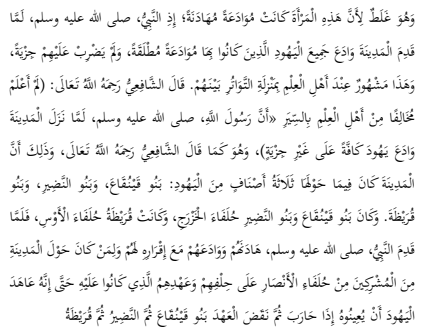
« Et c'est une erreur car cette femme était en paix et sous une trêve (Muhadanah). Cela est dû au fait que lorsque le Prophète ﷺ est arrivé à Al-Madinah, il a conclu la paix avec tous les Juifs qui y résidaient de manière sans restriction et il ne leur a pas imposé la capitation (Jizyah). Ceci est bien connu des gens de la science au point d'atteindre le niveau de Tawatur (transmission concurrente décisive) parmi eux. Ash-Shafi’iy (que la miséricorde d'Allah soit sur lui) a dit : “Je ne connais personne parmi les gens de la science de la Seera qui soit en désaccord sur le point suivant : ‘Que lorsque le Messager d'Allah ﷺ s'est installé à Al-Madinah, il a conclu la paix avec tous les Juifs sans l'imposition de la capitation (Jizyah)’”. C'est tel qu'Ash-Shafi’iy (que la miséricorde d'Allah soit sur lui) l'a déclaré. Cela est dû au fait qu'Al-Madinah était entourée de trois groupes de Juifs : Banu Qainuqaa’, Banu An-Nadir et Banu Quraizha. Banu Qainuqaa’ et Banu An-Nadir étaient les alliés des Khazraj, tandis que Banu Quraizha étaient les alliés des Aws. Puis, lorsque le Messager d'Allah ﷺ est arrivé à Al-Madinah, il a conclu une trêve et la paix avec eux par son approbation d'eux, aux côtés de ceux qui entouraient Al-Madinah parmi les polythéistes qui étaient les alliés des auxiliaires (Ansar), sur la base de leur alliance et du pacte sur lequel ils étaient précédemment. Il a même pris un pacte des Juifs selon lequel ils le soutiendraient s'ils étaient combattus. Ensuite, Banu Qainuqaa’ a rompu le pacte, suivis par An-Nadir puis Quraizha” [Fin de la citation].
“And it is a mistake because this woman was at peace and under a truce (Muhadanah). That is because when the Prophet (peace be upon him) came to Al-Madinah he made peace with all of the Jews residing there an unrestricted manner and he did not impose Jizyah upon them. This is well-known by the people of knowledge to the level of Tawatur (decisive concurrent transmission) among them. Ash- Shafi’iy (may Allah’s mercy be upon him) said: “I do not of any from the people of knowledge of Seera who disagree upon the point “That when the Messenger of Allah (peace be upon him) settled in Al- Madinah, he made peace with all of the Jews without the imposition of the Jizyah”. It is as Ash-Shafi’iy (May Allah’s mercy be upon him) stated. That is because Al-Madinah had three groups of Jews surrounding it: Banu Qainuqaa’, Banu An-Nadir and Banu Quraizha. Banu Qainuqaa’ and Banu An-Nadir were allies of the Khazraj, while Banu Quraizha were allies of the Aws. Then when the Messenger of Allah (peace be upon him) came to Al-Madinah, he made a truce and peace with them with his approval of them, alongside those who were around Al-Madinah from the polytheists who were allies of the Ansar, upon the basis of their alliance and covenant that they had previously been upon. He even took a covenant from the Jews that they would support him if he was fought against. Then, Banu Qainuqaa’ broke the covenant, followed by An-Nadir and then Quraizha” [End of Quote].

« La Wathiqa (document) fut écrite à deux occasions (Hadathani), lorsque le Prophète ﷺ arriva à Al-Madinah, avant la dominance de l'Islam et son renforcement, et avant qu'il ne reçoive l'ordre de prélever la capitation (Jizyah) auprès d'Ahl ul-Kitab (les gens du Livre) ».
“The Wathiqa (document) was written on two occurrences (Hadathani), when the Prophet (peace be upon him) arrived in Al- Madinah, prior to the dominance of Islam and its becoming strong and before he was commanded to take the Jizyah from Ahl ul-Kitab (the people of the book)” .
est vague car le mot « Hadathani » ne nous établit pas de cadre temporel déterminé pouvant être pris en considération. L'Islam ne s'est manifesté de manière prévalente et n'est devenu véritablement puissant qu'après la défaite des coalisés (Ahzab, c'est-à-dire la bataille de la tranchée). Cela est dû au fait que le Prophète ﷺ commença à passer à l'offensive contre les gens et que ceux-ci n'étaient plus à l'offensive contre lui. De plus, nous ne savons pas quand il a reçu l'ordre de prélever la capitation (Jizyah) auprès des gens. Cela alors que sa déclaration « prélevez la capitation (Jizyah) auprès des Ahl ul-Kitab (les gens du Livre) » est une répétition d'une erreur bien connue, car la vérité est que la capitation (Jizyah) était prélevée même auprès des polythéistes, y compris les Majus, comme cela a été rapporté dans le hadith d'An-Nu’man bin Muqarrin, consigné dans Sahih Muslim et d'autres recueils. 2) Quant à la déclaration d'Al-Baladhari
is vague because the word “Hadathani” does not establish for us a determined time frame that can be taken into consideration. Islam only manifested in a prevalent manner and truly became powerful following the defeat of the confederates (Ahzab i.e. battle of the trench). That is because the Prophet (peace be upon him) began to go on the offensive against the people and they were no longer on the offensive against him. In addition, we do not know when he was commanded to take the Jizyah from the people. That is whilst his statement “take the Jizyah from Ahl ul-Kitab (the people of the book)” is a repetition of a well-known error, as the truth is that the Jizyah was taken even from the polytheists, including the Majus, as has come stated in the Hadith of An-Nu’man bin Muqarrin, recorded in Sahih Muslim and other collections. 2) As for the statement of Al-Baladhari
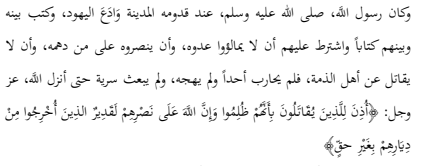
« Lorsque le Messager d'Allah ﷺ arriva à Al-Madinah, il conclut un traité (Muwada’ah) avec les Juifs et rédigea entre lui et eux un document. Il stipula qu'ils ne devaient ni soutenir ni prendre parti pour ses ennemis, qu'ils devaient le soutenir contre ceux qui l'attaquaient et qu'il ne combattrait pas pour la défense des Ahl udh-Dhimmah. Il ne fit alors la guerre à personne, ils ne le calomnièrent pas et il ne dépêcha aucune expédition militaire, jusqu'à ce qu'Allah ‘Azza Wa Jalla révèle : “La permission [de combattre] a été donnée à ceux qui sont attaqués, parce qu'ils ont été victimes d'injustice. Et certes, Allah est capable de leur donner la victoire. [Ce sont] ceux qui ont été expulsés de leurs demeures sans droit” (TMQ 22:39-40) ».
“When the Messenger of Allah (peace be upon him) arrived in Al- Madinah he made a treaty (Muwada’ah) with the Jews and wrote between himself and them a document. He stipulated upon them that they should not support or side with his enemies, to support him against those who attack him and that he would not fight in defence of the Ahl udh-Dhimmah. He did not then wage war against anyone, they did not defame him and he did not dispatch a military expedition, until Allah ‘Azza Wa Jalla revealed: “Permission [to fight] has been given to those who are being fought, because they were wronged. And indeed, Allah is capable of providing them victory. [They are] those who have been evicted from their homes without right” (TMQ 22:39-40)”.
Ce discours est contradictoire car il ﷺ n'avait pas été autorisé à l'origine à s'engager dans le combat avant la révélation du verset (Ayah) et n'était en état de guerre avec personne. Il n'y avait pas non plus d'attente d'une attaque contre Al-Madinah. Par conséquent, la phrase de son discours : « Il leur a stipulé qu'ils ne devaient ni soutenir ni prendre parti pour ses ennemis, afin de le soutenir contre ceux qui l'attaquent », qui résumait une partie de ce qui était énoncé dans la « Sahifah », est inconcevable et n'avait aucune réalité durant cette période. Plus atroce encore est l'affirmation : « Et qu'il ne combattrait pas pour la défense des Ahl udh-Dhimmah », en supposant qu'il n'y ait pas d'erreur d'impression. Premièrement, il n'y avait pas d'« Ahl udh-Dhimmah » là-bas à l'origine. Deuxièmement, comment se fait-il qu'ils soient obligés de le soutenir contre ceux qui l'attaquent, alors que lui n'est pas obligé de les soutenir contre ceux qui les attaquent ?! 3) La déclaration d'Al-Baladhariy concernant Banu Qainuqaa’ :
This speech is contradictory because he (peace be upon him) had not been permitted in origin to engage in fighting prior to the revelation of the Aayah and was not in a state of war with anyone. There was also no expectation for Al-Madinah to be attacked. Therefore, the sentence from his speech: “He stipulated upon them that they should not support or side with his enemies, to support him against those who attack him”, which summarized some of what came stated in the “Sahifah”, is inconceivable and has no reality to it during that time period. Even more atrocious is the statement: “And that he would not fight in defence of the Ahl udh-Dhimmah”, assuming there was no error in the printing. Firstly, there were no “Ahl udh-Dhimmah” there in origin. Secondly, how could it be that they are obliged to support him against those who attack him, whilst he is not obliged to support them against those who attack them?! 3) The statement of Al-Baladhariy concerning Banu Qainuqaa’:
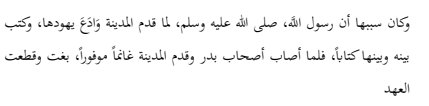
« La raison en était que le Messager d'Allah ﷺ, lorsqu'il arriva à Al-Madinah, conclut un accord de paix avec ses Juifs et rédigea un document entre lui et eux. Puis, lorsque les Musulmans furent victorieux à Badr et revinrent à Al-Madinah avec un butin abondant, les Juifs se révoltèrent et rompirent le pacte », alors cela n'a également aucun sens. C'est parce que la « Muwada’ah » (état de paix) est l'origine et n'a pas besoin d'être officiellement contractée mutuellement ou écrite. C'est alors que Ka’b bin Al-Ashraf fut le premier à transgresser, à faire la guerre et à rompre la « Muwada’ah » (état de paix ou trêve) qui, comme mentionné précédemment, a été établie via des transmissions transmises par de multiples voies (Mutawatir) et il écrivit ensuite la « Sahifah » qui n'était pas le but de l'établissement d'une « Muwada’ah » mais plutôt d'établir une « Union Confédérale (Ittihad Confedarali) ». Par la suite, Bani Qainuqaa’ sortit de l'« union » et fit la guerre, suivis par Banu An-Nadir, puis Quraizhah le trahit. 4) Concernant la déclaration d'At-Tabari :
“The reason for it was that the Messenger of Allah (peace be upon him), when he arrived in Al-Madinah, made a peace agreement with its Jews and wrote a document between himself and them. Then, when the Muslims were victorious at Badr and came back to Al- Madinah with abundant booty, the Jews rebelled and broke the covenant”, then this also has no meaning to it. That is because the “Muwada’ah” (state of peace) is the origin and does not need to be officially mutually contracted or write. That is while Ka’b bin Al-Ashraf was the first to transgress, war and cut the “Muwada’ah” (state of peace or truce) which, as previously mentioned, has been established via Mutawatir (decisive concurrent) transmissions and he then wrote the “Sahifah” which was not the purpose of establishing a “Muwada’ah” but rather to establish a “Confederal Union (Ittihad Confedarali)”. Thereafter, Bani Qainuqaa’ exited from the “union” and waged war, followed by Banu An-Nadir and then Quraizhah betrayed it. 4) Concerning the statement of At-Tabari:
« Puis le Messager d'Allah ﷺ resta à Al-Madinah après son retour de Badr. Lorsqu'il arriva à Al-Madinah, il conclut un pacte de paix avec ses Juifs à la condition qu'ils n'aident personne contre lui et que, s'il était attaqué à Al-Madinah par un ennemi, ils le soutiendraient. Puis, lorsque le Messager d'Allah ﷺ tua ceux qu'il avait tués parmi les Mushriks (associateurs) de Quraish, ils firent preuve d'envie et de rébellion envers lui et manifestèrent la rupture de l'alliance »,
“Then the Messenger of Allah (peace be upon him) remained in Al- Madinah after his return from Badr. When he had arrived in Al- Madinah he had made a peace agreement with its Jews upon the stipulation that they do not assist anyone against him and that if he was attacked in Al-Madinah by an enemy, they would support him. Then when the Messenger of Allah (peace be upon him) killed those whom he had killed from the Mushrikin (polytheists) of Quraish, they demonstrated envy and rebelliousness towards him and demonstrated the breaching of the covenant”,
cela est donc conforme aux propos d'Al-Baladhariy mentionnés plus haut et la réfutation est la même, bien que ce soit bien meilleur. Cela est parce qu'il n'a pas affirmé que l'ancienne « Muwada’ah » (accord de paix/trêve), avant Badr, était un document écrit, comme Al-Baladhariy a commis l'erreur de le faire, tout comme son texte n'inclut pas quelque chose d'équivalent à la phrase atroce « Et qu'il ne combattrait pas pour la défense des Ahl udh-Dhimmah ». Malgré cela, l'affirmation d'At-Tabari concernant la « rupture de l'alliance (Naqdh Al‘Ahd) » n'est pas quelque chose qui correspond à la réalité. Cela est parce qu'il n'y avait pas d'« Ahd » (alliance) préalable à l'origine, mais plutôt une « Muwada’ah » dans son état originel. À moins que nous ne considérions son acceptation et son respect comme étant implicitement un « Ahd » (Alliance/traité) ?! Comme l'indique Ahmad Abu Zaid :
then it is in line with the speech of Al-Baladhariy above and the refutation to it is the same, although it is much better. That is because he did not assert that the old “Muwada’ah” (agreement of peace/truce), prior to Badr, was a written document, as Al-Baladhariy slipped up in, just as his text does not include something equal to the atrocious sentence “And that he would not fight in defence of the Ahl udh-Dhimmah”. Despite that, the statement of At-Tabari “breaching of the covenant (Naqdh Al‘Ahd)” is not something that fits with reality. That is because there was no prior “Ahd” (covenant) in origin but rather a “Muwada’ah” upon its original state. That is unless we were to consider its acceptance and adherence to it as being an “Ahd” (Covenant/treaty) implicitly?! As the statement of Ahmad Abu Zaid:

« Dans ces témoignages transmis par de multiples voies (Mutawatir), il y a suffisamment d'éléments pour établir une prépondérance permettant de conclure que le document de l'accord de paix avec les Juifs a été rédigé lors de la première année de l'émigration (Hijrah). De plus, une analyse de ses articles et de ses textes indique qu'ils ne sont pas révélateurs d'une quelconque tension entre le Prophète ﷺ et les Juifs. En conséquence, en raison de tout cela, les affirmations de l'encyclopédie islamique s'effondrent et leurs doutes sont réfutés », puis il y a des erreurs significatives, voire fatales, en son sein.
“In these Mutawatir (concurrent transmissions indicating decisiveness) testimonies, there is enough to establish preponderance to conclude that the peace agreement document with the Jews was written in the first year of the Hijrah. In addition, an analysis of its articles and texts indicate that they are not indicative of any tension between the Prophet (peace be upon him) and the Jews. As such, due to all of this, the claims of the Islamic encyclopaedia fall down and their doubts are refuted”, then there are significant, indeed fatal errors in it.
1) Les déclarations ou les points de vue des historiens ne sont pas appelés des témoignages (shahada) à moins qu'ils ne proviennent d'un témoin contemporain (direct). Autrement, un tel point de vue n'est qu'une simple opinion basée sur des informations ou des prémisses correctes ou incorrectes. Un grand nombre d'opinions conformes ou similaires n'est pas appelé Tawatur (c'est-à-dire établi de manière définitive par une transmission concomitante) et elles n'ont pas la valeur de témoignages d'affirmation par Tawatur (décisifs).
1) The statements or views of the historians are not called testimonies (shahada) unless it is from a contemporary (first-hand) witness. Otherwise, such a view is merely an opinion based upon correct or incorrect information or premises. A large number of conforming or similar opinions is not called Tawatur (i.e. established definitely by concurrent transmission) and they do not hold the value of Tawatur (decisive) testimonies of affirmation.
2) Certaines constitutions pourraient être rédigées à la suite d'une guerre civile et pourtant leurs textes ne reflètent pas l'existence d'une quelconque tension entre les parties impliquées. Cela est dû au fait que l'objectif de la constitution est d'établir la réglementation de l'État (c'est-à-dire sous une forme unitaire ou fédérale, etc...). À ce titre, la date de la tension ou du conflit survenu avant sa rédaction n'est ni écrite ni mentionnée en son sein. Par conséquent, concernant l'affirmation « Ils (c'est-à-dire les textes) ne sont pas révélateurs d'une quelconque tension entre le Prophète ﷺ et les Juifs », l'opposé est également vrai. Cela est dû au fait que la rédaction d'une constitution confédérale ou d'un traité international en soi n'est pas une preuve de l'existence d'une tension, d'un conflit ou d'une guerre la précédant. Il pouvait y en avoir, tout comme il se peut qu'il n'y en ait pas eu. Cela ne pourrait être connu que par d'autres indications historiques examinées indépendamment du document faisant l'objet de l'étude, ou par les textes du document lui-même qui indiquent la fin d'un conflit, la cessation des combats ou la résolution de problèmes de compensations et de prix du sang, etc. Ustadh Ahmad Abu Zaid souhaite réfuter les affirmations de l'« Islamic Encyclopaedia » qu'il avait formulées peu de temps auparavant dans « As-Seera An-Nabawiyah » par Ahmad Abu Zaid (p : 70) comme suit :
« Après que l'encyclopédie a mentionné ce que la conclusion de ce traité (Mu’ahadah) contenait en termes de politique prophétique sage et après qu'elle a indiqué qu'Ibn Ishaq avait préservé le texte de ce traité, elle a déclaré : Il semble que ce texte ne remonte pas, en ce qui concerne la date de sa rédaction, à la première année de l'émigration (Hijrah), car il reflète les relations tendues entre le Prophète ﷺ et les Juifs ».
“After the encyclopaedia mentioned what the contracting of that treaty (Mu’ahadah) contained in terms of wise prophetic policy making and after it indicated to Ibn Ishaq having preserved the text of that treaty, it stated: It appears that this text does not go back, in respect to the date of its writing, to the first year of the Hijrah, because it reflects the tense relations between the Prophet (peace be upon him) and the Jews”.
La vérité est que la Sahifah d'Al-Madinah a été écrite au début de la troisième année de l'émigration (Hijrah) sur la base des preuves issues des textes historiques transmis que nous avons présentés précédemment. À ce titre, l'encyclopédie était correcte concernant cette question. Quant à la déduction des orientalistes, qui sont les auteurs de l'encyclopédie, selon laquelle le texte (c'est-à-dire la Sahifah)
The truth is that the Sahifah of Al-Madinah was written at the beginning of the third year of Hijrah based upon the evidence of the historical transmitted texts that we have presented earlier. As such, the encyclopaedia was correct regarding this matter. As for the deduction of the orientalists, who are the authors of the encyclopaedia, that the text (i.e. Sahifah)

« reflétait les relations tendues entre le Prophète ﷺ et les Juifs », .
“reflected tense relations between the Prophet (peace be upon him) and the Jews”, .
alors ceci n'est pas convaincant et est déplacé. Les gens ont laissé libre cours à leur imagination ici. Cela alors que l'histoire n'est que des événements et des réalités qui se sont produits, et ses rapports doivent être tirés de témoins directs et de registres de ceux qui vivaient à l'époque, et non d'imaginations ou même de déductions logiques. Oui, il est vrai que les circonstances entourant la rédaction de la Sahifah révèlent qu'elle a été écrite en raison de l'occurrence d'une tension dans les relations avec certains des Juifs (Ka’b in Al-Ashraf spécifiquement). Cependant, son texte ne contient rien indiquant une tension ou un conflit préalable, pas même de loin !
then this is not convincing and out of place. People have given free reign to their imaginations here. That is whilst history is merely events and realities that have passed by and its reports must be taken from first-hand witnesses and records of those living at the time, not from imaginations or even logical deductions. Yes, it is true that the circumstances surrounding the writing of the Sahifah reveal that it was written due to the occurrence of a tension in the relations with some of the Jews (Ka’b in Al-Ashraf specifically). However, its text does not include anything indicating to any prior tension or conflict and not even remotely!