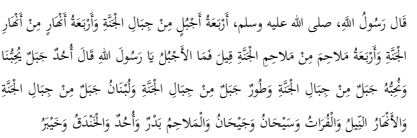
Le Messager d'Allah ﷺ a dit : « Certes, la religion (Deen) retournera au Hijaz comme un serpent retourne à son trou, et la religion (Deen) cherchera refuge au Hijaz comme la chèvre de montagne cherche refuge au sommet de la montagne. La religion (Deen) a commencé comme une chose étrange et reviendra comme une chose étrange. Bénis soient les étrangers ; ceux qui rectifieront ce que les gens après moi auront corrompu de ma sunna ».
That the Messenger of Allah (peace be upon him) said: “Verily, the Deen will retreat back to the Hijaz as a snake retreats back to its hole, and the Deen will seek refuge in the Hijaz as the mountain goat seeks refuge in the mountain top. The Deen began as something strange and will return as something strange. Blessed are the strangers; those who will rectify what the people after me have corrupted from my Sunnah”.
Certains ont parlé de Kathir, et s'ils s'étaient tus à son sujet, cela aurait été plus bénéfique. En vérité, seuls les ignorants ont parlé de lui et de ses motivations (ou de ses relations). J'ai entendu Ibn Uwais dire : Malik m'a interrogé sur ses hadith et Yahya bin Sa’id Al-Ansari a rapporté de lui. Je n'ai aucun doute avoir entendu Ibrahim bin Al-Mundhir (et si je ne l'ai pas entendu de lui, alors un Thiqah me l'a rapporté) dire : « Kathir prétendait que le Prophète ﷺ avait accordé des terres à son grand-père et il ne cessait de contester avec ceux de cette région. Il se querellait beaucoup. Il s'est rendu auprès d'Ibn ‘Imran pour se quereller et ainsi ‘Imran lui dit : "Ô Kathir, en vérité tu es un homme oisif qui se querelle beaucoup au sujet de ce que tu ne connais pas, tu prétends ce qui ne t'appartient pas et tu n'as aucune preuve pour ce que tu demandes. Ne m'approche donc pas et je ne te laisserai me voir que si tu considères que j'ai libéré mon temps pour les gens de l'erreur. Si tu vois cela, alors viens". Un jour, Ibn ‘Imran était avec nous et soudain Kathir bin Abdullah s'est approché de lui. Il (Ibn ‘Imran) dit : "Ne vous ai-je pas dit de ne pas venir vers moi à moins que vous ne me voyiez avoir libéré mon temps pour les gens de l'erreur ?" Kathir répondit alors : "Vous avez dit la vérité, qu'Allah améliore l'affaire du juge (Qadi). En vérité, je ne suis venu vers vous que lorsque les gens de l'erreur sont venus vers vous. Telle et telle personne est venue vers vous. Ils sont tous deux des gens de l'erreur, alors je suis venu avec eux deux". Cela faisait suite à l'ordre d'Ibn ‘Imran à son égard. » Abu Yusuf a dit : « Il a ordonné de rester ferme sur la colonne jusqu'à ce qu'il se soit levé des procédures judiciaires. » Abu Yusuf a dit : « Ils faisaient partie de ceux qui étaient dévoués à Ibn ‘Imran. » Ceci a également été enregistré dans la transcription de « Ash-Shamela Lil-Ma’rifah Wa At-Tarikh » (p. 62 – selon la numérotation de la bibliothèque électronique Shamela).
Some have spoken about Kathir who had they been silent about him it would have been more beneficial. Indeed, only the ignorant have spoken about him and his motives (or relations). I heard Ibn Uwais saying: Malik asked me about his Hadith and Yahya bin Sa’id Al-Ansari related from him. I have no doubt that I heard Ibrahim bin Al- Mundhir (And if I didn’t hear it from him, then a Thiqah related it to me) that he said: “Kathir used to claim that the Prophet (peace be upon him) had granted his grandfather land and he used to dispute with those in that area. He used to quarrel a lot. He went to Ibn ‘Imran to quarrel and so ‘Imran said to him: “O Kathir, indeed you are an idle man who quarrels a lot in respect to that which you don’t know, you claim that which does not belong to you and you have no evidence from what you demand. So, don’t approach me and I will not let me see you unless you see that I have freed my time for the people of falsehood. If you see that, then come”. One day Ibn ‘Imran was with us and then behold Kathir bin Abdullah had approached him. He (Ibn ‘Imran) said: “Did I not tell you to not come to me unless you see me having freed my time for the people of falsehood?” Kathir then replied: ““You have said the truth, may Allah make good the affair of the Qadi. Indeed, I only came to you when the people of falsehood came to you. So and so and so and so person came to you. They are both people of falsehood and so I came along with them both”. It was from the command of Ibn ‘Imran to him. Abu Yusuf said: “He commanded to remain fast to the column until he had stood from judicial proceedings”. Abu Yusuf said: “They were from those devoted to Ibn ‘Imran]. This has also been recorded in the transcript of “Ash-Shamela Lil- Ma’rifah Wa At-Tarikh” (p. 62 – by the numbering of the Shamela E- library).
Il est donc apparent qu'il (Kathir) avait l'habitude de discuter avec des hommes parmi ceux qui siégeaient en compagnie du juge (Qadi) Ibn ‘Imran et qui lui étaient dévoués, et qu'il les considérait comme faisant partie des « gens du mensonge ». Le juge (Qadi) Ibn ‘Imran se vengea alors de lui pour cette raison et, par conséquent, tout ce qui s'ensuivit se produisit.
It is therefore apparent that he (Kathir) used to argue with men from those who sat in the company of Qadi Ibn ‘Imran and were devoted to him, and that he considered them to be from the “people of falsehood”. Qadi Ibn ‘Imran then took revenge against him for that reason and as a result whatever took place as a consequence, took place.
Ce qui suit est un exemple type de l'imam Malik posant des questions sur son hadith et un exemple type de sa narration de sa part :
The following is a model example of Imam Malik questioning about his Hadith and a model example of his narrating from him:
- Ce qui suit est énoncé dans « Al-Lata’if min Daqa’iq Al-Ma’arif », par Abu Musa Al-Madini (170/303) :
- The following came stated in “Al-Lata’if min Daqa’iq Al-Ma’arif”, by Abu Musa Al-Madini (170/303):
[(La narration de Malik bin Anas de la part du fils de sa sœur Isma’il bin Abu Uwais) – Abu Al-Fat’h bin Al-Ikhshid nous a rapporté, d'après Abu Tahir bin Abdur Rahim, d'après Abu Al-Hasan Ad-Daraqutniy, d'après Muhammad bin Makhlad, d'après Hammad bin Al-Mu’ammal bin Matar Al-Kalbi, d'après Muhammad bin Abdullah Abu Bakr An-Naqid, d'après Isma’il bin Abu Uwais, qui a dit : mon oncle maternel Malik bin Anas m'a rapporté, de ma part (c'est-à-dire Anas bin Malik), d'après Kathir bin Abdullah bin ‘Amr bin ‘Awf, d'après son père, d'après son grand-père, qu’Allah l’agrée, qui a dit : ‘Umar ibn Al-Khattab, qu’Allah l’agrée, a dit : « Le voyageur a plus de droit à l'eau et à l'ombre que celui qui a bâti dessus (c'est-à-dire sur la terre) ». Abu Bakr a dit : J'ai demandé à Isma’il : « De qui as-tu rapporté ? » Il a répondu : « Kathir bin Abdullah m'a rapporté, cependant, j'ai souhaité insérer le nom de mon oncle maternel dans celui-ci (c'est-à-dire la chaîne de transmission (Isnad)) »].
[(The narration of Malik bin Anas from the son of his sister Isma’il bin Abu Uwais) – Abu Al-Fat’h bin Al-Ikhshid related to us from Abu Tahir bin Abdur Rahim, from Abu Al-Hasan Ad-Daraqutniy, from Muhammad bin Makhlad, from Hammad bin Al-Mu’ammal bin Matar Al-Kalbi, from Muhammad bin Abdullah Abu Bakr An-Naqid, from Isma’il bin Abu Uwais, who said: my maternal uncle Malik bin Anas related to me, from me (i.e. Anas bin Malik), from Kathir bin Abdullah bin ‘Amr bin ‘Awf, from his father, from his grandfather, may Allah be pleased with him, who said: ‘Umar ibn Al-Khattab, may Allah be pleased with him, said: “The wayfarer (or traveller) has more right to the water and the shade than the one who built upon it (i.e. the land)”. Abu Bakr said: I asked to Isma’il “Who did you relate from” He replied: “Kathir bin Abdullah related to me, however, I wished to insert the name of my maternal uncle in it (i.e. the Isnad)”].
- Ce qui suit est mentionné dans « Ittihaf Al-Maharah » par Ibn Hajar (12/518/16024) : [(Concernant le) hadith d'Ibn Abdul Barr : « J'ai laissé parmi vous deux choses ; vous ne vous égarerez jamais tant que vous vous y accrocherez : le Livre d'Allah et la sunna de Son Prophète ﷺ ». Malik a dit dans son « Al-Jami’ » : « Il lui est parvenu que le Messager d'Allah ﷺ a dit cela. Et la chaîne de transmission d'Ibn Abdul Barr passait par : Kathir bin Abdullah bin ‘Amr bin ‘Awf, de son père, de son grand-père, qui a dit la même chose (c'est-à-dire « J'ai laissé parmi vous etc... »). Il est donc apparent que Malik l'a pris (le hadith) de lui].
- The following came stated in “Ittihaf Al-Maharah” by Ibn Hajar (12/518/16024): [(Concerning the) Hadith of Ibn Abdul Barr: “I have left among you two matters; you will never go astray as long as you hold fast to them: the Book of Allah and the Sunnah of His Prophet”. Malik said in his “Al-Jami’”: “It reached him that the Messenger of Allah (peace be upon him) said that. And the chain of transmission of Ibn Abdul Barr was via: Kathir bin Abdullah bin ‘Amr bin ‘Awf, from his father, from his grandfather, who said the same (i.e. “I have left among you etc…). It is therefore apparent that Malik took it (the Hadith) from him].
Ce qui suit est un exemple modèle de l'imam Al-Bukhari vérifiant l'authenticité de son hadith :
The following is a model example of Imam Al-Bukhari verifying the authentication of his Hadith:
- Ce qui suit est rapporté dans le « Sunan Al-Kubra » d'Al-Baihaqi [avec « Al-Jawhar An-Naqi » à sa fin (3/286/6393)] :
- The following came stated in the “Sunan Al-Kubra” of Al-Baihaqi [With “Al-Jawhar An-Naqi” at its end (3/286/6393)]:
[Abu Abdullah Al-Hafizh nous a rapporté d'après Abu Bakr bin Ishaq Al-Faqih, d'après Al-Hasan bin ‘Ali bin Ziyad, d'après Ibn Abu Uwais, d'après Kathir bin Abdullah bin ‘Amr bin ‘Awf, d'après son père, d'après son grand-père : « Que le Messager d'Allah ﷺ faisait sept Takbirs dans la première Rak’ah des deux prières de l'Aïd et cinq Takbirs dans la seconde Rak’ah avant la récitation (c'est-à-dire d'Al-Fatihah) ». Il a également été rapporté par Abdullah bin Nafi’ d'après Kathir. Abu ‘Eisa At-Tirmidhi a dit : « J'ai interrogé Muhammad (signifiant Al-Bukhari) à propos de ce hadith et il a dit : "Il n'y a rien dans ce domaine (c'est-à-dire cette question) qui soit plus Sahih que cela, et mon avis est conforme à cela". Il a dit : Et le hadith d'Abdullah bin Abdur Rahman At-Ta’ifi d'après ‘Amr bin Shu’aib, d'après son père, d'après son grand-père, rapporté sur ce domaine est également Sahih].
[Abu Abdullah Al-Hafizh related to us from Abu Bakr bin Ishaq Al- Faqih, from Al-Hasan bin ‘Ali bin Ziyad, from Ibn Abu Uwais, from Kathir bin Abdullah bin ‘Amr bin ‘Awf, from his father, from his grandfather: “That the Messenger of Allah (peace be upon him), used to make seven Takbirs in the first Rak’ah of the two Eid prayers and five Takbirs in the second Rak’ah before the recital (i.e. of Al-Fatihah)”. It was also related by Abdullah bin Nafi’ from Kathir. Abu ‘Eisa At-Tirmidhi said: “I asked Muhammd (meaning Al-Bukhari) about this Hadith and he said: “There is nothing in this subject area (i.e. issue) that is more Sahih than it and my opinion is in accordance to it”. He said: And the Hadith of Abdullah bin Abdur Rahman At-Ta’ifi from ‘Amr bin Shu’aib, from his father, from his grandfather, related to this subject area is also Sahih].
On peut donc observer ici qu'il (c'est-à-dire Al-Bukhari) a donné la priorité au hadith de ce dernier (c'est-à-dire Kathir) sur celui de ‘Amr bin Shu’aib, de son père, de son grand-père, qu'il considérait également comme Sahih. D'après ce qui précède en termes d'explication, il est évident que l'imam Ibn Al-Qattan Al-Fasi a commis une erreur lorsqu'il a eu recours à des interprétations et des suppositions lointaines, comme on peut le trouver dans la référence suivante :
It can therefore be observed here that he (i.e. Al-Bukhari) gave precedence to his (i.e. Kathir’s) Hadith over that of ‘Amr bin Shu’aib, from his father, from his grandfather, which he also considered to be Sahih. From what has preceded in terms of explanation, it is evident that Imam Ibn Al-Qattan Al-Fasi made an error when he resorted to far-off interpretations and suppositions, as found in the following reference:
- Ce qui suit est mentionné dans « Nas Ar-Rayah Lil-Ahadeeth Al-Hidayah » par Jamal ud-Din Az-Zai’aliy (2/217) :
- The following came stated in “Nas Ar-Rayah Lil-Ahadeeth Al- Hidayah” by Jamal ud-Din Az-Zai’aliy (2/217):
[Concernant un autre hadith : rapporté par At-Tirmidhi et Ibn Majah d'après Kathir bin Abdullah bin ‘Amr bin ‘Awf Al-Muzani, d'après son père, d'après son grand-père ‘Amr bin ‘Awf Al-Muzani : que le Messager d'Allah ﷺ a effectué le Takbir, lors des deux prières de l'Aïd, sept fois dans la première Rak’ah, avant la récitation (du Coran) et cinq fois dans la dernière Rak’ah, avant la récitation” [Fin de citation]. At-Tirmidhi a dit : “(C'est) un hadith Hasan et c'est la meilleure chose qui ait été rapportée dans ce domaine” [Fin de citation]. Et il a dit dans son “Ilal Al-Kubra” : J'ai interrogé Muhammad à propos de ce hadith et il a dit : “Il n'y a rien dans ce domaine qui soit plus Sahih que cela et mon avis est en accord avec cela. Le hadith d'Abdullah bin Abdur Rahman At-Ta’ifi et At-Ta’ifi se rapproche du hadith” [Fin de citation]. Ibn Al-Qattan, dans son livre, a dit que cela n'est pas explicite en ce qui concerne l'authentification. Cela est dû au fait que sa déclaration : “C'est la chose la plus Sahih qui ait été rapportée dans ce domaine” signifie qu'elle ressemble à ce qui est venu en relation avec ce domaine et qu'elle est moins Da’if (faible). Tandis que sa déclaration : “Et mon avis est en accord avec cela” pourrait provenir de la parole d'At-Tirmidhi (c'est-à-dire et non d'Al-Bukhari), c'est-à-dire : Et je dis : que ce hadith ressemble à ce qui est venu en relation avec ce domaine. De même, sa déclaration : “Et le hadith d'At-Ta’ifi est également Sahih” pourrait également être de la parole d'At-Tirmidhi. La vérification (Tashih) du hadith de ‘Amr bin Shu’aib a déjà été établie de sa part et il semble donc de cela que la déclaration d'Al-Bukhari “La chose la plus Sahih” ne signifie pas qu'elle est Sahih. Il a dit : “Cela est même si nous sortions du sens littéral de l'expression formulée, ce qui est obligatoire, car Kathir bin Abdullah est Matruk (délaissé et non rapporté d'après eux) selon leur avis. Ahmad bin Hanbal a dit : « Kathir bin Abdullah ne vaut rien » et il a rejeté ses hadiths dans son Musnad et ne les a pas rapportés ». Ibn Ma’een a dit : « Ses hadiths ne valent rien ». An-Nasa’i et Ad-Daraqutniy ont dit : « Ses hadiths sont négligés ». Abu Zur’ah a dit : « Ses hadiths sont faibles/fragiles ». Ash-Shafi’iy a dit : « Il est un pilier parmi les piliers du mensonge ». Ibn Hibban a dit : « Il a rapporté de son père, de son grand-père, un récit fabriqué ; il n'est pas permis de les mentionner (c'est-à-dire ses narrations) dans les livres, sauf sous l'angle de l'étonnement ». Quant à At-Ta’ifi, les gens l'ont classé comme Da’if, y compris Ibn Ma’een » [Fin de la citation].
[Concerning another Hadith: Recorded by At-Tirmidhi and Ibn Majah from Kathir bin Abdullah bin ‘Amr bin ‘Awf Al-Muzani, from his father, from his grandfather ‘Amr bin ‘Awf Al-Muzani: That the Messenger of Allah (peace be upon him) made Takbir, in the two Eid prayers, seven times in the first Rak’ah, before the recital (of the Quran) and five in the last Rak’ah, before the recital” [End of Quote]. At-Tirmidhi said: “(It is) a Hasan Hadith and it is the best thing that has been narrated in this subject area” [End of Quote]. And he said in his “Ilal Al-Kubra”: I asked Muhammad about this Hadith and he said: “There is nothing in this subject area which is more Sahih than it and my opinion is in accordance with it. The Hadith of Abdullah bin Abdur Rahman At-Ta’ifi and At-Ta’ifi comes close to the Hadith” [End of Quote]. Ibn Al-Qattan, in his book, said that this is not explicit in respect to the authentication. That is because his statement: “It is the most Sahih thing that has been narrated in this subject area” means that it resembles what has come in relation to this subject area and less Da’if (weak). While his statement: “And my opinion is in accordance with it” could be from the speech of At-Tirmidhi (i.e. and not Al-Bukhari) i.e. And I say: That this Hadith resembles what has come in relation to this subject area. Similarly, his statement: “And the Hadith of At-Ta’ifi is also Sahih” could also possibly be from the speech of At-Tirmidhi. The verification (Tashih) of the Hadith of ‘Amr bin Shu’aib has already been established from him and so it appears from that, that the statement of Al-Bukhari “The most Sahih thing” does not mean that it is Sahih. He said: “That is even if we were to exit from the literal meaning of the worded expression, which is obligatory, as Kathir bin Abdullah is Matruk (disregarded and not related from them) in their view. Ahmad bin Hanbal said: “Kathir bin Abdullah does not equal anything” and he rejected his Hadith in his Musnad nor did he relate them”. Ibn Ma’een said: “His Hadith are not worth anything”. An-Nasa’i and Ad-Daraqutniy said: “His Hadith are disregarded”. Abu Zur’ah said: “His Hadith are feeble/flimsy”. Ash- Shafi’iy said: “He is a pillar from among the pillars of lying”. Ibn Hibban said: “He related from his father from his grandfather a fabricated transcript; it is not permissible to mention them (i.e. his narrations) in the books, except from the angle of astonishment”. As for At-Ta’ifi. Then the people classified him as Da’if, including Ibn Ma’een” [End of Quote]].
En outre, nous trouvons un unique hadith (de Kathir bin Abdullah) dans le Musnad de l'imam Ahmad et je ne sais pas si l'imam Ahmad l'a rapporté parce qu'il y avait des preuves venant soutenir le hadith ou si son fils l'imam Abdullah bin Hanbal l'a consigné. Il s'agit du suivant :
In addition, we find a single Hadith (of Kathir bin Abdullah) in the Musnad of Imam Ahmad and I don’t know if Imam Ahmad related to it because there was supportive evidence for the Hadith or if his son Imam Abdullah bin Hanbal recorded it. It is the following:
- Ce qui suit est rapporté dans le Musnad de l'imam Ahmad bin Hanbal (8/153) :
- The following came recorded in the Musnad of Imam Ahmad bin Hanbal (8/153):
[Hussein nous a rapporté d'après Abu Uwais, d'après Kathir bin Abdullah bin ‘Amr bin ‘Awf Al-Muzani, d'après son père, d'après son grand-père : « Que le Messager d'Allah ﷺ a attribué une terre à Bilal bin Al-Harith Al-Muzani, incluant les mines d'al-Qabaliyyah, tant celles situées en amont que celles situées en aval, ainsi que la terre de Quds qui est propice à la culture. Il ne lui a pas donné (la terre qui incluait) le droit d'un musulman. Le Prophète ﷺ a rédigé un document pour lui. Il s'énonce ainsi : "Au nom d'Allah, le Tout Miséricordieux, le Très Miséricordieux. Ceci est ce que le Messager d'Allah ﷺ a assigné à Bilal bin Al-Harith al-Muzani. Il lui a donné les mines d'al-Qabaliyyah, tant celles situées en amont que celles situées en aval, et (la terre) de Quds qui est propice à la culture. Il ne lui a pas donné le droit d'aucun musulman". ]
[Hussein related to us from Abu Uwais, from Kathir bin Abdullah bin ‘Amr bin ‘Awf Al-Muzani, from his father, from his grandfather: “That the Messenger of Allah (peace be upon him) allocated land to Bilal bin Al-Harith Al-Muzani including the mines of al-Qabaliyyah, both which lay on the upper side and which lay on the lower side, where it is suitable for cultivation, of Quds. He did not give him (the land which involved) the right of a Muslim. The Prophet (peace be upon him) wrote a document for him. It goes: "In the name of Allah, the Compassionate, the Merciful. This is what the Messenger of Allah (peace be upon him) assigned to Bilal bin Al-Harith al-Muzani. He gave him the mines of al-Qabaliyyah, both which lay on the upper side and which lay on the lower side, and (the land) which is suitable for cultivation, of Quds. He did not give him the right of any Muslim”.
- Le narrateur Abu Uwais a dit : un hadith similaire m'a été rapporté par Thawr ibn Zayd, d'après ‘Ikrimah, d'après Ibn Abbas, d'après le Prophète ﷺ.
- The narrator Abu Uwais said: A similar Hadith has been related to me by Thawr ibn Zayd from ‘Ikrimah, from Ibn Abbas, from the Prophet (peace be upon him).
Nous espérons que nous remarquerons en Conclusion que l'imam Al-Bukhari a vécu à Al-Madinah pendant de nombreuses années et qu'il a rencontré un groupe de ceux qui ont reçu de Kathir bin Abdullah. Il avait également beaucoup reçu de son Sheikh Isma’il bin Abu Uwais qui avait rencontré Kathir bin Abdullah et connaissait bien sa condition et son statut ; même mieux que lui. Par conséquent, Al-Bukhari connaissait Kathir bin Abdullah par l'intermédiaire d'autres personnes. De même, l'imam Ya’qub bin Sufyan possédait une vaste connaissance des gens d'Al-Madinah.
It is hoped that we observe in Conclusion, that Imam Al-Bukhari lived in Al-Madinah for many years and he met with a group of those who received from Kathir bin Abdullah. He had also received much from his Sheikh Isma’il bin Abu Uwais who had met Kathir bin Abdullah and knew his condition and status well; even better than him. Therefore, Al-Bukhari knew about Kathir bin Abdullah from others. Similarly, Imam Ya’qub bin Sufyan had vast knowledge of the people of Al-Madinah.
Par conséquent, nous demandons la guidance à Allah pour ce qui est juste, et nous considérons comme obligatoire de corriger ce qui a été énoncé dans « At-Taqrib » afin que le texte corrigé soit le suivant :
Consequently, we seek guidance from Allah for that which right, and see the obligation of correcting what came stated in “At-Taqrib” so that the corrected text will be as follows:
- « Taqrib At-Tahdhib » (1/460/5617) : [Kathir bin Abdullah bin ‘Amr bin ‘Awf Al-Muzani Al-Madani : Il n'y a pas de problème avec lui et ceux qui l'ont accusé de mensonge se sont trompés. Il appartient à la septième (génération ou lignée de rapporteurs)].
- “Taqrib At-Tahdhib” (1/460/5617): [Kathir bin Abdullah bin ‘Amr bin ‘Awf Al-Muzani Al-Madani: There is no issue (or problem) with him and those who attributed lying to him were mistaken. He is from the seventh (generation or line of transmitters)].
Grâce à cette correction, l'injustice faite à cet homme a été levée et il a été traité équitablement dans les limites de la modération. Et toute louange appartient à Allah, par la grâce de qui les bonnes œuvres sont accomplies ! Édité à London et révisé de nombreuses fois. La dernière révision a eu lieu le mercredi 10 Jumada Al-Akhira 1441 AH ; correspondant au 5 février 2020.
Through this correction, the injustice against this man has been lifted and he has been dealt with fairly within the limits of moderation. And all praise belongs to Allah, through whose blessing, the righteous acts are completed! Edited in London and revised many times. It was last revised on Wednesday the 10th of Jumada Al-Akhira 1441 AH; corresponding to the 5th of February 2020.