2.3 साथियों के मुसहफ़
2.3 The Masahif Of The Companions
हदीस साहित्य में कई संकेत मिलते हैं कि पैगंबर ﷺ के कई साथियों ने वह्य (ईश्वरीय प्रकाशन) के अपने लिखित संग्रह तैयार किए थे। [सुयूती, इत्क़ान, खंड I, पृ. 62] इनमें सबसे प्रसिद्ध इब्न मसऊद, उबय बिन काब और ज़ैद बिन साबित के संग्रह हैं। [देखें: Dodge, B, The Fihrist of al-Nadim, New York, 1970 (संक्षेप में fihrist), पृ. 53-63।] उन साथियों की सूची जिनके बारे में वर्णित है कि उनके अपने लिखित संग्रह थे, इस प्रकार है: इब्न मसऊद, उबय बिन काब, अली, इब्न अब्बास, अबू मूसा, हफ़्सा, अनस बिन मालिक, उमर, ज़ैद बिन साबित, इब्न अज़-ज़ुबैर, अब्दुल्लाह बिन अम्र, आइशा, सालिम, उम्म सलमा, उबैद बिन उमर। [देखें: इब्न अबी दाऊद: मसाहिफ़, पृ. 14। अंसारी, एम.: The Qur'anic Foundations and Structure of Muslim Society; कराची, 1973, विभिन्न स्रोतों के आधार पर कहते हैं (खंड 1, पृ. 76, टिप्पणी 2) कि पैगंबर ﷺ के जीवनकाल में कुरआन की कम से कम 15 लिखित प्रतियाँ मौजूद थीं। ऊपर दिए गए 15 नामों के अलावा वे अबू बक्र, उस्मान, मुआज़ बिन जबल, अबू दर्दा, अबू अय्यूब अंसारी, उबादा बिन अस-सामित, तमीम दारी को भी शामिल करते हैं। इस प्रकार कुल 23 लिखित प्रतियाँ होती हैं, जो पैगंबर ﷺ के जीवित रहते मौजूद थीं।] यह भी ज्ञात है कि आइशा और हफ़्सा के पास पैगंबर ﷺ के देहांत के बाद अपनी लिखित प्रतियाँ थीं। [रहीमुद्दीन, एम. (अनुवाद):
There are numerous indications in the literature of hadith that several of the Companions of the Prophet had prepared their own written collections of the revelations. [Suyuti. Itqan, I, p 62] The best-known among these are from Ibn Mas'ud, Ubay bin Ka'b and Zaid bin Thabit. [See Dodge, B, The Fihrist of al-Nadim, New York, 1970 (abbr. as fihrist), pp 53-63.] A list of Companions of whom it is related that they had their own written collections included the following: Ibn Mas'ud, Ubay bin Ka'b, 'All, Ibn 'Abbas, Abu Musa, Hafsa, Anas bin Malik, 'Umar, Zaid bin Thabit, Ibn Al-Zubair, 'Abdullah ibn 'Amr, 'A'isha, Salim, Umm Salama, 'Ubaid bin 'Umar. [See Ibn Abi Dawud: Masahif, p 14 Ansari, M.: The qura'nic Foundations and Structure of Muslim Society; Karachi, 1973, drawing upon various sources, says (1, p.76, note 2) that there existed at least 15 written copies of the Qur'an in the Prophet's lifetime. In addition to the list of 15 names quoted above, he includes Abu Bakr, 'Uthman, Mu'adh b. Jabal, Abu Darda', Abu Ayyub Ansari, 'Ubada b. al-Samit, Tamim Dari. This would add up to 23 written copies of the Qur'an, which existed while the Prophet was alive.] It is also known that 'A'isha and Hafsa had their own scripts written after the Prophet had died. [Rahimuddin, M. (transl.):
Muwatta) इमाम मालिक, लाहौर, 1980, नं. 307, 308; मालिक बिन अनस: अल-मुवत्ता', काहिरा, बे तारीख़, पृ. 105।] निम्नलिखित उन मसाहिफ़ (पाण्डुलिपियों) में से कुछ का अत्यंत संक्षिप्त विवरण है, जो नबी ﷺ के साथियों की ओर संबंधित किए जाते हैं।
Muwatta) Imam Malik, Lahore, 1980, No. 307, 308; Malik b. Anas: al-muwatta', Cairo, n.d., p. 105.] The following is a very brief description of some of the masdhif, which are attributed to the Companions of the Prophet.
सभी जानकारी शास्त्रीय स्रोतों पर आधारित है। [For details see Ibn Abi Dawud, also fihrist and Itqan]
All the information is based on classical sources. [For details see Ibn Abi Dawud, also fihrist and Itqan]
इब्न मसऊद का मुस्हफ़ (मृ. 33/653)
The Mushaf Of Ibn Mas'ud (d. 33/653)
उन्होंने एक मुसहफ़ लिखा, जिसमें सूरतें 1, 113 और 114 शामिल नहीं थीं। लेकिन इब्न अन-नदीम [Fihrist, I, pp. 57-8.] ने कहा कि उन्होंने इब्न मसऊद की नक़ल वाला एक क़ुरआन देखा था, जिसमें अल-फ़ातिहा (सूरा 1) नहीं थी। सूरतों की तरतीब 'उस्मानी पाठ' से अलग थी। इब्न मसऊद की नक़ल से जुड़ी तरतीब इस प्रकार बताई गई है: [Fihrist, I, pp. 53-7.] 2, 4, 3, 7, 6, 5, 10, 9, 16, 11, 12, 17, 21, 23, 26, 37, 33, 28, 24, 8, 19, 29, 30, 36, 25, 22, 13, 34, 35, 14, 38, 47, 31, 35, 40, 43, 41, 46, 45, 44, 48, 57, 59, 32, 50, 65, 49, 67, 64, 63, 62, 61, 72, 71, 58, 60, 66, 55, 53, 51, 52, 54, 69, 56, 68, 79, 70, 73, 74, 83, 80, 76, 75, 77, 78, 81, 82, 88, 87, 92, 89, 85, 84, 96, 90, 93, 94, 86, 100, 107, 101, 98, 91, 95, 104, 105, 106, 102, 97, 110, 108, 109, 111, 112.
He wrote a mushaf, in which sudras 1, 113 and 114 were not included. Ibn al-Nadim [Fihrist, I, pp. 57-8.] however said he had seen a copy of the Qur'an from Ibn Mas'ud which did not contain al-fatiha (Sura 1). The arrangement of the suras differed from the 'Uthmanic text. The following is the order attributed to Ibn Mas'ud's copy: [Fihrist, I, pp. 53-7.] 2, 4, 3, 7, 6, 5, 10, 9, 16, 11, 12, 17, 21, 23, 26, 37, 33, 28, 24, 8, 19, 29, 30, 36, 25, 22, 13, 34, 35, 14, 38, 47, 31, 35, 40, 43, 41, 46, 45, 44, 48, 57, 59, 32, 50, 65, 49, 67, 64, 63, 62, 61, 72, 71, 58, 60, 66, 55, 53, 51, 52, 54, 69, 56, 68, 79, 70, 73, 74, 83, 80, 76, 75, 77, 78, 81, 82, 88, 87, 92, 89, 85, 84, 96, 90, 93, 94, 86, 100, 107, 101, 98, 91, 95, 104, 105, 106, 102, 97, 110, 108, 109, 111, 112.
यह सूची स्पष्ट रूप से अधूरी है। इसमें केवल 106 सूरतें हैं, जबकि इब्न नदीम ने 110 लिखी थीं।
This list is obviously incomplete. It contains only 106 suras and not 110, as Ibn Nadim wrote.
सूरा अल-बक़रा में, जिसे मैं उदाहरण के तौर पर लेता हूँ, कुल 101 पाठ-भेद (variants) हैं। इनमें से अधिकतर वर्तनी (spelling) से संबंधित हैं, कुछ शब्दों के चयन (synonyms) से, और कुछ अव्ययों (particles) के प्रयोग आदि से।
In Sura al-baqara, which I take as an example, there are a total of 101 variants. Most of them concern spelling, some also choice of words (synonyms), use of particles, etc.
उदाहरण:
Examples:
उच्चारण:
Pronunciation:
2:70 इब्न मसऊद ने "अल-बकरा" के स्थान पर "अल-बकिरा" पढ़ा है। वर्तनी:
2:70 Ibn Mas'ud reads al-baqira in place of al-baqara Spelling:
2:19 वह "कुल्ला मा" को "कुल्लमा" के स्थान पर पढ़ता है। समानार्थी शब्द:
2:19 He reads kulla ma in place of kullama Synonyms:
उबै बिन काब का मुसहफ़ (मृत्यु 29 हिजरी/649 ई.)
The Mushaf Of Ubay Bin Ka'b (d. 29 H/649)
उसने एक मुसहफ़ लिखा, जिसमें बताया जाता है कि दो "अतिरिक्त सूरतें" और एक "अतिरिक्त आयत" पाई गईं।
He wrote a mushaf, in which two 'additional suras and another 'additional aya' were reportedly found.
[इत्क़ान, I, पृ. 65; इब्न अबी दाऊद, मसाहिफ़, पृ. 18S1; और नोल्देके, टी. एवं अन्य: Geschichte des Qorans, लाइपज़िग, 1909-38 (संक्षेप में GdQ), 11, पृ. 33-8।]
[Itqan, I, p. 65; Ibn Abi Dawud, masahif, pp. 18S1; also Noldeke, T. et al.: Ceschichte des Qorans, Leipzig, 1909-38 (abbr. as GdQ), 11, pp. 33-8.
पहली तथाकथित सूरा, जिसका शीर्षक अल-ख़ल' (अलगाव) है, का अनुवाद इस प्रकार है: "ऐ अल्लाह, हम तुझसे मदद माँगते हैं और तुझसे माफ़ी चाहते हैं, और हम तेरी प्रशंसा करते हैं और हम तेरा इनकार नहीं करते। जो तेरी नाफ़रमानी करता है, हम उससे अलग होते हैं और उसे छोड़ देते हैं।" दूसरी तथाकथित सूरा, जिसका शीर्षक अल-हफ़्द (जल्दी) है, का अनुवाद इस प्रकार है: "ऐ अल्लाह, हम तेरी इबादत करते हैं और तेरे लिए नमाज़ पढ़ते और सजदा करते हैं, और तेरी ओर दौड़ते और तेरी सेवा में जल्दी करते हैं। हम तेरी रहमत की उम्मीद रखते हैं और तेरे अज़ाब से डरते हैं। निश्चय ही तेरा अज़ाब इनकार करने वालों तक पहुँचेगा।" स्पष्ट है कि ये दोनों अंश तथाकथित 'क़ुनूत' हैं, यानी वे दुआएँ जिन्हें नबी ﷺ कभी-कभी फ़ज्र की नमाज़ या वित्र की नमाज़ में क़ुरआन की सूरतों की तिलावत के बाद पढ़ते थे। वास्तव में ये हदीस के संग्रहों में वर्णित क़ुनूत के कुछ हिस्सों के समान हैं। देखें: नववी, अल-अज़कार, क़ाहिरा, 1955, पृष्ठ 57-8।
The first so called sura entitled al-khal' (separation), translates as follows: 'O Allah, we seek your help and ask your forgiveness, and we praise you and we do not disbelieve in you. We separate from and leave who sins against you.' The second so-called sura, entitled al-hafd (haste) translates as follows: 'O Allah, we worship You and to You we pray and prostrate and to You we run and hasten to serve You. We hope for Your mercy and we fear Your punishment. Your punishment will certainly reach the disbelievers.' Obviously these two pieces constitute so-called 'qunut', i.e. supplications which the Prophet sometimes said in the morning prayer or witr prayer after recitation of suras from the Qur'an. They are in fact identical to some parts of qunut reported in the collections of hadith. See: Nawawi, al-adhkar, Cairo, 1955, pp. 57-8.
जहाँ तक उस अतिरिक्त तथाकथित आयत का सवाल है, उसका अनुवाद यह है: 'अगर आदम के बेटे को धन से भरी एक घाटी दे दी जाए, तो वह दूसरी की चाह करेगा, और अगर उसे धन से भरी दो घाटियाँ दे दी जाएँ, तो वह ज़रूर तीसरी माँगेगा। आदम के बेटे का पेट मिट्टी के सिवा कोई नहीं भरेगा, और अल्लाह उस पर क्षमाशील है जो तौबा करता है।' यह पाठ निश्चित रूप से पैग़म्बर ﷺ की एक हदीस के रूप में जाना जाता है। देखें बुख़ारी, VIII, नं. 444-47। इब्न अब्बास (नं. 445) और उबय (नं. 446) के अनुसार यह पाठ कभी-कभी क़ुरआन का हिस्सा समझा जाता था। लेकिन उबय ने स्वयं स्पष्ट किया कि सूरा 102 के उतरने के बाद, सहाबा ने उपरोक्त को क़ुरआन का हिस्सा नहीं माना। देखें बुख़ारी, VIII, नं. 446। उबय की यह व्याख्या यह भी बिल्कुल स्पष्ट करती है कि सहाबा इस बात पर बिल्कुल भी मतभेद नहीं रखते थे कि क़ुरआन का कौन-सा भाग है और कौन-सा नहीं, जब वह्य बंद हो गई। और यदि उबय के मुसहफ़ में यह हदीस आई भी, तो वह उनके अपने निजी उपयोग के लिए एक मुसहफ़ था, यानी उनकी निजी कॉपी, जहाँ वे क़ुरआनी सामग्री और हदीस में हमेशा भेद नहीं करते थे, क्योंकि वह आम उपयोग के लिए नहीं थी और वे स्वयं अपने नोट्स का अर्थ भली-भाँति जानते थे। यही बात क़ुरआन की उन अन्य प्रतियों पर भी लागू होती है जो कुछ सहाबा ने अपने निजी उपयोग के लिए रखी थीं। साथ ही, जिन लोगों ने सहाबा की इन प्रतियों के बारे में रिवायतें हम तक पहुँचाईं, उन्होंने भी वहाँ पाए गए विभिन्न अंतरों का ही वर्णन किया है, उन रिवायतों के अनुसार जो उन तक पहुँची थीं (जैसे बुख़ारी, VIII, नं. 446 की हदीस)।
इब्न अब्बास का मुसहफ़ (मृत्यु: 68 हिजरी / 687 ईस्वी)
The Mushaf of Ibn 'Abbas (d. 68H/687)
इब्न अब्बास ने भी एक मुसहफ़ लिखा था, जिसमें, इतकान [खंड I, पृ. 65; इब्न अबी दाऊद, मसाहिफ़, पृ. 193] के अनुसार, उबैय के पास मौजूद वे दो अतिरिक्त सूरतें भी शामिल थीं। उनका सूरों का क्रम भी अन्य प्रतियों से भिन्न था। सूरह अल-बक़रा में उनके यहाँ कुल 21 पाठांतर हैं, जिनमें से कुछ इब्न मसऊद और उबैय तथा अन्य सहाबियों के पाठों से मेल खाते हैं।
Ibn 'Abbas also wrote a mushaf, which according to the Itqan [I, p. 65; Ibn Abi Dawud, masahif, p. 193.] also included the two additional suras which Ubay had. Again his arrangement of the suras differed from the other copies. In Sura albaqara, he has a total of 21 variants, some of them identical with Ibn Mas'ud and Ubay as well as other Companions.
कुछ अन्य साथी
Some Other Companions
इत्क़ान [खंड I, पृ. 65; इब्न अबी दाऊद, मसाहिफ़, पृ. 210] के अनुसार अबू मूसा अल-अशअरी (मृत्यु 44 हिजरी/664 ई.) का मुसहफ़
According to the Itqan [I, p. 65; Ibn Abi Dawud, masahif, p. 210.] the mushaf of Abu Musa al-Ash'ari (d. 44H/664)
उसमें वही सामग्री थी जो उबय के पास थी।
contained the same material as Ubay had.
सूरा अल-बक़रा में उनसे केवल एक ही रिवायत मिलती है, जिसमें उन्होंने "इब्राहीम" के स्थान पर "इब्राहाम" पढ़ा।
There is only one variant reported from him in Sura al- baqara, namely that he read Ibraham in place of Ibrahim.
हफ़्सा (मृत्यु 45 हिजरी/665) के पास उसी सूरा में तीन पाठभेद थे, और अनस बिन मालिक (मृत्यु 91 हिजरी/709) के पास पाँच।
Hafsa (d. 45H/665) had three variants in the same sura, and Anas b. Malik (d. 91H/709) had five.
उदाहरण:
Examples:
इसे और स्पष्ट करने के लिए, यहाँ कुछ उदाहरण दिए गए हैं। इन्हें यथासंभव प्रसिद्ध सूरतों से लिया गया है।
To further illustrate, here are a number of examples. They have been taken, as far as possible, from well-known suras.
हालाँकि शायद इस बात को समझाने के लिए बेहतर उदाहरण मौजूद हों, फिर भी वे उन पाठकों के लिए उतने आसानी से समझ में न आएँ जो क़ुरआनी पाठ से कम परिचित हैं।
While perhaps better examples exist to illustrate the points under discussion, they might not be understood as easily by readers less familiar with the Qur'anic text.
स्वरांकन में अंतर:
Difference in vowelling:
इब्न अब्बास से रिवायत है कि उन्होंने सूरा 111 में इस प्रकार पढ़ा [I, p. 65; Ibn Abi Dawud, masahif, p. 208.]4
Ibn 'Abbas [I, p. 65; Ibn Abi Dawud, masahif, p. 208.] is reported to have read in sura 111:4
हमीलतुन अल-हतब, जिसे हम्मालता-ल-हतब के स्थान पर पढ़ा गया, जिसे शुरुआती लिखित पाठ के आधार पर अलग नहीं किया जा सकता था, क्योंकि उसमें न हरकत थी और न ही अलिफ़।
hamilatun al-hatab, in place of hammalata-l-hatab which could not be distinguished on the basis of the early written text, which omitted both haraka and alif.
स्पेलिंग में अंतर:
Difference In Spelling:
इब्न अब्बास [I, p. 65; इब्न अबी दाऊद, मसाहिफ़, p. 195.] से रिवायत है कि उन्होंने सूरा 1:6 में, और अन्य सभी स्थानों पर, शब्द "अल-सिरात" को "अस-सिरात" लिखा।
Ibn 'Abbas [I, p. 65; Ibn Abi Dawud, masahif, p. 195.] reportedly wrote in sura 1:6 as well as all other places the word alsirat as al-sirat.
इब्न मसऊद से मंसूब कुछ रिवायतें: [I, p. 65; Ibn Abi Dawud, masahif, p. 25.]
Some variants attributed to Ibn Mas'ud: [I, p. 65; Ibn Abi Dawud, masahif, p. 25.]
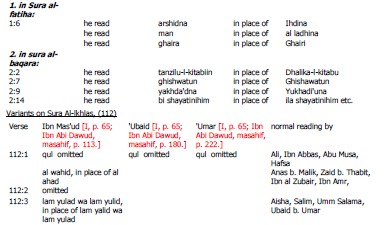
आज भी पाठ की उन प्रतियों में, जो सहाबा से संबंधित हैं, विभिन्न पाठभेद और पर्यायवाची शब्द मिलते हैं, और ये हमारे लिए कुछ मूल्य रखते हैं, इस अर्थ में कि ये तफ़सीर के एक प्रारंभिक, अपरिपक्व रूप का काम कर सकते थे। उदाहरण के लिए, कुछ रिवायतों के अनुसार शब्द 'सलात अल-वुस्ता' (बीच की नमाज़) हफ़सा [मुवत्ता मालिक; जेफ़री, पृ. 214], उबय [जेफ़री, पृ. 122] और इब्न अब्बास [जेफ़री, पृ. 196] द्वारा 'सलात अल-अस्र' (यानी अपराह्न की नमाज़) के रूप में पढ़ा और लिखा गया।
Even today the variants and synonyms are found in such copies of the text as are attributed to the Companions and are of some value to us in the sense that they may have served as an early rudimentary form of tafsir. For example, according to some reports the words 'salat al-wusta' (middle prayer) were read and written by Hafsa, [Muwatta' Malik; Jeffery, p. 214.] Ubay [Jeffery, p. 122.] and Ibn 'Abbas [Jeffery, p. 196.] as 'salat al-'asr' (i.e. afternoon prayer).
जब तक सहाबा अपनी निजी उपयोग के लिए अपनी प्रतियाँ लिखते थे, तब तक इसमें कोई दोष नहीं था, भले ही वे सूरतों के उस क्रम का कड़ाई से पालन न करते हों जो कुरआन का क्रम था। बाद में जब उस्मान की प्रति मानक संस्करण बन गई, तो सहाबा ने इसी प्रति का क्रम अपना लिया, जिसमें इब्न मसऊद भी शामिल थे, जो शायद सबसे अधिक भिन्न मत रखते थे। [इब्न अबी दाऊद, पृ. 12; सालिह, एस.: मबाहिस फ़ी उलूमिल कुरआन, बेरूत, 1964] जैसा कि संकेत किया गया, इन प्रतियों में कुछ पाठ-भेद भी थे, [नीचे सात क़िराअत और क़िरा'आत भी देखें।] जब कुछ शब्दों का उच्चारण और वर्तनी थोड़े भिन्न रूप से की जाती थी, आदि। हालाँकि, यह ध्यान रखना चाहिए कि पाठ-भेद आम तौर पर केवल एक व्यक्ति द्वारा रिपोर्ट किए जाते हैं, और कभी-कभार शायद दो या तीन द्वारा, जबकि 'उस्मानी पाठ' कहलाने वाला संस्करण मुतवातिर है, यानी असंख्य लोगों द्वारा प्रसारित है और इसमें कोई संदेह नहीं कि यह प्रामाणिक है।
As long as the sahaba wrote their own copies for personal use only, there was nothing wrong, if they did not strictly adhere to the order of suras which was the order of the Qur'an. Later on, when 'Uthman's copy became the standard version, the Companions adopted the order of this copy including Ibn Mas'ud who perhaps differed most. [Ibn Abi Dawud, p. 12; Salih, S.: Mabahith fi 'ulum al-qura'n, Beirut, 1964,] There were also, as indicated, some variant readings in these copies, [See also below, seven readings and qira'at.] when some words were pronounced and spelt in slightly different ways, etc. However, it should be noted that variant readings are usually reported by a single person only, and occasionally by perhaps two or three while the version called the 'Uthmanic text is mutawatir, i.e. transmitted by numerous people and is without doubt authentic.