2.3 Os Mushafs dos Companheiros
2.3 The Masahif Of The Companions
Há inúmeras indicações na literatura de hadith de que vários dos Companheiros do Profeta ﷺ haviam preparado suas próprias coletâneas escritas das revelações. [Suyuti. Itqan, I, p. 62] As mais conhecidas entre elas são as de Ibn Mas'ud, Ubay bin Ka'b e Zaid bin Thabit. [Ver Dodge, B, The Fihrist of al-Nadim, Nova York, 1970 (abrev. como fihrist), pp. 53-63.] Uma lista de Companheiros dos quais se relata que possuíam suas próprias coletâneas escritas incluía o seguinte: Ibn Mas'ud, Ubay bin Ka'b, 'Ali, Ibn 'Abbas, Abu Musa, Hafsa, Anas bin Malik, 'Umar, Zaid bin Thabit, Ibn al-Zubair, 'Abdullah ibn 'Amr, 'A'isha, Salim, Umm Salama, 'Ubaid bin 'Umar. [Ver Ibn Abi Dawud: Masahif, p. 14. Ansari, M.: The Qur'anic Foundations and Structure of Muslim Society; Karachi, 1973, baseando-se em diversas fontes, afirma (I, p. 76, nota 2) que existiam pelo menos 15 cópias escritas do Alcorão durante a vida do Profeta ﷺ. Além da lista de 15 nomes citada acima, ele inclui Abu Bakr, 'Uthman, Mu'adh b. Jabal, Abu Darda', Abu Ayyub Ansari, 'Ubada b. al-Samit, Tamim Dari. Isso totalizaria 23 cópias escritas do Alcorão, que existiam enquanto o Profeta ﷺ estava vivo.] Sabe-se também que 'A'isha e Hafsa mandaram escrever suas próprias folhas após a morte do Profeta ﷺ. [Rahimuddin, M. (transl.):
There are numerous indications in the literature of hadith that several of the Companions of the Prophet had prepared their own written collections of the revelations. [Suyuti. Itqan, I, p 62] The best-known among these are from Ibn Mas'ud, Ubay bin Ka'b and Zaid bin Thabit. [See Dodge, B, The Fihrist of al-Nadim, New York, 1970 (abbr. as fihrist), pp 53-63.] A list of Companions of whom it is related that they had their own written collections included the following: Ibn Mas'ud, Ubay bin Ka'b, 'All, Ibn 'Abbas, Abu Musa, Hafsa, Anas bin Malik, 'Umar, Zaid bin Thabit, Ibn Al-Zubair, 'Abdullah ibn 'Amr, 'A'isha, Salim, Umm Salama, 'Ubaid bin 'Umar. [See Ibn Abi Dawud: Masahif, p 14 Ansari, M.: The qura'nic Foundations and Structure of Muslim Society; Karachi, 1973, drawing upon various sources, says (1, p.76, note 2) that there existed at least 15 written copies of the Qur'an in the Prophet's lifetime. In addition to the list of 15 names quoted above, he includes Abu Bakr, 'Uthman, Mu'adh b. Jabal, Abu Darda', Abu Ayyub Ansari, 'Ubada b. al-Samit, Tamim Dari. This would add up to 23 written copies of the Qur'an, which existed while the Prophet was alive.] It is also known that 'A'isha and Hafsa had their own scripts written after the Prophet had died. [Rahimuddin, M. (transl.):
Muwatta) Imam Malik, Lahore, 1980, No. 307, 308; Malik b. Anas: al-muwatta', Cairo, n.d., p. 105.] A seguir, uma descrição muito breve de alguns dos maṣāḥif que são atribuídos aos Companheiros do Profeta ﷺ.
Muwatta) Imam Malik, Lahore, 1980, No. 307, 308; Malik b. Anas: al-muwatta', Cairo, n.d., p. 105.] The following is a very brief description of some of the masdhif, which are attributed to the Companions of the Prophet.
Todas as informações são baseadas em fontes clássicas. [For details see Ibn Abi Dawud, also fihrist and Itqan]
All the information is based on classical sources. [For details see Ibn Abi Dawud, also fihrist and Itqan]
O Mushaf de Ibn Mas'ud (m. 33/653)
The Mushaf Of Ibn Mas'ud (d. 33/653)
Ele escreveu um mushaf, no qual as suras 1, 113 e 114 não foram incluídas. Ibn al-Nadim [Fihrist, I, pp. 57-8.] afirmou, contudo, que tinha visto uma cópia do Alcorão de Ibn Mas'ud que não continha al-Fatiha (Sura 1). A ordem das suras diferia do texto 'Uthmânico. A seguinte é a ordem atribuída à cópia de Ibn Mas'ud: [Fihrist, I, pp. 53-7.] 2, 4, 3, 7, 6, 5, 10, 9, 16, 11, 12, 17, 21, 23, 26, 37, 33, 28, 24, 8, 19, 29, 30, 36, 25, 22, 13, 34, 35, 14, 38, 47, 31, 35, 40, 43, 41, 46, 45, 44, 48, 57, 59, 32, 50, 65, 49, 67, 64, 63, 62, 61, 72, 71, 58, 60, 66, 55, 53, 51, 52, 54, 69, 56, 68, 79, 70, 73, 74, 83, 80, 76, 75, 77, 78, 81, 82, 88, 87, 92, 89, 85, 84, 96, 90, 93, 94, 86, 100, 107, 101, 98, 91, 95, 104, 105, 106, 102, 97, 110, 108, 109, 111, 112.
He wrote a mushaf, in which sudras 1, 113 and 114 were not included. Ibn al-Nadim [Fihrist, I, pp. 57-8.] however said he had seen a copy of the Qur'an from Ibn Mas'ud which did not contain al-fatiha (Sura 1). The arrangement of the suras differed from the 'Uthmanic text. The following is the order attributed to Ibn Mas'ud's copy: [Fihrist, I, pp. 53-7.] 2, 4, 3, 7, 6, 5, 10, 9, 16, 11, 12, 17, 21, 23, 26, 37, 33, 28, 24, 8, 19, 29, 30, 36, 25, 22, 13, 34, 35, 14, 38, 47, 31, 35, 40, 43, 41, 46, 45, 44, 48, 57, 59, 32, 50, 65, 49, 67, 64, 63, 62, 61, 72, 71, 58, 60, 66, 55, 53, 51, 52, 54, 69, 56, 68, 79, 70, 73, 74, 83, 80, 76, 75, 77, 78, 81, 82, 88, 87, 92, 89, 85, 84, 96, 90, 93, 94, 86, 100, 107, 101, 98, 91, 95, 104, 105, 106, 102, 97, 110, 108, 109, 111, 112.
Esta lista é claramente incompleta. Contém apenas 106 suras e não 110, como escreveu Ibn Nadim.
This list is obviously incomplete. It contains only 106 suras and not 110, as Ibn Nadim wrote.
Na Sura al-Baqara, que tomo como exemplo, há um total de 101 variantes. A maioria delas diz respeito à grafia, mas algumas também à escolha de palavras (sinônimos), ao uso de partículas, etc.
In Sura al-baqara, which I take as an example, there are a total of 101 variants. Most of them concern spelling, some also choice of words (synonyms), use of particles, etc.
Exemplos:
Examples:
Pronúncia:
Pronunciation:
2:70 Ibn Mas'ud lê al-baqira no lugar de al-baqara Grafia:
2:70 Ibn Mas'ud reads al-baqira in place of al-baqara Spelling:
2:19 Ele lê "kulla ma" no lugar de "kullama". Sinônimos:
2:19 He reads kulla ma in place of kullama Synonyms:
O Mushaf de Ubay bin Ka'b (m. 29 H/649)
The Mushaf Of Ubay Bin Ka'b (d. 29 H/649)
Ele escreveu um mushaf, no qual, segundo relatos, foram encontradas duas suras adicionais e outro versículo adicional.
He wrote a mushaf, in which two 'additional suras and another 'additional aya' were reportedly found.
[Itqan, I, p. 65; Ibn Abi Dawud, masahif, pp. 18S1; também Noldeke, T. et al.: Ceschichte des Qorans, Leipzig, 1909-38 (abrev. como GdQ), 11, pp. 33-8.
[Itqan, I, p. 65; Ibn Abi Dawud, masahif, pp. 18S1; also Noldeke, T. et al.: Ceschichte des Qorans, Leipzig, 1909-38 (abbr. as GdQ), 11, pp. 33-8.
A primeira chamada sura, intitulada al-khal' (separação), traduz-se da seguinte forma: "Ó Allah, buscamos Tua ajuda e pedimos Teu perdão, e Te louvamos e não descremos em Ti. Nos separamos e deixamos aquele que peca contra Ti." A segunda chamada sura, intitulada al-hafd (pressa), traduz-se da seguinte forma: "Ó Allah, Te adoramos e a Ti oramos e prostramo-nos, e a Ti corremos e nos apressamos em Te servir. Esperamos Tua misericórdia e temos medo de Teu castigo. Teu castigo certamente alcançará os descrentes." Obviamente, esses dois trechos constituem o chamado "qunut", isto é, súplicas que o Profeta ﷺ às vezes recitava na oração da manhã ou na oração do witr, após a recitação de suras do Alcorão. Na verdade, são idênticos a algumas partes do qunut relatado nas coletâneas de hadith. Ver: Nawawi, al-Adhkar, Cairo, 1955, pp. 57-8.
The first so called sura entitled al-khal' (separation), translates as follows: 'O Allah, we seek your help and ask your forgiveness, and we praise you and we do not disbelieve in you. We separate from and leave who sins against you.' The second so-called sura, entitled al-hafd (haste) translates as follows: 'O Allah, we worship You and to You we pray and prostrate and to You we run and hasten to serve You. We hope for Your mercy and we fear Your punishment. Your punishment will certainly reach the disbelievers.' Obviously these two pieces constitute so-called 'qunut', i.e. supplications which the Prophet sometimes said in the morning prayer or witr prayer after recitation of suras from the Qur'an. They are in fact identical to some parts of qunut reported in the collections of hadith. See: Nawawi, al-adhkar, Cairo, 1955, pp. 57-8.
Quanto à chamada "aya" adicional, sua tradução é a seguinte: "Se o filho de Adão recebesse um vale cheio de riquezas, desejaria um segundo, e se lhe fossem dados dois vales cheios de riquezas, certamente pediria um terceiro. Nada encherá o ventre do filho de Adão, exceto o pó, e Allah é perdoador para com quem se arrepende." Novamente, este texto é conhecido por ser um hadith do Profeta ﷺ. Veja Bukhari, VIII, nº 444-47. Segundo Ibn 'Abbas (nº 445) e 'Ubay (nº 446), este texto chegou a ser considerado parte do Alcorão. Contudo, o próprio Ubay esclarece que, após a revelação da sura 102, os companheiros (ou seja, os sahaba) não consideravam o acima mencionado como parte do Alcorão. Veja Bukhari, VIII, nº 446. Esta explicação de Ubay também deixa muito claro que os Companheiros não divergiam em absoluto sobre o que fazia parte do Alcorão e o que não fazia parte do Alcorão quando a revelação havia cessado. E se, por exemplo, este hadith ocorreu no mushaf de Ubay, tratava-se de um mushaf para seu uso pessoal, em outras palavras, seu caderno particular, onde nem sempre distinguia o material corânico do hadith, pois não se destinava ao uso geral e ele mesmo sabia bem o que fazer de suas próprias anotações. O mesmo vale para as outras cópias do Alcorão que alguns Companheiros possuíam para seu uso pessoal. Também aqueles que nos transmitiram os relatos sobre essas cópias do Alcorão dos Companheiros apenas nos narraram as várias diferenças que ali ocorreram, segundo relatos que chegaram até eles (por exemplo, o hadith em Bukhari, VIII, nº 446).
O Mushaf de Ibn 'Abbas (m. 68H/687)
The Mushaf of Ibn 'Abbas (d. 68H/687)
Ibn 'Abbas também escreveu um mushaf, o qual, segundo o Itqan [I, p. 65; Ibn Abi Dawud, masahif, p. 193.], incluía também as duas suras adicionais que Ubay possuía. Mais uma vez, a sua disposição das suras diferia das outras cópias. Na Sura al-Baqara, ele apresenta um total de 21 variantes, algumas delas idênticas às de Ibn Mas'ud e Ubay, bem como às de outros Companheiros.
Ibn 'Abbas also wrote a mushaf, which according to the Itqan [I, p. 65; Ibn Abi Dawud, masahif, p. 193.] also included the two additional suras which Ubay had. Again his arrangement of the suras differed from the other copies. In Sura albaqara, he has a total of 21 variants, some of them identical with Ibn Mas'ud and Ubay as well as other Companions.
Outros Companheiros
Some Other Companions
De acordo com o Itqan [I, p. 65; Ibn Abi Dawud, masahif, p. 210.], o mushaf de Abu Musa al-Ash'ari (m. 44H/664)
According to the Itqan [I, p. 65; Ibn Abi Dawud, masahif, p. 210.] the mushaf of Abu Musa al-Ash'ari (d. 44H/664)
continha o mesmo material que Ubay possuía.
contained the same material as Ubay had.
Há apenas uma variante transmitida dele na Sura Al-Baqara, a saber, que ele leu "Ibraham" em lugar de "Ibrahim".
There is only one variant reported from him in Sura al- baqara, namely that he read Ibraham in place of Ibrahim.
Hafsa (m. 45H/665) teve três variantes na mesma sura, e Anas b. Malik (m. 91H/709) teve cinco.
Hafsa (d. 45H/665) had three variants in the same sura, and Anas b. Malik (d. 91H/709) had five.
Exemplos:
Examples:
Para ilustrar ainda mais, seguem-se alguns exemplos. Foram retirados, na medida do possível, de suras bem conhecidas.
To further illustrate, here are a number of examples. They have been taken, as far as possible, from well-known suras.
Embora existam, talvez, exemplos melhores para ilustrar os pontos em discussão, estes podem não ser compreendidos com tanta facilidade pelos leitores menos familiarizados com o texto corânico.
While perhaps better examples exist to illustrate the points under discussion, they might not be understood as easily by readers less familiar with the Qur'anic text.
Diferença na vocalização:
Difference in vowelling:
Ibn 'Abbas [I, p. 65; Ibn Abi Dawud, masahif, p. 208.] é relatado como tendo recitado na sura 111:4
Ibn 'Abbas [I, p. 65; Ibn Abi Dawud, masahif, p. 208.] is reported to have read in sura 111:4
hamilatun al-hatab, no lugar de hammalata-l-hatab, que não podiam ser distinguidas com base no texto escrito antigo, que omitia tanto a harakat quanto o alif.
hamilatun al-hatab, in place of hammalata-l-hatab which could not be distinguished on the basis of the early written text, which omitted both haraka and alif.
Diferença na Grafia:
Difference In Spelling:
Ibn 'Abbas [I, p. 65; Ibn Abi Dawud, masahif, p. 195.] teria escrito, segundo se relata, na sura 1:6 assim como em todos os outros lugares, a palavra alsirat como al-sirat.
Ibn 'Abbas [I, p. 65; Ibn Abi Dawud, masahif, p. 195.] reportedly wrote in sura 1:6 as well as all other places the word alsirat as al-sirat.
Algumas variantes atribuídas a Ibn Mas'ud: [I, p. 65; Ibn Abi Dawud, masahif, p. 25.]
Some variants attributed to Ibn Mas'ud: [I, p. 65; Ibn Abi Dawud, masahif, p. 25.]
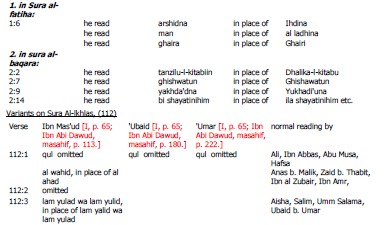
Até hoje, as variantes e sinônimos encontrados em cópias do texto atribuídas aos Companheiros têm algum valor para nós, no sentido de que podem ter servido como uma forma rudimentar e primitiva de tafsir. Por exemplo, segundo alguns relatos, as palavras 'salat al-wusta' (a oração do meio) foram lidas e escritas por Hafsa, [Muwatta' Malik; Jeffery, p. 214.] Ubay [Jeffery, p. 122.] e Ibn 'Abbas [Jeffery, p. 196.] como 'salat al-'asr' (isto é, a oração da tarde).
Even today the variants and synonyms are found in such copies of the text as are attributed to the Companions and are of some value to us in the sense that they may have served as an early rudimentary form of tafsir. For example, according to some reports the words 'salat al-wusta' (middle prayer) were read and written by Hafsa, [Muwatta' Malik; Jeffery, p. 214.] Ubay [Jeffery, p. 122.] and Ibn 'Abbas [Jeffery, p. 196.] as 'salat al-'asr' (i.e. afternoon prayer).
Desde que os sahaba escreviam as suas próprias cópias apenas para uso pessoal, não havia nada de errado se não seguissem estritamente a ordem das suras, que era a ordem do Alcorão. Mais tarde, quando a cópia de 'Uthman se tornou a versão padrão, os Companheiros adotaram a ordem desta cópia, incluindo Ibn Mas'ud, que talvez tenha discordado mais. [Ibn Abi Dawud, p. 12; Salih, S.: Mabahith fi 'ulum al-qura'n, Beirute, 1964,] Havia também, como indicado, algumas leituras variantes nestas cópias, [Ver também abaixo, sete leituras e qira'at.] quando algumas palavras eram pronunciadas e escritas de maneiras ligeiramente diferentes, etc. No entanto, deve-se notar que as leituras variantes são geralmente relatadas por uma única pessoa, e ocasionalmente por talvez duas ou três, enquanto a versão chamada texto 'Uthmanic é mutawatir, isto é, transmitida por numerosas pessoas, e é indubitavelmente autêntica.
As long as the sahaba wrote their own copies for personal use only, there was nothing wrong, if they did not strictly adhere to the order of suras which was the order of the Qur'an. Later on, when 'Uthman's copy became the standard version, the Companions adopted the order of this copy including Ibn Mas'ud who perhaps differed most. [Ibn Abi Dawud, p. 12; Salih, S.: Mabahith fi 'ulum al-qura'n, Beirut, 1964,] There were also, as indicated, some variant readings in these copies, [See also below, seven readings and qira'at.] when some words were pronounced and spelt in slightly different ways, etc. However, it should be noted that variant readings are usually reported by a single person only, and occasionally by perhaps two or three while the version called the 'Uthmanic text is mutawatir, i.e. transmitted by numerous people and is without doubt authentic.