4.1 Divisões do Texto
4.1 Divisions Of The Text
Aya e Sura
Aya And Sura
"Aya" (pl. "ayat") significa, na verdade, "sinal". Em linguagem técnica, é a menor divisão do texto do Alcorão, isto é, uma frase ou oração. A revelação é uma orientação de Deus para a humanidade e, por isso, não é de forma alguma surpreendente que as suas menores divisões sejam chamadas "sinais" (de orientação). O termo "versículo" não é apropriado, uma vez que o Alcorão não é poesia.
Aya (pl. ayat) actually means 'sign'. In technical language it is the shortest division of the Qur'anic text, i.e. a phrase or sentence. The revelation is guidance from God to mankind and it is therefore not at all surprising to find that its smallest divisions are called (guiding) 'signs'. The term 'verse' is not appropriate since the Qur'an is not poetry.
Sura (pl. Suwar) significa literalmente "fileira" ou "muralha". Em linguagem técnica, é a divisão do texto corânico por passagens, isto é, um capítulo ou parte, separado do texto que o precede e do que o segue.
Sura (pl. Suwar) means literally 'row' or 'fence'. In technical language, it is the passage-wise division of the Qur'anic text,i.e. a chapter or part, set apart from the preceding and following text.
O Alcorão tem 114 suras de comprimentos desiguais, sendo a mais curta composta por quatro ayat e a mais longa por 286 ayat.
The Qur'an has 114 suras of unequal length, the shortest consisting of four and the longest of 286 ayat.
Todas as suras (com exceção da Sura 9) começam com as palavras bismillahir rahmanir rahim. Isto não é um acréscimo posterior ao texto, mas já era utilizado mesmo antes da chamada de Muhammad ﷺ para a profecia. [Ver Sura 27: 30.] Todas as 114 suras do Alcorão têm nomes, que servem como uma espécie de título. Os nomes são muitas vezes derivados de uma palavra importante ou distintiva do próprio texto, como, por exemplo, al-anfal (8) ou al-baqara (2). Noutros casos, trata-se de uma das primeiras palavras com que a sura começa, por exemplo ta-ha (20) ou al-furqan (25).
All suras (with the exception of Sura 9) begin with the words bismillahir rahmanir rahim. This is not a later addition to the text, but was already used, even before Muhammad's call to prophethood. ' [See Sura 27: 30.] All 114 suras in the Qur'an have names, which serve as a sort of heading. The names are often derived from an important or distinguishing word in the text itself, such as e.g. al-anfal (8) or al-baqara (2). In other cases it is one of the first few words with which the sSra begins e.g. ta-ha (20) or al-furqan (25).
Ordem e Arranjo
Order And Arrangement
A ordem dos versículos dentro de cada surata e a disposição das suratas foram finalmente determinadas pelo Profeta ﷺ, sob orientação do Anjo Gabriel, no ano de sua morte, quando Gabriel veio duas vezes para revisar o texto com ele. [Ver acima. transmissão da revelação corânica, p. 31.] Os estudiosos também agruparam as suratas em quatro tipos:
Both the order of the ayat within each sura and the arrangement of the suras were finally determined by the Prophet under guidance from the Angel Gabriel in the year of his death, when Gabriel twice came to revise the text with him. [See above. transmission of the Qur'anic revelation, p. 31.] Scholars have also grouped the suras into four kinds:
al-tiwal (as longas): 2-10.
al-tiwal (long ones): 2-10.
al-Mi'un: suras com aproximadamente 100 ayat: 10-35.
al-mi'un: suras with approximately 100 ayat: 10-35.
al-mathani: suras com menos de 100 ayat: 36-49.
al-mathani: suras with less than 100 ayat: 36-49.
Al-Mufassal: a última seção do Alcorão, começando com a Surata Qaf: 50–114.
al-mufassal: the last section of the Qur'an beginning with Sura qaf: 50-114.
Outras Divisões do Texto
Other Divisions Of The Text
Juz' (pl. ajza') significa literalmente parte, porção. O Alcorão está dividido em 30 porções de comprimento aproximadamente igual, para facilitar a recitação durante as trinta noites de um mês, especialmente do mês de Ramadan. Geralmente são indicadas pela palavra e pelo número correspondente, junto a ela (por exemplo, juz' 30, começando com a Sura 78).
Juz' (pl. ajza') literally means part, portion. The Qur'an is divided into 30 portions of approximately equal length for easy recitation during the thirty nights of a month, especially of the month of Ramadan. Usually they are indicated by the word and the number of it given alongside, (e.g. juz' 30 beginning with Sura 78).
Algumas cópias do Alcorão têm as suras divididas em parágrafos chamados rukuʿ. Eles são indicados pelo símbolo, e a explicação dos numerais árabes escritos com cada um é a seguinte, por exemplo 2:20:
Some copies of the Qur'an have the suras divided into paragraphs called ruku'. They are indicated by the symbol and the explanation of the Arabic numerals written with each is as follows, e.g. 2:20:
O número superior (2) indica que esta é a segunda rukuʿ completa na respectiva sura (aqui, a Sura Al-Baqara).
The top figure (2) indicates that this is the second completed ruku ' in the respective sura (here Sura albaqara)
.
.
O número do meio (13) indica que este ruku' completo contém 13 ayat.
The middle figure (13) indicates that this completed ruku' contains 13 ayat.
A figura inferior (2) indica que este é o segundo ruku' no respectivo juz' (aqui, o primeiro juz').
The lower figure (2) indicates that this is the second ruku' in the respective juz' (here first juz').
Cópias do Alcorão impressas no Oriente Médio, em particular, têm cada juz' subdividido em quatro hizb, indicados pelo sinal, por exemplo, 2:74 é o início do segundo hizb do Alcorão, indicado pelo algarismo 2:
Copies of the Qur'an printed in the Middle East in particular have each juz' subdivided into four hizb indicated by the sign e.g. 2:74 is the beginning of the second hizb of the Qur'an, indicated by the figure 2:
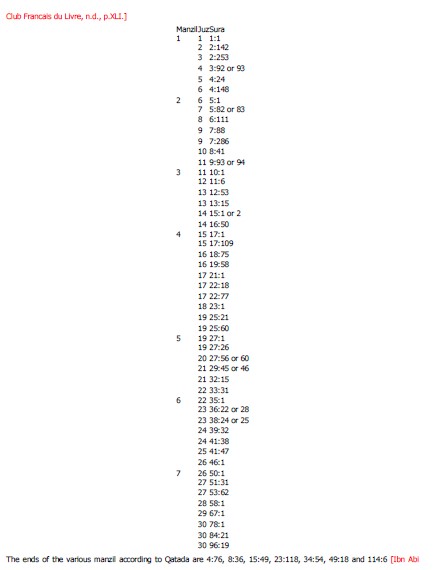
Cada hizb é novamente subdividido em quartos. O texto do Alcorão também é dividido em sete partes de comprimento aproximadamente igual, chamadas manzil, para recitação ao longo de sete dias, indicadas em algumas cópias pela palavra manzil e o respectivo número na margem. A tabela seguinte mostra a divisão do texto em juz' e manzil: [Hamidullah, Muhammad: Le Saint Coran. Traduction intégrale et notes. Paris: