2.3 教友たちのムサーハフ
2.3 The Masahif Of The Companions
ハディース文献には、預言者の教友の何人かが啓示を自分たちで書き留めた写本集を作成していたことを示す記述が数多く見られる。[スユーティー『イトカーン』I、62頁] そのなかで最もよく知られているのは、イブン・マスウード、ウバイ・ブン・カァブ、ザイド・ブン・サービトのものである。[ドッジ、B『フィフリスト・アル=ナディーム』、ニューヨーク、1970年(略称 fihrist)、53~63頁を参照。] 自分たちの書き留めた写本集を持っていたと伝えられる教友の一覧には、次の人々が含まれる。イブン・マスウード、ウバイ・ブン・カァブ、アリー、イブン・アッバース、アブー・ムーサー、ハフサ、アナス・ブン・マーリク、ウマル、ザイド・ブン・サービト、イブン・アル=ズバイル、アブドゥッラー・イブン・アムル、アーイシャ、サーリム、ウンム・サラマ、ウバイド・ブン・ウマル。[イブン・アビー・ダーウード『マサーヒフ』14頁を参照。アンサーリー、M.『The Qur'anic Foundations and Structure of Muslim Society』、カラチ、1973年は、さまざまな典拠に基づき(第1巻76頁、注2)、預言者の生前に少なくとも15部の写本のクルアーンが存在していたと述べている。彼は上記の15名に加えて、アブー・バクル、ウスマーン、ムアーズ・ブン・ジャバル、アブー・ダルダー、アブー・アイユーブ・アンサーリー、ウバーダ・ブン・アル=サーミト、タミーム・ダーリーを挙げている。これにより、預言者の生存中に存在していたクルアーンの写本は合計23部となる。] また、アーイシャとハフサは、預言者の死後に自分たちの写本を書き写させていたことも知られている。[ラヒームッディーン、M.(訳):
There are numerous indications in the literature of hadith that several of the Companions of the Prophet had prepared their own written collections of the revelations. [Suyuti. Itqan, I, p 62] The best-known among these are from Ibn Mas'ud, Ubay bin Ka'b and Zaid bin Thabit. [See Dodge, B, The Fihrist of al-Nadim, New York, 1970 (abbr. as fihrist), pp 53-63.] A list of Companions of whom it is related that they had their own written collections included the following: Ibn Mas'ud, Ubay bin Ka'b, 'All, Ibn 'Abbas, Abu Musa, Hafsa, Anas bin Malik, 'Umar, Zaid bin Thabit, Ibn Al-Zubair, 'Abdullah ibn 'Amr, 'A'isha, Salim, Umm Salama, 'Ubaid bin 'Umar. [See Ibn Abi Dawud: Masahif, p 14 Ansari, M.: The qura'nic Foundations and Structure of Muslim Society; Karachi, 1973, drawing upon various sources, says (1, p.76, note 2) that there existed at least 15 written copies of the Qur'an in the Prophet's lifetime. In addition to the list of 15 names quoted above, he includes Abu Bakr, 'Uthman, Mu'adh b. Jabal, Abu Darda', Abu Ayyub Ansari, 'Ubada b. al-Samit, Tamim Dari. This would add up to 23 written copies of the Qur'an, which existed while the Prophet was alive.] It is also known that 'A'isha and Hafsa had their own scripts written after the Prophet had died. [Rahimuddin, M. (transl.):
Muwatta) Imam Malik, Lahore, 1980, No. 307, 308; Malik b. Anas: al-muwatta', Cairo, n.d., p. 105.] 以下は、預言者の教友に帰せられるマスハフのいくつかについての、ごく簡単な説明である。
Muwatta) Imam Malik, Lahore, 1980, No. 307, 308; Malik b. Anas: al-muwatta', Cairo, n.d., p. 105.] The following is a very brief description of some of the masdhif, which are attributed to the Companions of the Prophet.
すべての情報は古典的な典拠に基づいています。 [For details see Ibn Abi Dawud, also fihrist and Itqan]
All the information is based on classical sources. [For details see Ibn Abi Dawud, also fihrist and Itqan]
イブン・マスウードのムスハフ(没 33年/653年)
The Mushaf Of Ibn Mas'ud (d. 33/653)
彼はムスハフを著したが、その中にはスーラ1、113、114が含まれていなかった。しかしイブン・アン=ナディーム(『フィフリスト』I、57〜58頁)は、イブン・マスウードのクルアーンの写本を見たと述べており、その写本にはアル=ファーティハ(スーラ1)が含まれていなかった。スーラの配列も、ウスマーン本の本文とは異なっていた。以下は、イブン・マスウードの写本に帰せられる順序である(『フィフリスト』I、53〜57頁):2、4、3、7、6、5、10、9、16、11、12、17、21、23、26、37、33、28、24、8、19、29、30、36、25、22、13、34、35、14、38、47、31、35、40、43、41、46、45、44、48、57、59、32、50、65、49、67、64、63、62、61、72、71、58、60、66、55、53、51、52、54、69、56、68、79、70、73、74、83、80、76、75、77、78、81、82、88、87、92、89、85、84、96、90、93、94、86、100、107、101、98、91、95、104、105、106、102、97、110、108、109、111、112。
He wrote a mushaf, in which sudras 1, 113 and 114 were not included. Ibn al-Nadim [Fihrist, I, pp. 57-8.] however said he had seen a copy of the Qur'an from Ibn Mas'ud which did not contain al-fatiha (Sura 1). The arrangement of the suras differed from the 'Uthmanic text. The following is the order attributed to Ibn Mas'ud's copy: [Fihrist, I, pp. 53-7.] 2, 4, 3, 7, 6, 5, 10, 9, 16, 11, 12, 17, 21, 23, 26, 37, 33, 28, 24, 8, 19, 29, 30, 36, 25, 22, 13, 34, 35, 14, 38, 47, 31, 35, 40, 43, 41, 46, 45, 44, 48, 57, 59, 32, 50, 65, 49, 67, 64, 63, 62, 61, 72, 71, 58, 60, 66, 55, 53, 51, 52, 54, 69, 56, 68, 79, 70, 73, 74, 83, 80, 76, 75, 77, 78, 81, 82, 88, 87, 92, 89, 85, 84, 96, 90, 93, 94, 86, 100, 107, 101, 98, 91, 95, 104, 105, 106, 102, 97, 110, 108, 109, 111, 112.
この一覧は明らかに不完全です。イブン・ナディームが書いたように110のスーラではなく、106のスーラしか含まれていません。
This list is obviously incomplete. It contains only 106 suras and not 110, as Ibn Nadim wrote.
「スーラ・アル=バカラ」を例にとると、全部で101の異読(変種)があります。その大半は綴りに関するもので、語の選択(同義語)や小辞の用法などに関するものもあります。
In Sura al-baqara, which I take as an example, there are a total of 101 variants. Most of them concern spelling, some also choice of words (synonyms), use of particles, etc.
Example:
Examples:
発音
Pronunciation:
2:70 イブン・マスウードは「al-baqara」の代わりに「al-baqira」と読んだ。綴り
2:70 Ibn Mas'ud reads al-baqira in place of al-baqara Spelling:
2:19 彼は「kullama」の代わりに「kulla ma」と読む。 同義語:
2:19 He reads kulla ma in place of kullama Synonyms:
2:68 彼は「sal」(求める、懇願する)と読む
2:68 He reads sal (seek, beseech)
「ud'u(祈願する)」の代わりに
in place of ud'u (beseech)
ウバイ・ブン・カアブのムスハフ(没 29年/649年)
The Mushaf Of Ubay Bin Ka'b (d. 29 H/649)
彼はムスハフを書いたが、その中に二つの追加のスーラと、もう一つの追加のアーヤが見つかったと伝えられている。
He wrote a mushaf, in which two 'additional suras and another 'additional aya' were reportedly found.
[Itqan, I, p. 65; Ibn Abi Dawud, masahif, pp. 18S1; also Noldeke, T. et al.: Ceschichte des Qorans, Leipzig, 1909-38 (abbr. as GdQ), 11, pp. 33-8. Note: the original text contains "pp. 18S1", which appears to be a typo for "pp. 18-51" in the source; this is kept as written.
[Itqan, I, p. 65; Ibn Abi Dawud, masahif, pp. 18S1; also Noldeke, T. et al.: Ceschichte des Qorans, Leipzig, 1909-38 (abbr. as GdQ), 11, pp. 33-8.
最初のいわゆる「スーラ」、題して「al-khal'(離反)」は次のように訳されます。「アッラーよ、私たちはあなたに助けを求め、あなたの赦しを請います。私たちはあなたを讃え、あなたを信じないことはありません。あなたに背く者から離れ、その者を見捨てます。」 二つ目のいわゆる「スーラ」、題して「al-hafd(急ぎ)」は次のように訳されます。「アッラーよ、私たちはあなたを崇拝し、あなたに向かって祈り、ひれ伏します。あなたに仕えるために走り、急ぎます。私たちはあなたの慈悲を望み、あなたの懲罰を恐れます。あなたの懲罰は必ず不信仰者たちに及ぶでしょう。」 これら二つの部分は明らかに、いわゆる「クヌート」、すなわちクルアーンのスーラの朗誦に続いて、預言者ﷺが時折、夜明けの礼拝やウィトルの礼拝で唱えた祈願文です。これらは実際にハディース集に伝えられているクヌートのいくつかの部分と同一です。参照:Nawawi, al-adhkar, Cairo, 1955, pp. 57-8.
The first so called sura entitled al-khal' (separation), translates as follows: 'O Allah, we seek your help and ask your forgiveness, and we praise you and we do not disbelieve in you. We separate from and leave who sins against you.' The second so-called sura, entitled al-hafd (haste) translates as follows: 'O Allah, we worship You and to You we pray and prostrate and to You we run and hasten to serve You. We hope for Your mercy and we fear Your punishment. Your punishment will certainly reach the disbelievers.' Obviously these two pieces constitute so-called 'qunut', i.e. supplications which the Prophet sometimes said in the morning prayer or witr prayer after recitation of suras from the Qur'an. They are in fact identical to some parts of qunut reported in the collections of hadith. See: Nawawi, al-adhkar, Cairo, 1955, pp. 57-8.
残りの追加されたいわゆる「アーヤ」について、その訳文は次の通りです。「もしアーダムの子に谷いっぱいの財産が与えられたならば、彼はもう一つを欲しがるであろう。そして二つの谷いっぱいの財産が与えられたならば、彼はきっと三つ目を求めるであろう。アーダムの子の腹を満たすものは土のほかにはない。そしてアッラーは悔い改める者を赦し給う。」この文章がムハンマド♯ﷺからのハディースであることは周知の事実です。ブハーリー、第8巻、第444〜447番を参照してください。イブン・アッバース(第445番)とウバイ(第446番)によれば、この文章は時にクルアーンの一部と考えられていた時期がありました。しかしウバイ自身が、スーラ102の「汝らを競い合わせる(タカースル)」が啓示された後には、教友たち(サハーバ)はこれをクルアーンの一部とはみなさなかったと明言しています。ブハーリー、第8巻、第446番を参照してください。このウバイの説明は、啓示が途絶えた後に何がクルアーンの一部であり何がそうでなかったかについて、教友たちの間に意見の相違が全くなかったことも明確に示しています。仮にこのハディースがウバイのムスハフに書かれていたとしても、それは彼個人の使用のためのムスハフ、すなわち彼の私的なノートであったと考えるべきです。一般の使用を意図したものではなく、彼自身が自分のメモの意味をよく心得ていたため、クルアーンの内容とハディースを必ずしも区別していなかったのです。教友の中には個人的な使用のためにクルアーンの写本を所有していた人々がおり、同じことが他のクルアーンの写本にも当てはまります。また、教友たちのこれらの写本に関する伝承を私たちに伝えた人々も、そこに存在した様々な相違について、彼らに届いた伝聞に基づいてのみ伝えてきたのです。(例:ブハーリー、第8巻、第446番のハディース)
As to the single additional so-called aya, its translation is as follows: 'If the son of Adam was given a valley full of riches, he would wish a second one, and if he was given two valleys full of riches, he would surely ask for a third one. Nothing will fill the belly of the son of Adam except dust, and Allah is forgiving to him who is repentant. ' Again this text is known to be a hadith from the Prophet. See Bukhari, VIII, No. 444-47. According to Ibn 'Abbas (No. 445) and 'Ubay (No. 446) this text was at times thought to be part of the Qur'an. However Ubay himself clarifies that after sura 102: I had been revealed, they (i.e. the sahaba) did not consider the above to be part of the Qur'an. See Bukhari, VIII, No. 446. This explanation of Ubay also makes it very clear that the Companions did not differ at all about what was part of the Qur'an and what was not part of the Qur'an. when the revelation had ceased. and if e.g. this hadith occurred in the mushaf of Ubay, it was a mushaf for his own personal use, in other words, his private notebook, where he did not always distinguish between Qur'anic material and hadith, since it was not meant for general use and he himself knew well what to make of his own notes. The same is true of the other copies of the Qur'an, which some of the Companions had for their own personal use. Also those who transmitted to us the reports about these copies of the Qur'an of the Companions have only narrated to us the various differences which occurred there according to reports that reached them (e.g. the hadith in Bukhari, VIII, No. 446
イブン・アッバースのムスハフ(没年:68年/687年)
The Mushaf of Ibn 'Abbas (d. 68H/687)
イブン・アッバースもまたムシュハフ(写本)を作成しており、『イトカーン』(I巻、65ページ;イブン・アビー・ダーウード『マサーヒフ』、193ページ)によれば、それにはウバイが持っていた二つの追加の章も含まれていた。ここでも、彼による章の配列は他の写本とは異なっていた。雌牛の章(スーラ・アルバカラ)には、合計21の異読があり、その中にはイブン・マスウード、ウバイ、そして他の教友たちのものと同一のものもあった。
Ibn 'Abbas also wrote a mushaf, which according to the Itqan [I, p. 65; Ibn Abi Dawud, masahif, p. 193.] also included the two additional suras which Ubay had. Again his arrangement of the suras differed from the other copies. In Sura albaqara, he has a total of 21 variants, some of them identical with Ibn Mas'ud and Ubay as well as other Companions.
他の教友たち
Some Other Companions
イトカーン[I、65頁;イブン・アビー・ダーウード『マサーヒフ』210頁]によれば、アブー・ムーサー・アル=アシュアリー(没年:44年/西暦664年)のムスハフは
According to the Itqan [I, p. 65; Ibn Abi Dawud, masahif, p. 210.] the mushaf of Abu Musa al-Ash'ari (d. 44H/664)
そこには、ウバイが持っていたものと同じ内容が含まれていた。
contained the same material as Ubay had.
スーラ・アル=バカラにおいて、彼から伝えられている異読はただ一つ、「イブラーム」を「イブラーヒーム」の代わりに読んだというものだけです。
There is only one variant reported from him in Sura al- baqara, namely that he read Ibraham in place of Ibrahim.
ハフサ(没年45年/665年)は同じ章に三つの異読を伝え、アナス・ブン・マーリク(没年91年/709年)は五つを伝えた。
Hafsa (d. 45H/665) had three variants in the same sura, and Anas b. Malik (d. 91H/709) had five.
Example:
Examples:
さらに例を示すため、いくつかの例を挙げます。できる限り、よく知られた章から取りました。
To further illustrate, here are a number of examples. They have been taken, as far as possible, from well-known suras.
しかしながら、論じられている点を説明するには、より適切な例が他にもあるかもしれません。ただし、クルアーンの本文に馴染みのない読者にとっては、それらの例はそれほど容易には理解されないかもしれません。
While perhaps better examples exist to illustrate the points under discussion, they might not be understood as easily by readers less familiar with the Qur'anic text.
母音の表記の違い
Difference in vowelling:
イブン・アッバース[I, p. 65; Ibn Abi Dawud, masahif, p. 208.]は、スーラ111を次のように読んだと伝えられている。4
Ibn 'Abbas [I, p. 65; Ibn Abi Dawud, masahif, p. 208.] is reported to have read in sura 111:4
ハミラトゥン・アル=ハタブ。これは、初期の書記テキストでは母音符号(ハラカ)もアリフも省略されていたため、ハンマラタ・ル=ハタブと区別できなかったものである。
hamilatun al-hatab, in place of hammalata-l-hatab which could not be distinguished on the basis of the early written text, which omitted both haraka and alif.
スペルの違い:
Difference In Spelling:
イブン・アッバース [I, p. 65; Ibn Abi Dawud, masahif, p. 195.] は、スーラ1:6をはじめ、他のすべての箇所においても「alsirat」という語を「al-sirat」と書いたと伝えられている。
Ibn 'Abbas [I, p. 65; Ibn Abi Dawud, masahif, p. 195.] reportedly wrote in sura 1:6 as well as all other places the word alsirat as al-sirat.
イブン・マスウードに帰せられるいくつかの異伝: [I, p. 65; Ibn Abi Dawud, masahif, p. 25.]
Some variants attributed to Ibn Mas'ud: [I, p. 65; Ibn Abi Dawud, masahif, p. 25.]
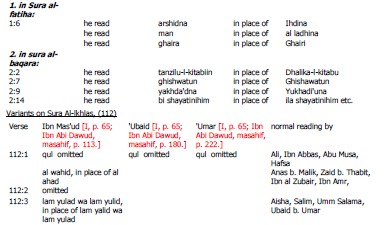
今日においても、変異読みや同義語が見られる、教友に帰せられる本文の写本が存在しており、それらは初期の素朴なタフスィールの一形態として役立った可能性があるという点で、私たちにとってある程度の価値を持っています。たとえば、いくつかの伝承によれば、「サラート・アル=ウスター」(中間の礼拝)という語句は、ハフサ、[Muwatta' Malik; Jeffery, p. 214.] ウバイ、[Jeffery, p. 122.] そしてイブン・アッバース[Jeffery, p. 196.]によって「サラート・アル=アスル」(すなわち午後の礼拝)として読まれ、書写されていたとされています。
Even today the variants and synonyms are found in such copies of the text as are attributed to the Companions and are of some value to us in the sense that they may have served as an early rudimentary form of tafsir. For example, according to some reports the words 'salat al-wusta' (middle prayer) were read and written by Hafsa, [Muwatta' Malik; Jeffery, p. 214.] Ubay [Jeffery, p. 122.] and Ibn 'Abbas [Jeffery, p. 196.] as 'salat al-'asr' (i.e. afternoon prayer).
サハーバ(教友)たちが個人的な使用のためだけに自分のコピーを書いていた限りでは、スーラの順序がクルアーンの順序どおりに厳密に従われていなかったとしても、何の問題もありませんでした。その後、ウスマーンのコピーが標準版となると、教友たちはこのコピーの順序を採用しました。それには、最も異なる見解を持っていたと思われるイブン・マスウードも含まれます。[Ibn Abi Dawud, p. 12; Salih, S.: Mabahith fi 'ulum al-qura'n, Beirut, 1964,] 前述のとおり、これらのコピーにはいくつかの異読もありました。[See also below, seven readings and qira'at.] 一部の語が多少異なる発音や綴りで書かれていた、などです。しかしながら、異読は通常ただ一人によって伝えられ、ときに二、三人によって伝えられるにすぎない一方、ウスマーン版と呼ばれる本文は穏当に伝承(ムタワーティル)されたものであり、すなわち多数の人々によって伝えられ、疑いなく真正であることに留意すべきです。
As long as the sahaba wrote their own copies for personal use only, there was nothing wrong, if they did not strictly adhere to the order of suras which was the order of the Qur'an. Later on, when 'Uthman's copy became the standard version, the Companions adopted the order of this copy including Ibn Mas'ud who perhaps differed most. [Ibn Abi Dawud, p. 12; Salih, S.: Mabahith fi 'ulum al-qura'n, Beirut, 1964,] There were also, as indicated, some variant readings in these copies, [See also below, seven readings and qira'at.] when some words were pronounced and spelt in slightly different ways, etc. However, it should be noted that variant readings are usually reported by a single person only, and occasionally by perhaps two or three while the version called the 'Uthmanic text is mutawatir, i.e. transmitted by numerous people and is without doubt authentic.