2.3 Les Masahif des Compagnons
2.3 The Masahif Of The Companions
Il existe de nombreuses indications dans la littérature du hadith que plusieurs des Compagnons du Prophète ﷺ avaient préparé leurs propres collections écrites des révélations. [Suyuti. Itqan, I, p 62] Les plus connues d'entre elles proviennent d'Ibn Mas'ud, Ubay bin Ka'b et Zaid bin Thabit. [Voir Dodge, B, The Fihrist of al-Nadim, New York, 1970 (abrégé en fihrist), pp 53-63.] Une liste de Compagnons dont il est rapporté qu'ils possédaient leurs propres collections écrites comprenait les suivants : Ibn Mas'ud, Ubay bin Ka'b, 'Ali, Ibn 'Abbas, Abu Musa, Hafsa, Anas bin Malik, 'Umar, Zaid bin Thabit, Ibn Al-Zubair, 'Abdullah ibn 'Amr, 'A'isha, Salim, Umm Salama, 'Ubaid bin 'Umar. [Voir Ibn Abi Dawud: Masahif, p 14 Ansari, M.: The qura'nic Foundations and Structure of Muslim Society; Karachi, 1973, s'appuyant sur diverses sources, affirme (1, p.76, note 2) qu'il existait au moins 15 copies écrites du Qur'an du vivant du Prophète ﷺ. En plus de la liste des 15 noms cités ci-dessus, il inclut Abu Bakr, 'Uthman, Mu'adh b. Jabal, Abu Darda', Abu Ayyub Ansari, 'Ubada b. al-Samit, Tamim Dari. Cela porterait le total à 23 copies écrites du Qur'an, qui existaient du vivant du Prophète ﷺ.] Il est également connu qu' 'A'isha et Hafsa possédaient leurs propres manuscrits écrits après la mort du Prophète ﷺ. [Rahimuddin, M. (trad.) :
There are numerous indications in the literature of hadith that several of the Companions of the Prophet had prepared their own written collections of the revelations. [Suyuti. Itqan, I, p 62] The best-known among these are from Ibn Mas'ud, Ubay bin Ka'b and Zaid bin Thabit. [See Dodge, B, The Fihrist of al-Nadim, New York, 1970 (abbr. as fihrist), pp 53-63.] A list of Companions of whom it is related that they had their own written collections included the following: Ibn Mas'ud, Ubay bin Ka'b, 'All, Ibn 'Abbas, Abu Musa, Hafsa, Anas bin Malik, 'Umar, Zaid bin Thabit, Ibn Al-Zubair, 'Abdullah ibn 'Amr, 'A'isha, Salim, Umm Salama, 'Ubaid bin 'Umar. [See Ibn Abi Dawud: Masahif, p 14 Ansari, M.: The qura'nic Foundations and Structure of Muslim Society; Karachi, 1973, drawing upon various sources, says (1, p.76, note 2) that there existed at least 15 written copies of the Qur'an in the Prophet's lifetime. In addition to the list of 15 names quoted above, he includes Abu Bakr, 'Uthman, Mu'adh b. Jabal, Abu Darda', Abu Ayyub Ansari, 'Ubada b. al-Samit, Tamim Dari. This would add up to 23 written copies of the Qur'an, which existed while the Prophet was alive.] It is also known that 'A'isha and Hafsa had their own scripts written after the Prophet had died. [Rahimuddin, M. (transl.):
[Muwatta) imam Malik, Lahore, 1980, No. 307, 308; Malik b. Anas : al-muwatta', Le Caire, s.d., p. 105.] Ce qui suit est une description très brève de certains des masahif, qui sont attribués aux Compagnons du Prophète ﷺ.
Muwatta) Imam Malik, Lahore, 1980, No. 307, 308; Malik b. Anas: al-muwatta', Cairo, n.d., p. 105.] The following is a very brief description of some of the masdhif, which are attributed to the Companions of the Prophet.
Toutes les informations sont basées sur des sources classiques. [For details see Ibn Abi Dawud, also fihrist and Itqan]
All the information is based on classical sources. [For details see Ibn Abi Dawud, also fihrist and Itqan]
Le Mushaf d'Ibn Mas'ud (mort en 33/653)
The Mushaf Of Ibn Mas'ud (d. 33/653)
Il a écrit un mushaf, dans lequel les sourates 1, 113 et 114 n'étaient pas incluses. Ibn al-Nadim [Fihrist, I, pp. 57-8.] a toutefois dit avoir vu une copie du Coran d'Ibn Mas'ud qui ne contenait pas al-fatiha (sourate 1). L'arrangement des sourates différait du texte 'Uthmanique. Voici l'ordre attribué à la copie d'Ibn Mas'ud : [Fihrist, I, pp. 53-7.] 2, 4, 3, 7, 6, 5, 10, 9, 16, 11, 12, 17, 21, 23, 26, 37, 33, 28, 24, 8, 19, 29, 30, 36, 25, 22, 13, 34, 35, 14, 38, 47, 31, 35, 40, 43, 41, 46, 45, 44, 48, 57, 59, 32, 50, 65, 49, 67, 64, 63, 62, 61, 72, 71, 58, 60, 66, 55, 53, 51, 52, 54, 69, 56, 68, 79, 70, 73, 74, 83, 80, 76, 75, 77, 78, 81, 82, 88, 87, 92, 89, 85, 84, 96, 90, 93, 94, 86, 100, 107, 101, 98, 91, 95, 104, 105, 106, 102, 97, 110, 108, 109, 111, 112.
He wrote a mushaf, in which sudras 1, 113 and 114 were not included. Ibn al-Nadim [Fihrist, I, pp. 57-8.] however said he had seen a copy of the Qur'an from Ibn Mas'ud which did not contain al-fatiha (Sura 1). The arrangement of the suras differed from the 'Uthmanic text. The following is the order attributed to Ibn Mas'ud's copy: [Fihrist, I, pp. 53-7.] 2, 4, 3, 7, 6, 5, 10, 9, 16, 11, 12, 17, 21, 23, 26, 37, 33, 28, 24, 8, 19, 29, 30, 36, 25, 22, 13, 34, 35, 14, 38, 47, 31, 35, 40, 43, 41, 46, 45, 44, 48, 57, 59, 32, 50, 65, 49, 67, 64, 63, 62, 61, 72, 71, 58, 60, 66, 55, 53, 51, 52, 54, 69, 56, 68, 79, 70, 73, 74, 83, 80, 76, 75, 77, 78, 81, 82, 88, 87, 92, 89, 85, 84, 96, 90, 93, 94, 86, 100, 107, 101, 98, 91, 95, 104, 105, 106, 102, 97, 110, 108, 109, 111, 112.
Cette liste est manifestement incomplète. Elle ne contient que 106 sourates et non 110, comme l'a écrit Ibn Nadim.
This list is obviously incomplete. It contains only 106 suras and not 110, as Ibn Nadim wrote.
Dans la sourate al-Baqara, que je prends comme exemple, il y a un total de 101 variantes. La plupart d'entre elles concernent l'orthographe, certaines concernent également le choix des mots (synonymes), l'usage de particules, etc.
In Sura al-baqara, which I take as an example, there are a total of 101 variants. Most of them concern spelling, some also choice of words (synonyms), use of particles, etc.
Exemples :
Examples:
Prononciation :
Pronunciation:
2:70 Ibn Mas'ud lit al-baqira au lieu de al-baqara Orthographe :
2:70 Ibn Mas'ud reads al-baqira in place of al-baqara Spelling:
2:19 Il lit kulla ma à la place de kullama Synonymes :
Le Mushaf d'Ubay Bin Ka'b (mort en 29 H/649)
The Mushaf Of Ubay Bin Ka'b (d. 29 H/649)
Il a écrit un mushaf, dans lequel deux « sourates additionnelles » et un autre « verset additionnel » auraient été trouvés.
He wrote a mushaf, in which two 'additional suras and another 'additional aya' were reportedly found.
[Itqan, I, p. 65 ; Ibn Abi Dawud, masahif, pp. 18S1 ; également Noldeke, T. et al. : Geschichte des Korans, Leipzig, 1909-38 (abrégé en GdQ), 11, pp. 33-8.
[Itqan, I, p. 65; Ibn Abi Dawud, masahif, pp. 18S1; also Noldeke, T. et al.: Ceschichte des Qorans, Leipzig, 1909-38 (abbr. as GdQ), 11, pp. 33-8.
La première prétendue sourate intitulée al-khal' (séparation), se traduit comme suit : « Ô Allah, nous implorons Ton aide et nous demandons Ton pardon, nous Te louons et nous ne Te dénions pas. Nous nous séparons de et nous délaissons quiconque pèche contre Toi. » La seconde prétendue sourate, intitulée al-hafd (hâte), se traduit comme suit : « Ô Allah, nous T'adorons et c'est vers Toi que nous prions et nous nous prosternons, et c'est vers Toi que nous courons et nous hâtons de Te servir. Nous espérons Ta miséricorde et nous craignons Ton châtiment. Ton châtiment atteindra certainement les mécréants. » Évidemment, ces deux parties constituent ce que l'on appelle le « qunut », c'est-à-dire des supplications que le Prophète ﷺ prononçait parfois lors de la prière du matin ou de la prière de witr après la récitation de sourates du Coran. Elles sont en fait identiques à certaines parties du qunut rapportées dans les recueils de hadith. Voir : Nawawi, al-adhkar, Le Caire, 1955, pp. 57-8.
The first so called sura entitled al-khal' (separation), translates as follows: 'O Allah, we seek your help and ask your forgiveness, and we praise you and we do not disbelieve in you. We separate from and leave who sins against you.' The second so-called sura, entitled al-hafd (haste) translates as follows: 'O Allah, we worship You and to You we pray and prostrate and to You we run and hasten to serve You. We hope for Your mercy and we fear Your punishment. Your punishment will certainly reach the disbelievers.' Obviously these two pieces constitute so-called 'qunut', i.e. supplications which the Prophet sometimes said in the morning prayer or witr prayer after recitation of suras from the Qur'an. They are in fact identical to some parts of qunut reported in the collections of hadith. See: Nawawi, al-adhkar, Cairo, 1955, pp. 57-8.
Quant à la prétendue aya supplémentaire, sa traduction est la suivante : « Si le fils d'Adam recevait une vallée pleine de richesses, il en souhaiterait une seconde, et s'il recevait deux vallées pleines de richesses, il en demanderait certainement une troisième. Rien ne remplira le ventre du fils d'Adam si ce n'est la poussière, et Allah est Pardonneur envers celui qui se repent. » De nouveau, il est connu que ce texte est un hadith du Prophète ﷺ. Voir Bukhari, VIII, No. 444-47. Selon Ibn 'Abbas (No. 445) et 'Ubay (No. 446), ce texte a parfois été considéré comme faisant partie du Coran. Cependant, 'Ubay lui-même précise qu'après la révélation de la sourate 102, ils (c'est-à-dire les compagnons (Sahabah)) ne considéraient pas ce qui précède comme faisant partie du Coran. Voir Bukhari, VIII, No. 446. Cette explication d'Ubay rend également très clair le fait que les Compagnons ne différaient pas du tout sur ce qui faisait partie du Coran et ce qui n'en faisait pas partie lorsque la révélation avait cessé. Et si, par exemple, ce hadith figurait dans le mushaf d'Ubay, il s'agissait d'un mushaf pour son usage personnel, en d'autres termes, son carnet privé, où il ne distinguait pas toujours le matériel coranique du hadith, puisqu'il n'était pas destiné à un usage général et qu'il savait lui-même très bien quoi faire de ses propres notes. Il en va de même pour les autres copies du Coran que certains des Compagnons possédaient pour leur usage personnel. De plus, ceux qui nous ont transmis les rapports concernant ces copies du Coran des Compagnons ne nous ont narré que les diverses différences qui y figuraient selon les rapports qui leur sont parvenus (par exemple, le hadith dans Bukhari, VIII, No. 446).
Le Mushaf d'Ibn 'Abbas (mort en 68H/687)
The Mushaf of Ibn 'Abbas (d. 68H/687)
Ibn 'Abbas a également écrit un mushaf qui, selon l'Itqan [I, p. 65 ; Ibn Abi Dawud, masahif, p. 193.], incluait également les deux sourates supplémentaires qu'Ubay possédait. De nouveau, son agencement des sourates différait des autres copies. Dans la sourate al-Baqara, il possède un total de 21 variantes, certaines d'entre elles étant identiques à celles d'Ibn Mas'ud et d'Ubay ainsi qu'à celles d'autres Compagnons.
Ibn 'Abbas also wrote a mushaf, which according to the Itqan [I, p. 65; Ibn Abi Dawud, masahif, p. 193.] also included the two additional suras which Ubay had. Again his arrangement of the suras differed from the other copies. In Sura albaqara, he has a total of 21 variants, some of them identical with Ibn Mas'ud and Ubay as well as other Companions.
D'autres Compagnons
Some Other Companions
Selon l'Itqan [I, p. 65 ; Ibn Abi Dawud, masahif, p. 210.], le mushaf d'Abu Musa al-Ash'ari (d. 44H/664)
According to the Itqan [I, p. 65; Ibn Abi Dawud, masahif, p. 210.] the mushaf of Abu Musa al-Ash'ari (d. 44H/664)
contenait le même contenu qu'Ubay avait.
contained the same material as Ubay had.
Il n'y a qu'une seule variante rapportée de sa part dans la sourate al-Baqara, à savoir qu'il a lu Ibraham au lieu d'Ibrahim.
There is only one variant reported from him in Sura al- baqara, namely that he read Ibraham in place of Ibrahim.
Hafsa (d. 45H/665) avait trois variantes dans la même sourate, et Anas b. Malik (d. 91H/709) en avait cinq.
Hafsa (d. 45H/665) had three variants in the same sura, and Anas b. Malik (d. 91H/709) had five.
Exemples :
Examples:
Pour illustrer davantage, voici un certain nombre d'exemples. Ils ont été tirés, dans la mesure du possible, de suras bien connues.
To further illustrate, here are a number of examples. They have been taken, as far as possible, from well-known suras.
Bien que des exemples meilleurs existent peut-être pour illustrer les points en discussion, ils pourraient ne pas être compris aussi facilement par les lecteurs moins familiers avec le texte coranique.
While perhaps better examples exist to illustrate the points under discussion, they might not be understood as easily by readers less familiar with the Qur'anic text.
Différence de vocalisation :
Difference in vowelling:
Il est rapporté qu'Ibn 'Abbas [I, p. 65; Ibn Abi Dawud, masahif, p. 208.] a récité dans la sourate 111 :4
Ibn 'Abbas [I, p. 65; Ibn Abi Dawud, masahif, p. 208.] is reported to have read in sura 111:4
hamilatun al-hatab, au lieu de hammalata-l-hatab qui ne pouvait être distingué sur la base du texte écrit ancien, lequel omettait à la fois la haraka et l'alif.
hamilatun al-hatab, in place of hammalata-l-hatab which could not be distinguished on the basis of the early written text, which omitted both haraka and alif.
Différence d'orthographe :
Difference In Spelling:
Ibn 'Abbas [I, p. 65; Ibn Abi Dawud, masahif, p. 195.] aurait écrit dans la sourate 1:6 ainsi qu'à tous les autres endroits le mot alsirat sous la forme al-sirat.
Ibn 'Abbas [I, p. 65; Ibn Abi Dawud, masahif, p. 195.] reportedly wrote in sura 1:6 as well as all other places the word alsirat as al-sirat.
Certaines variantes attribuées à Ibn Mas'ud : [I, p. 65; Ibn Abi Dawud, masahif, p. 25.]
Some variants attributed to Ibn Mas'ud: [I, p. 65; Ibn Abi Dawud, masahif, p. 25.]
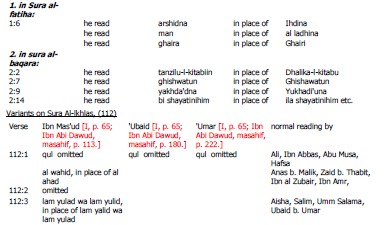
Même aujourd'hui, on trouve des variantes et des synonymes dans des copies du texte qui sont attribuées aux Compagnons et qui présentent une certaine valeur pour nous, dans le sens où elles ont pu servir de forme rudimentaire et précoce d'exégèse (Tafsir). Par exemple, selon certains rapports, les mots « salat al-wusta » (la prière du milieu) ont été lus et écrits par Hafsa, [Muwatta' Malik; Jeffery, p. 214.] Ubay [Jeffery, p. 122.] et Ibn 'Abbas [Jeffery, p. 196.] comme « salat al-'asr » (c'est-à-dire la prière de l'après-midi).
Even today the variants and synonyms are found in such copies of the text as are attributed to the Companions and are of some value to us in the sense that they may have served as an early rudimentary form of tafsir. For example, according to some reports the words 'salat al-wusta' (middle prayer) were read and written by Hafsa, [Muwatta' Malik; Jeffery, p. 214.] Ubay [Jeffery, p. 122.] and Ibn 'Abbas [Jeffery, p. 196.] as 'salat al-'asr' (i.e. afternoon prayer).
Tant que les compagnons (Sahabah) écrivaient leurs propres copies pour un usage strictement personnel, il n'y avait aucun mal, à condition qu'ils ne respectent pas strictement l'ordre des sourates qui était l'ordre du Coran. Plus tard, lorsque la copie de 'Uthman est devenue la version standard, les Compagnons ont adopté l'ordre de cette copie, y compris Ibn Mas'ud qui était peut-être celui qui s'en écartait le plus. [Ibn Abi Dawud, p. 12; Salih, S.: Mabahith fi 'ulum al-qura'n, Beirut, 1964,] Il y avait également, comme indiqué, certaines lectures variantes dans ces copies, [Voir aussi ci-dessous, sept lectures et qira'at.] lorsque certains mots étaient prononcés et orthographiés de manières légèrement différentes, etc. Cependant, il convient de noter que les lectures variantes sont généralement rapportées par une seule personne seulement, et occasionnellement par peut-être deux ou trois, tandis que la version appelée le texte 'Uthmanique est transmis par de multiples voies (Mutawatir), c'est-à-dire transmise par de nombreuses personnes et est sans aucun doute authentique.
As long as the sahaba wrote their own copies for personal use only, there was nothing wrong, if they did not strictly adhere to the order of suras which was the order of the Qur'an. Later on, when 'Uthman's copy became the standard version, the Companions adopted the order of this copy including Ibn Mas'ud who perhaps differed most. [Ibn Abi Dawud, p. 12; Salih, S.: Mabahith fi 'ulum al-qura'n, Beirut, 1964,] There were also, as indicated, some variant readings in these copies, [See also below, seven readings and qira'at.] when some words were pronounced and spelt in slightly different ways, etc. However, it should be noted that variant readings are usually reported by a single person only, and occasionally by perhaps two or three while the version called the 'Uthmanic text is mutawatir, i.e. transmitted by numerous people and is without doubt authentic.