4.1 Divisions du texte
4.1 Divisions Of The Text
Ayat et sourate
Aya And Sura
Ce chapitre a été traduit automatiquement (langue d’origine : anglais) et peut contenir des erreurs. Lire l’original
4.1 Divisions Of The Text
Aya And Sura
Aya (pl. ayat) signifie en réalité « signe ». Dans le langage technique, il s'agit de la plus petite division du texte coranique, c'est-à-dire une phrase ou une proposition. La révélation est une guidance de Dieu pour l'humanité et il n'est donc pas du tout surprenant de constater que ses plus petites divisions sont appelées des « signes » (directeurs). Le terme « verset » n'est pas approprié puisque le Qur'an n'est pas de la poésie.
Aya (pl. ayat) actually means 'sign'. In technical language it is the shortest division of the Qur'anic text, i.e. a phrase or sentence. The revelation is guidance from God to mankind and it is therefore not at all surprising to find that its smallest divisions are called (guiding) 'signs'. The term 'verse' is not appropriate since the Qur'an is not poetry.
Sourate (pl. sourates) signifie littéralement « rangée » ou « clôture ». Dans le langage technique, il s'agit de la division par passages du texte coranique, c'est-à-dire un chapitre ou une partie, séparé du texte précédent et suivant.
Sura (pl. Suwar) means literally 'row' or 'fence'. In technical language, it is the passage-wise division of the Qur'anic text,i.e. a chapter or part, set apart from the preceding and following text.
Le Coran contient 114 souras de longueurs inégales, la plus courte étant composée de quatre et la plus longue de 286 versets (Ayah).
The Qur'an has 114 suras of unequal length, the shortest consisting of four and the longest of 286 ayat.
Toutes les sourates (à l'exception de la sourate 9) commencent par les mots bismillahir rahmanir rahim. Il ne s'agit pas d'un ajout ultérieur au texte, mais cela était déjà utilisé, même avant l'appel de Muhammad ﷺ à la prophétie. [Voir sourate 27: 30.] Les 114 sourates du Coran ont des noms, qui servent de sorte de titre. Les noms sont souvent dérivés d'un mot important ou distinctif dans le texte lui-même, comme par exemple al-anfal (8) ou al-baqara (2). Dans d'autres cas, il s'agit de l'un des premiers mots par lesquels la sourate commence, par exemple ta-ha (20) ou al-furqan (25).
All suras (with the exception of Sura 9) begin with the words bismillahir rahmanir rahim. This is not a later addition to the text, but was already used, even before Muhammad's call to prophethood. ' [See Sura 27: 30.] All 114 suras in the Qur'an have names, which serve as a sort of heading. The names are often derived from an important or distinguishing word in the text itself, such as e.g. al-anfal (8) or al-baqara (2). In other cases it is one of the first few words with which the sSra begins e.g. ta-ha (20) or al-furqan (25).
Order And Arrangement
L'ordre des versets (Ayah) au sein de chaque sourate ainsi que l'agencement des sourates ont été finalement déterminés par le Prophète ﷺ sous la guidance de l'Ange Gabriel au cours de l'année de sa mort, lorsque Gabriel vint à deux reprises réviser le texte avec lui. [Voir ci-dessus. transmission of the Qur'anic revelation, p. 31.] Les savants ont également regroupé les sourates en quatre types :
Both the order of the ayat within each sura and the arrangement of the suras were finally determined by the Prophet under guidance from the Angel Gabriel in the year of his death, when Gabriel twice came to revise the text with him. [See above. transmission of the Qur'anic revelation, p. 31.] Scholars have also grouped the suras into four kinds:
al-tiwal (les longues) : 2-10.
al-tiwal (long ones): 2-10.
al-mi'un : sourates comportant environ 100 versets (Ayah) : 10-35.
al-mi'un: suras with approximately 100 ayat: 10-35.
al-mathani : sourates avec moins de 100 versets (Ayah) : 36-49.
al-mathani: suras with less than 100 ayat: 36-49.
al-mufassal : la dernière section du Coran commençant par la sourate qaf : 50-114.
al-mufassal: the last section of the Qur'an beginning with Sura qaf: 50-114.
Other Divisions Of The Text
Juz' (pl. ajza') signifie littéralement partie, portion. Le Coran est divisé en 30 portions de longueur approximativement égale pour faciliter la récitation durant les trente nuits d'un mois, particulièrement durant le mois de ramadan. Habituellement, ils sont indiqués par le mot accompagné de son numéro (par exemple, le juz' 30 commençant par la sourate 78).
Juz' (pl. ajza') literally means part, portion. The Qur'an is divided into 30 portions of approximately equal length for easy recitation during the thirty nights of a month, especially of the month of Ramadan. Usually they are indicated by the word and the number of it given alongside, (e.g. juz' 30 beginning with Sura 78).
Certaines copies du Qur'an ont les sourates divisées en paragraphes appelés ruku'. Ils sont indiqués par le symbole et l'explication des chiffres arabes écrits avec chacun est la suivante, par exemple 2:20 :
Some copies of the Qur'an have the suras divided into paragraphs called ruku'. They are indicated by the symbol and the explanation of the Arabic numerals written with each is as follows, e.g. 2:20:
Le chiffre du haut (2) indique qu'il s'agit du deuxième ruku' achevé dans la sourate respective (ici la sourate al-Baqara).
The top figure (2) indicates that this is the second completed ruku ' in the respective sura (here Sura albaqara)
.
.
Le chiffre du milieu (13) indique que ce ruku' achevé contient 13 versets (Ayah).
The middle figure (13) indicates that this completed ruku' contains 13 ayat.
Le chiffre inférieur (2) indique qu'il s'agit du deuxième ruku' dans le juz' respectif (ici le premier juz').
The lower figure (2) indicates that this is the second ruku' in the respective juz' (here first juz').
Les exemplaires du Qur'an imprimés au Moyen-Orient en particulier ont chaque juz' subdivisé en quatre hizb indiqués par le signe, par exemple 2:74 est le début du deuxième hizb du Qur'an, indiqué par le chiffre 2:
Copies of the Qur'an printed in the Middle East in particular have each juz' subdivided into four hizb indicated by the sign e.g. 2:74 is the beginning of the second hizb of the Qur'an, indicated by the figure 2:
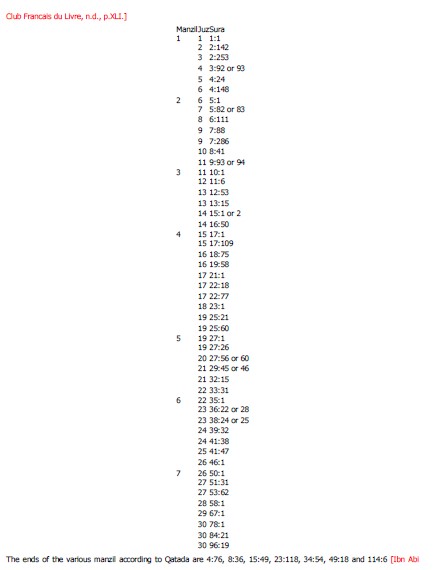
Chaque hizb est à nouveau subdivisé en quatre quarts. Le texte coranique est également divisé en sept parties de longueur approximativement égale, appelées manzil, pour une récitation sur sept jours, indiquées dans certains exemplaires par le mot manzil et le numéro respectif dans la marge. Le tableau suivant montre la division du texte en juz' et manzil : [Hamidullah, Muhammad: Le Saint Coran. Traduction integraleetnores. Paris:
Each hizb is again subdivided into quarters The Qur'anic text is also divided into seven parts of approximately equal length, called manzil, for recitation over seven days, indicated in some copies by the word manzil and the respective number in the margin. The following table shows the division of the text into juz' and manzil: [Hamidullah, Muhammad: Le Saint Coran. Traduction integraleetnores. Paris: