5.29 穆斯林沦为易受攻击的目标
5.29 Muslims Becoming Easy Prey
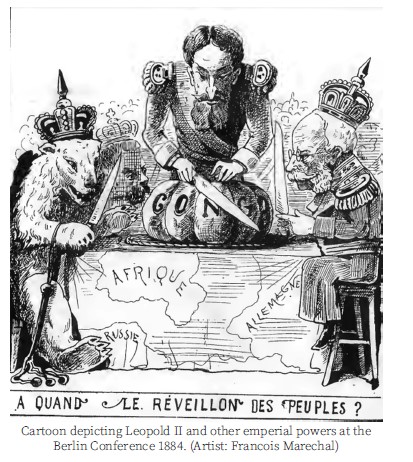
先知ﷺ还预言,肉欲的追求不仅会侵染他的民族,还将成为其衰落与毁灭的根源。萨不尔(Thawbān)传述,先知ﷺ说:"各民族很快就会互相邀请来吞食你们,就像食客被邀请去分食一盘菜肴。"有人问:"那时候是因为我们人数少吗?"他说:"不,你们那时人数会很多,但你们会像河面上的泡沫一样毫无分量。真主将从你们敌人的心中去除对你们的畏惧,并将软弱投入你们的心中。"有人问:"真主的使者啊,这软弱是什么?"他说:"热爱今世,厌恶死亡。" 令人惊叹的是,一个世纪前,比利时国王利奥波德二世曾非常著名地把他的殖民野心称为"这块华丽的非洲大蛋糕",欧洲列强在1884年的柏林会议上随意地瓜分了它。人们很容易找到当时许多将这次会议以食物为喻的政治漫画,这与上述圣训所说的几乎如出一辙。
The Prophet صلى الله عليه وسلم also prophesied that carnal pursuits would not only infect his nation but would be the cause of their downfall and devastation. Thawbān reports that the Prophet صلى الله عليه وسلم said, “The nations will soon invite one another to devour you, just as diners are invited to a dish.” It was said, “Will it be because of our small number on that day?” He said, “No, rather you will be many on that day, but you will be weightless foam, like the foam on the river. And Allah will remove the fear of you from the hearts of your enemies and will cast weakness into your hearts.” Someone said, “O Messenger of Allah, what will this weakness be?” He said, “The love of this world, and the hatred of death.”333 It is incredible how one century ago, King Leopold of Belgium very famously referred to his colonial ambitions as “this magnificent African cake,” which the European powers carved at will during the Berlin Conference of 1884. A person can easily find the many political cartoons of that day conceptualizing this conference in food terms, almost exactly like the hadith above had stated.
这在一定程度上是由于利奥波德国王的那个比喻,但也因为与会者此行只是为了正式划分非洲的势力范围,他们完全相信,这块幅员辽阔、资源丰富的大陆根本无力对他们贪婪的掠夺欲和帝国的扩张野心做出任何有意义的抵抗。
This was in part due to King Leopold’s metaphor, but also because the attendees were only there to formalize the divisions of Africa, fully confident that the large and resourceful continent could not hold its weight in any meaningful resistance to their ravenous greed and imperial appetite.
进一步强调这一点,安斯·本·马立克(Anas ibn Mālik)传述,先知ﷺ说:"当我的民族认为五件事是可以允许的时候,毁灭就会降临到他们身上:当相互咒骂出现,饮酒,穿丝绸,演奏乐器,男人与男人自我满足,女人与女人自我满足。"⁽³³⁴⁾ 当然,今天的穆斯林并非不受接纳同性行为之意识形态的影响。即便是一位坚持礼拜、常去清真寺的穆斯林,如果任由自己的虔诚被化约为一种文化身份,这种情况也是可以想象的,正如先知ﷺ在阿卜杜拉·本·阿慕尔('Abdullah ibn 'Amr)传述的一段圣训中所说:"必定会有这样一个时代:人们聚集在清真寺里礼拜,而他们之中没有一个信士。"335
Reinforcing this point, Anas ibn Mālik narrates that the Prophet صلى الله عليه وسلم said, “Once my nation considers five things permissible, then destruction will befall them: when cursing one another appears, wine is drunk, silk is worn, musical instruments are played, and men suffice themselves with men and women suffice themselves with women.”334 Certainly, Muslims today are not insulated from the ideologies that accept same-sex acts. This is even imaginable for a practicing, mosque-attending Muslim, if they allow their religiosity to be reduced to a cultural identity, as the Prophet صلى الله عليه وسلم said in a hadith narrated by ‘Abdullah ibn ‘Amr , “An age will surely come when people gather and pray in the mosques, while there is not a single believer amongst them.”335
333 Abū Dāwūd,《Sunan Abī Dāwūd》,4:111 #4297;al-Albānī 在注释中予以认证。
333 Abū Dāwūd, Sunan Abī Dāwūd, 4:111 #4297; authenticated by al-Albāni in the comments.
334 艾哈迈德·伊本·侯赛因·拜希给,《信仰支部》(利雅得:Maktabat al-Rushd lil-Nashr wal-Tawzī',2003年),7:328 #5084;据阿勒巴尼在《优良的鼓励与警告》(利雅得:Maktabat al-Ma'ārif,2000年)2:608 #2386中的判定,该传述链为 ḥasan(可接受)。
334 Aḥmad ibn al-Ḥusayn al-Bayhaqī, Shu‘ab al-Īmān (Riyadh: Maktabat al-Rushd lil-Nashr wal-Tawzī’, 2003), 7:328 #5084; a ḥasan (acceptable) chain according to al-Albānī in Ṣaḥīḥ al-Targhīb wal-Tarhīb (Riyadh: Maktabat al-Maʻā rif, 2000), 2:608 #2386.
虽然这些禁令在此处看似绝对,但学者们结合对其他先知圣训的整体理解,对它们作了限定。例如,此处禁止穿丝绸的规定,经限定只适用于男子,且仅限于数量较多的情况,并在没有必要时才适用。同样,学者们普遍认为,击打手鼓(达夫)属于对乐器禁令的例外,至少在某些场合如此,而有些学者更进一步扩大了这一让步的范围。
While these prohibitions appear absolute here, scholars have qualified them considering their cumulative read of other prophetic traditions. For instance, the prohibition of silk here is qualified by being applicable to men only, and in significant amounts, and in the absence of necessity. Similarly, scholars generally consider striking the tambourine an exception to the prohibition of musical instruments, at least on occasion, and some widen the concession further.
335 Abū Bakr ibn Abī Shaybah,《Al-Īmān》(贝鲁特:伊斯兰书局,1983年),第1卷:40
335 Abū Bakr ibn Abī Shaybah, Al-Īmān (Beirut: al-Maktab al-Islāmī, 1983), 1:40
由阿尔巴尼(al-Albānī)在注释中认证。
#101; authenticated by al-Albānī in the comments.