2.2 Uning sodda va kamtarligi
2.2 His Simplicity and Humility
Payg'ambarimiz ﷺ ning sodda va kamtarona hayot tarzi uning da'vati o'z manfaati uchun emasligini ko'rsatadigan muhim dalildir, ayniqsa tarixdagi ko'plab soxta payg'ambarlarning hashamatli va isrofgarlik bilan to'la hayoti bilan solishtirilganda. Axir, bu inson hayotining oxirida butun Arabistonni o'z nazorati ostiga olgan edi. Undan ham oldin, Madinada uning minglab izdoshlari bor edi, ular unga ehtirom bilan bog'langan va uning uchun dunyodagi hamma narsani qilishga tayyor bo'lishgan. Shunga qaramay, uning hayotining hech bir sohasida hashamat belgisini ko'rmaymiz.
The simple, austere lifestyle of the Prophet صلى الله عليه وسلم is a major indication that his mission could not have been self-serving, especially when contrasted with the decadent, extravagant lifestyles of so many false prophets in world history. After all, this was a man who controlled all of Arabia by the end of his life. Even before that, he had thousands of followers in Madinah, followers who obsessed over him and would have done anything in the world for him. Yet, we see no signs of luxury in any sphere of his life.
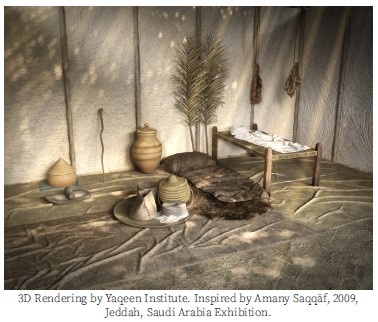
Uning yashash xonasi shunchalik tor edi, u ﷺ ibodat qilmoqchi bo‘lganda, sajda qilish uchun joy bo‘lsin deb ‘Oishaga oyoqlarini bukishni ishora qilib turtardi. Ichish yoki cho‘milish uchun xonasida osilib turgan kichik charm suv idishiga qo‘l cho‘zardi. Oylab davom etadigan vaqtlarda uyida ovqat pishirish uchun olov yoqilmas edi, va oilasi kimdir sut hadya qilmasa, xurmo va suv bilan qanoatlanardi.58 ‘Umar ibn al-Xattob roziyallohu anhu rivoyat qiladi: u bir safar Allohning Elchisi ﷺ xonasiga kirib, u ﷺ yotganini ko‘rdi va ostidagi qo‘pol hasir yonboshida izlar qoldirganini payqadi. Buni, arpa va barg kabi oz miqdordagi ozuqani hamda burchakda osilgan charm xaltani ko‘rib, ko‘zlari yoshga to‘ldi. Payg‘ambar ﷺ dedi: “Nima seni yig‘latyapti, ey Xattobning o‘g‘li?” U dedi: “Ey Allohning Payg‘ambari, hasir yonboshingizda shunday izlar qoldirganini ko‘rib, oziq-ovqat javoningizda shuncha oz narsa borligini ko‘rib, qanday yig‘lamay? Qaysar va Kisro mevalar va suv buloqlari bilan o‘ralgan holda yashaydi, sizesa Allohning Elchisi va Uning tanlagan zotisiz, va hamon ahvolingiz shu.” Payg‘ambar ﷺ dedi: “Ey Xattobning o‘g‘li, bular bizga oxiratda, ularga esa bu dunyoda berilgani sizni xursand qilmaydimi?” Men dedim: “Albatta.”59 Boshqa rivoyatda u javobini shunday boshladi: “Shubhadamisan, ey Xattobning o‘g‘li? Bular dunyo hayotida lazzatlari tezlashtirilgan xalqdir.”60
His living quarters were so tight that when he صلى الله عليه وسلم wished to pray, he would tap ‘Āishah to bend her legs to make room for him to prostrate. To drink or bathe, he would reach for the small leather water skin that hung in his room. For months on end, no fire would be kindled for cooking in his home, and his family was content with dates and water unless someone gifted them some milk.58 ‘Umar ibn al-Khattāb reports that he once entered the room of the Messenger of Allah صلى الله عليه وسلم to find him lying down and noticed that the coarseness of the straw mat under him had left marks on his side. Upon noticing that, and the meager rations of barley and leaves, and the leather bag hanging in the corner, his eyes welled with tears. The Prophet صلى الله عليه وسلم said, “What makes you weep, O son of al-Khaṭṭāb?” He said, “O Prophet of Allah, how can I not cry after seeing how the mat has left these marks on your side, and how little you have in your food cupboard? Caesar and Chosroes live surrounded by fruits and springs of water, while you are the Messenger of God and His chosen one, and yet this is your condition.” The Prophet صلى الله عليه وسلم said, “O son of al-Khaṭṭāb, does it not please you that these [luxuries] are for us in the Hereafter and for them in this world?” I said, “Of course.”59 In another narration, he began his response with, “Are you in doubt, O son of al-Khaṭṭāb? These are a people whose pleasures have been expedited in the life of this world.”60
58 al-Buxoriy, Sahihi al-Buxoriy, 8:97 #6459.
58 al-Bukhārī, Ṣaḥīḥ al-Bukhārī, 8:97 #6459.
Muslim, Sahih Muslim, 2:1105 #1479.
59 Muslim, Ṣaḥīḥ Muslim, 2:1105 #1479.
60 al-Bukhārī, Ṣaḥīḥ al-Bukhārī, 3:133 #2468.
60 al-Bukhārī, Ṣaḥīḥ al-Bukhārī, 3:133 #2468.
61 Edward Gibbon, Decline and Fall of the Roman Empire: Volume the Fifth (London:
61 Edward Gibbon, Decline and Fall of the Roman Empire: Volume the Fifth (London:
Electric Book Co, 2001), bob L, 252.
Electric Book Co, 2001), chapter L, 252.
62 Ibid., 251-252.
62 Ibid., 251-252.
63 Washington Irving va Bertram R. Davis, The Life of Mahomet (London: G.
63 Washington Irving and Bertram R. Davis, The Life of Mahomet (London: G.
Routledge & Co, 1850), 186-187.
Routledge & Co, 1850), 186-187.
64 Ibid., 203.
64 Ibid., 203.
65 al-Tirmidhī, Sunan al-Tirmidhī, 5:90 #2754; al-Tirmidhiy tomonidan izohlarda sahih deb baholangan.
65 al-Tirmidhī, Sunan al-Tirmidhī, 5:90 #2754; authenticated by al-Tirmidhī in the comments.
66 Bosworth Smith, Mohammed and Mohammedanism (London: Smith, Elder, and Co., 1874), 235.
66 Bosworth Smith, Mohammed and Mohammedanism (London: Smith, Elder, and Co., 1874), 235.
Muslim, Ṣaḥīḥ Muslim, 1:1 #8.