1.1 危機の構造
1.1 Anatomy Of A Crisis
世の中には、現行の体制の終わりを予言する書き手が後を絶たない。実際、今この瞬間にも多くの著者が、フクヤマの悪名高い(そして今では時代遅れとなった)1989年の論文「歴史の終わり」に対抗して、「資本主義の終焉」という題名で一番乗りを狙い、原稿を出版社に送っているに違いない。では、この出来事は本当に資本主義の終わりになるのだろうか。その可能性は低い。しかし、これは資本主義の終わりの始まりなのだろうか。おそらくそうであり、資本主義が今まさに集中治療を必要とし、最大の危機に直面していることは疑いようがない。
There has been no shortage of writers predicting an end to the system as we know it. Indeed as we speak many authors are probably sending manuscripts to publishers trying to be first with the title “The End of Capitalism” to rival Fukuyama’s infamous (and now defunct) essay on the End of History in 1989. But will this event really be the end for Capitalism? Unlikely. But, is this the beginning of the end of capitalism? Quite probably, and it is without doubt that Capitalism currently needs intensive care and is facing its greatest crisis.
2008年9月の出来事は、資本主義の歴史において最も暗い時期の一つとして記憶されることになるだろう。米連邦準備制度理事会の元議長アラン・グリーンスパンは、現在の出来事は五十年か百年に一度という稀なものだと述べた。米国にとって、今回の危機は真珠湾攻撃と9・11を合わせたほどの経済的衝撃に当たる。体制に対する深刻な衝撃であり、今後何年、いや何十年にもわたって感じられることになるだろう。現代の金融資本主義の礎であった単独型の投資銀行モデルの終焉を我々は目の当たりにしただけでなく、政府が次の金融機関を救済しようと奔走する中で、自由放任の自由市場経済学という教義も打ち砕かれるのを目にしたのである。
The events of September 2008 will go down in history as one of the darkest times in the history of Capitalism. Alan Greenspan former Chairman of the US Federal Reserve stated that the current events were rare, once every fifty or hundred years. For the US, in particular the current crisis constitutes the economic equivalent of Pearl Harbour and 9-11 combined a profound shock to the system which will be felt for years if not decades ahead. Not only have we witnessed the end of the stand alone investment banking model which was the cornerstone of modern financial capitalism, we have also seen the dogma of laissez faire free market economics trashed as Governments scramble around to bail out the next financial institution.
グリーンスパンは一世紀に一度の出来事について間違っている。ドットコムバブルの崩壊からわずか八年しか経っておらず、その崩壊によって株式市場の時価総額は約7兆ドルも消え失せた。では、我々はどうしてこの混乱に陥ったのか。経済規模が14兆ドルのアメリカ合衆国という超大国が、どうして物笑いの種になってしまったのか。ほんの最近まで数百億ドルの価値があったとされ、二度の世界大戦と大恐慌を生き延びた投資銀行が、どうしてこれほど容易に消滅してしまったのか。かつては開発途上国に対して経済運営の技術を得意げに説いていた西側諸国の政府が、どうして単なる「バナナ共和国」同然の振る舞いしかできなくなっているのか。
Greenspan is wrong about a once a century occurrence, it has only been eight years since the dot com fiasco which wiped off almost 7 trillion dollars off stock market valuations. So how did we get into this mess, how could the United States, a superpower with a $14 trillion economy now become a laughing stock. How could investment banks valued only recently at tens of billions of dollars and who were able to survive two world wars and the great depression be wiped out so easily. How could western governments who used to smugly preach to the developing world the art of economic competence act no better than glorified banana republics?.
過去一か月の出来事の根源はサブプライム分野にあった。仲介業者は多額の手数料に駆り立てられ、住宅ローンを大量に、トラックいっぱいの量で何百万人もの借り手に売り込んだのである。広く持ち家を促すこの政策は、マイホームを持つことがアメリカン・ドリームの一部だと信じた歴代政権によって続けられてきた。すぐに儲けたいという思いに動かされ、安易な信用に支えられた多くの借り手にとって、住宅価格が急騰して大きな利益が得られるなら、住宅ローンを組むことは小さな代償にすぎなかった。手数料を手にした仲介業者は、ローンを売り払うことにし、やがてそれらは束ねられて住宅ローン担保証券(MBS)となり、世界中の銀行によって売買されるようになった。低金利の時代にあって、株主やアナリスト、つまり企業資本主義の応援団に駆り立てられた世界中の銀行は、より高い収益を追い求めることを迫られた。したがってMBSはまるで天国からの涅槃のようなものであり、住宅価格が上昇する一方で、そうした金融商品やその他の代替的な金融商品への需要は高いままであった。
The events of the past month were rooted in the sub prime sector when brokers incentivised by fat commissions sold mortgages in their truck loads to millions of borrowers. This policy of encouraging widespread home ownership had been followed by successive administrations who believed that owning one’s house was part of the American dream. For many borrowers motivated by a quick buck and cushioned by easy credit, getting a mortgage was a small price to pay in exchange for a huge profit as house prices rose exponentially. Brokers having banked their commissions decided to sell their mortgages on and soon these would be parcelled up and form mortgage backed securities (MBS) sold and resold by banks throughout the world. At a time of low interest rates, banks throughout the world egged on by shareholders and analysts, the cheerleaders of corporate capitalism, were challenged to seek to gain higher and higher returns. MBSs therefore were like nirvana from heaven and while house prices rose, demand for such instruments and other alternative instruments remained high.
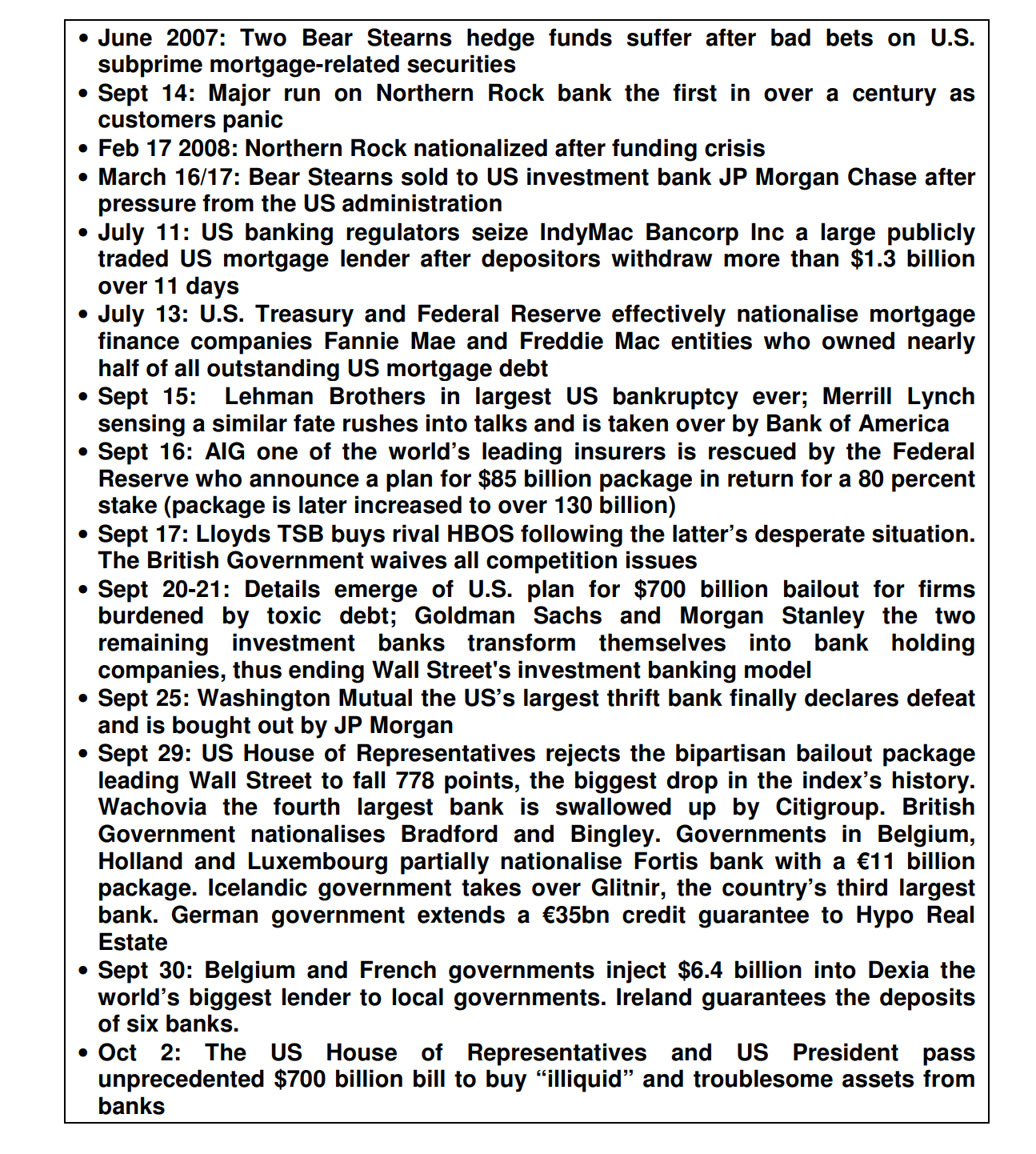
当時、こうした新しい形態の証券販売は、規制当局も論評者も等しく独創的だとみなしていた。これらの商品はリスクを分散し、どの一つの主体も過度にさらされないことを保証すると考えられていたからである。何年にもわたる住宅価格の上昇の後、誰もが満足していたが、避けられない暴落が訪れた。当時、リスク分散という利点とは程遠く、銀行が実はリスクがどこにあるのかを把握していなかったと気づいたことで、深刻なパニックが広がった。その結果、信用の深刻な喪失と銀行間融資の凍結を招いた。MBSの価値が下落し、専門用語で言えば「有害資産」となり、他の銀行が巨額の損失を抱えているかもしれないと考えられたため、銀行同士は互いを信用しなくなった。この凍結によって、一部の銀行は債務超過に陥り、他の銀行は高レバレッジのデリバティブ投機の後に流動性を失って倒産に追い込まれた。また、信用はより高価になり、貯蓄に対する不安が広がり、商品価格は上昇し、通貨は弱くなり、その結果物価はさらに高くなった。以下は、危機が始まって以来、世界を襲った主な出来事である。
At the time, this new model of selling on such instruments was considered ingenious by regulators and commentators alike as they believed these products diversified risk and ensured that no one entity would be disproportionately exposed. After years of house price growth, everyone was happy until the inevitable crash. At the time, far from the benefits of diversified risk, deep panic set in as banks discovered that they actually didn’t know where the risk was, thereby leading to a chronic loss of confidence and the freezing of inter bank lending. Banks simply didn’t trust each other believing that other banks could be potentially sitting on huge losses as these MBSs lost value or to use the technical term became “toxic”. This freeze would make certain banks insolvent and others would go to the wall due to a lack of liquidity following highly leveraged derivative bets. It would also make credit more expensive, lead to mass insecurity around savings, increase commodity prices and weaken currencies, so making prices higher. The following are the key events that have hit the world since the crisis began.

出来事はかつてないほどの激動となっている。大恐慌以来、これほどの出来事を目にし、金融システムがこれほど脆弱であるのを見たことはない。米国政府が米国の銀行システムから最大7,000億ドルの不良資産を買い取る提案は、当初、下院で228対205の票差で否決された。多くの人々が、この対策案がアメリカ国民の間で極めて不人気であることを理由に挙げた。 人々が正当に指摘しているのは、ウォール街は好景気の時には数十億ドルの利益を私物化して喜んでいたのに、景気が悪くなると、その損失を「国有化」し、アメリカの納税者にその負担をさせようとしている、という点である。人々が食料、エネルギー、医療の費用高騰に苦しみ続けている一方で、ウォール街の銀行家たちの報酬は支払われ続けており、リーマン元社員たちは2009年に新しい雇用主から数十億ドル規模の巨額のボーナスを受け取る見込みである。人々がウォール街やワシントンの協力者たちにこれほど幻滅しているのも無理はない。 さらに、すでに数兆ドルもの債務を抱える米国が、どうしてこれほど巨額の救済策を賄えるのか、また、どうして米国および世界の市場に数千億ドルもの流動性を供給し続けることができるのか、と疑問を呈する人々もいる。ここで登場するのが、現連邦準備制度理事会(FRB)議長のベン・バーナンキと、その魔法の杖である。6年前の講演でバーナンキは、次のように述べて自身の秘密兵器を明らかにしたのである。
The events have been of unprecedented volatility. Not since the Great Depression have we witnessed such events and seen such fragility in the financial system. The US government’s proposal to buy toxic assets up to $700 billion from the US banking system was initially defeated by 228-205 in the House of Representatives, with many citing the sheer unpopularity of the package with the American people. People have rightly pointed to the fact that Wall Street was more than happy to keep their billion dollar profits private in the good times and yet want to ‘nationalise’ their losses, to be paid for by the American taxpayer when the going got tough. While people continue to suffer from higher food, energy and healthcare costs, Wall Street bankers’ compensation packages continue to be paid with ex Lehman’s staff on course for huge multi billion dollar bonuses from their new employers in 2009. No wonder people are so disillusioned with Wall Street and their cohorts in Washington. In addition some ask how the US, already trillions in debt can afford such huge bailouts and how they can continue to be able to provide hundreds of billions of dollars in liquidity to the US and world markets. Step forward Ben Bernanke the current Chairman of the Federal Reserve and his magic wand! In a speech given six years ago Bernanke revealed his secret weapons when he stated the following.
「金と同じく、米ドルも供給が厳しく制限されている限りにおいてのみ価値を持つ。しかし米国政府は、印刷機(今日では電子的な同等物)と呼ばれる技術を持っており、それによってほぼ費用をかけずに、望む量のドルを生み出すことができる。」
“Like gold, U.S. dollars have value only to the extent that they are strictly limited in supply. But the US government has a technology, called a printing press (or, today, its electronic equivalent), that allows it to produce as many U.S. dollars as it wishes at essentially no cost.".
信頼という根本的な前提が崩れてしまった今、資本主義国家の政府に残された手段は、紙幣を刷る印刷機とその電子的な等価物だけである。ベア・スターンズを救済し、AIG、そしてフレディマックとファニーメイを救うために、数千億ドルもの資金を投じてきたが、その原資はすべて印刷された紙幣か、あるいは国債の追加発行による借入であった。体制を短期的に何としても安定させることに注力するあまり、インフレの高進や通貨価値の下落への影響は完全に無視されている。
With the fundamental condition of confidence now shot, the only things capitalist governments have at their disposal is their printing presses and electronic equivalents. Having bailed out Bear Stearns, AIG as well as Freddie Mac and Fannie Mae at the cost of hundreds of billions of dollars, all financed by either printed money or borrowed by issuing more treasury bills. Intent on stabilising the system in the short term at all costs, the impact on higher inflation and a devalued currency are completely ignored.