5. Al-Hasan Ibn Ali
5. Al-hasan Ibn Ali
Que Allah esteja satisfeito com ele
May Allah Be Pleased With Him
Al-Hasan ibn Ali ibn Abi Talib, que Allah esteja satisfeito com ele, Abu Muhammad, neto do Mensageiro de Allah ﷺ, seu descendente e o último dos califas segundo as palavras explícitas do Profeta ﷺ.
Al-Hasan ibn Ali ibn Abi Talib, may Allah be pleased with him, Abu Muhammad, the grandson of the Messenger of Allah, may Allah bless him and grant him peace, his descendant and the last of the khulafa by his (the Prophet’s, may Allah bless him and grant him peace) explicit words.
Ibn Sa'd narrou que Imran ibn Sulayman disse: "Al-Hasan e al-Husayn são dois dos nomes dos habitantes do Paraíso. Os árabes não usavam esses nomes na Jahiliyyah."
Ibn Sacd narrated that Tmran ibn Sulayman safd: Al-Hasan and al-Hussein are two of the names of the people of the Garden. The Arabs did not use these names in the Jahiliyyah.
Al-Hasan, que Allah esteja satisfeito com ele, nasceu em meados do mês de Ramadã, no terceiro ano da Hégira. Hadiths foram transmitidos por ele do Profeta ﷺ. 'Aishah, que Allah esteja satisfeita com ela, transmitiu hadiths dele, assim como um grande número dos Tabi'un, entre eles seu filho al-Hasan, Abu'l-Hawra' Rabi'ah ibn Sinan, Ash-Shaʿbi, Abu Wa'il e Ibn Sirin.
Al-Hasan, may Allah be pleased with him, was born in the middle of Ramadan in the third year of the Hijrah. Hadith have been related from him from the Prophet, may Allah bless him and grant him peace. cA’ishah, may Allah be pleased with her, related hadith from him, and a great number of the Followers, of them his son al-Hasan, Abu’l-Hawra’ Rabicah ibn Sinan, Ash-Shacbi, Abu Wa’il and Ibn Sirin.
Ele se parecia com o Profeta ﷺ. O Profeta ﷺ deu-lhe o nome de al-Hasan, sacrificou uma ovelha por ele no sétimo dia, raspou seu cabelo e ordenou que o peso do cabelo em prata fosse doado como sadaqah. Ele foi o quinto da família do manto (quando o Profeta ﷺ disse: "Ó Allah, estes são a minha família"). Abu Ahmad al-cAskari disse: Este nome não era conhecido na Jahiliyyah.
He resembled the Prophet, may Allah bless him and grant him peace. The Prophet, may Allah bless him and grant him peace, named him al-Hasan, slaughtered a sheep for him on his seventh day, shaved off his hair and ordered that the weight of the hair in silver should be given away as sadaqah. He was the fifth of the family of the mantle (when the Prophet, may Allah bless him and grant him peace, said, ‘O Allah, these are my family.’X Abu Ahmad al-cAskari said: This name was not known in the Jahiliyyah.
Al-Mufaddal disse: Allah ocultou os nomes de al-Hasan e al-Husayn até que o Profeta, que a paz e as bênçãos de Allah estejam sobre ele, os usou para nomear seus dois netos.
Al-Mufaddal said: Allah veiled the names of al-Hasan and alT h e H isto r y o f t h e K h a l ifa h s Hussein until the Prophet, may Allah bless him and grant him peace, used them to name his two grandsons.
Al-Bukhari narrou que Anas disse: Ninguém se parecia mais com o Profeta ﷺ do que al-Hasan ibn ʿAli.
Al-Bukhari narrated that Anas said: No-one more resembled the Prophet, may Allah bless him and grant him peace, than al-Hasan ibn cAli.
Os dois Shaykhs narraram que al-Bara' disse: Vi o Profeta ﷺ com al-Hasan sobre seus ombros, dizendo: "Ó Allah, eu o amo, então ama-o." Al-Bukhari narrou que Abu Bakrah disse: Ouvi o Profeta ﷺ sobre o minbar, com al-Hasan ao seu lado, olhando para as pessoas uma vez e olhando para ele uma vez, dizendo: "Este meu filho é um chefe, e é provável que por meio dele Allah estabeleça a paz entre dois grupos dos muçulmanos." Al-Bukhari narrou que Ibn 'Umar disse: O Profeta ﷺ disse: "Eles são os meus dois ramos de manjericão (literalmente 'meus dois ramos de manjericão' ou 'minhas duas plantas [ou flores] de aroma doce') no mundo", referindo-se a al-Hasan e al-Hussein.
The two Shaykhs narrated that al-Bara’ said: I saw the Prophet, may Allah bless him and grant him peace, with al-Hasan upon his shoulder, saying, ‘O Allah, I love him, so love him.’ Al-Bukhari narrated that Abu Bakrah said: I heard the Prophet, may Allah bless him and grant him peace, upon the minbar, with al-Hasan by his side looking at the people one time and looking at him one time, saying, ‘This son of mine is a chief, and it is likely that through him Allah will make peace between two parties of the Muslims.’ Al-Bukhari narrated that Ibn cUmar said: The Prophet, may Allah bless him and grant him peace, said, ‘They are my two descendants (literally ‘my two sprigs of basil’ or ‘my two sweet-smelling plants [or flowers]’) in the world,’ meaning al-Hasan and al-Hussein.
Al-Tirmidhi e al-Hakim narraram que Abu Sa'id al-Khudri disse: O Mensageiro de Allah ﷺ disse: "Al-Hasan e al-Husayn são os dois senhores dos jovens do povo do Paraíso." Al-Tirmidhi narrou que Usama ibn Zayd disse: Vi o Profeta ﷺ, e al-Hasan e al-Husayn estavam sobre os seus quadris (um de cada lado), e ele disse: "Estes são os meus dois filhos e os dois filhos da minha filha. Ó Allah, eu os amo, então ama-os e ama quem os ama." Ele narrou que Anas disse: Perguntaram ao Profeta ﷺ: "Quem dos membros da sua casa são os mais amados por si?" Ele disse: "Al-Hasan e al-Husayn." Al-Hakim narrou que Ibn 'Abbas disse: O Profeta ﷺ aproximou-se carregando al-Hasan sobre os ombros. Um homem encontrou-o e disse: "Que montaria abençoada tens, rapaz!" O Profeta ﷺ respondeu: "E que cavaleiro abençoado ele é." Ibn Sa'd narrou que 'Abdullah ibn az-Zubayr disse: Aquele que mais se parecia com o Profeta ﷺ entre a sua família e o mais amado por ele era al-Hasan ibn 'Ali. Vi-o chegar enquanto ele estava em prostração e subir sobre os seus ombros — ou disse: "sobre as suas costas" — e ele não o fez descer até que ele mesmo descesse. Vi-o enquanto se inclinava na oração, e ele afastava as pernas para que ele pudesse passar pelo outro lado. Ibn Sa'd narrou que Abu Salamah ibn 'Abd al-Rahman disse:
At-Tirmidhi and al-Hakim narrated that Abu Sacid al-Khudri said: The Messenger of Allah, may Allah bless him and grant him peace, said, ‘Al-Hasan and al-Hussein are the two lords of the youth of the people of the Garden.’ At-Tirmidhi narrated that Usamah ibn Zaid said: I saw the Prophet, may Allah bless him and grant him peace, and al-Hasan and al-Hussein were upon his hips (one on each), and he said, ‘These are my two sons and the two sons of my daughter. O Allah, I love them, so love them and love whoever loves them.’ He narrated that Anas said: The Prophet, may Allah bless him and grant him peace, was asked, ‘Who of the people of your house are most beloved to you?’ He said, ‘Al-Hasan and al-Hussein.’ Al-Hakim narrated that Ibn cAbbas said: The Prophet, may Allah bless him and grant him peace, approached carrying al-Hasan on his shoulder. A man met him and said, ‘What a blessed mount you have, boy!’ The Prophet, may Allah bless him and grant him peace, replied, And what a blessed rider is he.’ Ibn Sacd narrated that “Abdullah ibn az-Zubayr said: The one most like the Prophet, may Allah bless him and grant him peace, of his family and the most beloved to him is al-Hasan ibn cAli. I saw him come while he was prostrate and mount his shoulders — or he said, ‘his back’ - and he did not make him get down until he himself got down. I saw him while he was bowing in prayer and he would separate his legs for him so that he could pass through the other side.’ Ibn Sacd narrated that Abu Salamah ibn cAbd ar-Rahman said:
O Profeta ﷺ costumava estender a língua para al-Hasan ibn ʿAli, e quando a criança via a vermelhidão da língua, ficava alegre com ele.
The Prophet, may Allah bless him and grant him peace, used to put forth his tongue for al-Hasan ibn cAli, then when the infant saw the redness of the tongue, he would be merry with him.
Al-Hakim narrou que Zuhayr ibn al-Arqam disse: Al-Hasan ibn Ali levantou-se para proferir o khutbah, e um homem da tribo Azd Shanu'ah levantou-se e disse: "Testemunho que vi o Profeta ﷺ colocá-lo no colo (hubwah denota sentar-se sobre os calcanhares com as pernas dobradas contra a barriga, frequentemente com um pano envolvendo as pernas e as costas como apoio), dizendo: 'Quem me ama, que o ame, e quem está presente que o transmita a quem está ausente', e se não fosse pela grande consideração pelo Mensageiro de Allah ﷺ, eu não o teria relatado a ninguém." Al-Hasan, que Allah esteja satisfeito com ele, possuía muitas virtudes: era nobre, paciente, possuía serenidade, dignidade e modéstia; era extremamente generoso e muito louvado; detestava as discórdias e a espada; casou-se muitas vezes; e costumava doar a um único homem até cem mil.
Al-Hakim narrated that Zuhayr ibn al-Arqam said: Al-Hasan ibn cAli stood to deliver the khutbah, and a man from Azd Shanu’ah stood up and said, ‘I witness that I saw the Prophet, may Allah bless him and grant him peace, place him in his lap (hubwah denotes sitting on the haunches with the legs drawn in to the belly, often with a cloth wrapped around the legs and the back in support), saying, “Whoever loves me, let him love him, and let the one who is present convey it to whoever is absent,” and if it were not for high regard for the Messenger of Allah, may Allah bless him and grant him peace, I would not have related it to anyone.’ Al-Hasan, may Allah be pleased with him, had many virtues: he was lordly, forbearing, possessing tranquillity, gravity and modesty; he was liberally generous, much praised; he disliked seditions and the sword; he married a great deal; and he would bestow upon a single man as much as one hundred thousand.
Al-Hakim narrou que cAbdullah ibn cUbayd ibn cUmayr disse:
Al-Hakim narrated that cAbdullah ibn cUbayd ibn cUmayr said:
Al-Hasan realizou o Hajj vinte e cinco vezes a pé, e os animais de montaria de raça nobre eram conduzidos ao seu lado.
Al-Hasan performed the Hajj twenty-five times walking, and the high-bred, riding beasts were led along with him.
Ibn Sa'd narrou que 'Umayr ibn Ishaq disse: Ninguém jamais falou na minha presença de quem fosse mais preferível, quando falava, que não se calasse do que al-Hasan ibn 'Ali. Nunca ouvi dele uma palavra imprópria, exceto uma vez. Houve uma disputa entre al-Hasan e 'Amr ibn 'Uthman sobre um terreno. Al-Hasan propôs algo que 'Amr não apreciou. Al-Hasan disse: "Não há outra saída para nós senão agir apesar dele (literalmente 'que seu nariz se cole ao pó')." Esta foi a palavra mais imprópria que ouvi dele.
Ibn Sacd narrated that cUmayr ibn Ishaq said: No-one ever spoke in my presence who it was more preferable, when he talked, that he should not be silent than al-Hasan ibn cAli. I never heard from him an improper word except for one time. There was a dispute between al-Hasan and cAmr ibn cUthman about some land. Al- Hasan proposed something which cAmr did not like. Al-Hasan said, ‘There is nothing for it with us but to act in spite of him (literally ‘that his nose cleave to the dust’).’ This was the most improper word I ever heard from him.
Ibn Sa'd narrou que 'Umayr ibn Ishaq disse: Marwan era o governador sobre nós, e costumava insultar 'Ali em toda sexta-feira do alto do minbar, enquanto al-Hasan escutava e não respondia. Então enviou-lhe um homem dizendo: "Juro por 'Ali, por 'Ali, por 'Ali, e por ti, por ti! Não encontro para ti semelhança alguma, exceto a mula, à qual se pergunta: 'Quem é o teu pai?', e ela responde: 'Minha mãe é uma égua.'" Al-Hasan disse-lhe: "Volta a ele e diz-lhe: 'Por Allah, não apagarei por ti nada do que disseste ao insultar-te. Contudo, tu e eu temos um encontro juntos diante de Allah. Então, se fores verdadeiro, que Allah te recompense pela tua veracidade; se fores mentiroso, então Allah é pior em vingança.'" Ibn Sa'd narrou que Zurayq ibn Sawwar disse: Houve algumas palavras entre al-Hasan e Marwan, então Marwan aproximou-se dele, tornou-se muito duro com ele — e al-Hasan ficou em silêncio. Marwan assoou o nariz usando a mão direita. Al-Hasan disse-lhe: "Ai de ti! Não sabes que a mão direita é para o rosto, e a esquerda para as partes íntimas (e para as coisas impuras em geral)? Sinto nojo de ti (literalmente, 'imundície para ti')!" Marwan calou-se.
Ibn Sacd narrated that cUmayr ibn Ishaq said: Marwan was the amir over us, and he used to abuse cAli every Jumucah from the minbar, while al-Hasan would listen and make no reply. Then he sent a man to him saying, ‘I swear by cAli, by cAli, by cAli, and by you, by you! I don’t find any likeness for you except the mule, to which it is said, “Who is your father?” and it replies, “My mother is a mare.’” Al-Hasan said to him, ‘Return to him and say to him, “By Allah, I will not efface for you anything of what you have said by abusing you. However, you and I have an appointment together before Allah. Then, if you are truthful, may Allah recompense you for your truthfulness. If you are a liar, then Allah is worse in revenge.’” Ibn Sacd narrated that Zurayq ibn Sawwar said: There were some words between al-Hasan and Marwan, then Marwan approached him, became very tough on him — and al-Hasan was silent. Marwan blew his nose using his right hand. Al-Hasan said to him, ‘Woe to you! Do you not know that the right hand is for the face, and the left for the private parts (and for unclean matters generally)? I am disgusted with you (literally ‘filth to you’)!’ Marwan became silent.
Ibn Sa'd narrou de Ash'ath ibn Sawwar que um homem disse: Um homem sentou-se com al-Hasan, e ele (al-Hasan) disse: "Você se sentou conosco no momento em que íamos nos levantar. Permite?" Ibn Sa'd narrou que 'Ali ibn Zayd ibn Judan disse: Al-Hasan doou sua propriedade duas vezes por causa de Allah, e Allah dividiu sua propriedade e a compartilhou com ele três vezes, a ponto de ele costumar dar uma sandália e guardar outra consigo, ou doar uma meia de couro (conhecida como khuff) e guardar outra.
Ibn Sacd narrated from Ashcath ibn Sawwar that a man said: A man sat down with al-Hasan and he (al-Hasan) said, ‘You have sat down with us at the moment we were going to stand. Will you permit?’ Ibn Sacd narrated that cAli ibn Zaid ibn Judacan said: Al-Hasan gave forth his property twice for the sake of Allah, and Allah divided up his property and shared it with him three times, to such an extent that he used to give a sandal and keep a sandal with him, or give away a leather sock (known as khuff) and keep another sock.
Ibn Sa'd narrou que 'Ali ibn al-Husayn disse: Al-Hasan era inclinado a divorciar mulheres, e ele não se separava de uma mulher sem que ela o amasse. Ele casou-se com noventa mulheres.
Ibn Sacd narrated that cAli ibn al-Hussein said: Al-Hasan was given to divorcing women, and he did not separate from a woman but that she loved him. He married ninety women.
Ibn Sa'd narrou de Ja'far ibn Muhammad que seu pai disse:
Ibn Sacd narrated from Jacfar ibn Muhammad that his father said:
Al-Hasan costumava casar-se e divorciar-se com tanta frequência que eu temia que ele causasse inimizade entre nós e as tribos.
Al-Hasan used to marry and divorce so much that I was afraid he would cause enmity towards us among the tribes.
Ibn Sa'd narrou de Ja'far ibn Muhammad que seu pai disse: 'Ali disse: "Povo de Kufa, não casem suas mulheres com al-Hasan, pois ele é um homem muito propenso ao divórcio". Um homem de Hamadan disse: "Por Allah, nós as casaremos com ele".
Ibn Sacd narrated from Jacfar ibn Muhammad that his father said: cAli said, ‘People of Kufa, do not marry (your womenfolk) to al-Hasan because he is a man much given to divorce.’ A man from Hamadan said, ‘By Allah, we will marry him (to our womenfolk).
“Quem lhe agradar ele pode manter, e quem lhe desagradar ele pode divorciar.” Ibn Sa'd relatou que 'Abdullah ibn Hasan disse: Hasan era um homem que costumava casar-se com muitas mulheres, e elas raramente lhe agradavam. Foram muito poucas as mulheres com quem ele se casou que não o amavam e não estavam profundamente apegadas a ele.
Whosoever pleases him he can keep, and whosoever displeases him he can divorce.’ Ibn Sacd narrated that cAbdullah ibn Hasan said: Hasan was a man who used to marry women a great deal, and they very rarely found favour with him. There were very few women he married who did not love him and were not passionately attached to him.
Ibn cAsakir narrou que Juwayriyyah ibn Asma’ disse: Quando al-Hasan morreu, Marwan chorou durante a oração fúnebre por ele. Al-Hussein disse-lhe: “Você chora por ele depois de tê-lo forçado a engolir aquilo que engoliu?” Ele respondeu: “Eu fazia isso com alguém mais paciente do que este”, e apontou para a montanha. (A montanha era proverbialmente o exemplo máximo de paciência).
Ibn cAsakir narrated that Juwayriyyah ibn Asma’ said: When al- Hasan died, Marwan wept at his funeral prayer. Al-Hussein said to him, ‘Do you weep when you forced him to swallow that which you did?’ He said, ‘I used to do that to one more forbearing than this,’ and he pointed towards the mountain. (The mountain was proverbially the epitome of forbearance).
Ibn ʿAsākir narrou que al-Mubarrad disse: Alguém disse a al-Hasan ibn ʿAli: "Abu Dharr diz: 'A pobreza é mais amada por mim do que a riqueza, e a doença mais amada por mim do que a saúde.'" Ele disse: "Que Allah tenha misericórdia de Abu Dharr. Quanto a mim, digo: 'Quem depende absolutamente da bondade da escolha de Allah para ele não deseja estar em nenhum estado que não seja aquele que Allah escolheu para ele.'" Este é o limite na investigação sobre o tema da contentamento com aquilo que o destino faz girar.
Ibn cAsakir narrated that al-Mubarrad said: Someone said to al- Hasan ibn cAli, ‘Abu Dharr says, “Poverty is more beloved to me than wealth, and illness more beloved to me than health.’” He said, ‘May Allah show mercy to Abu Dharr. As for me, I say, “Whoever is absolutely dependent on the goodness of Allah’s choosing for him does not wish to be in any state other than the one which Allah has chosen for him.’” This is the limit in research into the subject of contentment with that which destiny turns about.
Al-Hasan, que Allah esteja satisfeito com ele, assumiu o califado após a morte de seu pai por meio do juramento de lealdade do povo de Kufa, e permaneceu nele por seis meses e alguns dias. Então Mucawiyah se levantou contra ele — e o assunto pertence a Allah — e al-Hasan enviou-lhe uma mensagem oferecendo entregar-lhe o califado, com a condição de que o califado fosse dele após a sua morte, que ninguém do povo de Madinah, do Hijaz e do Iraque fosse procurado para vingança ou retaliação por algo que tivesse acontecido no tempo de seu pai, e que ele pagaria suas dívidas. Mucawiyah concordou com o que ele pediu, concluíram um tratado sobre essa base, e o milagre profético tornou-se evidente em suas palavras, que a bênção e a paz de Allah estejam sobre ele: "Allah fará a paz por meio dele entre dois grupos dos muçulmanos". Ele abdicou do califado em favor de Mucawiyah. Al-Balqini buscou provar, a partir de sua abdicação do califado — que é a mais elevada posição — que é permitido abdicar e renunciar a cargos e funções. Sua abdicação ocorreu no ano 41 AH, no mês de Rabi al-Awwal. Também foi dito que foi em Rabi al-Akhir, ou Jumada al-Ula. Seus companheiros disseram-lhe: "Ó vergonha dos mu'minin!", e ele respondia: "A vergonha é melhor que o Fogo." Um homem disse-lhe: "A paz esteja contigo, ó humilhador dos crentes!" Ele respondeu: "Não sou o humilhador dos crentes, mas não quis matar-te pelo domínio." Então al-Hasan mudou-se de Kufa para Madinah e ali residiu.
Al-Hasan, may Allah be pleased with him, took charge of the khilafah after the death of his father through the pledge of allegiance of the people of Kufa, and he remained in it for six months and some days. Then Mucawiyah came out against him - and the matter belongs to Allah — and so al-Hasan sent a message to him to offer to surrender the khilafah to him, on condition that the khilafah should be his after him, that no-one of the people of Madinah, al- Hijaz and Iraq should be sought out for revenge or retaliation for anything which had happened in the time of his father, and that he would pay off his debts for him. Mucawiyah agreed to what he asked, they concluded a treaty upon that basis, and the prophetic miracle became evident in his words, may Allah bless him and grant him peace, ‘Allah will make peace through him between two groups of the Muslims.’ He abdicated from the khilafah for him. Al-Balqini sought to prove from his abdication from the khilafah — which is the greatest rank - that it is permitted to abdicate from and renounce offices and positions. His abdication from it was in the year 41 AH, in the month of Rabic al-Awwal. It has also been said that it was in Rabic al-Akhir, or Jumada al-Ula. His companions said to him, ‘O disgrace of the mu’minin\’ and he would say, ‘Disgrace is better than the Fire.’ A man said to him, ‘Peace be upon you, humiliator of the believers!’ He said, ‘I am not the humiliator of the believers, but I disliked to kill you for the sovereignty.’ Then al-Hasan moved from Kufa to Madinah and resided there.
Al-Hakim narrou que Jubayr ibn Nufayr disse: Eu disse a al-Hasan: "As pessoas estão dizendo que você quer o califado." Ele disse: "Os líderes dos árabes estavam comigo, em guerra com quem eu estivesse em guerra e em paz com quem eu estivesse em paz. Abandonei isso buscando a Face de Allah e para evitar derramar o sangue da ummah de Muhammad ﷺ."
Al-Hakim narrated that Jubayr ibn Nufayr said: I said to al-Hasan, ‘People are saying that you want the khilafah.’ He said, ‘The chiefs of the Arabs were with me, at war with whomever I was at war with, and at peace with whomever I was at peace with. I abandoned that desiring the Face of Allah, and to prevent spilling the blood of the ummah of Muhammad, may Allah bless him and grant him peace.
Agora, mais tarde, devo tomá-lo à força com a ajuda dos rebanhos de cabras do povo de al-Hijaz?” Al-Hasan, que Allah esteja satisfeito com ele, morreu em Medina envenenado. Sua esposa, Ja'dah bint al-Ash'ath ibn Qais, envenenou-o. Yazid ibn Mu'awiyah sugeriu secretamente a ela que o envenenasse e que, depois, ele se casaria com ela, e ela assim o fez. Quando al-Hasan morreu, ela enviou uma mensagem a Yazid pedindo-lhe o cumprimento do que ele lhe havia prometido. Ele respondeu: “Não ficamos satisfeitos com você por causa de al-Hasan, então como ficaríamos satisfeitos com você por nós mesmos?” Sua morte ocorreu no ano 49 AH. Também foi dito que foi no dia cinco de Rabi' al-Awwal do ano 50 AH.
Now later, shall I take it by force with the help of the herds of goats of the people of al-Hijaz?’ Al-Hasan, may Allah be pleased with him, died in Madinah through poisoning. His wife, Jacdah bint al-Ashcath ibn Qais poisoned him. Yazid ibn Mucawiyah suggested secretly to her that she should poison him and that then he would marry her, and she did so. When al-Hasan died, she sent a message to Yazid asking him for the fulfilment of what he had promised her. He said, ‘We were not pleased with you for al-Hasan, so should we then be pleased with you for ourselves?’ His death was in 49 AH. It has also been said that it was on the fifth of Rabic al-Awwal in the year 50 AH.
E foi dito que isso aconteceu no ano 51 AH. Seu irmão insistiu com ele para que revelasse quem lhe dera a bebida (envenenada), mas ele não quis dizer. Ele disse: "Allah é o mais severo em retribuição, caso seja aquele que eu suspeito. Se não for, então nenhuma pessoa inocente deve ser morta em retaliação por mim."14
And it has been said that it was in 51 AH. His brother argued with him to get him to tell him who had given him the (poisoned) drink, but he would not tell him. He said, ‘Allah is most severe in revenge if it should be the one I suspect. If not, then no innocent person must be killed in retaliation for me.’14
Ibn Sa'd narrou que 'Imran ibn 'Abdullah ibn Talhah disse:
Ibn Sacd narrated that cImran ibn “Abdullah ibn Talhah said:
Al-Hasan viu em sonho como se estivesse escrito entre seus olhos: ‘Diga: “Ele, Allah, é Um”’ (Alcorão 112:1), e sua família se alegrou com isso. Contaram o sonho a Sa'id ibn al-Musayyab, que disse: ‘Se o sonho for verdadeiro, então ele tem muito poucos dias de vida.’ Ele viveu apenas mais alguns dias antes de morrer.
Al-Hasan saw as if there were written between his eyes, ‘Say, “He Allah is One"' (Qur’an 112: 1) and his family rejoiced at that. They told it to Sacid ibn al-Musayyab and he said, ‘If his dream is true, then he has very few days left to live.’ He only lived a few days more before he died.
Al-Bayhaqi e Ibn cAsakir narraram, por meio de Abu’l-Mundhir Hisham ibn Muhammad, que seu pai disse: Al-Hasan ibn cAli passava por dificuldades (em seu sustento), e seu estipêndio era de cem [dirhams]. 14 Contrariamente ao seu costume, as-Suyuti não indica fonte para esta narração.
Al-Bayhaqi and Ibn cAsakir narrated by way of Abu’l-Mundhir Hisham ibn Muhammad that his father said: Al-Hasan ibn cAli was constricted (in his provision), and his stipend was one hundred 14 Contrary to his usual practice, as-Suyuti gives no source for this story.
Na obra "In Defence Against Disaster", o Qadi Abu Bakr ibn al-Arabi diz, a respeito da alegação de que o Amir al-Mu'minin Mu'awiyah, que Allah esteja satisfeito com ele, envenenou al-Hasan, '...foi um assunto desconhecido. Somente Allah sabe disso. Como podes presumi-lo sem prova e atribui-lo a uma de Suas criaturas em um tempo distante, quando não temos nenhuma transmissão autêntica a esse respeito?' (p. 203) O mesmo se aplica a esta história. No mesmo livro, o Qadi isenta Yazid de grande parte da calúnia que lhe foi imputada e diz: '[Ahmad ibn Hanbal] incluiu-o entre os homens de zuhd (desapego do mundo)'.
In Defence Against Disaster, Qadi Abu Bakr ibn al-Arabi says concerning the allegation that the Amir al-Mu’minin Mucawiyah, may Allah be pleased with him, poisoned al-Hasan, ‘...it was an unknown business. Only Allah knows about it. How can you assume it without proof and ascribe it to one of His creatures in a distant time when we do not have any sound transmission about it?’ (p. 203) The same applies to this story. In the same book, the Qadi exonerates Yazid of a great deal of the slander levelled at him and says, ‘[Ahmad ibn Hanbal] included him among the men of zuhd (doing without the world)
dos Companheiros e dos Seguidores... Na verdade, ele o incluiu no grupo dos Companheiros antes de passar a mencionar os Seguidores.
of the Companions and Followers... Indeed, he included him in the group of Companions before he proceeded to mention the Followers.’.
...mil por ano. Muawiyah deixou de lhe pagar isso durante um ano, e ele ficou extremamente apertado. Ele disse: "Pedi um tinteiro para escrever a Muawiyah e lembrá-lo de mim, mas então me contive. Vi o Mensageiro de Allah ﷺ em sonho, e ele disse: 'Como vai, Hasan?' Eu disse: 'Bem, meu pai.' E queixei-me a ele da retenção da propriedade. Ele disse: 'Você pediu um tinteiro para escrever a uma criatura como você para lembrá-lo disso?' Eu disse: 'Sim, Mensageiro de Allah. O que devo fazer?' Ele disse: 'Diga:
thousand a year. Muawiyah withheld it from him one year, and he was extremely constricted. He said, ‘I called for an ink-pot so that I might write to Muawiyah to remind him about myself, and then I controlled (myself). I saw the Messenger of Allah, may Allah bless him and grant him peace, (in a dream) and he said, “How are you, Hasan?” I said, “Well, father.” And I complained to him about the withholding of the property from me. He said, “Did you call for an ink-pot to write to a creature like yourself to remind him of that?” I said, “Yes, Messenger of Allah. What should I do?” He said, “Say:
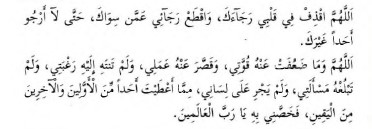
Ó Allah, põe em meu coração a esperança em Ti, corta minha esperança em tudo o que não seja Tu, até que eu não espere por ninguém além de Ti. Ó Allah, aquilo para o qual minha força é fraca demais, e no qual minha ação fica aquém, que meu desejo não alcança, que minha súplica não atinge, e que não flui sobre minha língua, dessa certeza que Tu concedeste a qualquer um dos antigos e dos povos posteriores, então distingue-me com ela, Senhor dos mundos.” Ele disse: “Então, por Allah, eu não havia persistido nisso por uma semana quando Mucawiyah me enviou um milhão e quinhentos mil, e eu disse: ‘Louvado seja Allah, que não esquece quem O recorda e não decepciona quem Lhe suplica.’ Vi o Profeta ﷺ em sonho, e ele disse: ‘Hasan, como estás?’ Eu disse: ‘Bem, Mensageiro de Allah’, e contei-lhe minha história. Ele disse: ‘Meu filho, assim é para quem espera (algo) do Criador e não espera (algo) da criatura.’” Há em at-Tuyuriyyat que Sulaym ibn cIsa, o recitador do Alcorão do povo de Kufa, disse: Quando a morte chegou a al-Hasan, ele foi tomado por agitação e aflição. Al-Hussein disse-lhe: “Meu irmão, o que é essa agitação e aflição? Tu vais ao encontro do Mensageiro de Allah ﷺ, e cAli e eles são teus dois pais, e a Khadijah e Fatimah, e elas são tuas duas mães, e a al-Qasim e at-Tahir, e eles são teus dois tios maternos, e a Hamzah e Jacfar, e eles são teus dois tios paternos.” Al-Hasan disse-lhe: “Irmão, estou entrando num assunto de Allah, exaltado seja Ele, semelhante ao qual nunca entrei, e vejo uma criação de Allah semelhante à qual nunca vi.” Ibn ʿAbd al-Barr disse: De diversas fontes relatamos que, quando chegou o seu tempo, ele disse ao seu irmão: "Meu irmão, teu pai ergueu os olhos para esta autoridade, mas Allah o desviou dela e colocou Abu Bakr à frente dela (o califado). Depois, ele ergueu os olhos para ela, mas ela foi desviada dele para ʿUmar. Depois, mais uma vez, ele não tinha dúvida, na época do Conselho, de que ela não lhe escaparia, mas ela foi desviada dele para ʿUthman. Quando ʿUthman foi morto, então ʿAli recebeu o juramento de lealdade. Então fomos contidos até que as espadas foram desembainhadas, e assim ela (o califado) nunca foi plenamente sua. Por Allah, não penso que Allah reúna a profecia e o califado em nós. Não sei se os tolos de Kufa não tentarão nomeá-lo califa e expulsá-lo." Perguntei a ʿAisha, que Allah esteja satisfeito com ela, se eu poderia ser sepultado junto ao Mensageiro de Allah ﷺ, e ela disse: "Sim." Quando eu morrer, pergunte-lhe sobre isso, mas só antecipo que as pessoas tentarão impedi-lo. Se o fizerem, não discuta com elas." Quando ele morreu, al-Husayn foi até a Mãe dos Crentes, ʿAisha, que Allah esteja satisfeito com ela, e ela disse: "Sim, e isso é uma honra", mas Marwan os impediu. Então al-Husayn e os que estavam com ele empunharam as suas espadas, até que Abu Hurayrah os impediu, e assim ele foi sepultado em al-Baqiʿ, ao lado de sua mãe, que Allah esteja satisfeito com ela.
O Allah, cast into my heart hope in You, and cut off my hope in everything other than You, until I don’t hope for anyone other than You. O Allah, that for which my strength is too weak, and my action falls short of, my desire does not attain, my supplication does not reach, and what does not flow upon my tongue, of that certainty which You have given anyone of the ancients and the later peoples, then single me out for it, Lord of the Worlds.’” He said, ‘Then, by Allah, I had not persisted in it for a week before Mucawiyah sent me one million and five hundred thousand, and I said, “Praise be to Allah Who does not forget whoever remembers Him and doesn’t disappoint whoever supplicates Him.” I saw the Prophet, may Allah bless him and his family and grant them peace, in sleep and he said, “Hasan, how are you?” I said, “Well, Messenger of Allah,” and I told him my story. He said, “My son, that is how it is for whoever hopes for (something) from the Creator and does not hope for (something) from the creature.’” There is in at-Tuyuriyyat that Sulaym ibn cIsa, the Qur’an reciter of the people of Kufa, said: When death came to al-Hasan he was overcome with agitation and grief. Al-Hussein said to him, ‘My brother, what is this agitation and grief? You are going to the Messenger of Allah, may Allah bless him and his family and grant them peace, and cAli and they are your two fathers, and to Khadijah and Fatimah and they are your two mothers, and to al-Qasim and at-Tahir and they are your two maternal uncles, and to Hamzah and Jacfar and they are your two paternal uncles.’ Al-Hasan said to him, ‘Brother, I am entering into a matter of Allah’s, exalted is He, the like of which I have never entered, and I see a creation of Allah’s the like of which I have never seen.’ Ibn cAbd al-Barr said: From various sources we relate that when his time came, he said to his brother, ‘My brother, your father raised his eyes to this authority and Allah averted him from it and put Abu Bakr in charge of it (the khilafah). Later, he raised his eyes to it, but it was turned away from him to cUmar. Later again, he had no doubt at the time of the Council that it would not pass him by, but it was turned away from him to cUthman. When TJthman was killed, then °Ali was pledged allegiance. Then we were restrained until swords were unsheathed and so it (the khilafah) was never undisturbedly his. By Allah, I don’t think that Allah will combine prophecy and khilafah in us. I don’t know but that the fools of Kufa will try to appoint you as khalifah and drive you out. I have asked cA’ishah, may Allah be pleased with her, that I should be buried with the Messenger of Allah, may Allah bless him and his family and grant them peace, and she said, “Yes.” When I die, ask her about that, but I only anticipate that people will try to prevent you. If they do, don’t bandy words with them.’ When he died, al-Hussein came to the Mother of the Believers, cA’ishah, may Allah be pleased with her, and she said, ‘Yes, and it is an honour,’ but Marwan prevented them. Then al-Hussein and those with him donned their swords, until Abu Hurayrah prevented them, and so he was buried in al- Baqic by the side of his mother, may Allah be pleased with her.