2.1 Daleel的结构
2.1 Structure of Daleel
如前所述,达利勒(Daleel)是对伊斯兰教中某一观点、概念、裁决或思想的证据。任何达利勒都涉及两个方面:Riwayah(传述)与Dalalah(含义)。
As mentioned earlier, a Daleel is an evidence for an opinion, concept, ruling, or a thought from Islam. There are two aspects related to any Daleel, Riwayah (reportage) and Dalalah (meaning).
“Riwayah”(传述)涉及的是信息如何传递给我们的问题,包括其传述人的数量和诚实可靠程度。
The Riwayah covers issues related to how the information was relayed to us, which includes the number and the integrity of its reporters.
“Dalalah”与文本在“Daleel”(证据)中所表达的含义相关。与“Riwayah”(传述)和“Dalalah”(所指)相关,还有两个术语:“Qata‟i”(确定的)和“Dhanni”(或然的)。
The Dalalah is related to the meaning of the text in the Daleel. There are also two terms used in connection with Riwayah and Dalalah; Qata‟i and Dhanni.
"Qata'i"(确定性的,决定性的)被定义为具有结论性或决定性,而"Dhanni"(或然性的)则与Qata'i相反,意为非确定的、推测性的或不明确的。
Qata‟i is defined as being conclusive or decisive, while Dhanni is the opposite of Qata‟i and means non-definite, speculative or indecisive.
传述
Riwayah
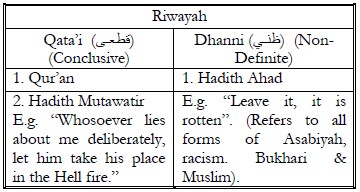
任何来自《古兰经》的一节经文或来自圣训“穆塔瓦特尔”(传闻普遍)的内容,在其传述(Riwayah)方面都被视为确定的(Qat‘i)。
Any Ayah from the Qur‟an or Hadith Mutawatir is considered Qata‟i (conclusive) in its Riwayah (report).
在传述层面上,"Qat‘i"(确定性)所表示的是:该证据的真实性是毫无疑义的。这种真实性是依据传述的方法论而确立的。
The Qata‟i in Riwayah implies that the evidence is authentic without any shadow of doubt. This authenticity is established based on the methodology of transmission.
《古兰经》的传承方式排除了任何伪造的可能。这段经文一代接一代地以完全相同的方式传递下来。整整一代人不可能伪造、删除或增添《古兰经》的内容。要相信那一代中的每一个人都聚在一起,达成共识,增删《古兰经》的某些部分,是难以想象的。那一代人中的每个人都在诵读相同的《古兰经》内容,从而印证了其内容的真实可靠。
The methodology by which the Qur‟an was transmitted to us precludes any possibility of fabrication. The report was transmitted generation by generation in exactly the same manner. It is impossible for an entire generation to fabricate, erase, or add contents to the Qur‟an. It is inconceivable to believe that every single individual in that generation assembled together and agreed to add or delete parts of the Qur‟an. Everyone in that generation was reciting the same contents of the Qur‟an, thus authentifying its contents.
"Hadith Mutawatir"在中文中通常译为"穆坦瓦提尔圣训"。 穆坦瓦提尔圣训并非逐代单传,而是由大量的人转述。由于传述该证据的人数众多、居住地各不相同,且他们的可靠性与确信程度已得到公认,因此这一证据出错的可能性是不可想象的。除《古兰经》和穆坦瓦提尔圣训之外的任何信息传述,例如艾哈德圣训(Hadith Ahad),都被视为"Dhanni"(或然的,非确定性的),这意味着该证据可能存在极其微小的出错可能。总而言之:
Hadith Mutawatir was not transmitted generation-by-generation, but rather by a large number of people. Due to the large number of people reporting the Daleel, and their diversity of residence, their established reliability and conviction, it is inconceivable that this Daleel could be wrong. Any report of information other than through the Qur‟an or Hadith Mutawatir, such as Hadith Ahad, is considered Dhanni (non-definite), meaning that there is a minute possibility that the Daleel could contain error. To summarise:
Dalalah
Dalalah
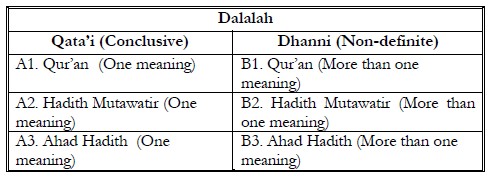
上述“达利勒”的第二个方面是“达拉拉”(含义)。若《古兰经》的经文、穆坦瓦提尔圣训或阿哈德圣训的文本清晰、明确,且只有一种含义,则被视为“定论”(Qata‟i)。定论性达利勒的文本必须只有一种含义,不能容许任何其他解释。若文本可以有一种以上的解释,则被视为“或然”(Dhanni)。由于这些解释都依托于阿拉伯语,任何解释都必须以阿拉伯语来加以论证。综上所述:
The second aspect of the Daleel is the Dalalah (meaning). If the text of Qur‟an, Hadith Mutawatir or Hadith Ahad is clear, specific, and has only one meaning, then it is considered Qata‟i. The text of a Qata‟i Daleel has to have only one meaning and cannot be open to any other interpretation. If the text is open to more than one interpretation, then it is considered Dhanni. Since interpretations are due to the Arabic language, any interpretation has to be justified through the Arabic language. To summarise:
A1. 具有确定性(qata'i)含义的古兰经经文示例:
A1. Example of Qur‟an with a Qata‟i (conclusive) meaning:
“你们的妻子所遗留的,如果她们没有子女,你们可得一半。”(TMQ An-Nisa: 12)
“What your wives leave, your share is a half, if they leave no child”. (TMQ An-Nisa: 12)
“那些指控贞洁妇女犯通奸罪,却不能提供四名证人(来证明)的人,要鞭笞他们八十下。”(TMQ 《光明》章:4)
“Those who accuse chaste woman of zina (adultery) and fail to bring four witnesses (to prove it) flog them eighty stripes.” (TMQ An-Nur: 4)
这些裁决中的数量方面,即二分之一和八十,是明确的,因此不可能有其他的解释。
The quantitative aspect of these rulings, namely one half and eighty are clear and therefore cannot be open to any other interpretations.
A2. 具有确定(决定性)含义的穆太瓦特尔圣训举例:
A2. Example of Hadith Mutawatir with Qata‟i (conclusive) meaning:
“谁故意歪曲我的话,让他坐火狱中自己的位置吧。”(布哈里与穆斯林) Note: The original text is a hadith quotation. I've rendered it faithfully in Simplified Chinese, kept the source attribution, and omitted the honorific since "(Prophet Muhammad saw)" appears as an inline honorific in the original, which per the rules is converted to a single ﷺ after the Prophet's name. Correction to be exact about the rule: the Prophet's mention should carry ﷺ once. The corrected translation is: “谁故意歪曲我ﷺ的话,让他坐火狱中自己的位置吧。”(布哈里与穆斯林)
“Whosoever lies about me (Prophet Muhammad saw) deliberately let him take his place in the hell-fire.” (Bukhari & Muslim)
这段圣训在主题上非常明确,因此从文本中只能得出一种理解:凡是故意捏造先知ﷺ所说的话的人,必将进入火狱。
This Mutawatir Hadith is very clear in its subject; thus there is only one understanding from the text that whoever lies about what Prophet (saw) said, intentionally, he will go to hell-fire.
A3. 圣训阿哈德(Ahad)具有确定意义(Qat'i)的例子:
A3. Example of Hadith Ahad with Qata‟i (conclusive) meaning:
有传述称,先知(愿主赐福他并使他平安)在闰月(Shawwal)中斋戒了6天,这段圣训属于非穆塔瓦提尔(Mutawatir)圣训。从这段圣训中可以得出以下确定的含义: Wait, correction: the rules say to write ﷺ after every mention of the Prophet and keep (SWT) as is, and not write written-out honorifics. Here is the corrected translation: 有传述称,先知ﷺ在沙瓦勒月(Shawwal)中斋戒了6天。这段圣训属于非穆塔瓦提尔(Mutawatir)圣训。从这段圣训中可以得出以下确定的含义:
It is reported from a non-Mutawatir Hadith that the Prophet (saw) fasted 6 days in Shawwal. The conclusive meanings from this Hadith are the following:
a) 斋戒沙瓦勒月六天的合法性。
a) Permissibility of fasting 6 days in Shawwal.
b) 除了开斋节的第一天,即沙瓦勒月的第一天,因为这是开斋节,斋戒在开斋节是哈拉姆(禁止)的。
b) Except on the first day of Shawwal, since it is the day of Eid, and it is Haram to fast on Eid.
B1. 具有或然(非确定)含义的古兰经节例:
B1. Example of Quranic Ayah with a Dhanniy (non-definite) meaning:
真主(SWT)说:
Allah (swt) says:
“{哦,信道的人们!当你们起来礼拜的时候,你们应当洗脸,洗手至于两肘,摩擦你们的头,洗脚至于两踝。如果你们是不洁的,那么你们应当洗涤全身。如果你们患病,或者旅行,或者你们中有人从厕所来,或者你们与妇女接触,而找不到水,那么,你们应当趋向洁净的泥土,用它摩擦你们的脸和手。}”(《古兰经》,马伊代章:6)
“O you who believe! When you intend to offer As-Salat (the prayer), wash your faces and your hands (forearms) up to the elbows, rub (by passing wet hands over) your heads, and (wash) your feet up to ankles. If you are in a state of Janaba (i.e. had a sexual discharge), purify yourself (bathe your whole body). But if you are ill or on a journey or any of you comes from answering the call of nature, or you have been in contact with women and you find no water, then perform Tayammum with clean earth and rub therewith your faces and hands.” (TMQ Al-Maida: 6)
经文说,如果你们“lamastum”女人,就会破坏Wudhu(小净)。“lamastum”一词被解释为有两种含义:
The verse says if you „lamastum‟ the women, it breaks the Wudhu. The word „lamastum‟ has been interpreted as having two meanings:
a) 触摸 b) 性交 因此,这节经文具有“ظنّي الدلالة”(或译“或然性的指示”),即它可以指:触摸女性会破坏小净(Wudhu),也可以指:与女性性交会破坏小净。
a) Touching b) Sexual intercourse Thus the Ayah has a Dhanni Dalalah, i.e. it could mean touching women breaks the Wudhu, or sexual intercourse with a woman breaks the Wudhu.
B2. 符合圣训穆坦瓦提尔(Mutawatir)条件但含义属于盖然性(Dhanniy,非确定性)的例子:
B2. Example of Hadith Mutawatir with a Dhanniy (non-definite) meaning:
据传,先知(愿主赐其平安)解除朝觐戒衣(Ihram)的方式有其特定之处。然而,当圣门弟子(愿主喜悦他们)告诉先知(愿主赐其平安),他们解除戒衣的方式与先知(愿主赐其平安)所做的不同时,先知(愿主赐其平安)认可了他们的做法。虽然这一事件是穆塔瓦特尔(Mutawatir)的,但解除戒衣的规定有很多种。
It was reported that the Prophet (saw) used to take off his Ihram in a specific manner. However, when the Sahabah (ra) told the Prophet (saw) that they took it off in a manner different from the way he (saw) took it off, the Prophet (saw) approved of their actions. Though this incident is Mutawatir, the rules to take off one‟s Ihram are many.
B3. 圣训“Ahad”(独传圣训)具有“Dhanniy”(或然性)含义的例子:
B3. Example of a Hadith Ahad with a Dhanniy (non-definite) meaning:
据一则非穆塔瓦提尔(非多源传承)的圣训记载,先知(愿主福安之)在闪瓦勒月斋戒了六天。这段圣训的非确定性含义包括:
It is reported from a non-Mutawatir Hadith that the Prophet (saw) fasted 6 days in Shawwal. The non-definite meanings of this Hadith are:
a) 六天斋戒是否必须连续进行?
a) Whether the six days of fasting are consecutive or not?
b) 在沙瓦勒月的哪一部分斋戒?
b) Fasting in which part of Shawwal?
到目前为止,我们分别讨论了传述(Riwayah)和意义推导(Dalalah)两方面的确定性(Qata'i)与或然性(Dhanni)。然而,判断证据(Daleel)在传述和意义推导两方面是确定性的还是或然性的,方法如下:
So far we have discussed the Qata‟i and Dhanni aspects of both Riwayah and Dalalah separately. However, the method to determine whether the Daleel (both in Riwayah and Dalalah) is Qata‟i (conclusive) or Dhanni (non-definite) is the following:
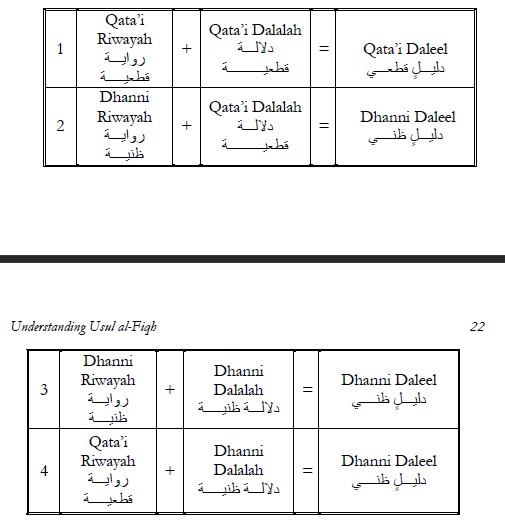
任何与’Aqeedah(信仰/信条)相关的观念、想法或概念,都必须以确定性的证据(Qata'i Daleel)为基础。例如,天使存在这一观念,是以确定性的证据而非或然性的证据(Dhanni)为基础的。同样,在Usul al-Fiqh(伊斯兰教法原理)中,若要确立一个用于推导教法规定的依据来源,按照最有力的观点,该来源也必须以确定性的证据为基础。
Any idea, thought, or concept related to the „Aqeedah has to be based upon a Qata‟i Daleel. As an example, the concept that Angels exists is based upon a Qata‟i Daleel not Dhanni. Also, in Usul al-Fiqh, to establish a source for extracting rulings according to the strongest view, the source must base upon a Qata‟i Daleel as well.
作为例子,要把“伊jma‟ as-Sahabah”(圣门弟子的共识)视为立法依据,那么证明圣门弟子共识具有权威性的证据,必须在riwayah(传述)和dalalah(所指)两方面都是qata‟i(确定的),尽管一条律例既可以从qata‟i的证据推导出,也可以从dhanni(或然的)证据推导出。
As an example, to consider Ijma‟ as-Sahabah (consensus of the Companions) as a source of rulings, the Daleel to prove the authority of Ijma‟ as-Sahabah has to be Qata‟i both in Riwayah and Dalalah, though a ruling can be derived from either Qata‟i or Dhanni Daleel.
人们可能会疑惑,为什么理解《古兰经》和圣训的经文如此复杂?
One might wonder why understanding the text of Qur‟an and Sunnah is so complicated?
通过考察《古兰经》和圣训的文本,可以看出它们的篇幅是有限的。然而,正是在这有限的文本之中,人们可以推导出针对任何时间、任何地方所出现的各种问题的裁决,直至末日审判之日。
By examining the text of Qur‟an and Sunnah one can see that it is limited in its volume. With its limited text one can generate rulings to any problems affecting us anywhere and anytime until the Day of Judgment.
这是真主(SWT)的一项奇迹:《古兰经》与圣训的经文能够从一节经文、一段圣训中推导出众多的律例;而在世界上任何其他法律文本中,都找不到能从单一文本中理解出多种含义的这种能力!每一代穆斯林的挑战在于,努力理解经文,并将其与自己的生活联系起来,因为《古兰经》与圣训适用于所有时代和所有地方。
It is a miracle from Allah (swt) that the texts of the Qur‟an and Sunnah have the ability to express numerous rulings from a single Ayah and Hadith; whereas, the ability to understand many meanings from a single text cannot be found in any other legal text in the world! The challenge is for Muslims in each generation to try to understand the text and relate it to their lives since the Qur‟an and Sunnah are relevant to all times and places.
除了上述一点之外,我们还必须认识到,从《古兰经》和《逊奈》中理解并推导律法,是有相关的规则和准则的。没有熟悉这些规则(阿拉伯语,以及区分不同类型经文的规则等)的人,是无法理解《古兰经》和《逊奈》的经文的。
Besides the point mentioned above, we have to realise that there are rules and guidelines related to understanding and deriving laws from the Qur‟an and Sunnah. No one, without being acquainted with these rules (Arabic language, rules which differentiate one type of text from another, etc.) can understand the text of Qur‟an and Sunnah.
即使是理解人为制定的宪法,人也需要花费数年时间研读和理解其条文。那么,我们怎能指望一个不熟悉法理学(Usul al-Fiqh)的人,打开《古兰经》和圣训,就开始从中提取律法呢?
伊斯兰教法律规定(Hukm Shar‟i)的来源
Sources of Hukm Shar‟i
如前所定义,哈昆·沙尔仪(Hukm Shar‟i)是真主(SWT)针对我们行为所作的裁定。这些裁定是从某些渊源中推导出来的。用于推导裁定的渊源,必须以确定性证据(Adilla Qata‟iya)为基础。
As defined earlier, Hukm Shar‟i are the rulings of Allah (swt) addressing our actions. These rulings are derived from certain sources. The sources, which are used to extract rulings, have to be based on Adilla Qata‟iya (Decisive evidences).
伊斯兰教法(Hukm Shar‟i)的四个确定性来源是:《古兰经》、圣训(Sunnah)、圣门弟子的一致意见(Ijma‟ as-Sahabah)和类比推理(Qiyas)。这些将在接下来的章节中讨论。随后将简要总结学者们存在分歧的有争议的来源。
The four definitive sources of Hukm Shar‟i are; the Qur‟an, Sunnah, Ijma‟ as-Sahabah and Qiyas. These will be discussed in the following chapters. This will be followed by a brief summary of the disputed sources which the scholars disagree on.