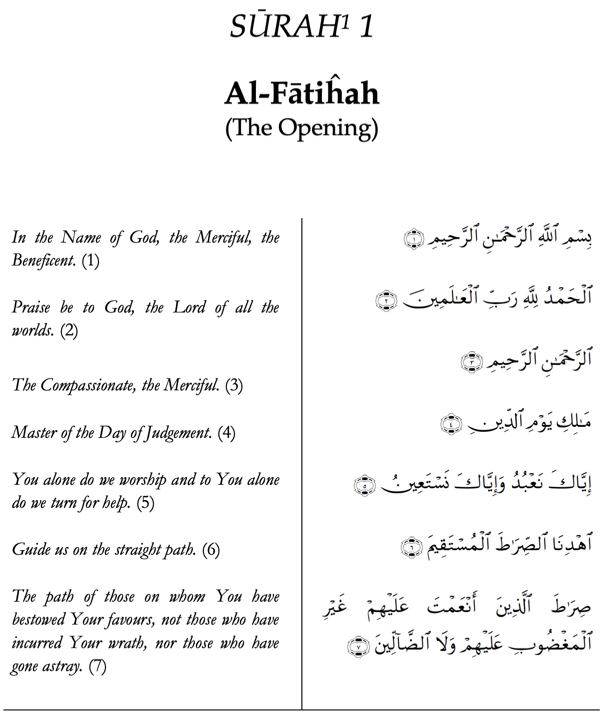
每位穆斯林每天至少诵读这篇由七节经文组成的短章十七遍。有一段真实可靠的圣训,先知穆罕默德ﷺ说:“不诵读《法蒂哈》的人,其拜功无效。”这篇短章包含了伊斯兰教核心基本理念的大量内容,涵盖其信仰与概念,勾勒出其中许多重要的认知与态度。由此可见,它之所以被选定经常诵读,以及它对拜功有效性之所以不可或缺,其原因一目了然。
Every Muslim recites this short sūrah of seven verses at least seventeen times a day. An authentic ĥadīth of the Prophet Muĥammad (peace be upon him), says: “A prayer by one who does not read the Fātiĥah is invalid.” This short sūrah contains a great deal of the central basic ideas of Islam, its beliefs and concepts. It outlines many of its essential perceptions and attitudes. All this makes it clear why it is chosen for frequent recitation and why it is essential for the validity of prayer.
这一章以这句话开头:
The sūrah opens with the phrase:
奉至仁至慈的真主之名。(第1节)
In the name of God, the Compassionate, the Merciful. (Verse 1)
这一点为大多数学者所公认:它本身就是该章的一节经文,使该章的经文凑足七节。然而,对于《古兰经》中其他以相同词语作为开篇的章,它是否同样如此,学者们存在分歧。有些学者认为,下面这段《古兰经》经文所指的是《法提哈章》:“我已经赐给你七节常诵的经文和这部崇高的《古兰经》。”(15:87)
This is recognized by the majority of scholars as a verse of the sūrah, in its own right, completing its verses into seven. There is, however, a difference of opinion over whether this is so with respect to all other sūrahs of the Qur’ān in which the same words appear as the opening phrase. Some scholars maintain that it is to the Fātiĥah that the following Qur’ānic statement refers: “We have given you seven oft- repeated verses and this sublime Qur’ān.” (15: 87)
《古兰经》中最初降示给先知穆罕默德ﷺ的几节经文,以“你应当奉你主的名而诵读……”(96:1)开始,确立了伊斯兰礼仪:每一件事之始,都当诵念真主之名。这也与伊斯兰的一项根本原则相契合,即真主是“最先的,也是最后的;是显露的,也是隐微的”(57:3)。祂确实是真实的存在,是一切存在之物的本原和存在的根由。因此,每一个动作与行为都奉祂的名而作,万事都以祂的名而开始。
The very first verses of the Qur’ān revealed to Prophet Muĥammad, which begin with: “Read in the name of your Lord...” (96: 1) establish the Islamic etiquette of invoking the name of God at the beginning of every action. This is also in line with the fundamental Islamic principle that God is “the first and the last, the outward and the inward.” (57: 3) He is indeed the real being, the origin and the raison d’être of all that exists. In His name, therefore, every movement and action is made, and in His name everything begins.
真主的至仁(al-Raḥmān)与至慈(al-Raḥīm)这两个神圣属性,涵盖了慈悲的一切方面和含义,并且只能在一起使用,且只用于指称安拉至高无上的真主。用"al-Raḥīm"来指称人是恰当的,但伊斯兰信仰要求"al-Raḥmān"这一称谓专属于真主。至于两个形容词中哪一个表示更广泛的慈悲与怜悯之义,这一争论与我们此处无关。不过,我们可以得出结论:两者合在一起,涵盖了慈悲的所有方面和维度。
The divine attributes of the Compassionate, al-Raĥmān, and the Merciful, al-Raĥīm, encompass all aspects and meaning of mercy, and can only be used together with respect to God Almighty. It would be appropriate to use the attribute of al-Raĥīm in reference to a human being, but the Islamic faith requires that use of al-Raĥmān is exclusive to God. As for the debate over which of the two adjectives denotes the wider meaning of mercy and compassion, it does not concern us here. We can conclude, however, that when combined, they encompass all aspects and dimensions of mercy.
由于在每件事开始时诵念真主的尊名,构成了穆斯林信仰的第一项基本原则;而将 al-Raĥmān 与 al-Raĥīm 这两个名称专属于真主,则构成第二项原则,并界定了真主与人之间的关系。人在诵念真主之名并承认祂无限的慈悯之后,便被引导去赞颂真主,并承认祂对一切万物的绝对主权。
As the invocation of God’s name at the beginning of every action constitutes the first fundamental principle of the Muslim faith, the restriction of the use of al-Raĥmān and al-Raĥīm to God alone constitutes the second principle and defines the relationship between God and man. Having invoked God’s name and acknowledged His infinite mercy, one is directed to praise God and recognize His absolute sovereignty over all beings:
赞美归于真主,众世界的主。(第2节)
Praise be to God, the Lord of all the worlds. (Verse 2)
赞颂真主,是信士心中一听到真主之名便涌起的第一种情感。因为人自身的存在,本身就是真主无尽恩典的体现,它激发人对真主的感恩与敬畏。真主对人类及其他受造物慷慨施与的种种恩惠遍布各处,每时每刻都能看到。在每一件事的开始和结束时赞颂真主,也是伊斯兰信仰的另一项根本原则。《古兰经》说:“他是真主,除他之外,别无应受崇拜的主。今世和后世,一切赞颂都归他……”(28:70)
Praise of God is the first feeling aroused in a believer’s heart at the mention of God. For man’s own existence is an aspect of God’s infinite grace, which engenders gratitude and reverence towards God. The manifestations of God’s munificence and generosity to man and other creatures abound everywhere and can be seen at every moment. To praise God at the beginning and at the end of every action is another fundamental principle of the Islamic faith. The Qur’ān says: “He is God; there is no deity but He. To Him belongs praise in the first and in the last...” (28: 70)
然而,真主的恩典是这样的:当信士说“赞美归于真主”时,这一言语会被记录为他的一件善功,其价值超过一切。乌麦尔·本·黑塔卜是先知的同伴,他转述说,先知(愿主福安之)讲述过这样一件事:有一个人曾说:“主啊,我赞美你,与你尊贵的容颜和你伟大的权能相称。”伴随那人的两位天使无法估量这句话的分量,便向至高无上的真主请示。真主命令他们:“照他所说的,把它记录在他的功过簿上,待他回到我面前时,我将按他应得的予以回报。”
这节经文的最后一部分,“众世界的主”,表达了对绝对普遍主宰性的信仰,这正是伊斯兰关于真主观念的核心。真主是唯一的、绝对的、终极的所有者,拥有完全独立的权能,主宰整个宇宙。他是至高无上的主宰,创造了世界,并持续地看顾它、护理它,确保它的稳定与安康。造物主与被造物之间这种鲜活、动态的关系,是一切受造物生命永不枯竭的源泉。真主并没有创造了世界便将它抛弃,任其自生自灭。他持续地对自己的creation施以鲜活而有效的主宰,赐予它延续和有意义的生命所需要的一切。这适用于真主的一切创造物。
Nevertheless, God’s grace is such that when a believer says, ‘praise be to God,’ it is recorded for him as a good deed outweighing everything. `Umar ibn al-Khaţţāb, the Prophet’s Companion, relates that the Prophet (peace be upon him) told how a man once said, “Lord, I praise You as befits the majesty of Your face and the greatness of Your power.” The two angels accompanying that man could not evaluate the remark and referred to God Almighty, who commanded them: “Register it in his record as he said it, and I shall reward him as he deserves when he returns to Me.” The last part of this verse, “Lord of all the worlds”, expresses the belief in absolute universal Godhead which is at the very core of the Islamic concept of God. God is the sole, absolute and ultimate owner with full independent authority to act in the whole cosmos. He is the overall supreme master who has created the world and continues to watch over it, take care of it, and ensure its stability and well-being. This living and dynamic relationship between the Creator and the created is the perpetual fountain of life for all creation. God has not created the world and abandoned it to its own devices. He continues to be an active living authority over His creation, giving it what it needs for its continued and meaningful life. This applies to all God’s creation.
承认真主的绝对主宰地位,能够使人在真主的绝对独一性问题上从困惑走向清晰。人们往往把承认真主是唯一的创造者,与相信还有多位神灵在自己的生活中拥有权威结合起来。人们竟会持有这样的信念,看似荒谬,但这在过去确实如此,今天依然如此。《古兰经》提到有人声称:"我们崇拜他们(那些次要的神灵),只是为了让他们使我们亲近真主。"(39:3)经文还提到,一些犹太教和基督教团体"以他们的拉比和祭司为主,舍真主而崇拜他们"。(9:31)在伊斯兰教于7世纪于阿拉伯半岛兴起时,多神信仰十分普遍,即除了被认为是"至大之神"的神灵之外,还崇拜若干其他神祇或半神。
Acknowledging God’s absolute Lordship makes all the difference between clarity and confusion with regard to God’s absolute oneness. People often combined their acknowledgement of God as the sole creator with belief in multiple deities having authority in their life. It may seem absurd that people should ever hold such a belief, but this was true in the past and is still true today. The Qur’ān speaks of those who claim that they “only worship them [minor gods] so that they may bring us nearer to God.“ (39: 3) It also mentions that some Jewish and Christian groups who “have taken their rabbis and priests as gods alongside God.” (9: 31) Polytheism, or the worship of several deities or demigods besides the perceived ‘Grand Deity’, was widespread when Islam emerged in the 7th century in Arabia.
对独一之神绝对主权与积极权能的确认。
The affirmation of the absolute sovereignty and active authority of the One God.
对整个创造而言,必须确保人的理性与内心的安宁,并使他摆脱多神信仰所带来的残酷迷惘。人必须确信,有一位警醒而关怀的真主掌管着这个世界,祂绝不会抛弃它或撇下它不管。
over all creation was necessary to ensure man’s rationality and peace of mind, and to relieve him from the cruel bewilderment of polytheism. Man must be reassured that a vigilant and caring God is in charge of this world and will never abandon or forsake it.
当伊斯兰教降临之时,世界上充斥着错误的信仰与哲学,以及建立在迷信、传说和神话之上的虚假宗教。其中真实、甚至合乎理性的东西少之又少。关于真主的概念,以及祂与人类和世界的关系,存在着大量令人遗憾的混乱。这进而导致人类对世界的理解,以及对自身在世界中的地位与角色的认识也陷入混乱。
At the advent of Islam, the world was full of erroneous beliefs and philosophies, and of false religions based on superstition, legend and mythology. Very little of it was true or even rational. As far as the concept of God and His relationship with man and the world was concerned, there was plenty of miserable confusion. This in turn led to confusion in man’s understanding of the world and of his own position and role within it.
只有当我们研究人类历史上那些缺乏这样一套体系的黑暗时期时,人们才会意识到一套理性、清晰且一致的信仰体系的必要性。那时我们便会认识到,这些庞大的神话和错误信仰给人类带来了多么沉重的负担。当我们在研究《古兰经》中的具体例证时,还会对此有更多的论述。
The need for a rational, clear and consistent system of beliefs only becomes apparent when we study those dark periods of human history when there was no such system. We then realize how heavily such great myth and false beliefs weigh on man. There will be more on this when we come to study specific instances in the Qur’ān.
正是出于这样的需要,伊斯兰教格外注重纠正人的信仰,并非常清楚地界定了真主的概念与本质、祂的属性,以及造物主与被造物之间的关系。
It is in the light of such need that Islam has taken great care to correct man’s beliefs and define very clearly the concept and nature of God and His attributes, and the relationship between Creator and creation.
这体现在伊斯兰关于真主独一性的概念之中,这是伊斯兰教的本质和最根本的原则。人们在确立和阐明“真主是独一的、绝对超越的主宰和统治者,掌管一切存在”这一论断上,付出了极大的努力。伊斯兰教对这一概念另一个最为重视的方面,是对真主属性的界定;而这一问题在历史上也曾造成诸多困惑、模糊不清以及混乱的宗教和哲学思考。
This is embodied in the Islamic concept of God’s oneness, the essence and most fundamental principle of Islam. Much care has been devoted to establishing and elucidating the affirmation that God is the One, absolute and transcendent Lord and Master of all that exists. The other aspect of this concept to which Islam has given its greatest attention is the definition of God’s attributes, which has been the cause of much confusion, obfuscation and muddled religious and philosophical thinking through the ages.
伊斯兰教对真主独一性的概念,以及与之相关的一切问题,所给予的强调程度、着力之深与阐述之详尽,只有置于历史长河中积累下来的大量错误信仰与混乱神学的背景之下,才能真正领会。从这一角度看,伊斯兰教可以被视为真主赐予人类的一项深刻而及时的恩典,这份恩典以美好、简明、清晰、和谐,并与人性完全契合的方式降临。
The intensity, emphasis and detail with which Islam has dealt with the concept of God’s oneness, and all subjects related to it, can only be appreciated against the background of the great mass of erroneous beliefs and confused theologies that had accumulated in the course of history. From this perspective, Islam can readily be seen as a profound and timely act of divine mercy bestowed on humanity — mercy that is given with beauty, simplicity, clarity, harmony and full accordance with human nature.
(第三节)
The Compassionate, the Merciful. (Verse 3)
这两个属性涵盖了慈悲与怜悯的一切含义和方面,集中体现了真主至大的慈爱之性。这两个属性界定了作为造物主的主与其受造物之间的联系。这种联系完全建立在爱、平安、安慰和关怀之上,并在人心中自然而然地激发出对真主的感恩与赞颂之情。
These are two attributes that encompass all meanings and aspects of mercy and compassion, and epitomize mercy as a property of God Almighty. These two attributes define the link between the Lord as Creator and His creation. It is a link based entirely on love, peace, reassurance and care, and which inspires within man a spontaneous feeling of gratitude and praise towards God.
与希腊神话或旧约(创世记,4:11-12)不同,伊斯兰教并不把真主描绘成一个对人类进行无情复仇、怀着恶意和怨恨谋划、算计其受造物的敌人。
Unlike Greek mythology or the Old Testament (Genesis, 4: 1112), Islam does not depict God as an enemy who pursues man with relentless vengeance, or plots and schemes against His creation with spite and vindictiveness.
审判日的主宰。(第4节)
Master of the Day of Judgement. (Verse 4)
这节经文阐述了伊斯兰教一项根本原则,这一原则对人类生活有着极其深远的影响:对后世的信仰。《古兰经》评论了一个奇特的现象:人们常常相信真主是创造者,却不相信审判日,不相信后世——在那里,奖惩将被施行,以恢复公正的平衡。针对这些人,《古兰经》说:"如果你问他们:'谁创造了天地?'他们一定会回答:'真主。'"(31:25)《古兰经》在别处也谈到这类人:"他们以为奇怪,一位警告者竟从他们当中降临到他们那里。因此,不信道者说:'这真是件奇事!我们死了、变成尘土之后,还会复活吗?这种复归实在太遥远了!'"(50:2-3)
This verse states a fundamental Islamic principle that has a most profound influence on human life: belief in the hereafter. The Qur’ān comments on the curious fact that people have often believed in God as Creator but have failed to believe in a Day of Judgement, in a life to come, when reward and punishment are meted out to restore the balance of justice. It is in reference to these that the Qur’ān says: “If you ask them, ‘Who is it that created the heavens and the earth?’ they will surely answer, ‘God’” (31: 25) Elsewhere the Qur’ān says of such people: “They deem it strange that a warner should have come to them from their own midst. Thus, the unbelievers say, A strange thing is this! [Are we to be resurrected] after we have died and become mere dust? Such a return seems far-fetched indeed!’“ (50: 2-3)
对来世的信仰至关重要,因为它能触动人的灵魂与心智,并把人的注意力集中于未来的存在。这反过来有助于约束人对今世的执着,使他超越眼前的尘世欲望。他不再急于在此时此地获取所有的回报;他能够克服自私,培养利他的情感与兴趣。人因此能够以有动力、宽容、自信和乐观的姿态度过一生。
Belief in the hereafter is essential because it engages the human soul and mind and concentrates man’s attention on a future existence. This in turn helps to rein in man’s obsession with the present life, and to transcend his immediate earthly desires. He is no longer anxious to reap all his rewards here and now; he can conquer his selfishness and develop altruistic feelings and interests. Man is able to go through life as a motivated, tolerant, confident and optimistic being.
这一核心的伊斯兰信仰清楚地区分了两者:一方面是追求人所需要、也理应拥有的道德与理智上的自由;另一方面是屈从于世俗与私欲的享受。它标志着一个均衡而有良知的人类与一个自私自利、只顾自我的人类之间的区别。
This central Islamic belief distinguishes clearly between aspiring to gain the moral and intellectual freedom that man needs and deserves, and capitulation to worldly and selfish desires and pleasures. It marks the difference between a well-balanced and conscientious humanity and an egotistic, self-seeking one.
人类的生活只有在人们相信,今生所获得的东西并非一切、也非终点时,才可能达到平衡与公正。人需要一种坚定的信念作为动力:他相信还有另一种生命在等待着他,而那种生命值得他在这短暂的一生中为之奋斗、牺牲和付出努力。这种信念会从根本上改变持有它的人的情感、态度和行为。
Human life can never be balanced and equitable until people believe that what they earn in this transient life is not the be-all and the end- all. Man needs to have the incentive of a confident belief that another life awaits him, which is worth the struggle and the sacrifices and the effort he may have to make here in this short one. This belief brings a fundamental difference in the feelings, attitudes and behaviour of those who uphold it.
我们唯独崇拜你,也唯独向你求助。(第5节)
You alone do we worship and to You alone do we turn for help. (Verse 5)
这节经文又阐明了一项基本原则,它与前面的经文逻辑相承。这也是一项决定性的关键原则,它划清了人顺服真主所获得的自由,与人奴役人所隐含的压迫和贬损之间的界限。
This verse expresses another fundamental principle that follows logically from the preceding ones. It is also a decisive and crucial principle that draws a line between the freedom man gains in submitting to God and the abuse and debasement implicit in man’s servitude to man.
一旦人将自己顺服于真主,并且只向祂寻求帮助与引导,他便从一切宗教、思想、道德和政治权威的专制之下获得了彻底的解放。
Once man has submitted himself to God and sought help and guidance from Him alone, he has achieved total liberation from the tyranny of all religious, intellectual, moral and political powers.
对信仰伊斯兰教的人而言,人间的权力可分为两类:一类是得到正道引导的权力,承认真主,遵行祂的指示;另一类是傲慢悖逆的权力,不承认真主的主权与权威。穆斯林必须支持并拥护前者,无论它多么弱小或处于劣势;也必须拒绝并反对后者,无论它多么强大或居于统治地位。《古兰经》说:"许多小股军队,借真主的恩典,战胜了庞大的军队。"(2:249)这种看似弱势一方的胜利,只有在它依靠万能之源真主的情况下才能实现。
To the believer in Islam, human power falls into two categories: a rightly-guided power that recognizes God and abides by His directions, and an arrogant, rebellious one that does not admit to God’s sovereignty and authority. A Muslim is required to support and endorse the former, no matter how weak or disadvantaged it may be, and to reject and oppose the latter, regardless of its strength or dominance. The Qur’ān says: “Many a small band, by the grace of God, has vanquished a large one.” (2: 249) Such victory of the apparently weaker host could only be achieved when it relies on God, the source of all power.
对于自然力量,穆斯林的态度是好奇与友善,而非恐惧或敌对。人的力量与自然的力量,都被视为真主之大能所派生的表现,并服从于祂的旨意。因此,二者是完全互补、相互依存的。
Towards natural forces, a Muslim’s attitude is one of curiosity and friendliness rather than fear or hostility. The powers of man and the powers of nature are perceived as by-products of God’s own power, and subject to His will. They are, therefore, perfectly complementary and interdependent.
伊斯兰教教导说,真主创造了物质世界及其一切力量,供人类自身使用并造福于人。人被特别教导和引导去研究周围的世界,发掘其潜能,并利用周围的一切为自己谋福利,也为同胞谋福利。人所遭受的任何来自大自然的伤害,仅仅是由于他对大自然及支配它的规律缺乏认识或理解。人对大自然了解得越多,他与大自然和环境的关系就越和平、越和谐。
Islam teaches that God has created the physical world and all its forces for man’s own use and benefit. Man is specifically taught and directed to study the world around him, discover its potential and utilize all his environment for his own good and the good of his fellow humans. Any harm that man suffers at the hands of nature is a result only of his ignorance or lack of understanding of it and of the laws governing it. The more man learns about nature, the more peaceful and harmonious his relationship with nature and the environment.
因此,“征服自然”这一观念很容易被看作是愤世嫉俗且消极的。它与伊斯兰的认知格格不入,也暴露出对世界被创造时所秉持的精神、以及其背后神圣智慧的无耻无知。
Hence the notion of “conquering nature” can readily be seen as cynical and negative. It is alien to Islamic perceptions and betrays a shameless ignorance of the spirit in which the world has been created and the divine wisdom that underlies it.
时刻意识到真主在塑造和主宰世界中的作用,穆斯林对人与自然的关系持积极、友好和建设性的看法。简而言之,这种看法承认真主是所有这些力量的源头和创造者,它们遵循同一套公理和法则。它们被设计成共同运作,为了共同的目标,在和谐、协调与相互支持中运行。自然界的力量本质上服从于人类,人类在心智和体能上都具备辨识它们、揭示其奥秘、理解支配它们的法则的能力,进而驾驭它们,以提高地球上的生活质量。《古兰经》断言:"他为你们制服了天地间的万物。"(45:13)
Being always aware of God’s hand and role in shaping and running the world, Muslims have a positive, friendly and constructive outlook on man’s relationship with nature. Simply stated, it acknowledges God as the origin and Creator of all these forces, on the basis of the same set of axioms and laws. They are designed to function together, for a common purpose, in harmony, compatibility and mutual support. The forces of nature are essentially subservient to man, who is mentally and physically equipped to discern them, unravel their secrets, comprehend the laws governing them and, subsequently, to harness them to improve the quality of life on earth. The Qur’ān asserts: “He has all that is on the earth subservient to you.” (45: 13)
这种观念消除了一切恐惧与孤立之感,使人产生一种深刻的归属感。在这种观念中,人不仅被视为世界整体设计中不可或缺的一部分,而且是一个本质上有效、有影响力的存在。因此,他的世界成为一个友善的世界。先知ﷺ曾经面对乌侯德山,那里曾是穆斯林遭受惨败的地方,并说:"我们多么爱这座山,它也多么爱我们!"这句话简要地表达了先知ﷺ对自然的亲近之情,即使是在最崎岖的自然形态中。
Such an outlook eliminates all traces of fear or isolation and allows, instead, a profound sense of belonging in which man is seen not only as an integral part of the overall design of the world, but also an essentially effective and influential one. Thus, his world becomes a friendly one. This is best expressed by the Prophet when he once faced Mount Uĥud, the scene of a bitter defeat for Muslims, and said, “How we love this mountain, and how it loves us!” This expresses in a nutshell the affinity the Prophet felt towards nature even in its most rugged forms.
在确立了这些基本原则之后,此章又指明了应对它们的若干实际方法,其中最重要的便是礼拜。
Having established these fundamental principles, the sūrah points the way to certain practical means of responding to them, foremost among which is prayer:
求你引导我们走上正路,走上你所恩赐的人的道路,不是那些遭受你愤怒的人的道路,也不是迷误者的道路。(第6-7节)
Guide us on the straight path; the path of those on whom You have bestowed Your favours, not those who have incurred Your wrath, nor those who have gone astray. (Verses 6-7)
信士以这些话语祈求被指引上正道,并蒙受扶助而行于其上;若无真主的引导、眷顾与慈悲,这一切便无从实现。承认这一点本身,就是承认真主对万物和万事的主权与主宰。
With these words a believer pleads to be shown the Right Way and to be helped along it, which cannot be achieved without God’s guidance, care and mercy. To acknowledge that is in itself a recognition of God’s sovereignty and dominance over all things and events.
引导人走上正道,可以保障人在今世和后世的幸福。其实质是引导人的天性、本能、欲望与灵感,使其认识并理解真主的旨意,从而使人的行为与自然秩序和物质世界保持协调一致。
Guidance to the right way of life guarantees man’s happiness in this world and in the hereafter. It comes about, in effect, by guiding human nature and man’s instincts, desires and inspirations towards the recognition and comprehension of the divine will, so bringing human activity into rhythm with the natural order and the physical world.
该章揭示了“正路”的本质:它是那些蒙主恩宠之人所行的道路,而非那些因偏离真理而招致主之恼怒的人的道路,也非那些不明真理、疏忽怠慢的人的道路。它是幸福与救赎之路。
The sūrah reveals the nature of the “straight path” as being one taken by those whom God has favoured, not the way of those who have earned His displeasure by their deviation from the Truth, nor that of the heedless who have no knowledge of the truth. It is the path of happiness and salvation.
这便是《法谛哈》(al-Fātiĥah),即被选定为每日经常诵读的章节,没有它,伊斯兰拜功便无效。尽管篇幅简短,它包含了伊斯兰信仰中一些最根本的原则,以及由此衍生的若干见解。
This, then, is al-Fātiĥah, the sūrah selected for frequent daily recitation, without which Islamic prayers are invalid. Despite its brevity, it contains some of the most fundamental principles of the Islamic faith and certain insights that arise from them.
先知穆罕默德ﷺ可靠地转述了真主的话:祈祷的果实由我与我的仆人平分,我的仆人所求的必将得到。当礼拜者诵读“赞颂归于真主,全世界的主”时,真主会说:“我的仆人赞颂了我。”当他诵读“至仁至慈的”时,真主会说:“我的仆人感谢了我。”当他诵读“报应日的主宰”时,真主会说:“我的仆人尊崇了我。”当他说“我们唯独崇拜你,唯独向你求助”时,真主会说:“这是我与我的仆人之间的事,我的仆人必得所求。”当他说“求你引导我们走上正路,走上你所赐恩惠者的道路,不是受你谴怒者的道路,也不是迷误者的道路”时,真主会说:“这是为我的仆人的,他必得所求。”这段圣训阐述了《法提哈章》的一些含义。读者或许会发现,这对理解真主为何选定此章,让穆斯林每天至少十七次诵读,即在昼夜间的日常的必修拜功中站立时诵读,甚至在每次念诵自愿拜时更加频繁地诵读,会有所帮助。
The Prophet Muĥammad is reliably reported to have quoted God as saying that the fruits of prayer are shared equally between Me and My servant, and My servant will be granted what he asks for. As the worshipper recites [in Prayer]: “Praise be to God, the Lord of all the worlds,” God will say: ‘My servant has praised Me.’ As he recites: “The Compassionate, the Merciful,” God will say: ‘My servant has thanked Me.’ As he recites: “Master of the Day of Judgement,” God will say: “My servant has glorified Me.” As he says: “You alone do we worship, and to You alone do we turn for help,” God will say: ‘This is between Me and My servant, and My servant will receive what he asks for.’ And, as he says: “Guide us on the straight path, the path of those on whom You have bestowed Your favours, not those who have incurred Your wrath, nor those who have gone astray,” God will say: ‘This is for My servant, and he will be granted his wish.’“ This ĥadīth explores some of the meanings of al-Fātiĥah. The reader will perhaps find it helpful in understanding why God has chosen this sūrah for recitation by Muslims at least seventeen times a day, as they stand up for their obligatory prayers, spread over the night and day, and even more frequently, whenever they offer voluntary prayers.