Wannan hadisi a bayyane yake wajen bayyana shugabanni nagari da marasa nagarta, kuma a bayyane yake wajen haramta yakar su da takobi muddin suna kafa addini, domin kafa sallah yana nuni da tsayuwar addini da yin hukunci da shi.
This hadith is clear in informing about the good and bad leaders, and clear in prohibiting confronting them with the sword as long as they establish the deen, since establishing the salat (prayer) indicates upholding of the deen and ruling by it.
Saboda haka, wajibcin da ya rataya a wuyan Musulmi na naɗa Khalifah, wanda ke kafa dokokin Musulunci kuma ya isar da kiransa, wani al'amari ne wanda babu shakka a cikin ingantattun nassoshin Shari'a. Haka kuma, wajibi ne saboda Allah (SWT) ya sanya wa Musulmi farilla su kafa mulkin Musulunci da kuma kare mutuncin Musulmi. Duk da haka, wannan aiki ne na gama-gari, don haka idan wasu daga cikin al'ummar Musulmi suka cika shi, to farillar ta cika, kuma nauyin ya sauka daga sauran al'ummar. Amma idan wani ɓangare na al'ummar ya kasa cimma farillar, duk da cewa sun aiwatar da ayyukan da ke kafa ta, to nauyin yana kan dukkan Musulmi, kuma farillar tana kan kowane Musulmi muddin Musulmi ba su da Khalifah.
So the obligation upon Muslims to appoint the Khalifah who establishes the laws of Islam and conveys its call is a matter which has no doubt with regard to its certainty in the sound texts of Shari’ah. Moreover, it is an obligatory duty due to the fact that Allah (swt) made it fard upon Muslims to establish the rule of Islam and to protect the honour of Muslims. However, this duty is a collective one, so if some people of the Ummah accomplished it, the fard is fulfilled and thus responsibility drops from the rest of the Ummah. And if part of the Ummah was unable to achieve the fard, though they carried out the actions which establish it, then the responsibility remains upon all the Muslims, and the fard remains upon every Muslim as long as Muslims are without a Khalifah.
Hausa translation:
Barin kafa Khalifah ga Musulmi na daga cikin manyan zunubai, domin hakan yana nufin kin aiwatar da daya daga cikin manyan farillai na Musulunci wadanda aiwatar da addini ya dogara a kansu; ma dai, ma kasancewar Musulunci a fagen rayuwa ma ya dogara da hakan. Saboda haka Musulmi baki daya suna aikata babban zunubi ta hanyar barin kafa Khalifah ga dukkan Musulmi. Kuma idan su duka sun yarda su zauna ba tare da Khalifah ba, zunubin zai rataya a wuyan dukkan Musulmi a dukkan yankunan duniya da ake zaune. Sai dai idan wasu daga cikin Musulmi suka fara aiki don kafa Khalifah, wasu kuma ba su yi ba, to zunubin zai sauka daga kafadun wadanda suka fara aikin kafa Khalifah, duk da cewa farillar tana kan su har sai an nada Khalifah. (Hakan ne) domin shiga cikin kafa farillar yana kawar da zunubin jinkirin kafa ta a lokacinta, da kuma rashin kafa ta, saboda aikin da mutum yake yi don kafa ta da kuma kyamarsa ga abin da yake hana shi kafa ta.
To refrain from establishing a Khalifah for the Muslims is among the greatest sins because it is abstaining from carrying out among the most important obligations of Islam upon which the implementation of the deen depends; nay even the very existence of Islam in the battlefield of life depends upon it as well. So Muslims as a whole commit a great sin by refraining from establishing a Khalifah for all Muslims. And if they all agreed to remain without a Khalifah the sin would befall all Muslims in all inhabited regions (entire world). However, if some of the Muslims embarked on working to establish a Khalifah and the others did not, the sin will drop from the shoulders of those who started to work to establish the Khalifah though the fard remains upon them until the Khalifah is appointed. (This is so) because the involvement in establishing the fard removes the sin for the delay in establishing it in its proper time, and for its non-establishment, due to one’s work to establish it and his hatred of that which prevents him from establishing it.
Waɗanda ba su shiga aikin kafa farillah ba, zunubi zai ci gaba da kasancewa a kansu bayan kwana uku sun wuce daga tafiyar Khalifah har zuwa nada sabon Khalifah, domin Allah (SWT) ya ɗora musu wata farilla wadda ba su aiwatar ba, kuma ba su shiga aikin da ake buƙata don cika ta ba. Saboda haka, sun cancanci zunubi, kuma sun cancanci azabar Allah (SWT) a duniya da lahira. Cancantar su ta zunubi saboda kauracewarsu daga kafa Khalifah, ko aiwatar da ayyukan da (bisa ga Shari'ah) ke kafa Khalifah, a bayyane take saboda Musulmi yana cancanci azabar Allah (SWT) idan ya yi watsi da duk wani aiki da aka wajabta masa, musamman wajibi wanda ta hanyarsa ake aiwatar da sauran wajibai, ake kafa dokokin addini, ake ɗaukaka matsayin Musulunci, kuma kalmar Allah (SWT) ta zama mafi girma a cikin ƙasashen Musulunci da sauran duniya.
As for those who were not engaged in the work to establish the fard, the sin will remain on them after three days have passed from the departure of the Khalifah until the appointment of a new Khalifah, because Allah (swt) has entrusted them with a fard which they did not carry out nor engage themselves in the work which is required for its completion. Therefore, they are deserving of sin and deserve the punishment of Allah (swt) in this life and the hereafter. Their deserving of sin due to their refraining from establishing the Khalifah, or performing the actions which (according to Shari’ah) establish the Khalifah, is explicitly clear in that a Muslim deserves the punishment of Allah (swt) when he ignores any of the duties enjoined upon him, particularly the obligation by which the other obligations are implemented, the rules of the deen are established, the cause of Islam is raised high and the word of Allah (swt) becomes exalted in the Islamic lands and the rest of the world.
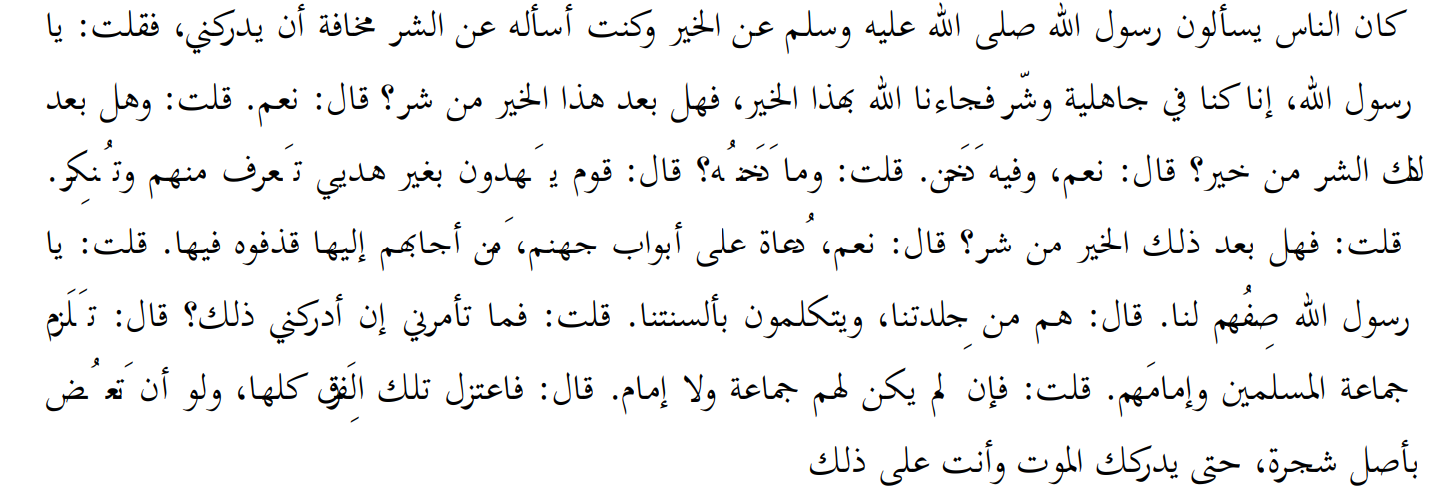
Game da abin da ya zo a wasu hadisai dangane da keɓewa daga mutane, da takaita kai ga bin al'amuran ibada ta kai kaɗai da al'amuran addini, waɗannan hadisai ba su dace a matsayin dalili na kauracewa kafa Khalifa ba, kuma ba sa kawar da zunubin da ke tattare da wannan kauracewa. Duk wanda ya yi nazari sosai a kan waɗannan hadisai zai ga cewa suna da alaƙa da batun riko da addini, ba izini ba ne na kauracewa kafa Khalifa ga Musulmi. Misali, Al-Bukhari ya ruwaito daga Bisr bin Ubaydullah al-Hadrami cewa ya ji Abu Idrees al-Khoolani yana cewa ya ji Hudhaifah bin al-Yaman yana cewa:
As for what came in some of the ahadith regarding isolation from the people, and restricting oneself to adhering only to matters of personal worship of the matters of the deen, these ahadith are not suitable as evidence to refrain from establishing a Khalifah nor removing the sin due to this abstention. Whoever studies these ahadith carefully will find them related to the matter of adhering to the deen rather than permission to refrain from establishing a Khalifah for Muslims. For example, Al-Bukhari narrated about Bisr bin Ubaydullah al-Hadhrami that he heard Abu Idrees al-Khoolani say that he heard Hudhayfah bin al-Yaman saying: