21.6 Yarjejeniyoyin Gaggawa
21.6 Emergency Treaties
Musulmi na iya faɗawa cikin mawuyacin hali da ke tilasta shi aikata abubuwan da ba a halatta ba, amma larura ta sa hakan. Daular Musulunci na iya faɗawa cikin rikice-rikicen cikin gida ko na waje da ke tilasta mata kulla yarjejeniyoyi waɗanda ba sa kai tsaye ga isar da da'wah ko yaƙi a hanyar Allah (SWT), amma suna sauƙaƙa samar da yanayi da zai ba da damar isar da ita a nan gaba, ko kuma suna hana mugunta ta dakatar da da'wah, ko kuma suna kiyaye kasancewar Musulmi. Larura ce ke tilasta irin waɗannan yarjejeniyoyi a kulla su, saboda haka ya halatta ga Khalifah ya kulla su, kuma Musulmi na wajibi su bi su. Waɗannan yarjejeniyoyi suna faruwa a yanayi biyu waɗanda malaman fiqhu (fuqaha) suka bayyana a fili, kuma su ne:
Muslims can fall into severe situations which compel them to matters which are not allowed but the necessity obliges it. The Islamic State can fall into internal or external crises which compel it to contract treaties which do not lead directly to conveying the da’wah or fighting in the way of Allah (swt) but they facilitate creating conditions which will enable conveying it in the future or prevent the evil of stopping the da’wah or preserve the entity of the Muslims. Necessity compels these types of treaties to be contracted therefore it is allowed for the Khalifah to contract them and they are executed upon Muslims. These treaties occur in two situations which the jurisprudents (fuqaha) stated clearly, and they are:
Al'amari na farko: Idan wasu mutanen yaƙi suka nemi yarjejeniya daga Musulmi na wasu shekaru ƙayyadaddu, bisa sharaɗin cewa mutanen yaƙin za su bayar da kharaj kowace shekara a adadin da aka ƙayyade, kuma ba za a aiwatar da dokokin Musulunci a kansu a ƙasashensu ba; wannan ba a yin sa, domin hakan yarda ce da kafirci, sai dai idan Daular ba ta iya hana zalunci ba, kuma tana ganin alheri ga Musulmi a cikin wannan yarjejeniya, to a lokacin ana halatta a kulla ta saboda larura. A cikin wannan yanayi babu taimako ko goyon baya a gare su daga Daular Musulunci, domin yarjejeniyar ba ta tilasta su bin dokokin Musulunci ba, kuma ba sa fita daga matsayin mutanen yaƙi idan ba sa biyayya ga dokokin Musulunci. Saboda haka, ɗaukar nauyin goyon bayansu ba wajibi ba ne a kan Musulmi. Manzon Allah ﷺ ya kulla yarjejeniya da Yuhanna bin Rubi'a yayin da yake Tabuk a kan iyakokin Bilad ash-Sham. Ya bar shi a yankinsa bisa addininsa, bai shiga ƙarƙashin tutar Musulmi da mulkinsu ba. Wannan yarjejeniya ta ƙayyadaddun lokaci tana tabbatar da tsaron wannan Daula da Daular Musulunci ta bayar. Duk wanda ya shiga cikinta daga Musulmi, yana shiga da tsaron yarjejeniyar ba tsaron kansa na mutum ɗaya ba, kuma ba a halatta masa ya yi wa mutanenta adawa ba. Duk wanda ya shiga ƙasashen Musulmi daga 'yan wannan ƙasa, yana shiga da tsaron yarjejeniyar, ba ya buƙatar wani sabon tsaro banda yarjejeniyar, kuma babu wani daga Musulmi da aka halatta ya hana shi. Ba a hana 'yan kasuwa kai kaya zuwa wannan Daula ba, sai dai kayan aikin yaƙi kamar makamai da kayayyakin yaƙi da abin da ya yi kama da haka, domin su mutanen yaƙi ne, koda Musulmi suna da yarjejeniya da su.
The first situation: If some people of the people of war seek a treaty from the Muslims for specific years on condition that the people of war give kharaj every year for a specified amount and that the Islamic rules are not executed upon them in their lands; this is not done as it is consenting upon disbelief unless the State is not able to prevent oppression and sees in this treaty good for Muslims, then at this point it is allowed to contract it out of necessity. In this situation there is no assistance or support for them from the Islamic State because they are not compelled by this treaty with the Islamic rules and do not depart from being people of war when they do not obey the rules of Islam. So undertaking support for them is not obliged upon the Muslims. The Messenger of Allah (saw) made a treaty with Yuhanna bin Rub’ah while he was at Tabuk in the boundaries of Bilad AsSham. He left him in his zone upon his religion, and he did not enter under the banner of Muslims and their rule. This treaty of limited period makes the security of this State guaranteed by the Islamic State. Whoever enters it from the Muslims enters it with the security of the treaty and not an individual security, and it is not allowed for him to oppose its people. Whoever enters the Muslim lands from the citizens of this land enters with the security of the treaty and does not require a new security other than the treaty, nor is anyone from the Muslims allowed to oppose him. Traders are not prevented from carrying merchandise to this State except tools used in war like weapons and war materials and what is similar to this because they are people of war even if the Muslims have a treaty with them.
Yanayin na biyu: Wannan ya saba da yanayin farko, inda Musulmi ke biyan kuɗi ga abokin gābansu don su yi shiru game da su. Malaman fiqhu sun ambata cewa idan abokin gāba ya kewaye Musulmi kuma ya nemi yarjejeniyar zaman lafiya na shekaru ƙayyadaddu, bisa sharaɗin Musulmi su biya kafirai wani adadi ƙayyadadde kowace shekara, bai halatta Khalifa ya amince da hakan ba, saboda wulakanci da raini da ke cikinsa ga Musulmi, sai dai idan akwai larura. Wannan yana faruwa ne (lokacin) idan Musulmi sun ji tsoron a hallaka su, kuma Khalifa ya ga akwai alheri a cikin wannan sulhu. A wannan lokaci, babu laifi a cikin hakan saboda abin da aka riwaito.
The second situation: This is opposite to the first situation wherein the Muslims pay money to their enemy in return for their silence regarding them. The fuqaha mentioned that if the enemy sieges the Muslims and require a treaty for specified years on condition that the Muslims pay the disbelievers a specific amount every year, it is not correct for the Khalifah to comply to them upon that due to the contemptibility and humiliation therein for Muslims except under necessity. This is (when) the Muslims fear extermination for themselves, and the Khalifah views there is good in this truce. At this point, there is no harm in that due to what was narrated
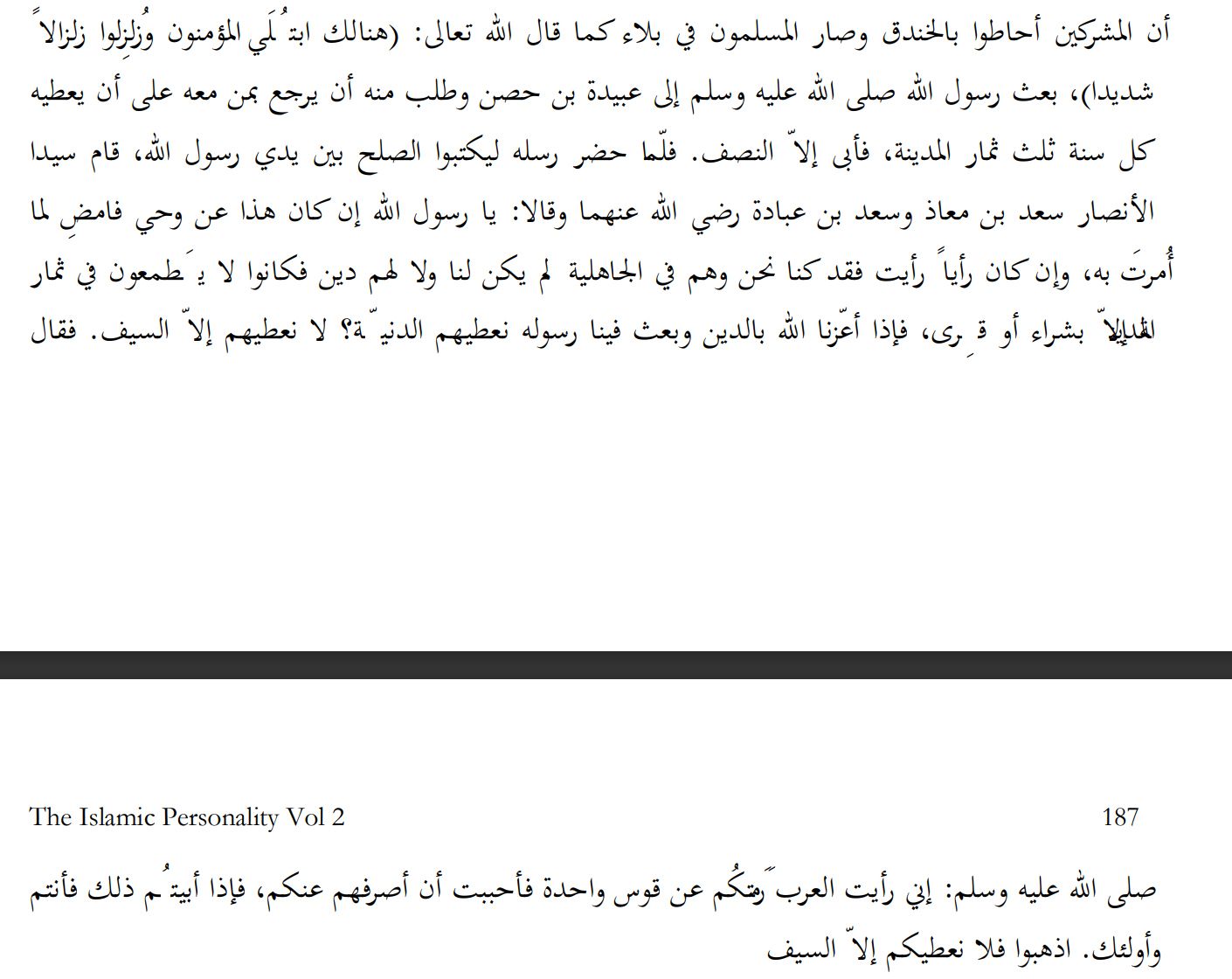
"Cewa maushrikai sun kewaye rami, Musulmi kuma suna cikin jarabawa kamar yadda Allah (swt) ya ce: ‘A nan ne aka jarabci muminai, aka girgiza su da girgizawa mai tsanani’ [TMQ 33:11]. Manzon Allah ﷺ ya aika zuwa ga ‘Uyaynah bin Hasan, yana neman ya koma tare da mutanensa, bisa ga ba shi kashi ɗaya bisa uku na amfanin Madina, amma ya ƙi sai dai rabi. Lokacin da wakilansa suka zo domin a rubuta yarjejeniyar a gaban Manzon Allah ﷺ, sai manyan Ansarawa biyu, Sa‘ad bin ‘Ubadah da Sa‘ad bin Mu‘adh (ra) suka tashi tsaye suka ce: ‘Ya Manzon Allah ﷺ, idan wannan daga wahayi ne, to ka aiwatar da abin da aka umarce ka da shi. Amma idan ra’ayi ne da ka yi tunani a kansa, to su da mu muna cikin jahiliyya, lokacin da ba mu da addini tukuna, ba su taɓa cin amfanin Madina ba sai ta hanyar saye ko baƙunci. To yanzu da Allah ya girmama mu da addini, ya aiko Manzonsa a cikinmu, shin za mu ba su wannan duniya alhali muna cikin wulakanci? A’a, ba za mu ba su komai ba sai takobi.’ Sai ya ﷺ ya ce: ‘Na ga Larabawa suna harbi daga baka ɗaya, shi ya sa na so in karkatar da su daga gare ku. Idan kuka ƙi haka, to ku da su. Ku tafi, domin ba za mu ba ku komai ba sai takobi!’”
“That the polytheists surrounded the trench and Muslims were in trial like Allah (swt) said: ‘Therein the believers were tested and shaken with a severe shaking’ [TMQ 33:11].The Messenger of Allah (saw) sent to ‘Uyaynah bin Hasan and requested that he return with those together with him upon giving him a third of the fruits of Madinah but he refused except a half. When his messengers appeared to write the truce in front of the Messenger of Allah, the two chiefs of the Ansar, S'aad bin ‘Ubadah and S'aad bin Mu’adh (ra) stood and they said: ‘O Messenger of Allah, if this is from revelation then execute what you are commanded with but if it is an opinion which you considered, then they and we were in jahiliyyah when neither they nor we had a religion yet they did not eat of the fruits of Madinah except through purchase or hospitality. So when Allah honoured us with the deen and sent His Messenger among us, should we give them this dunya while being contemptible? No, we will not give them except the sword. So he (saw) said: ‘I saw the Arabs shooting from one bow so I liked to divert them from you. If you reject that, then it is you and those. Go away for we will not give you except the sword!’”
Wannan yana nuna cewa Manzon Allah ﷺ da farko ya karkata ga yarjejeniyar sulhu saboda abin da ya gani na raunin Musulmai. Amma da ya ga ƙarfi a cikinsu saboda abin da S'aad bin ‘Ubadah da S'aad bin Mu'adh (ra) suka faɗa, sai ya daina abin da ya nuna cewa babu laifi a yi yarjejeniya da kafirai ta hanyar biyan su kuɗi idan akwai haɗarin cutarwa. Wannan saboda idan sun ci Musulmai, za su kwashe dukkan dukiya da iyalai a matsayin bayi (sabaya), don haka biyan wasu kuɗi domin kare Musulmai da iyalansu da dukiyarsu ya fi ƙasƙanci kuma ya fi amfani.
This indicates that the Messenger of Allah (saw) initially inclined to the truce due to what he sensed of the Muslims’ weakness. When he saw the strength in them due to what S'aad bin ‘Ubadah and S'aad bin Mu’adh (ra) said, he refrained from that which indicates that there is no harm from contracting a treaty with disbelievers paying them money when there is danger of harm. This is because if they conquered Muslims they would take all the wealth and the families as captives (sabaya), so paying some wealth to safeguard Muslims and their families and wealth is less contemptible and more beneficial.