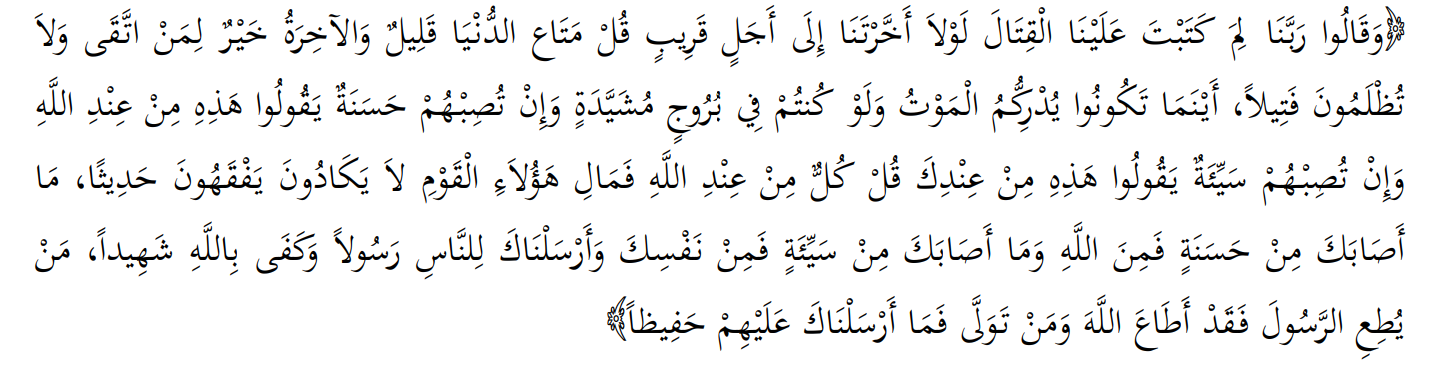
To haka ne, batun shi ne abin da ya same su, ba abin da suke aikatawa ba. Don haka babu ruwansa da nazarin al-qadā’ wa‘l-qadar.
So the subject is what befalls them and not what they are doing. Thus it has nothing to do with the study of al-qadā’ wa‘l-qadar.
Saboda haka, duk abin da aka ambata a sama ba shi da alaƙa da nazarin al-qadā’ wa‘l qadar; ba sa cikin ma'anarsa, kuma babu wata dangantaka tsakanin su da abin da aka ambata a sama. Maimakon haka, al-qadā’ wa‘l-qadar a matsayin ma'ana ya samo asali ne daga falsafar Girka, wadda Mu'tazilah suka karɓa suka kuma bayar da ra'ayi a kanta. Ahl al-Sunnah da Jabriyyah sun karyata su, Ahl al-Sunnah kuma sun yi raddi ga Jabriyyah. An takaita muhawara ga ma'ana guda ɗaya, kuma an dogara ga tushe guda ɗaya. Don haka, batun wata ma'ana ce da ta samo asali daga falsafar Girka, kuma ta fito fili a cikin muhawarar da ke faruwa tsakanin Musulmai da kafirai waɗanda ke da falsafar Girka a hannunsu. Ma'ana ce da ke da alaƙa da ‘aqīdah (akida), saboda haka abin da ake so shi ne a bayyana matsayin Musulunci game da wannan ma'ana. Mu'tazilah sun bayar da ra'ayi, Jabriyyah suka karyata su suka bayar da wani ra'ayi daban. Ahl al-Sunnah sun karyata su duka suka bayar da nasu ra'ayi, kuma sun ce game da shi cewa ra'ayi ne na uku wanda ya fito daga cikin ra'ayoyin biyu, suka kwatanta shi da "madara mai tsafta, mai daɗin sha, wadda ke fitowa daga tsakanin najasa da jini."
Therefore, all that has been mentioned above has nothing to do with the study of al-qadā’ wa‘l qadar; they do not come under its meaning and have no relation whatsoever with what has been mentioned above. Rather, al-qadā’ wa‘l-qadar as a meaning has come from Greek philosophy which was transmitted by the Mu'tazilah who gave an opinion with regards to it. Ahl al-Sunnah and the Jabriyyah refuted them and Ahl al-Sunnah (also) made a refutation of the Jabriyyah. The discussion was confined to the same meaning and preceded upon the same premise. Thus the issue is a meaning/sense that came from Greek philosophy and it came to the fore in the debate which used to take place between the Muslims and the kuffar who used to be armed with the Greek philosophy. It is a meaning which has a relevance to the ‘aqīdah (creed), thus what is desired is to give Islam's opinion regarding this meaning. The Mu'tazilah gave an opinion and the Jabriyyah refuted them and gave another opinion. Ahl al-Sunnah refuted all of them and gave an opinion, and said about it that it is a third opinion which has come out from the two opinions and they described it as ‘the pure milk, sweet to drink, that comes out from between excrement and blood’.
Saboda haka, maudu'in tattaunawa, wanda ya samo asali daga falsafar Girka, ya zama sananne, kuma tunda yana da alaka da al-'aqidah (akida), dole ne Musulmi ya kasance a sarari game da abin da imaninsa yake dangane da wannan maudu'i. Musulmai sun bayyana ra'ayoyinsu, kuma makarantu uku na tunani suka taso. Saboda haka, ba a halatta a mayar da batun al-qada' wal-qadar zuwa ga abin da ma'anar al-qada' ko al-qadar ta kasance a harshe da kuma a Shari'a ba, kuma ba a halatta a yi tunani ko hasashen wata ma'ana ga al-qada' ko al-qadar daga zato kawai, tunani ko hasashe, da ce misali cewa al-qada' hukunci ne na gaba daya kan abubuwan gaba daya kawai, al-qadar kuma hukunci ne na gaba daya kan abubuwan juzi'i da cikakkun bayanansa, ko kuma a ce al-qadar tsari ne na har abada ga abubuwa, al-qada' kuwa aiwatarwa ne da halitta bisa wannan kaddara da tsari. Haka ne, wannan ba a halatta ba, domin wannan kawai hasashe ne, zato ne, kuma yunkuri ne da bai yi nasara ba na amfani da wasu kalmomi na harshe da na Shari'a, domin ba su dace da shi ba, sai dai suna nuna ma'anoni gaba daya. Don haka zai zama aiki na son rai ne a takaita kalmomin biyu zuwa wadannan ma'anoni na musamman ba tare da hujja ba.
Therefore, the subject of discussion, which came from the Greek philosophy, became known, and since it is related to the ‘aqīdah (creed), the Muslim must be clear as to what his belief is regarding this subject. The Muslims did actually state their opinion and three schools of thought arose. Thus it is not allowed to refer the issue of al-qadā’ wa‘l-qadar to what has come of the meaning of al-qadā’ or al-qadar, linguistically and in the Sharī’ah, nor is it allowed to imagine or conceive for al-qadā’ or ‘al-qadar any meaning from mere supposition, conception or imagination, and to say, for example, that al-qadā’ is the universal judgement on only the universals and al qadar is the universal judgement on the partial aspects and its details, or to say that al-qadar is the eternal plan for things and al-qadā’ is the execution and creation according to that predetermination and plan. Indeed, this is not allowed because this is mere imagination, assumption and a failed attempt of applying certain linguistic and shar’i expressions because they do not apply to it, they rather indicate general meanings; . It would then be an arbitrary action to restrict the two words to these specific meanings without evidence.
Haka kuma, ba a halatta a ce al-qadā’ wa‘l-qadar wani sirri ne daga cikin sirrikan Allah ba, kuma an hana mu tattaunawa a kansa, domin babu nassi na shari’a da ya ce yana daga cikin sirrikan Allah, balle a ce abin da ake magana a kansa abu ne da ake iya gani da ji, wanda kuma dole ne a bayar da ra’ayi a kansa, to ta yaya za a ce ba za a yi nazari a kansa ba?! Bugu da kari, lamari ne na bincike mai amfani da hankali, kuma magana ce da ta shafi al’amuran da hankali ke nazari a kansu a matsayin gaskiya da ake iya gani da ji; kuma tun da yake yana da alaka da imani da Allah. Don haka, al-qadā’ wa‘l-qadar, ta ma’anar da aka sanya shi a matsayin abin magana, kuma ya zama wani bangare na akida, dole ne a yi nazari a kansa.
Similarly, it is not allowed to claim al-qadā’ wa‘l-qadar is a secret from amongst the secrets of Allah and that we have been forbidden to discuss it, because there is no shar’i text to say that it is one of the secrets of Allah , not to mention the fact that the subject matter is sensorially perceivable, for which an opinion must be given, so how can it be said that it cannot to be studied?! In addition to the fact that it is a rational inquiry and a subject which relates to matters that are studied by the intellect as a reality that is sensorially-perceivable; and since it relates to the imān in Allah . Thus, al-qadā’ wa‘l-qadar, in the meaning placed as the subject matter and which became part of the ‘aqīdah (creed) must be studied.
Al-qadā’ wa‘l-qadar, wato, batun al-qadā’ wa‘l-qadar, shi ne ayyukan bayi da sifofin abubuwa. Wannan saboda batun da aka ambata shi ne ayyukan bawa da abin da ke tasowa daga waɗannan ayyuka, wato, sifofin da bawa ke haifarwa a cikin abubuwa: shin halittar Allah ne? Shin Allah ne ya halicce su ya kuma samar da su? Ko kuwa bawa ne? Shin bawa ne ya halicce su ya kuma samar da su?
Mu'tazilawa, dukansu, sun ce bawa ne ke halittar ayyukansa: shi ne ke halittar aikin ya kuma samar da shi. Sun sabawa juna game da sifofi. Wasu daga cikinsu sun ce bawa ne ke halittar dukkan sifofin da mutum ke haifarwa, shi ne kuma ke sa su kasance. Wasu kuma sun bambanta tsakanin sifofi. Daga cikinsu, wasu sun ce waɗanda bawa ke haifarwa a cikin abubuwa, shi ne ya halicce su kuma ya samar da su, sashensu kuma sun ce waɗanda aka halicce su a cikin abubuwa Allah ne ya halicce su ya kuma samar da su.
Ƙungiyar Jabriyyah kuwa sun ce Allah ne ke halittar dukkan ayyukan mutum da dukkan sifofin da mutum ke haifarwa a cikin abubuwa. Shi ne ke samar da su; bawa ba shi da hannu a halitta da tsara aikin ko a haifar da sifa a cikin abu.
Ahlus-Sunnah sun ce ayyukan bawa da sifofin da bawa ke haifarwa a cikin abubuwa Allah ne ke halittar su. Amma sun ce Allah yana halittar su ne a lokacin da bawa yake aikata aikin, kuma bawa ne ke haifar da sifar, ba tare da ƙarfinsa da nufinsa ba. Don haka Allah yana halittar su a lokacin da bawa yake da ikon yi da nufi, ba da ikon bawa da nufin kansa ba.
The question of al-qadā’ wa‘l-qadar, or in other words, the issue of al-qadā’ wa‘l-qadar, is the actions of the servants and the attributes of things. This is because the issue mentioned is the actions of the servant and what arises from these actions, that is, the attributes brought about by the servant in things: are they the creation of Allah ? Is He the one who has created them and brought them into being? Or is it the servant? Is the servant the one who created them and brought them into being? The Mu'tazilah, all of them, said that the servant is the one who creates his own actions: he is the one who creates the action and brings it into being. They differed about the attributes. Some of them said that the servant is the one who creates all of the attributes that are caused by man and he is the one who brings them into existence. Others differentiated between the attributes. Some of these made them as being created in things by the servant and brought into existence by him and part of them made them as being created in things by Allah and brought into existence by Him. As for the Jabriyyah, they said that Allah creates all the actions of man as well as all the attributes caused by man in things. He is the one who brings them into existence; the servant has nothing to do with the creation and formation of the action or in causing the attribute in the thing. Ahl us-Sunnah said that the actions of the servant and the attributes caused in things by the servant are created by Allah . But they said that Allah creates them while the servant performs the action and the servant causes the attribute. So Allah creates them when the servant has the ability and will and not by his own ability and will.
Wannan shi ne batun al-qadā’ wa‘l-qadar, kuma ga taƙaitaccen bayanin ra'ayoyin da aka faɗa a kansa. Duk wanda ya yi nazari a kan waɗannan ra'ayoyi dole ne ya san tushen da aka gina muhawarar a kansa, domin muhawarar ta kasance a kan tushe ɗaya. Saboda haka sakamakonta zai kasance kamar yadda tushen muhawarar ya bukata, kuma ba zai zama kuskure ba.
Tushen muhawarar a al-qadā’ wa‘l-qadar ba shi ne aikin bawa ta fuskar ko shi ne ya halicci aikin ko Allah ne ya halicce shi ba, haka kuma ba shi ne nufin Allah ba, ta yadda nufinsa zai dogara ga aikin bawa, don haka dole ne ya kasance tare da wannan nufi. Haka kuma ba shi ne Sanin Allah ba ta fuskar cewa Yana sane bawa zai yi irin wannan aiki ko cewa Sanin Nasa ya kewaye bawa, ko kuma cewa an rubuta wannan aikin bawa a cikin Lawh al-Mahfūẓ, don haka dole ne ya yi bisa abin da aka rubuta. Lalle, tushen muhawarar tabbas ba ɗaya daga cikin waɗannan abubuwa ba ne, domin ba su da alaƙa da maudu'in ta fuskar lada da azaba; suna da alaƙa da tambayar ta fuskar halittar daga babu, alaƙar nufi da dukkan yiwuwa, Sanin da ya kewaye dukkan abubuwa, da Lawh al-Mahfūẓ. Wannan ya bambanta sosai da maudu'in lada da azabar aiki.
Maudu'in muhawara wanda bisa tushensa ake gina tambayar al-qadā’ wa‘l-qadar shi ne batun lada da azaba a kan aiki, wato: shin mutum ya wajaba ya aikata aiki, nagari ko mugunta, ko yana da zaɓi? Kuma shin mutum yana da zaɓi wajen aikata aiki, ko ba shi da zaɓi? Duk mai bincika ayyukan bayi yana ganin cewa mutum yana rayuwa ne a cikin yanayi biyu: na farko wanda yake mallaka, wato yanki da yake a cikin fagen halayensa, wanda ayyukansa ke faruwa gaba ɗaya bisa zaɓinsa; na biyu kuwa yana mallakarsa, shi ne yake rinjayensa; yana rayuwa ne a cikin iyakokinsa, kuma ayyukan da ke faruwa a cikinsa, ko sun fito daga gare shi ko suka same shi, suna faruwa ba tare da zaɓinsa ba.
This is the issue - the issue of al-qadā’ wa‘l-qadar – and this is a summary of the opinions that have been opined about it. Anyone who scrutinises these views must know the basis on which the discussion has been built such that the discussion is on a common basis. Thus the outcome will be as required by the basis of the discussion and it will not be an incorrect one. The basis of the discussion in al-qadā’ wa‘l-qadar is not the action of the servant in terms of whether he created the action or Allah created it, nor is it the will of Allah in that His will is conditional on the action of the servant so it must exist with this will, nor is it the Knowledge of Allah in terms of Him knowing that the servant will do such and such an action or that His Knowledge encompasses the servant, or that this action of the servant is written in the Lawh al-Mahfūdh so he must act according to what has been written. Indeed, the basis of the discussion is definitely none of these things, because they have no relation to the subject from the perspective of reward and punishment; they are related to the question from the perspective of formation from nothing, the connection of the will to all possibilities, the all-encompassing Knowledge of all things and the Lawh al-Mahfūdh. This is quite different from the subject of the reward and punishment for an action.The topic of discussion on whose basis the question of al-qadā’ wa‘l qadar is built is the issue of reward and punishment for an action, that is, is man obliged to perform an action, good or evil, or does he have a choice? And, does man have the choice to perform an action, or does he have no choice? The person who scrutinises the actions of the servants sees that man lives within two spheres: one which he dominates, the sphere that is present within the region of his conduct, and within which his actions happen absolutely by his choice; the other (sphere) dominates him; he exists within its domain, and the actions that occur within it, whether they originate from him or fall upon him, occur without his choice.
Saboda haka, ayyukan da ke cikin fagen da ke mamaye mutum, mutum ba shi da zaɓi a cikinsu ko a wanzuwarsu; suna da nau'i biyu: nau'i ɗaya wanda ya zama wajibi ne bisa dokokin duniya, da kuma nau'in da dokokin duniya ba su wajabta ba, ko da yake ba duk abubuwan da ke faruwa ne ke fitowa daga waɗannan dokoki ba. Dangane da ayyukan da dokokin duniya suka wajabta, mutum yana miƙa wuya gare su gaba ɗaya; yana aiki bisa su ta hanyar tilastawa, domin yana tafiya tare da Duniya da Rayuwa, waɗanda ake yi wa wata ƙayyadaddiyar tsari, wadda ba ta canzawa. Saboda haka, ayyukan mutum a wannan fage suna faruwa ba tare da nufinsa ba, ana tilasta shi a cikinsu, kuma ba shi da zaɓi. Ya zo wannan rayuwa ba tare da nufinsa ba, kuma zai bar ta ba tare da nufinsa ba; ba zai iya tashi sama ta hanyar amfani da jikinsa kawai ba, ba kuma zai iya tafiya a ƙasa irin yadda yake a dabi'ance a kan ruwa ba, ko zaɓar wa kansa launin idanunsa, siffar kansa ko girman jikinsa. Lallai, Allah ne ya halicci duk wannan ba tare da wani tasiri ko dangantaka daga mutumin da aka halitta ba, domin Allah ya halicci dokokin duniya, ya sa su daidaita duniya, ya kuma sa duniya ta yi aiki bisa su ba tare da iya canza su ba. Dangane da nau'i na biyu, su ne ayyukan da ke faruwa fiye da ikon mutum, waɗanda ba zai iya kauce musu ba, kuma ba su da alaƙa da dokokin duniya; su ne ayyukan da ke faruwa ba da niyya ba ta hanyarsa ko a kansa, waɗanda ba zai iya gujewa ba, kamar idan wani ya faɗo kan wani mutum ya kashe shi, ko idan wani ya harbi tsuntsu sai harsashin ya bugi mutum ba da niyya ba ya kashe shi, ko idan mota, jirgin ƙasa ko jirgin sama ya yi hatsari, ba tare da wata damar kauce wa abin ba, sakamakon haka fasinjoji su mutu. Duk waɗannan misalai ayyuka ne da suka faru daga mutum ko a kansa - duk da cewa suna ɗaure da dokokin duniya - sun faru ba tare da nufinsa ba kuma fiye da ikonsa na sarrafa su, kuma suna cikin fagen da ke mamaye mutum. Duk ayyukan da ke faruwa a cikin yankin da ke mamaye mutum ana kiransu qadā, domin Allah ne shi kaɗai ya ƙaddara su, bai kuma ba bawa 'yancin zaɓi a cikin irin waɗannan ayyukan ba; ba shi da zaɓi game da su. Saboda haka ba a lissafa mutum a kan waɗannan ayyukan, ko da kuwa akwai amfani ko cuta a cikinsu ga mutum, ko son rai ko ƙin su, wato ba tare da la'akari da ko su nagari ne ko marasa kyau a wurin mutum ba. Allah shi kaɗai ne ya san alheri da sharri a cikin waɗannan ayyukan, domin mutum ba shi da tasiri a kansu; ba ya sanin su ko yadda ake samar da su, kuma ba shi da iko ko kaɗan na gujewa ko haifar da su. Saboda haka babu lada ko azaba a kansu. Wannan shi ne qadā, kuma shi ya sa ake cewa aikin ya faru ta hanyar qadā. Wajibi ne mutum ya yi imani da wannan qadā, kuma cewa wannan qadā daga Allah yake, Mai tsarki da ɗaukaka.
Thus, the actions that fall within the sphere that dominates man, man has no choice in them or in their existence; they are of two types: a type which is a requirement of the laws of the universe, and a type not necessitated by the universal laws, even though all the things (that occur) may not emanate from these laws. As for the actions necessitated by the laws of the universe, man submits to them totally; he acts according to them as a matter of compulsion, because he moves with the Universe and Life, which are subjected to a specific regulation, which does not change. Subsequently, man's actions in this sphere occur without his will, he is forced in these actions and has no choice. He came to this life without his will and he will leave it without his will; he cannot fly merely by the use of his own body, nor can he walk in his natural form on water, nor choose for himself the colour of his eyes, the shape of his head or the size of his body. Indeed, it was Allah who created all of this without any influence or relation from the created man, because Allah created the laws of the Universe, made them regulate the universe and made the universe act according to them without having the ability to change. As for the second type, they are actions which happen beyond man's control, which he cannot avoid and which are not related to the laws of the universe; they are the actions which occur either unintentionally through him or upon him and which he cannot avoid, such as if someone falls on a person and thus kills him, or if someone shoots at a bird and unintentionally hits a person and kills him, or if a car, train or plane should crash, without any possibility to avoid the incidents, and as a result the passengers die. All these examples are actions which occurred from a man or upon him - though they are bound by the laws of the universe - they happened without his will and outside his ability to control them, and they are within the sphere that dominates man. All the actions which occur within the sphere that dominates man are termed qadā, because Allah alone has decreed them, and has not given the servant the freedom of will in such actions; he has no choice with regards to them. Therefore man is not reckoned on these actions, whether, with respect to man, there is benefit or harm in them or like or dislike, that is, regardless of whether they are, according to man, good or bad; Allah alone knows the good and bad in these actions, because man has no influence on them; he does not know them or how they are brought into existence, and he is absolutely unable to avoid and bring them about. Therefore there is no reward or punishment for them. Thus this is qadā’, and it is therefore said that the action happened by qadā’. It is upon man to have imān in this qadā’ and that this qadā’ is from Allah , the Glorified and Exalted.
Game na ayyukan da ke faruwa a fagen da mutum ke iko da shi, shi ne fagen da yake aiwatar da zaɓinsa bisa tsarin da ya zaɓa, ko shari'ar Allah ce ko kuma wani tsari dabam. Wannan fage shi ne wanda ayyukan da mutum yake aikatawa ko waɗanda suka shafe shi ke faruwa da nufinsa. Don haka yakan yi tafiya, ya ci, ya sha, ya yi balaguro a duk lokacin da ya so; haka nan yakan hana kansa yin ɗaya daga cikin waɗannan abubuwa a duk lokacin da ya so; yakan ƙone da wuta, ya yanke da wuka idan ya zaɓa, kuma yakan biya buƙatun sha'awarsa ta haihuwa, ta mallaka da ta yunwa yadda ya ga dama. Duk waɗannan yakan aikata su ko ya kauracewa su, da zaɓinsa. Saboda haka, mutum yana da alhaki a kan ayyukan da ke faruwa a cikin wannan fage. Don haka, ana saka masa da lada saboda aikin da ya cancanci lada, kuma ana hukunta shi saboda aikin da ya cancanci hukunci. Waɗannan ayyuka ba su da alaƙa da al-qadā' ba, kuma al-qadā' ba shi da alaƙa da su, domin mutum ne ya ɗauke su da nufinsa da zaɓinsa. Saboda haka, ayyukan zaɓi ba sa shiga ƙarƙashin al-qadā'.
As for the actions that occur in the sphere that man dominates, it is the sphere in which he proceeds with choice according to the system he chooses, whether it is the Sharī’ah of Allah or any other. This sphere is the one in which actions carried out by man or involving him occur by his will. Thus he walks, eats, drinks and travels anytime he likes; likewise he refrains from doing any of these things whenever he likes; he also burns with fire and cuts with a knife when he chooses, and he satisfies his instincts of procreation, ownership and hunger as he likes. All this he performs or abstains from, by his choice. Therefore, man is accountable on actions which occur within this sphere. Thus, he is rewarded for the action deserving reward and is punished for the action deserving punishment. These actions have nothing to do with qadā’ nor does it have anything to do with them because man is the one who undertook them with his own will and choice. Therefore, actions of choice do not come under al-qadā’.
Dangane da al-qadar, yana da alaƙa da ayyuka, ko sun faru a cikin yankin da mutum yake iko da shi ko a cikin yankin da yake ƙarƙashin ikonsa, waɗanda ke faruwa daga abubuwa ko a kansu ta hanyar al'amarin halitta, mutum da rayuwa, kuma suna haifar da sakamako, wato wani abu yana samuwa daga aikin; to wannan tsari da mutum yake haifarwa a cikin abubuwa dangane da sifofi, shin mutum ne yake halitta shi ko Allah, kamar yadda Ya halicci abubuwan kansu? Duk wanda ya yi nazari a kan wannan batu zai ga cewa waɗannan al'amura da ake haifarwa a cikin abubuwa daga cikin sifofin abubuwan suke, ba daga aikin mutum ba, kamar yadda shaida take da cewa mutum ba ya iya samar da su (wato waɗannan sakamako) sai a cikin abubuwan da suke da sifar da ta dace a cikin sifofinsu. Amma abubuwan da ba su da sifar da ta dace a cikin sifofinsu, mutum ba ya iya haifar da abin da yake so a cikinsu. Saboda haka waɗannan al'amura ba daga ayyukan mutum suke ba, sai dai daga sifofin abubuwan.
As for al-qadar, it relates to the actions, whether they occur in the sphere which man dominates or in the sphere which dominates him, which occur from or on things through the matter of the universe, man and life, and cause an effect, that is, something results from the action; so this mechanism that man causes in things in terms of attributes, is it created by man or by Allah just as He has created the things themself. The one who scrutinises this issue will find that these matters which are caused in things are from the attributes of the things, not from the action of man, as evidenced by the fact that man is not able to form them (i.e these effects) except in the things which possess the (relevant) attribute amongst its attributes. As for the things which do not have the (relevant) attribute amongst their attributes, man is not able to cause in them what he wants. Therefore these matters are not from the actions of man but from the attributes of the things.
Don haka, Allah ya halicci abubuwa kuma ya sanya [qaddara] a cikinsu siffofi ta yadda babu wani abu da zai iya fitowa daga gare su sai abin da Ya sanya a cikinsu, kamar sanya a cikin tsaban dabino siffar tsiron dabino daga gare shi ba tuffa ba, haka kuma maniyyin mutum yana haifar da mutum ba wani dabba ba. Allah ya halicci takamaiman siffofi a cikin abubuwa, misali, ya halicci a cikin wuta siffar kone-kone, a cikin itace siffar kama wuta, a cikin wuka kuma siffar yankewa. Ya sanya siffofin su zama wani muhimmin ɓangare na abubuwan, mai dorewa, bisa ga Dokokin Duniya. Idan ya bayyana cewa siffofin ba sa nan kuma, to yana nufin Allah ya cire su, kuma irin wannan lamari ba kasafai ba ne; yana faruwa ne kawai ga annabawa a matsayin mu'ujiza a gare su. Haka kuma, kamar yadda Allah ya halicci siffofi ga abubuwa, ya halicci a cikin mutum ilhami da bukatu na jiki, kuma kamar yadda ya halicci siffofi a cikin abubuwa, ya halicci a cikin ilhami da bukatun jiki takamaiman siffofi. Saboda haka, a cikin ilhamar haihuwa Allah ya halicci sha'awar jima'i, kuma a cikin bukatun jiki ya halicci siffar yunwa. Ya sanya wadannan siffofi su manne da su bisa ga dokokin duniya. Takamaiman siffofin da Allah Madaukakin Sarki ya halitta a cikin abubuwa, ilhami da bukatun jiki ana kiransu al-qadar, domin Allah shi kaɗai ne ya halicci abubuwan, ilhami da bukatun jiki, kuma ya ƙayyade siffofinsu a cikinsu. Saboda haka, idan sha'awar jima'i ta taso a cikin mutum, idan ya bude idanunsa ya gani, da kuma idan dutse ya tashi sama idan aka jefa shi sama, ya fadi kasa idan aka jefa shi kasa, duk wannan ba da aikin mutum ba ne, sai dai da aikin Allah. Ma'ana, daga yanayin abubuwa ne su kasance haka, wato Allah ne ya halicce su, ya kuma sanya wasu siffofi a cikinsu, don haka siffofin nan daga Allah suke, ba daga mutum ba; mutum ba shi da wani hannu a cikinsu, kuma ba zai iya yin wani tasiri a kansu ta kowace hanya ba. Wannan shi ne al-qadar, kuma ana cewa al-qadar a cikin maudu'in al-qadā' wa'l-qadar, siffofin abubuwa ne da mutum yake haddasawa a cikinsu. Ya wajaba a kan mutum ya yi imani da cewa wanda ya tsara siffofin nan a cikin wadannan abubuwa shi ne Allah.
Thus, Allah has created the things and set [qaddara] in them attributes in a manner that nothing else is possible to come from them except what He has set in them, such as setting in the date pit (the attribute) of growing date palm from it and not apple, and such the human sperm to result in humans not any other animal. Allah has created specific attributes in things, for example, He created in fire the attribute of burning, in wood the attribute of catching fire, and in the knife the attribute of cutting. He made the attributes an essential and perpetual part of the objects in accordance with the Laws of the Universe. When it appears that the attributes are no longer present, it means Allah has stripped them off, and such an event would be unusual; it only happens to the prophets as a miracle for them. Likewise, in the manner that Allah created attributes for the objects, He created in man instincts and organic needs and, as He created attributes in objects, He created in the instincts and organic needs specific attributes. Hence, in the procreational instinct Allah created the sexual inclination, and in the organic needs He created the attribute of hunger. He made these attributes adhere to them according to the laws of the universe. The particular attributes that Allah the Exlated has created in objects, instincts and organic needs are called al-qadar, because Allah alone created the things, instincts and organic needs and determined in them their attributes. Thus when the sexual desire occurs in man, when he sees upon opening his eyes and when the stone goes up when thrown upwards and down when thrown downward, all of this is not by man’s action, rather it is by the action of Allah ; meaning that it is from the nature of the things to be so, that is, Allah created them and created particular attributes in them, thus they (the attributes) are from Allah and are not from man; man has nothing to do with them, nor can he effect them in any way. This is al-qadar, and it is thus said that al-qadar in the subject of al-qadā’ wa‘l-qadar is the attributes of the things which man causes in them. It is upon man to have imān in that the one who determined the attributes in these things is Allah .
Saboda haka al-qadā’ wa‘l-qadar su ne ayyukan da ke faruwa a cikin yankin da ke mulkin mutum, ko suna cikin abin da dokokin Halitta suka wajabta ko ba haka ba, ko sun fito daga gare shi ko sun auku a kansa, da kuma siffofin da ke haifar da abubuwa. Ma’anar imani da al-qadā’ wa‘l-qadar, cewa duka alherinsa da sharrinsa daga Allah suke, shi ne imani da cewa ayyukan da ke faruwa daga gare shi ko a kansa, duk da son ransa, kuma ba shi da iko na korar su, da kuma siffofin da mutum ke haifarwa a cikin abubuwa, duk daga Allah suke, ba daga bawa ba, kuma shi ba shi da hannu a cikinsu.
Saboda haka ayyukan da mutum yake da zaɓi a kansu ba a cikin batun al-qadā’ wa‘l-qadar suke ba, domin waɗannan ayyuka suna faruwa daga mutum ko a kansa ta hanyar zaɓinsa. Lokacin da Allah ya halicci mutum, ya halicci siffofi a cikin abubuwa, da cikin ilhama da bukatun jiki, ya kuma halicci a cikin mutum hankali mai banbancewa, sai ya ba shi zaɓi ya aikata aikin ko ya kauracewa shi, bai tilasta shi ya aikata ko ya bar shi ba. Haka kuma bai sanya a cikin siffofin abubuwa, ko a cikin ilhama da bukatun jiki, wani abu da zai tilasta wa mutum aikatawa ko barin aikin ba. Don haka mutum yana da zaɓi ya aikata aikin ko ya kauracewa shi ta hanyar hankali mai banbancewa da Allah ya ba shi, kuma ya sanya hankali mai lafiya ya zama ma’auni na hisabi. Saboda haka ya kafa wa mutum lada saboda aikin alheri, domin hankalinsa ya zaɓi aiwatar da umurnin Allah da kuma kauracewa haramcinsa, kuma ya kafa masa azaba saboda aikin sharri, domin hankalinsa ya zaɓi saɓa wa umurnin Allah da aikata abin da ya hana. Don haka hisabinsa a kan irin waɗannan ayyuka gaskiya ne kuma adalci ne, domin mutum yana da zaɓi ya aikata ayyukan kuma ba a tilasta shi ba; al-qadā’ wa‘l-qadar kuwa ba shi da alaƙa da wannan al’amari, al’amari ne na mutum da kansa yana aikata aikinsa da zaɓinsa. Saboda haka mutum yana da alhakin abin da yake samu,
Hence al-qadā’ wa‘l-qadar are the actions which occur in the sphere that dominates man, irrespective of whether they are a requirement of the Laws of the Universe or not, or if they emanate from him or fall upon him, and the attributes which results in the objects. The meaning of imān in al-qadā’ wa‘l-qadar, both the good and the bad thereof being from Allah , is (having) imān in that the actions which occur from him or upon him against his will, and he has no power to drive them away, and the attributes which man causes in the object are from Allah and are not from the servant, nor does he have anything to do with them. Thus the actions with regards to which man has a choice are excluded from the subject of al-qadā’ wa‘l-qadar, because these actions occur from man or upon him by his choice, and because when Allah created man and created the attributes in the objects and in the instincts and the organic needs, and created in man the distinguishing intellect, He gave him the choice to carry out the action, or abstain from it, and He did not oblige him to do or not do it. Nor did He make in the attributes of things, or in the instincts and organic needs anything that obliges man to do or not to do the action. Therefore man has the choice to carry out the action or abstain from it by way of the distinguishing mind that Allah bestowed him with, and He made the (sound) intellect the criteria of the accountabilty. Therefore He set for man reward for doing good, because his mind chose to carry out the orders of Allah and abstain from his prohibitions, and He also set for him punishment for doing bad, because his mind chose to disobey the the orders of Allah and commit what He had prohibited. So his accounting on such actions is true and just, because man has the choice to carry out the actions and is not compelled to do so; and al qadā’ wa‘l-qadar has nothing to do with this matter, it is a question of the man himself doing his action by choice. Therefore man is accountable for what he earns,