20.3 Shahidi
20.3 The Martyr
Shuhadaa (shahidai) suna da nau'i uku; shahidi na Lahira amma ba bisa ka'idojin duniya ba; shahidi na duniya kawai, da kuma shahidi na duniya da Lahira. Dangane da shahidi na Lahira kawai, wanda ba shi da matsayin shahada a duniya, an ambace su a cikin hadisai. A wasu riwayoyi sun kai bakwai, a wasu takwas, a wasu tara, kuma a wasu sha ɗaya. Ingantaccen matsayi, kamar yadda ya zo a cikin Muslim, shi ne cewa su biyar ne, wato: (al-mat'un) wanda shi ne wanda ya mutu sanadiyyar annoba, watau sanannen annobar nan; (al-mabtun) wanda shi ne mai gudawa; wanda ya nutse a ruwa ya mutu saboda ruwan; wanda ya mutu sanadiyyar (al-hadm) watau ginin da ya rushe; da kuma wanda ya mutu a hanyar ɗaukaka kalmar Allah a wajen fagen yaƙi. Muslim ya ruwaito daga Abu Hurayra (ra) cewa Manzon Allah ﷺ ya ce:
Martyrs (shuhadaa) are of three types; the shaheed of the Akhirah but not by the rules of the world; the shaheed of the world only and the shaheed of the world and Akhirah. As for the shaheed of the Akhirah only and not of this world, they are mentioned in the ahadith. In some narrations they are seven, in some eight, in some nine and in some eleven. The authentic (position) as what came in Muslim is that they are five who are: (al-mat’un) who is the one who dies in the plague i.e. the famous pestilence, the (mabtun) who is the one with diarrhoea, the drowned person who dies because of water, the one who dies of (al-hadm) i.e. the collapsed building, and the one who dies in the way of raising the word of Allah outside the battlefield. Muslim narrated from Abu Hurayra (ra) that the Messenger of Allah (saw) said:
Wani mutum yana tafiya a kan hanya ya ga wani reshen ƙaya a cikin hanya, sai ya cire shi. Allah ya yi godiya a gare shi, ya kuma gafarta masa. Shi (saw) ya ce: Shahidai (shuhadaa) su ne biyar: wanda ya mutu sanadiyar annoba (al-mat’un), wanda ya mutu sanadiyar ciwon ciki (al-mabtun), wanda ya nutse a ruwa, wanda ya mutu sakamakon rushewar gini, da kuma shahidi a hanyar Allah ‘azza wa jalla.ﷺ
“A man walking along the road found a thorn-branch in the road and removed it. Allah was grateful to him and forgave him. He (saw) said: The martyrs (shuhadaa) are five: (al-mat’un), (al-mabtun), the drowned one, the one who died in a collapsed (building) and the shaheed in the way of Allah ‘azza wa jalla.”
Muslim ya ruwaito daga Abu Hurairah (ra) wanda ya ce: Manzon Allah ﷺ ya ce:
Muslim narrated from Abu Hurairah (ra) who said: The Messenger of Allah (saw) said:
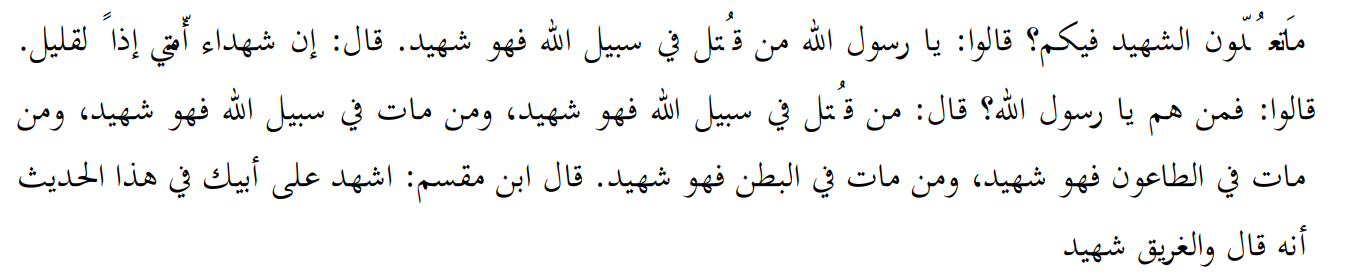
"Wa ku ke ɗaukar wane ne shahidi a cikinku?" Suka ce: Ya Manzon Allah, wanda aka kashe a hanyar Allah shahidi ne. Ya ce: To, shuhadan al'ummata za su zama kaɗan. Suka ce: To su wane ne, ya Manzon Allah? Ya ce: Wanda aka kashe a hanyar Allah shahidi ne, wanda ya mutu a hanyar Allah shahidi ne, wanda aka kashe ta annoba shahidi ne, wanda aka kashe saboda ciki shahidi ne (Ibn Muqsim ya ce: Ina shaida a kan mahaifinka a cikin wannan hadisi cewa ya ce) kuma wanda ya nutse a ruwa shahidi ne.
“Whom do you consider a shaheed among you? They said: O Messenger of Allah, the one killed in the way of Allah is a shaheed. He said: Then the shuhadaa among my Ummah would be few. They said: Then who are they, O Messenger of Allah? He said: The one killed in the way of Allah is a shaheed, the one who dies in the way of Allah is a shaheed, the one killed in pestilence is a shaheed, the one killed due to the stomach is a shaheed (ibn Muqsim said: I testify that upon your father in this hadith that he said) and the drowned person is a shaheed.”
Ma'anar waɗannan shahidai ita ce: suna da ladan shahidai a Lahira; amma a duniya kuwa, ana yi musu wanka, ana kuma yi musu sallah. Idan aka faɗi kalmar "shahidi" dangane da lada da hadisin da ya zo game da hakan, to daidai ne a yi ƙarin bayani ga waɗannan mutane. Amma idan an yi amfani da kalmar "shahidi" ba tare da takaitawa ba, babu wani abin da ke nuna ta, to ba a ɗauke ta a matsayin tana nufin waɗannan mutane ba, sai dai tana nufin waɗanda aka kashe a tafarkin Allah kawai.
The meaning of these shuhadaa is that there is for them in the Akhirah the reward of the shuhadaa; as for this world, they are washed and prayed over. When the word “shaheed” is said in connection with reward and the hadith about that, it is correct to generalize it to these (persons). However, if the word “shaheed” is used in an unrestricted manner without any connotation, then it is not taken to denote these (persons) but rather to denote only those killed in the way of Allah.
Shahidin duniya, ba lahira ba, shi ne wanda ya ɗauki hukuncin shahidin duniya, dangane da cewa ba a yi masa wanka ba, ba kuma a yi masa salla ba, sai dai a binne shi cikin tufafinsa. Sai dai shi ba ya samun a lahira ladan shahidin da ya yi yaƙi don ɗaukaka kalmar Allah (SWT). Wannan shi ne wanda ya yi yaƙi ba a hanyar Allah ba, kamar yaƙi don neman suna kawai ko don ganima, ko kuma yayin da yake ja da baya. Wannan saboda hadisai sun ƙayyade ladan shahidi ga wanda ya yi shahada a hanyar Allah (SWT), kuma wanda ya yi yaƙi yana gaba, ba yana ja da baya ba. Muslim ne ya ruwaito shi daga Abu Musa al-Ash'ari.
As for the shaheed of the world not the Akhirah, he is the one who takes the rules of the shaheed of the world in so far as he is not washed nor prayed over but rather buried in his clothes. However he does not take in the Akhirah the reward of the shaheed who fought to raise the word of Allah the highest. This is the one who fights in other than the way of Allah such as fighting for fame or booty alone or while retreating. This is because the ahadith specified the shaheed’s reward for the shaheed who fights in the way of Allah (swt), and the one fighting advancing not retreating. Muslim narrated from Abu Musa al-Ash’ari
Cewa wani mutum ya zo wurin Annabi ﷺ ya ce: Ya Manzon Allah, mutumin da yake yaƙi don ganima, mutumin da yake yaƙi don a ambace shi, da kuma mutumin da yake yaƙi don a ga matsayinsa, wane ne yake cikin hanyar Allah? Manzon Allah ﷺ ya ce: "Wanda yake yaƙi domin kalmar Allah ta zama mafi ɗaukaka, shi ne yake cikin hanyar Allah."
“That a man came to the Prophet (saw) and said: O Messenger of Allah, the man who fights for booty, the man who fights to be mentioned and the man who fights so that his rank is seen. Which one is in the way of Allah? The Messenger of Allah (saw) said: ‘The one who fights so that the word of Allah be highest is the one in the way of Allah.”
Muslim ya ruwaito daga Abu Musa
Muslim narrated from Abu Musa
Manzon Allah ﷺ aka tambaye shi game da mutumin da yake yaƙi don nuna jarumtaka, da wanda yake yaƙi saboda fushi, da wanda yake yaƙi don nuna wa mutane (cikin riya). Manzon Allah ﷺ ya ce: Wanda yake yaƙi don kalmar Allah ta zama mafi girma, shi ne yake cikin hanyar Allah.
“The Messenger of Allah (saw) was asked about the man who fights (to show his) courage, the one who fights out of anger, and the one who fights to show off (hypocritically). The Messenger of Allah (saw) said: The one who fights so that the word of Allah is highest is in the way of Allah.”
Manzon Allah ya sanya sharadi ga shahidi samun gafarar zunubansa cewa ya yi yaƙi yana ci gaba, ba yana ja da baya ba. Muslim ya ruwaito daga Abdullah bin Abi Qatadah, daga Qatadah, cewa ya ji ana ruwaitowa daga Manzon Allah ﷺ.
The Messenger made a condition of the shaheed being forgiven his sins that he fights advancing not retreating. Muslim narrated from Abdullah bin Abi Qatadah from Qatadah that he heard it being narrated from the Messenger of Allah
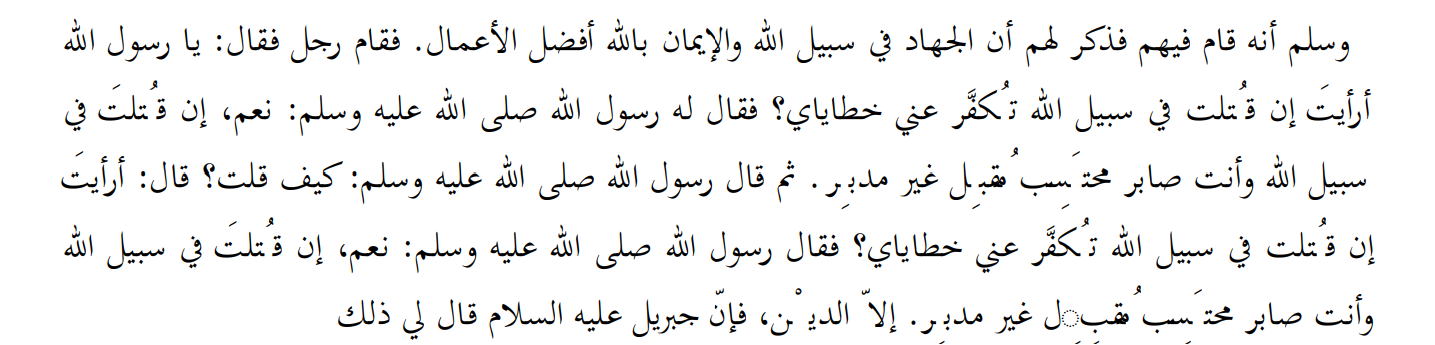
"Cewa ya tsaya a cikinsu yana tunatarwa cewa jihadi a hanyar Allah da imani mai ƙarfi ga Allah sune ayyuka mafi kyau. Sai wani mutum ya tashi ya ce: Ya Manzon Allah, kana ganin idan na yi yaki a hanyar Allah, za a gafarta mini dukan kuskurena? Manzon Allah ﷺ ya ce masa: Eh, idan ka yi yaki a hanyar Allah kana mai haƙuri, mai fatan lada, mai ci gaba ba mai juyawa baya ba. Sai Manzon Allah ﷺ ya ce: Me ka ce? Ya ce: Kana ganin idan na yi yaki a hanyar Allah, za a gafarta mini dukan zunubaina? Manzon Allah ﷺ ya ce masa: Eh, idan kana mai haƙuri, mai fatan lada, mai ci gaba ba mai juyawa baya ba, sai dai bashi, kamar yadda Jibril (AS) ya gaya mini haka."
“That he stood among them and reminded them that jihad in the way of Allah and decisive belief in Allah is the best deeds. So a man stood up and said: O Messenger of Allah, do you see that if I fought in the way of Allah that all my errors would be forgiven? The Messenger of Allah (saw) said to him: Yes, if you fought in the way of Allah and you are patient, hopeful, advancing and not retreating. Then the Messenger of Allah (saw) said: What did you say? He said: Do you see that if I fought in the way of Allah that all my sins would be forgiven? The Messenger of Allah (saw) said: Yes, if you are patient, hopeful, advancing and not retreating except for debts as Jibril (AS) told me that.”
Fahimtar wannan ita ce cewa sha'anin mayaƙin da ya janye baya ba a gafarta masa zunubansa ba, kuma ba ya samun ladan shahada. Game da wanda ya yi yaƙi don neman suna, Manzon Allah ﷺ ya bayyana cewa za a azabtar da shi, duk da haka ya kira shi shahīd. Muslim ya ruwaito daga Sulaiman bin Yasar, wanda ya ce: Mutane sun warwatse a kewayen Abu Hurairah (ra), sai Natil, wanda yake daga mutanen Sham, ya ce masa: "Ya Shaikh, ka ba mu labarin wani hadisi da ka ji daga Manzon Allah ﷺ." Sai ya ce: "Eh, na ji Manzon Allah ﷺ yana cewa:"
The understanding of this is that the retreating fighter’s sins are not forgiven nor does he have the reward of the shaheed. As for the one fighting for fame, the Messenger (saw) clarified that he would be punished and (yet) called him shaheed. Muslim narrated from Sulayman bin Yasar who said: People dispersed about Abu Hurairah (ra) and Natil who was from the people of Sham said to him: O Sheikh related to us a hadith you heard from the Messenger of Allah (saw). He said: Yes, I heard the Messenger of Allah (saw) saying:
"Lalle ne mutum na farko da za a yi wa hukunci a Ranar Alkiyama shi ne wanda aka kashe a matsayin shahīd. Sai a kawo shi gaban Allah (SWT), Shi kuwa Ya sanar da shi ni'imomin Allah, shi kuma ya amince da su. Sai Ya ce: Me ka aikata da su? Sai ya amsa: Na yi yaƙi dominka har sai da aka kashe ni a matsayin shahīd. Sai Ya ce: Kai ka yi ƙarya. Hakika ka yi yaƙi ne don a ce: 'Shi jarumi ne,' kuma an ce haka. Sannan Ya umarci a kan sa, sai a ja shi a fuskarsa har a jefa shi cikin Wuta."
“Verily the first person(s) to be judged on the Day of Judgement is a man who was killed as a shaheed. He is brought to Him (Allah) and He informs him of the bounties (of Allah) and he acknowledges them. He (swt) says: What did you do with them? He answers: I fought for you until I was killed as a shaheed. He says: You lied. Rather you fought so that it be said ‘(he is) brave’ and it has been said. Then He commands regarding him and he is dragged upon his face until he is thrown into the Fire”
Har zuwa ƙarshen hadisin. Wannan yana nuna cewa wanda aka kashe saboda neman suna, koda yana karɓar hukunce-hukuncen shahid a duniya, ba zai samu ladan shahid ba a Ranar Alƙiyama, a maimakon haka za a azabtar da shi.
Till the end of the hadith. This indicates that the one killed for fame, even if he takes the rules of the shaheed in this world, will not gain the reward of the shaheed on the Day of Judgement but would be punished.
Shahidin duniya da lahira kuwa shi ne wanda ya yi yaƙi da kafirai don ɗaukaka kalmar Allah, kuma aka kashe shi a filin yaƙi tsakanin Musulmi da kafirai, ko yaƙin ya kasance a ƙasar yaƙi ne ko a ƙasar Musulunci. Allah (SWT) ya ce:
As for the shaheed of the world and the Akhirah, he is the one who fights the disbelievers to raise the word of Allah and was killed in the battle (field) between Muslims and disbelievers, whether the fighting was in the land of war or the Islamic land. Allah (swt) said:
Kada ku yi tunanin cewa waɗanda aka kashe a hanyar Allah matattu ne. A'a, suna raye suna samun arziƙi a wajen Ubangijinsu.
“Do not think that those killed in the way of Allah are dead. Rather they are alive and receiving sustenance before their Lord” [TMQ 3:169].
Wannan shahidi shi ne wanda hukunce-hukuncen Shari'a suka zo game da haƙƙoƙinsa. An keɓe shi da kasancewa wanda aka kashe a yaƙi da kafirai; haka kuma wanda aka ji rauni a fagen yaƙi sannan ya mutu sakamakon raunin da ya samu a fagen yaƙi, shi ma ana ɗaukarsa kamar wanda aka kashe a fagen yaƙi. Amma banda waɗannan, ba a ɗaukarsu shahidai. Saboda haka, wanda aka kashe yayin faɗa da 'yan tawaye (bughat) ba a ɗaukarsa shahidi, haka ma wanda aka ji rauni a fagen yaƙi sannan ya warke daga raunin ya mutu saboda shi. Shahidin da yake da hukunce-hukunce na musamman, kuma wanda Allah ya faɗi cewa yana raye, an keɓe shi ga wanda aka kashe a fagen yaƙi da kafirai don ɗaukaka kalmar Allah, da kuma wanda aka ji wa rauni a fagen yaƙi sannan ya mutu sakamakon wannan raunin.
This shaheed is the one upon whose rights came in the Shari’ah rules. He is specified as the one killed in the war with disbelievers; similarly the one who was wounded in the battlefield then died of the wound he received in the battlefield is also considered like the one killed in the battlefield. As for other than these, they are not considered shaheed. Accordingly the one killed in fighting with rebels (bughat) is not considered shaheed nor the one wounded in the battlefield then recovered from the wound then died because of it. The shaheed who has specific rules, and the one about whom Allah stated that he is alive, is specified to the one killed in the battlefield with the disbelievers to raise the word of Allah and the one injured in the battlefield then died due to this wound.
Ka'idar wannan shahidi ita ce, ba a yi masa wanka ba, kuma ba a naɗe shi da kafan kabari ba; a maimakon haka, ana binne shi cikin jininsa da tufafinsa, domin shahidi zai tashi a Ranar Alƙiyama da ƙamshin jininsa kamar ƙamshin miski mafi daɗin ƙamshi. Dangane da rashin yi wa shahidi wanka kuwa, wannan yana bisa abin da Al-Bukhari ya ruwaito daga Jabir, wanda ya ce:
The rule of this mentioned shaheed is that he is neither washed nor shrouded in burial shrouds; rather he is buried in his blood and clothes because the shaheed is resurrected on the Day of Judgement with the smell of his blood like the sweetest-smelling musk. As for not washing the shaheed, this is due to what Al-Bukhari narrated from Jabir who said:
Manzon Allah ﷺ yana tattara maza biyu daga cikin waɗanda aka kashe a Uhud a cikin zane guda, sannan ya ce: "Wane daga cikinsu ne ya fi sanin Alqur'ani?" Idan aka nuna masa ɗaya daga cikin biyun, sai ya gabatar da shi a cikin ramin kabari (lihd) ya ce: "Ni ne shaida a kan waɗannan." Ya umarta a binne su da jininsu, kuma bai yi musu sallah ba, bai kuma yi musu wanka ba.
“The Messenger of Allah (saw) would collect two men of those killed in Uhud in one cloth, and then he would say: Which one of them knew more of the Qur’an? If one of the two was indicated to him, he brought him forward in the grave-niche (lihd) and said: I am a witness over these. He commanded their burial with their blood and did not pray over them nor wash them.”
Kuma Ahmad (ya ruwaito) cewa Annabi ﷺ ya ce game da waɗanda aka kashe a yakin Uhud:
And Ahmad (narrated) that the Prophet (saw) said about those killed in Uhud:
"Kada ku yi musu wanka, domin kowane rauni ko (kowane digon) jini zai watsa kamshin miski a Ranar Alkiyama, kuma bai yi musu sallah ba."
“Do not wash them because each wound or (each drop of) blood will diffuse musk on the Day of Judgement and he did not pray over them.”
An rawaito cewa Annabi ﷺ ya ce game da waɗanda aka kashe a Uhudu:
It is narrated that the Prophet (saw) said about those killed in Uhud:
"Ku naɗe su da jininsu, kada ku wanke su, domin babu wani rauni da aka ji a hanyar Allah sai dai zai zo ranar Alƙiyama yana zuba jini daga jijiyarsa, launinsa launin jini ne, kuma ƙamshinsa ƙamshin miski ne."
“Cover them in their blood and do not wash them as there is no wound wounded in the way of Allah save that it will come on the Day of Judgement with its jugular vein flowing blood whose colour is the colour of blood and the odour is the odour of musk.”
An Anas ya ruwaito
It has been narrated from Anas
Cewa Annabi ﷺ bai yi wa waɗanda aka kashe a Uhudu salla ba, kuma bai yi musu salla ba.
“That the Prophet (saw) did not pray over those killed in Uhud or pray over them.”
Kamar yadda bai yi wa waɗanda aka kashe a Uhud wanka ba, haka nan bai yi wa shahidan Badar wanka ba; sannan haka nan bai yi wa shahidan Khandaq da Khaibar wanka ba. Don haka ya bayyana cewa ba a yin wa shahidi wanka. Haka nan ba a naɗe shahidi a cikin kafanin da ake naɗe mamaci da shi ba; a maimakon haka ana naɗe shi a cikin tufafin da yake sanye da su, saboda maganar Manzon Allah ﷺ game da waɗanda aka kashe a Uhud.
Just as he did not wash those killed in Uhud, he did not wash the shuhadaa of Badr; similarly he did not wash the shuhadaa of Khandaq and Khayber. So it became clear that the shaheed is not washed. Similarly the shaheed is not enshrouded as the dead person is shrouded; rather he is shrouded in the clothes that he has due to the Messenger of Allah (saw)’s statement about those killed in Uhud:
"Ku lulluɓe su da raunukansu da jininsu" (Ahmad ne ya ruwaito shi)
“Cover them in their wounds and blood” (narrated by Ahmad)
Kuma saboda abin da Ibn Abbas (ra) ya ruwaito
And also due to what ibn Abbas (ra) narrated
Cewa Manzon Allah ﷺ ya umarta game da waɗanda aka kashe a Uhudu cewa a cire daga jikinsu ƙarfe da fatu, kuma a binne su tare da jinin su da tufafinsu (wanda Abu Dawud ya riwaito).
“That the Messenger of Allah (saw) commanded about those killed in Uhud that the iron and skins be removed from them and that they be buried with their blood and clothes” (narrated by Abu Dawud).
Game da sallah a kan shahīd, an halatta a yi musu sallah, kuma an halatta a bar yin musu sallah. Game da halascin yin sallah a kansu, hakan yana bisa ga hadisan da suka zo cewa Manzon Allah ﷺ ya yi sallah a kan wadanda aka kashe a Uhudu bayan an binne su, kuma ya yi sallah a kan Hamza da wani mutum da aka kashe a fagen yaki. A cikin Al-Bukhari an rawaito daga Uqbah bin ‘Amir
As for the prayer over the shaheed, it is allowed to pray over them and it is allowed not to pray over them. As for the permissibility of prayer over them, this is due to the narrations which came that the Messenger (saw) prayed over those killed in Uhud after their burial and prayed over Hamza and a man killed in the battlefield. In Al-Bukhari it is narrated from Uqbah bin ‘Amir
Ya yi salla a kan waɗanda aka kashe a Uhudu bayan shekara takwas, sallar jana'iza ta zama kamar bankwana ga waɗanda ke raye da waɗanda suka mutu. ﷺ
“He (saw) prayed over those killed in Uhud after eight years, the prayer over the dead was like a farewell to those alive and those dead.”
Kuma daga Abu Dawud daga Malik al-Ghiffari
And from Abu Dawud from Malik al-Ghiffari
Ya yi salla a kan waɗanda aka kashe a Uhudu a rukunin mutum goma-goma, tare da Hamza a cikin kowane goma, har ya yi sallar sau saba'in a kansa ﷺ. Wait, correcting per the rules: ﷺ should appear once after the Prophet's mention, and "(saw)" must be replaced by ﷺ, not kept. The correct output is: Ya yi salla a kan waɗanda aka kashe a Uhudu a rukunin mutum goma-goma, tare da Hamza a cikin kowane goma, har ya yi sallar sau saba'in a kansa ﷺ.
“He (saw) prayed over those killed in Uhud in groups of ten with Hamza in each ten until he prayed seventy times over him.”
Abu Dawud ya ruwaito daga Abu Salim, daga wani mutum na cikin Sahabban Annabi ﷺ wanda ya ce:
Abu Dawud narrated from Abu Salim from a man of the Prophet (saw)’s Sahabah who said:

"Mun kai musu hari ba zato ba tsammani kan wata kabila daga Juhainah. Wani mutum daga cikin Musulmai ya nemi wani mutum daga cikinsu domin ya buge shi, amma ya yi kuskure, sai ya buge kansa. Manzon Allah ﷺ ya ce: "Dan'uwanku ne, ya ku jama'ar Musulmai." Sai mutane suka yi gaggawa, suka same shi ya mutu. Manzon Allah ﷺ ya lulluɓe shi da tufafinsa da jininsa, ya yi masa salla, ya kuma binne shi. Suka ce: "Shin shahidi ne?" Ya ce: "Eh, kuma ni ne shaida a kansa."
“We attacked by surprise a tribe from Juhainah. A man of the Muslims sought a man of them to strike him, but he missed and struck himself. The Messenger of Allah (saw) said: Your brother, O community of Muslims so the people hastened and found him dead. The Messenger of Allah (saw) covered him in his clothes and blood, prayed over him and buried him. They said: Is he a shaheed? He said: Yes, and I am a witness for him.”
“Mun kai musu hari ba zato ba tsammani kan wata kabila daga Juhainah. Wani mutum daga cikin Musulmai ya nemi wani mutum daga cikinsu domin ya buge shi, amma ya yi kuskure ya buge kansa. Manzon Allah ﷺ ya ce: "Ɗan'uwanku ne, ya ku jama'ar Musulmai." Sai mutane suka yi gaggawa, suka same shi ya riga mu gidan gaskiya. Manzon Allah ﷺ ya naɗe shi cikin tufafinsa da jininsa, ya yi masa salla, ya binne shi. Suka ce: "Shin shahidi ne?" Ya ce: "Eh, ni kuma shaida ce a kansa."”
“We attacked by surprise a tribe from Juhainah. A man of the Muslims sought a man of them to strike him, but he missed and struck himself. The Messenger of Allah (saw) said: Your brother, O community of Muslims so the people hastened and found him dead. The Messenger of Allah (saw) covered him in his clothes and blood, prayed over him and buried him. They said: Is he a shaheed? He said: Yes, and I am a witness for him.”
Cewa Annabi ﷺ bai yi sallah ga waɗanda aka kashe a Uhudu ba, kuma bai yi musu wanka ba.
“That the Prophet (saw) did not pray over those killed in Uhud or wash them.”
Kuma Ahmad ya ruwaito daga Anas
And Ahmad narrated from Anas
Shahidan Uhud ba a yi musu wanka ba. An binne su cikin tufafinsu, kuma ba a yi musu salla ba.
“The shuhadaa of Uhud were not washed. They were buried in their clothes and not prayed over.”
Al-Bukhari ya ruwaito daga Jabir bin Abdullah (ra) wanda ya ce:
Al-Bukhari narrated from Jabir bin Abdullah (ra) who said:

Manzon Allah ﷺ yana haɗa maza biyu daga cikin waɗanda aka kashe a yakin Uhudu, sannan yana cewa: Wane daga cikinsu ya fi haddace Alqur'ani? Idan aka nuna masa ɗaya daga cikin biyun, sai ya ba da umarnin a sa shi a gaba cikin ramin kabari, ya ce: Ni ne shaida a kan waɗannan a Ranar Alqiyama. Ya umarci a binne su cikin jininsu, kuma bai yi musu wanka ba, bai kuma yi musu sallah ba.
“The Prophet (saw) would combine between two men of those killed in Uhud then say: Which one of them memorized more of the Qur’an? When one of the two was indicated to him, he would bring him forward in the grave-niche and he said: I am the witness over these on the Day of Judgement, commanded their burial in their blood and did not wash them or pray over them.”
Waɗannan hadisai ingantattu ne, kuma suna da bayyananniyar ma'ana cewa ba a yi wa shahīd salla ba. Ash-Shāfi'ī ya amsa hadisin Ibn 'Abbās (ra) da abin da ya zo game da ma'anarsa dangane da yin salla ga waɗanda aka kashe a Uhudu kafin a binne su, inda ya ce: "Bayanin ya zo kamar na takamaiman mutane ne, duk da cewa mutawātir ya tabbata cewa Manzo bai yi wa waɗanda aka kashe a Uhudu salla ba." Duk waɗannan hadisai ingantattu ne, ko waɗanda aka ruwaito cewa Manzo (ﷺ) ya yi wa shuhadā' salla, ko waɗanda aka ruwaito cewa bai yi musu salla ba. Babu wata hanya da za a ƙi ɗayansu saboda rashin ingancinsa, domin dukansu suna cikin waɗanda ake amfani da su a matsayin hujja ta fuskar riwaya da ma'ana. Babu kuma hanyar da za a fifita ɗayansu a kan ɗayan, domin yana da nisa Sahabbai su manta da yin salla ga waɗannan shuhadā', haka kuma yana da nisa su bar wani abu da ya saɓa wa abin da aka tabbatar daga gare shi (ﷺ) na yin salla ga matattu. Don haka ta yaya za a fifita ɗaya a kan ɗaya? Haka kuma, ba daidai ba ne a ce salla a cikin hadisan da suka tabbatar da yin salla ga shahīd tana nufin addu'a, ta yadda maganarsa "ya yi salla" za a fassara ta da "ya yi addu'a." Ba za a iya cewa haka ba, domin ma'anonin Shari'a sun fi ma'anonin harshe fifiko, muddin babu wata alama da ke nuna wata ma'ana. Anan babu wata alama, saboda haka dole ne a ce ma'anar salla ita ce salla ta Shari'a ga matattu. Haka kuma, ba daidai ba ne a ce hadisan yin salla ga matattu sun soke hadisan rashin yin salla gare su, domin wanda yake cikinsu, wato yin salla ga waɗanda aka kashe a Uhudu bayan shekara takwas, an yi shi a makare fiye da dukan hadisan, kamar yadda ya zo a riwayar Ibn Hibbān.
These ahadith are established and of explicit indication that the shaheed is not prayed over. Ash Shafi’ responded to the hadith of ibn Abbas (ra) and what came of its meaning regarding praying over those killed in Uhud before their burial “that the information came as if it were specific ones in the face of mutawatirah that the Messenger did not pray over those killed in Uhud.” All these ahadith are established whether those narrated that the Messenger (saw) prayed over the shuhadaa or those narrated that he didn’t pray over them. There is no way to reject any of them due to their authenticity, and because they are of those used as proofs in narration and meaning. There is no way to outweigh one over the other as it is remote that the Sahabah forgot to pray over those shuhadaa, just as it is also remote for them to leave an issue which is opposite of what is established about him (saw) of praying over the dead. So how can one be outweighed over the other? Nor should one say that the prayer in the ahadith which established the prayer over the shaheed is the du’a so that his saying “prayed” means made du’a. One cannot say this since the Shari’ah realities precede the linguistic (realities) as long as there is no connotation. Here there is no connotation so it is inevitable that the meaning of prayer is the Shari’ah prayer over the dead. Nor should one say that the ahadith of praying over the dead abrogates the ahadith of not praying over them since one of them, which is the prayer over those killed in Uhud after eight years is prayed to later than all the ahadith since it came in the narration of ibn Hibban
Sai ya shiga gidansa, bai fita ba har Allah ya sa shi ya mutu.
“Then he entered his house and did not go out until Allah caused him to die.”
Ba za a ce haka ba, domin kasancewar hadisi na baya-bayan nan kadai ba ya isa alama ta nuna cewa an soke hukuncin farko ba; sai dai dole ne a sami wata alama ta daban da za a fahimci soke-hukuncin daga gare ta. A nan babu wata alama da take nuna haka, don haka babu soke-hukunci a cikinsa. Don haka dukkan riwayoyin suna nan a matsayin abin karɓa, kuma ana fahimtar su da cewa rashin yin sallah a kan shahīd halal ne. Ba a rawaito cewa Manzon Allah ﷺ ya yi sallah a kan waɗanda aka kashe a Badar, da Khandaq, ko Khaibar ba. Ana kuma fahimtar su da cewa idan mutum ya yi sallah a kan shahīd babu laifi a hakan, kuma ba a hana mutane yin sallah a kansu ba. Ana kiran shahīd da sunan shahīd (shaida) saboda Aljanna tana shaida masa ta hanyar nassin Alkur'ani a fili. Allah (SWT) ya ce:
One should not say that because the lateness of the hadith alone is not sufficient indication of abrogation; rather there must be another connotation from which abrogation is understood. Here no connotation is present so there is no abrogation in it. So all the narrations remain recognized and are taken to mean that not praying over the shaheed is allowed. It is not narrated that the Messenger (saw) prayed over those killed in Badr, Khandaq or Khayber. They are also taken to mean that if one prays over the shaheed there is nothing (wrong) in that and people are not prevented from praying over them. The shaheed is named shaheed (witness) as Paradise is witnessed for him by the explicit text of the Qur’an. Allah (swt) said:
Lalle Allah ya sayi daga muminai rayukansu da dukiyoyinsu a madadin Aljanna. Suna yaƙi a hanyar Allah, suna kashewa kuma ana kashe su. [TMQ 9:111]
“Verily Allah purchased from the believers there souls and wealth in return for paradise. They fight in the way of Allah, killing and being killed” [TMQ 9:111].
Muslim ya ruwaito daga Jabir wanda ya ce:
Muslim narrated from Jabir who said:
Wani mutum ya ce: Ina zan kasance, ya Manzon Allah, idan an kashe ni? Sai ya ce: A Aljanna. Sai ya jefar da dabino da ke hannunsa, ya yi yaki har aka kashe shi. Kuma a cikin hadisin Suwaid, wani mutum ya ce wa Annabi ﷺ a ranar Uhudu.
“A man said: Where am I, O Messenger of Allah, if I am killed? He said: In Paradise. So he threw the dates that were in his hands and fought until he was killed and in the hadith of Suwaid. A man said to the Prophet (saw) on the day of Uhud.”
An rawaito daga Anas bin Malik (RA) cewa Manzon Allah ﷺ ya tafi tare da Sahabbansa har suka riga mushrikai zuwa Badr. Mushrikan suka zo, sai Manzon Allah ﷺ ya ce:
It is narrated from Anas bin Malik (ra) that the Messenger of Allah (saw) went with his Sahabah until they preceded the polytheists to Badr. The polytheists came and the Messenger of Allah (saw) said:
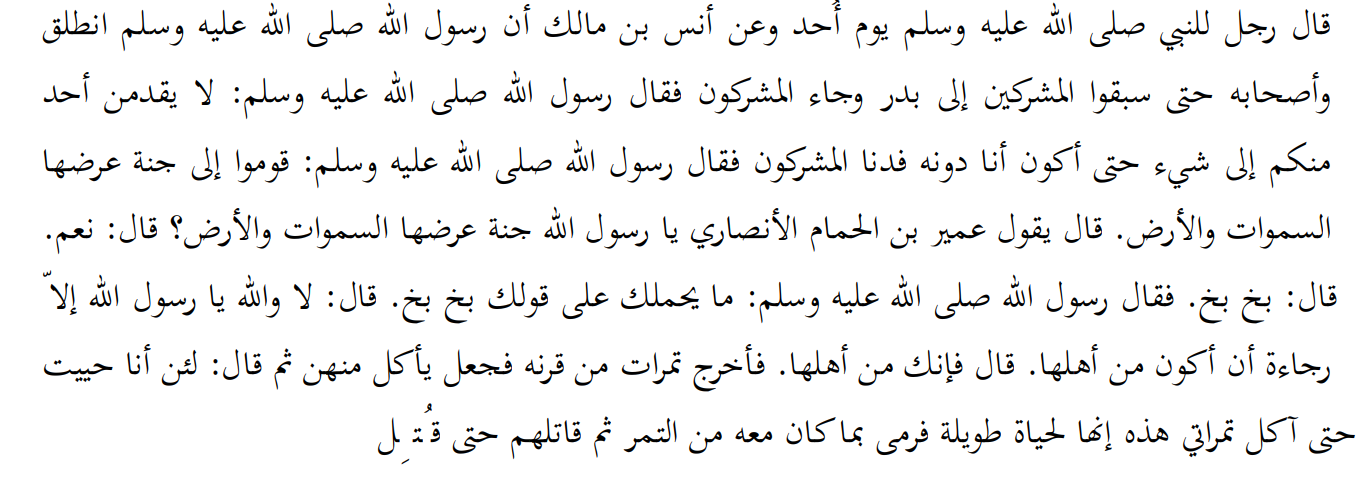
“Kada ɗayanku ya riga wani zuwa wani abu ba tare da izinina ba. Mushrikai suka matso, sai Manzon Allah ﷺ ya ce: Ku tashi zuwa Aljanna wadda fadinta yake kamar sammai da ƙasa. Ya ce: ‘Umairu ɗan al-Hammam al-Ansari ya ce: Ya Manzon Allah, Aljanna wadda fadinta yake kamar sammai da ƙasa? Sai ya ce: (Bakh! Bakh!). Sai Manzon Allah ﷺ ya ce: Me ya sa ka ce (Bakh! Bakh!)? Ya ce: Ba komai, na rantse da Allah, sai dai fatan cewa ni ma in zama ɗaya daga cikin mutanenta. Ya ce: Lallai kai ɗaya ne daga cikin mutanenta. Sai ya fitar da dabino daga cikin jakarsa ya fara ci daga cikinsa. Sannan ya ce: Idan na rayu har na ci waɗannan dabinon, to, rayuwa ta yi tsawo! Sai ya jefar da dabinon da ke hannunsa ya yi yaƙi har sai da aka kashe shi.” (Muslim ne ya rawaito shi).
“Let none of you precede to anything without my being. The polytheists came close so the Messenger of Allah (saw) said: Stand forth to a Paradise whose breadth is that of the heavens and the earth. He said: ‘Umayr bin al-Hammam al-Ansari said: O Messenger of Allah, a Paradise whose breadth is that of the heavens of the earth? He said: (Bakh! Bakh!). So the Messenger of Allah (saw) said: What carried you to your statement, (Bakh! Bakh!). He said: Nothing, by Allah, except the hope that I be one of its people. He said: Verily you are one of its people. He removed dates from his (qaran) and began eating from them. Then he said: If I were to live until I ate these dates, it would then be a long life! He threw the dates that had then fought them until he was killed” (Narrated by Muslim).
Don haka Allah (SWT) da Manzon Allah ﷺ sun shaida Aljannah ga shahid. Dangane da rayuwar shahid kuwa, an tabbatar da ita ta bayyanannen nassin Alqur'ani. Allah (SWT) ya ce:
So Allah (swt) and the Messenger of Allah (saw) have witnessed the Paradise for the shaheed. As for the life of the shaheed, it is established by the explicit text of the Qur’an. Allah (swt) said:
Kada ku yi tunanin cewa waɗanda aka kashe a hanyar Allah sun mutu, a'a, suna raye a wurin Ubangijinsu suna samun arziki. Suna farin ciki da abin da Allah ya ba su na falalarSa, kuma suna yi wa waɗanda suke baya, waɗanda ba su riske su ba, bushara cewa babu tsoro a kansu, kuma ba za su yi baƙin ciki ba. Suna samun bushara ta ni'ima daga Allah da falalarSa, kuma haƙiƙa Allah ba ya tozarta ladan masu bangaskiya.
“Do not think that those killed in the way of Allah are dead, rather (they are) alive with sustenance before their Lord. Pleased with what Allah gave them of His favours and with good tidings for those behind them who have not met them, that there is no fear for them nor do they grieve. They have glad tidings of blessings from Allah and His favour, and verily Allah does not cause the reward of the believers to be lost” [TMQ 3:169].
Wannan rayuwar shahidai ba ta ganuwa ce wadda ba mu fahimta ba, kuma ba mu iya hango ta yadda take a gidan dawwama. Duk da cewa ba mu fahimci wannan ɓoyayyiyar rayuwa ba, kuma ba mu iya hango ta ba, amma muna imani da kasancewarta, sai dai ba mu fahimci hakikanin abin da take ba. Imaninmu da kasancewarta al'amari ne wanda babu makawa, domin an tabbatar da shi ta hanyar nassin Alkur'ani bayyananne. Allah (SWT) ya ce:
This life for the shuhadaa is unseen which we do not understand nor perceive as it is in the eternal abode. Although we do not understand this hidden life nor perceive it, nevertheless we believe in its existence but do not understand its reality. Our conviction in its existence is an inevitable matter as it is established by a definite Qur’anic text. Allah (swt) said:
"Kada ku ce game da waɗanda aka kashe a hanyar Allah cewa 'matattu ne'... A'a, suna raye, amma ba ku sani ba" {TMQ 2:154}.
“Do not say of those killed in the way of Allah (are) ‘dead’... Rather they are alive but you do not know” [TMQ 2:154].
Rayuwar shahidai na daga cikin al'amuran gaibi wadanda imani da su wajibi ne. Game da falalar shahidai kuwa, falala ce mai girma wadda babu wata makamancinta, kuma Manzon Allah ﷺ ya bayyana ta a cikin hadisai da dama. Al-Bukhari ya ruwaito daga Qatadah, wanda ya ce: Na ji Anas bin Malik (ra) yana ruwaitowa daga Manzon Allah ﷺ, wanda ya ce:
The life of the shuhadaa is from the unseen (matters) in which iman is obliged. As for the virtue of the shuhadaa, it is a great virtue without an equivalent and he (saw) clarified it in numerous ahadith. Al-Bukhari narrated from Qatadah who said: I heard Anas bin Malik (ra) from the Prophet (saw) who said:
Babu wanda zai shiga Aljannah da zai so ya koma duniya don ya samu duk abin da ke cikin duniya, sai dai shahidai, waɗanda za su so su koma duniya don a kashe su sau goma saboda abin girma (karamah) da suke gani.
“No one who enters Paradise would like to return to the world to obtain all that is upon the world except the shuhadaa who would wish to return to the world to be killed ten times due to what he sees of the honour (karamah).”
Kuma a cikin Al-Bukhari:
And in Al-Bukhari:
Al-Mughira bin Shu’bah ya ce: Annabinmu ﷺ ya sanar da mu saƙon Ubangijinmu cewa duk wanda aka kashe daga cikinmu zai shiga Aljanna. Sai Umar ya ce wa Annabi ﷺ: "Ashe ba matattunmu suna Aljanna, matattunsu kuma suna Wuta ba?" Ya ce: "Eh."
“Al-Mughira bin Shu’bah said that our Prophet (saw) informed us of the message of our Lord that whoever is killed among us goes to Paradise and Umar said to the Prophet (saw): ‘Are not our dead in Paradise and their dead in the Fire. He said: Yes.”
Kuma daga Abdullahi ɗan ‘Amr ɗan al-‘Aas, cewa Manzon Allah ﷺ ya ce:
And from Abdullah bin ‘Amru bin al-‘Aas that the Messenger of Allah (saw) said:
"Ana gafarta dukkan zunubban shahidi sai bashi" (Muslim ne ya ruwaito shi).
“All the shaheed’s sins are forgiven except the debt” (narrated by Muslim).
"Ana gafarta dukkan zunubban shahidi sai bashi" (Muslim ne ya ruwaito shi).
“All the shaheed’s sins are forgiven except the debt” (narrated by Muslim).
Duk wanda aka kashe a hanyar Allah, dukkan zunubansa ana gogewa, sai dai bashi.
“The one killed in the way of Allah has all his sins wiped out except the debt.”
Kuma Al-Bukhari da Muslim sun ruwaito daga Abu Hurairah (RA) daga Annabi ﷺ wanda ya ce:
And Al-Bukhari and Muslim narrated from Abu Hurairah (ra) from the Prophet (saw) who said:
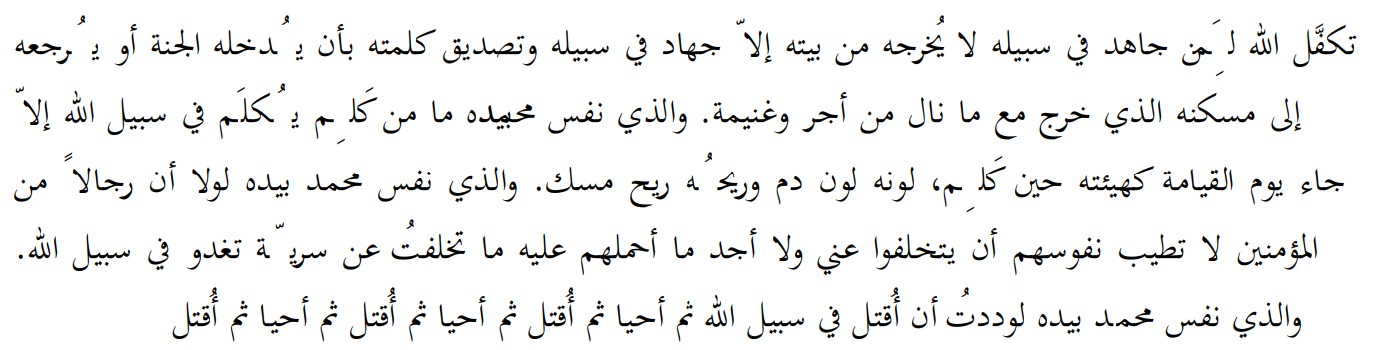
Allah ya ba da tabbacin tsaro ga wanda ya mutu yana yin jihadi a hanyar Allah, wanda bai bar gidansa ba don wani dalili face jihadi a hanyar Allah da kuma imani da maganganunSa, cewa zai shigar da shi Aljanna ko ya mayar da shi gidansa daga inda ya fita tare da abin da ya samu na lada ko ganima. Ina rantsuwa da Wanda rai na Muhammad ﷺ yana hannunSa, duk wanda aka ji masa rauni a hanyar Allah, ba zai zo ranar Alkiyama ba face kamar yadda yake a lokacin da aka ji masa rauni, launinsa launin jini ne, kamshinsa kamshin miski. Ina rantsuwa da Wanda rai na Muhammad ﷺ yana hannunSa, da ba don akwai mutane daga cikin muminai waɗanda rayukansu ba sa yarda su zauna a baya na (idan na tafi) ba, kuma ba na samun abin da zan hawan da su ba, da ban zauna a baya ba duk wata tawaga da ta fita a hanyar Allah da safe. Ina rantsuwa da Wanda rai na Muhammad ﷺ yana hannunSa, ina so in mutu a hanyar Allah, sannan a tashe ni, sannan a kashe ni, sannan a tashe ni, sannan a kashe ni, sannan a tashe ni, sannan a kashe ni.
“Allah guarantees security for the one who dies jihad in His way, not leaving his house for any other reason except jihad in His way and believing in His words, that He will enter him into Paradise or return him to his abode from which he left together with what he achieved of reward or booty. By the One in whose hand lies the should of Muhammad, whoever is wounded in the way of Allah will not come on the Day of Judgement except in his form when he was wounded, his colour the colour of blood and his odour the odour of musk. By the one in whose hand lies the soul of Muhammad, were it not that there were men among the believers whose souls are not pleased to stay behind me (when I go) nor do I find that could carry them upon, I would not stay behind any expedition that goes out in the way of Allah in the morning. By the One in whose hand lies the soul of Muhammad, I would love to die in the way of Allah then I am resurrected then killed, then resurrected then killed, then resurrected then killed.”