20. Jihad
20. Jihad
Jihad shi ne bayar da ƙoƙari wajen yaƙi a hanyar Allah (SWT), kai tsaye ko taimakawa da dukiya ko da ra'ayi ko ta ƙara yawan mayaƙa ko wata hanya banda haka. Yaƙi domin ɗaukaka kalmar Allah shi ne jihad. Dangane da jihad ta magana a hanyar Allah (SWT), wannan jihad ne idan maganar tana da alaƙa kai tsaye da yaƙi a hanyar Allah. Idan kuma ba ta da alaƙa kai tsaye da shi, to ba jihad ce ta Shari'a ba, koda kuwa tana ɗauke da wahala, koda kuwa sakamakonta yana amfanar ɗaukaka kalmar Allah (SWT). Wannan saboda jihad a Shari'a takamaimai ce ga yaƙi, don haka duk abin da yake da alaƙa kai tsaye da yaƙi yana shiga cikinta. Haka abin yake ga rubutu da magana; su jihad ne idan suna da alaƙa kai tsaye da yaƙi a hanyar Allah (SWT), kamar jawabi ga sojoji don ƙarfafa su su yi yaƙi kai tsaye, ko kalmomi da ke tada hankali kan yaƙar abokan gaba. Idan ba haka ba, ba jihad ba ce. Gwagwarmayar siyasa da tsawatarwa ga masu mulki ba a kiran su jihad, duk da cewa ladansu yana da girma da kuma amfaninsu ga Musulmai babba ne. Batun ba wahala ko amfani ba ne, a'a, batun ma'anar Shari'a ce wadda wannan kalma ta zo da ita. Ma'anar Shari'a ita ce yaƙi da duk abin da ke da alaƙa da shi daga ra'ayi, magana, rubutu, dabarun yaƙi da sauran abubuwa.
Jihad is expending (one’s) effort in fighting in the way of Allah (swt) directly or assisting by wealth or opinion or increasing numbers or other than that. The fighting to raise the word of Allah is jihad. As for jihad by speaking in the path of Allah (swt), this is jihad if the speech relates directly to fighting in the way of Allah. If it does not relate directly to it, it is not Shar’i jihad even if it involves difficulty and even if the results benefit in raising the word of Allah (swt). This is because jihad in Shar’a is specific to fighting, so there enters within it everything related directly to fighting. Similar to the opinion is writing and speaking; they are jihad if they are related directly to fighting in the way of Allah (swt) like the speech to the army to encourage it to fight directly or words inciting fighting the enemies. If not, this is not (jihad). Neither political struggle nor rebuking the rulers is termed jihad though their reward is high and their benefit to the Muslims great. The issue is neither difficulty nor the benefit, but rather it is the Shar’i meaning with which it came for this word. The Shari’ah meaning is fighting and all that it relates to from opinion, speech, writing, strategy and other things.
Dalilin jihadi ba shi ne jizyah ba, ko da yake muna dakatar da yakinsu idan sun amince da biyan jizyah. A maimakon haka, dalilin jihadi shi ne cewa wadanda muke yaki da su kafirai ne (kuffar) da suka ki karbar da'awah. Allah (SWT) ya ce:
The cause of jihad is not jizyah even though we stop (fighting) them when they accept the jizyah. Rather, the cause of jihad is that those whom we fight are disbelievers (kuffar) who rejected the da’wah. Allah (swt) said:
"Ku yaƙi waɗanda ba sa yin imani da Allah, ba kuma da Ranar Lahira, ba kuma sa haramta abin da Allah da Manzonsa suka haramta ba, ba kuma sa bin addinin gaskiya daga cikin Ahlul Kitab, har sai sun biya jizya da hannunsu alhali kuma suna ƙasƙantattu" [TMQ 9:29].
Fight those who do not believe in Allah nor the Last Day, nor forbid what Allah and His Messenger have forbidden, nor follow the deen of truth among the People of the Book until they pay the jizyah from their hands while they are humiliated” [TMQ 9:29].
Umurnin yaƙar su yana (saboda) siffarsu ta kafirci, watau ku yake su saboda ba su yin imani da Allah da Ranar Lahira, da sauransu. Don haka wannan siffantawa takaitawa ce, kuma a wannan matsayi ta zama dalili. Dalilin yaƙi shi ne kafirci. Ya zo a wata ayar kuma:
The command to fight them is (due to) their attribute of disbelief i.e. fight them because they do not believe in Allah and the Last Day etc. So this description is a restriction and at this point it becomes a cause. So the cause of fighting is disbelief. It came in another ayah:
"Ya ku waɗanda suka yi imani, ku yaƙi waɗanda suke kewaye da ku daga cikin kafirai (kusa da ku a yanki), kuma ku bar su su sami tsauri daga gare ku." [TMQ 9:123]
“O you who believe, fight those who encircle you (close to you geographically) of the disbelievers and let them find harshness in you” [TMQ 9:123]
To nan, umarnin yaƙi da su yana saboda sifar kafirci. Akwai ayoyi da yawa irin wannan, kamar:
So the command to fight them is due to the attribute of disbelief. There are many similar ayat such as:
"Yaƙi da abokan Shaiɗan" [TMQ 4:76]
“Fight the allies of Satan” [TMQ 4:76]
Da
And
"Ku yaƙi shugabannin kafirci" [TMQ 9:12]
“Fight the leaders of disbelief” [TMQ 9:12]
Da
And
"Ku yaƙi masu shirka gaba ɗaya" [TMQ 9:36]
“Fight the polytheists altogether” [TMQ 9:36]
Duk waɗannan ayoyin suna umartar yaƙi saboda wani sifa ta musamman wadda ita ce dalilin yaƙi, watau kafirci. Game da biyan jizyah kuwa, Alƙur'ani ya haɗa ta da wulakanci a matsayin dalilin dakatar da yaƙi, ba dalilin yaƙi ba. Daga nan ana fahimtar cewa dalilin jihadi shi ne kafirci. Idan waɗanda muke yaƙa sun karɓi da'awa, sai su zama Musulmi; idan sun ƙi karɓar Musulunci amma sun karɓi biyan jizyah kuma sun amince a yi musu mulki da Musulunci, to ana karɓar hakan daga gare su, kuma ba a yaƙe su ba, domin ba a halatta a tilasta musu karɓar Musulunci ba. Muddin sun amince a yi musu mulki da shi kuma suka biya jizyah, to sun miƙa wuya ga da'awar ko da ba su karɓi Musulunci ba. Saboda haka, ba a halatta a yaƙe su ba bayan sun amince a yi musu mulki da shi kuma suka biya jizyah. Sai dai idan sun amince su biya jizyah amma sun ƙi a yi musu mulki da Musulunci, to ba a halatta a karɓi hakan daga gare su ba, domin dalilin yaƙi wanda shi ne cewa su kafirai ne da suka ƙi karɓar da'awa yana nan daram, don haka yaƙe su ya kasance wajibi, wajibi wanda bai sauka daga wuyan Musulmi ba. As for yarjejeniyoyin gaggawa da Khalifa yake karɓar jizyah daga gare su yana barin su su yi wa kansu mulki da tsarin kafirci, saboda rashin cika sharuddan yanayin waje da na cikin gida a gare shi, to Shari'a ta ba da sassauci ga wannan yanayin gaggawa a cikin hali na larura, don haka ba a yi qiyasi a kansa ba. Saboda haka dalilin jihadi shi ne cewa waɗanda muke yaƙa kafirai ne da suka ƙi karɓar da'awa, kuma babu wani dalili na jihadi. Game da jizyah tare da wulakanci kasancewar dalilin dakatar da yaƙi, wannan yana kan Larabawa ne waɗanda ba masu shirka ba kawai. Su kuwa Larabawa masu shirka, ba a karɓa daga gare su sai Musulunci ko yaƙi, saboda faɗin Allah:
All these ayat command the fighting due to a specific attribute which is the cause of fighting i.e. disbelief. As for the payment of jizyah, the Qur’an combined it with humiliation as the cause of stopping the fighting not the cause of fighting. From here it is understood that the cause of jihad is disbelief. If those whom we fight accept the da’wah they become Muslims; if they refuse to accept Islam (but) accept to pay the jizyah and be ruled by Islam, it is accepted from them and they are not fought as it is not permitted to force them to accept Islam. As long as they accept to be ruled by it and pay the jizyah, they have submitted to the da’wah even if they have not accepted Islam. Accordingly, it is not allowed to fight them after they accept to be ruled by it and pay the jizyah. However, if they accept to pay the jizyah but refuse to be ruled by Islam, it is not allowed to accept this from them because the cause of fighting which is that they are disbelievers who have refused to accept the da’wah remains standing so fighting them remains obligatory, an obligation which has not fallen from the Muslims’ necks. As for the emergency treaties in which the Khalifah accepts from them the jizyah while leaving them to rule themselves by the system of disbelief, due to the absence of compliance of the external and internal circumstances for it, the Shar’a gave concession to this emergency situation in the situations of necessity so no analogy is done upon it. Therefore the cause of jihad is that those whom we fight are disbelievers who refused to accept the da’wah and there is no other cause for jihad. As for jizyah together with humiliation being a cause to stop fighting, this is only with non polytheist Arabs. As for polytheist Arabs, it is not accepted from them except Islam or fighting due to Allah’s statement:
"Za ku yi yaƙi da su, ko kuma su musulunta" [TMQ 48:16].
“You will fight them or they will become Muslims” [TMQ 48:16].
Jihad wajibi ne bisa ga nassi bayyananne daga Alkur'ani da Hadisi. Allah (SWT) ya ce:
Jihad is obligatory by the explicit text of the Qur’an and Hadith. Allah (swt) said:
"Ku yaƙe su har sai babu sauran (fitnah), addini kuma ya zama na Allah kaɗai." [TMQ 8:39]
“Fight them so that there remains no (fitnah) and the deen becomes only for Allah” [TMQ 8:39]
Kuma Ya ce (SWT):
And He (swt) said:
Ku yaƙi waɗanda ba su yi imani da Allah ba, ba kuma da Ranar Lahira ba, kuma ba sa haramta abin da Allah da ManzonSa suka haramta, ba kuma sa bin addinin gaskiya daga cikin Ahlul Kitab, har sai sun bayar da jizya da hannayensu alhali suna cikin wulakanci. [TMQ 9: 29 ]
“Fight those who don’t believe in Allah nor the Last Day, nor forbid what Allah and His Messenger have forbidden, nor follow the deen of truth among the People of the Book until they pay the jizyah from their hands while they are humiliated” [TMQ 9: 29 ]
Allah (SWT) ya ce:
And Allah (swt) said:
"Idan ba ku fita (domin jihadi) ba, zai azabta ku da azaba mai raɗaɗi" [TMQ 9: 39]
“If you do not go out (for jihad), He will punish you with a painful punishment” [TMQ 9: 39]
Kuma Ya ce (SWT):
And He (swt) said:
"Ya ku waɗanda suka yi imani, ku yaƙi waɗanda suke kewaye da ku daga cikin kafirai, kuma ku bar su su sami tsauri daga gare ku" [TMQ 9: 123].
“O you who believe, fight those who encircle you of the disbelievers and let them find harshness in you” [TMQ 9: 123].
An Ruwaito daga Anas (ra) wanda ya ce: "Manzon Allah ﷺ ya ce:
It is narrated from Anas (ra) who said: “The Messenger of Allah (saw) said:
"Ku yi jihadi a kan masu shirki da dukiyoyinku, da hannayenku, da harsunanku" (An-Nasa'i ne ya ruwaito).
“Fight the polytheists with your wealth, your hands and your tongues” (narrated by An-Nisai).
Haka kuma daga Anas, cewa Annabi ﷺ ya ce:
Also from Anas that the Prophet (saw) said:
"Lalle! Tafiya da safe ko da yamma don yin yaƙi a hanyar Allah ta fi duniya da abin da ke cikinta." (Al-Bukhari ne ya ruwaito shi).
“Verily! Setting out in the early morning or in the evening in order to fight in Allah's way is better than the world and what it contains.” (narrated by Al-Bukhari).
Ya kuma ruwaito cewa ya ce: ﷺ
He also narrated that he (saw) said:
"An umurce ni da in yi yaki da mutane har sai sun ce: 'Babu abin bautawa da gaskiya sai Allah.'"
“I was commanded to fight the people until they say ‘There is no god but Allah”
Imam Ahmad da Abu Dawud sun ruwaito daga Anas, wanda ya ce: Manzon Allah ﷺ ya ce:
Imam Ahmad and Abu Dawud narrated from Anas who said: The Messenger of Allah (saw) said:
"…jihadi zai ci gaba da kasancewa tun ranar da Allah ya aiko ni a matsayin annabi har zuwa ranar da na karshe daga cikin al'ummata zai yaƙi Dajjal (Al-Masihu Dajjal). Zalunci na kowane azzalumi da adalcin kowane mai adalci (mai mulki) ba za su ɓata shi ba."
“…jihad will be performed continuously since the day Allah sent me as a prophet until the day the last member of my community will fight with the Dajjal (Antichrist). The tyranny of any tyrant and the justice of any just (ruler) will not invalidate it.”
An ruwaito daga Zaid bin Khalid cewa: Manzon Allah ﷺ ya ce:
It has been narrated from Zayd bin Khalid who said: The Messenger of Allah (saw) said:
"Duk wanda ya shirya jarumi a hanyar Allah, to ya yi yaƙi, kuma duk wanda ya kula da iyalinsa da alheri (khayr) bayansa, to ya yi yaƙi" (Ahmad ya ruwaito shi).
“Whoever prepares a warrior in the way of Allah has (also) fought, and whoever takes care of his family in goodness (khayr) after him has (also) fought” (narrated by Ahmad).
An ce: Ya Manzon Allah, wane ne mafi alheri daga cikin mutane? Sai Manzon Allah ﷺ ya ce: "Mumini wanda yake yin jihadi a hanyar Allah da jikinsa da dukiyarsa." (Al-Bukhari ne ya ruwaito shi).
“It was said: O Messenger of Allah, which of the people is better? The Messenger of Allah (saw) said: ‘A believer who does jihad in the way of Allah by his body and wealth” (narrated by Al-Bukhari).
Kuma ya ce ﷺ:
And he (saw) said:
Duk wanda ya mutu ba tare da yaƙi ba, kuma ransa bai taɓa tunanin yaƙi ba, to ya mutu a kan reshe na munafunci.
“Whoever dies without fighting or his soul thinking of fighting has died upon a branch of hypocrisy.”
An rawaito daga Abi Awfa (ra) cewa Manzon Allah ﷺ ya ce:
It has been narrated from Abi Awfa (ra) that the Messenger of Allah (saw) said:
“Ku sani cewa Aljanna tana ƙarƙashin inuwar takubba” (Al-Bukhari ne ya ruwaito shi).
“Know that paradise is beneath the shade of swords” (narrated by Al-Bukhari).
An rawaito daga Abu Hurayra (ra) cewa ya ce:
It is narrated from Abu Hurayra (ra) who said:

Wani daga cikin Sahabban Manzon Allah ﷺ ya wuce ta wani kwari mai koguna na ruwan zaki a cikinsa, sai ya yi mamakin kyansa, sai ya ce: Me zai hana in rabu da mutane in zauna a cikin wannan kwarin? Amma ba zan taba yin hakan ba sai na nemi izinin Manzon Allah ﷺ. Sai ya ambaci hakan ga Manzon Allah ﷺ, shi kuma ya ce: Kada ka yi (haka), gama tsayuwar daya daga cikinku a hanyar Allah ta fi sallarsa a gidansa shekara saba'in.” (At-Tirmidhi ne ya ruwaito shi).
“One of the Sahabah of the Messenger of Allah (saw) passed by a ravine with rivers of sweet water in it and was astounded by its beauty, so he said: What if I separated from the people and stayed in this ravine? But I will never do it until I seek permission from the Messenger of Allah (saw) so he mentioned that to the Messenger of Allah who said: Do not do (so) for the standing of one of you in the way of Allah is better than his praying in his house for seventy years” (narrated by At-Tirmidhi).
Jihadi farali ne na kifaya a bangaren kai hari, kuma farali ne na kowane mutum (fard 'ayn) ga makiyin da ya kai wa mutane hari, yayin da ya zama farali na kifaya ga sauran mutane. Wajibcin ba ya sauka har sai an kori makiyin kuma an 'yantar da kasar Musulunci daga datti nasu. Ma'anar cewa jihadi farali ne na kifaya a bangaren kai hari shi ne, muna fara yaki da makiyi ko da su ba su fara yakar mu ba. Idan babu Musulmi da zai yi yakin kai hari a kowane lokaci, to za su yi zunubi saboda barin sa. Idan mutanen Masar suka yi jihadin kai hari, to wajibcin ya sauka daga kan mutanen Indonesia, domin akwai yakin hakika da Musulmi suke yi da kafirai masu yaki, don haka wajibcin jihadi ya tabbata. Amma idan yaki ya barke tsakanin Musulmi da kafirai amma kifaya ba ta tabbata ba saboda mutanen Masar kadai suna yakar kafirai, to wajibcin ba ya sauka daga kan mutanen Indiya da Indonesia ta hanyar aikin mutanen Masar da Iraki. Maimakon haka, wajibi ne a kan wanda yake kusa (da Musulmi) sannan wanda yake kusa da makiyi, har sai kifaya ta tabbata. Idan kifaya ba ta tabbata ba sai da dukkan Musulmi, to jihadi ya zama wajibi a kan dukkan Musulmi har sai an ci makiyi da karfi. Jihadi farali ne na kifaya idan Khalifa bai umarce shi da ya tafi ba. Amma wanda Khalifa ya umarce shi da ya shiga, to jihadi ya zama wajibi a kansa saboda fadin Allah:
Jihad is an obligation of sufficiency (fard kifayah) offensively, and an individual obligation (fard ‘ayn) against the enemy who attacks them while being a obligation of sufficiency upon the rest. The obligation does not fall until the enemy is expelled and the Islamic land liberated from their filth. The meaning of jihad being an obligation of sufficiency offensively is that we start fighting the enemy even if they do not start (fighting) us. If no Muslim performs the fighting offensively at any period then they will be sinful for leaving it. If the people of Egypt perform the offensive jihad then (its obligation) falls from the people of Indonesia, as there exists practical fighting by Muslims against belligerent disbelievers therefore the obligation of jihad has occurred. However if fighting broke out between Muslims and disbelievers but the sufficiency (kifayah) has not occurred by the people of Egypt fighting the disbelievers alone, then its obligation does not fall from the people of India and Indonesia by the performance of the people of Egypt and Iraq. Rather it is obligatory upon the nearest (Muslim) then the nearest to the enemy until sufficiency occurs; if sufficiency does not occur except with all the Muslims, then jihad becomes obligatory upon all the Muslims until the enemy is subdued. Jihad is an obligation of sufficiency (fard kifayah) if the Khalifah has not told him to advance; as for the one whom the Khalifah has told him to take part, then jihad has become obligatory upon him due to Allah’s statement:
"Ya ku waɗanda suka yi imani, me ya same ku da, idan aka ce muku: 'Ku fita a cikin hanyar Allah', sai ku manne da ƙasa?"
“O you who believe, what is wrong with you that when it is said: ‘Go forth in the way of Allah’ you hold firm to the earth”
Kuma maganarsa ﷺ:
And his (saw) statement:
"Kuma idan aka nemi ka ci gaba, to ka ci gaba." (Bukhari da Muslim ne suka ruwaito shi)
“And if you are asked to advance, then advance.” (Narrated by Bukhari & Muslim)
Ma'anar isharwa a cikin jihadi a cikin Daular Musulunci shi ne cewa za a samu mutane domin jihadi wadanda yakinsu ya isa; ko dai sojoji ne da akwai littattafan rajista (dawawin) dominsu kamar yadda lamarin ya kasance a zamanin Umar (ra), ko kuma sun shirya kansu domin jihadi da son rai kamar yadda lamarin ya kasance a zamanin Abu Bakr (ra). Iri daya ne ko na farko ne ko na baya ne ko kuma duk su biyu tare, muddin idan makiya suka kai hari a kansu suna iya kare kansu, don haka wajibi ne na isarwa a kansu. Idan ba su iya kare kansu ba, to sai Khalifa ya shirya wasu domin jihadi, haka dai har a ci gaba. Jihadin kai hari ba yana nufin mu fara yaki da makiya kai tsaye ba; a maimakon haka dole ne mu fara kiran su zuwa Musulunci.
The meaning of the sufficiency in jihad in the Islamic State is that there arise for jihad a people whose fighting is sufficient; whether they are an army for whom there are books of accounts (dawawin) for this as was the case in the time of Umar (ra), or they had prepared themselves for jihad freely as was the case in the time of Abu Bakr (ra). It is the same whether the first ones or the latter ones or both of them together such that if the enemy targets them they are able to defend so it is a obligation of sufficiency upon them. If they are unable to defend, then the Khalifah prepares others for jihad and so on. Offensive jihad does not mean that we initiate fighting the enemy directly; rather we must first call them to Islam.
Ba a halatta ga Musulmi su yi yaƙi da waɗanda da’watul Islam bai isa gare su ba; a maimakon haka, dole ne a fara kiran kafirai zuwa Musulunci. In sun ƙi, sai a nemi su biya jizyah; idan kuma sun ƙi, sai mu yi yaƙi da su. Muslim ya ruwaito daga Sulaiman bin Buraidah, daga mahaifinsa:
If is not allowed for Muslims to fight those whom the Islamic da’wah has not reached; rather, the disbelievers must first be called to Islam. If they reject, then they are asked to pay the jizyah; and if they reject, we fight them. Muslim narrated from Sulayman bin Buraydah from his father:
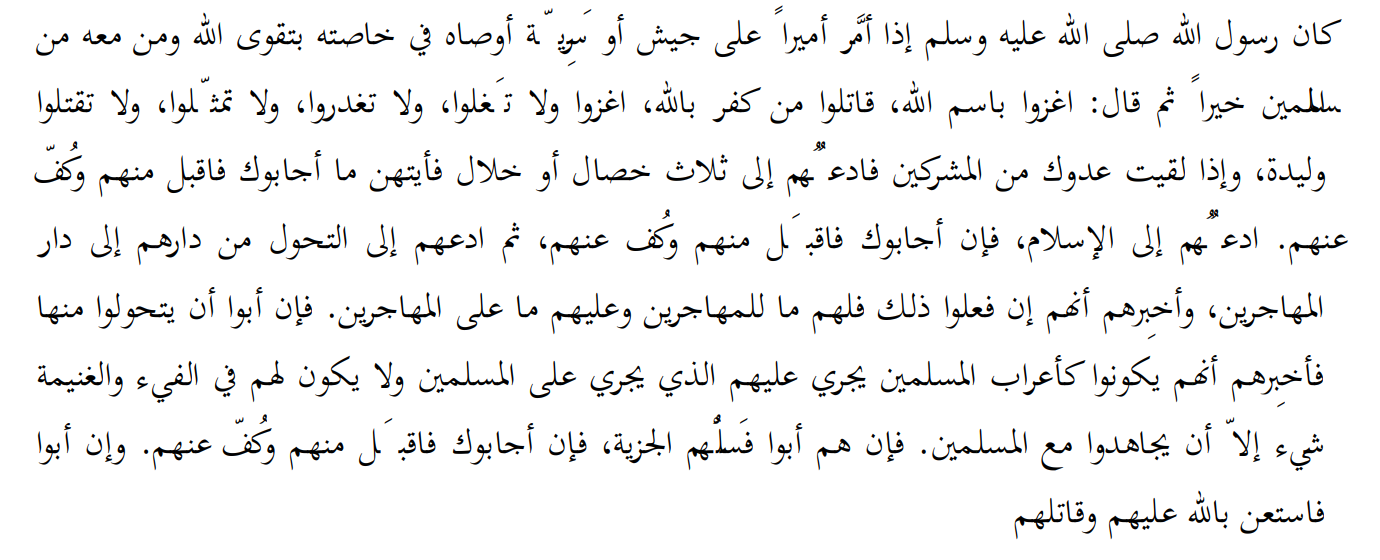
“Duk lokacin da ya naɗa wani mutum ya jagoranci rundunar yaƙi, Manzon Allah ﷺ yakan ba shi shawara musamman ya ji tsoron Allah, kuma ya kyautata wa Musulmi da ke tare da shi. Ya ce: ‘Ku yi yaƙi da sunan Allah da kuma saboda Allah. Ku yi yaƙi da waɗanda suka kafirta da Allah. Ku yi yaƙi, amma kada ku yi cin amana, kada ku yi sata daga cikin ganimar yaƙi, kada ku yanke jiki, kuma kada ku kashe yara. Idan kun haɗu da abokan gābanku daga cikin masu bautar gumaka, ku kira su zuwa ɗaya daga cikin abubuwa uku. Duk wanda suka amsa daga cikinsu, ku karɓa daga gare su, kuma ku daina yaƙar su. Ku kira su zuwa karɓar Musulunci, idan sun amsa, to ku karɓa daga gare su, kuma ku daina yaƙar su. Sa'an nan ku kira su su bar ƙasarsu su koma ƙasar masu bautar gumaka. Ku faɗa musu cewa idan suka yi haka, to za su sami haƙƙoƙi da wajibai iri ɗaya da na masu bautar gumaka. Idan suka ƙi, to ku faɗa musu cewa za su zama kamar Balarabe Musulmi (waɗanda ke zaune a hamada), waɗanda ke ƙarƙashin hukunce-hukuncen Allah iri ɗaya da masu bi. Amma ba za su sami rabo daga Fai’i ko ganimar yaƙi ba, sai dai idan sun yi yaƙi tare da Musulmi. Idan suka ƙi shiga Musulunci, to ku nemi su biya Jizya. Idan suka yi haka, to ku karɓa daga gare su, kuma ku daina yaƙar su. Amma idan suka ƙi, to ku nemi taimakon Allah a kansu, ku yaƙe su.’”
“Whenever he appointed a man to lead a military detachment, the Messenger of Allah (saw) would advise him especially to fear Allah and treat the Muslims with him well. He (saw) said: ‘Fight in the Name of Allah and in the cause of Allah. Fight those how disbelieve in Allah. Fight but do not be treacherous, do not steal from the spoils of war, do not mutilate and do not kill children. When you meet your enemy from among the polytheists, call them to one of three things. Whichever of them they respond to, accept it from them and refrain from fighting them. Invite them to accept Islam, and if they respond then accept it from them and refrain from fighting them. Then invite them to leave their land and move to the land of the polytheists. Tell them that if they do that, then they will have the same rights and duties as the polytheists. If they refuse, then tell them that they will be like the Muslim Bedouins (who live in the desert), subject to the same rulings of Allah as the believers. But they will have no share of Fay’ or war spoils, unless they fight alongside the Muslims. If they refuse to enter Islam, then ask them to pay the Poll-tax. If they do that, then accept it from them and refrain from fighting them. But if they refuse, then seek the help of Allah against them and fight them”
Daga Ibn Abbas (ra):
And from ibn Abbas (ra):
"Manzon Allah ﷺ bai taba yin yaƙi ba sai dai bayan ya kira su (zuwa Musulunci)" (Ahmad ne ya ruwaito shi).
“The Messenger of Allah (saw) never fought except that he invited them” (Narrated by Ahmad).
Kuma daga Furwat bin Maseek, wanda ya ce:
And from Furwat bin Maseek who said:
"Na ce wa Manzon Allah ﷺ, shin in yi yaƙi da waɗanda ke cikin mutanena da suke gaba (a kan) waɗanda daga cikinsu suke gudu? Ya ce: Eh. Lokacin da na juya don tafiya, sai ya kira ni ya ce: Kada ka yi yaƙi da su har sai ka kira su zuwa Musulunci."
“I said to the Messenger of Allah, should I fight with those of my people advancing (against) those of them fleeing? He said: Yes. When I turned (to go), he called me and said: Do not fight them until you invite them to Islam.”