17.8 Hanyar Nada Khalifah
17.8 The Method To Appoint The Khalifah
Lokacin da Shari'ah ta wajabta wa Al'ummah naɗa Khalifa, ta kuma bayyana hanyar da ake naɗa Khalifan. Wannan hanya tana da hujja daga Alƙur'ani, da Sunnah, da Ijma'in Sahabbai (ra), kuma wannan hanya ita ce bai'ah. Don haka naɗin Khalifa ana yinsa ne ta hanyar bai'ah a gare shi. Hujjar cewa wannan hanya ita ce bai'ah ta tabbata daga bai'ar Musulmi ga Annabi ﷺ, da kuma umarnin Annabi ﷺ a gare mu da mu yi wa Imam bai'ah. Bai'ar Musulmi ga Annabi ﷺ ba ta kasance a kan annabcinsa ba; a maimakon haka ta kasance a kan mulki, domin bai'a ce a kan aiki, ba bai'a a kan akida ba. Don haka an yi wa Annabi ﷺ bai'a a matsayinsa na shugaba, ba a matsayinsa na Annabi da Manzo ba. Domin amincewa da annabci da saƙo al'amari ne na akida, ba na bai'a ba, don haka bai'ar ba za ta kasance a gare shi ba face a matsayinsa na shugaban Dawla. An ambaci bai'a a cikin Alƙur'ani da hadisai. Allah (swt) ya ce:
When the Shari’ah made it obligatory upon the Ummah to appoint a Khalifah, it also defined the method by which the Khalifah is appointed. This method is proven by the Qur’an, the Sunnah and the Ijma’a of the Sahabah (ra), and this method is the bay’ah. So the appointment of the Khalifah is carried out by the bay’ah to him. The Proof that this method is the bay’ah is confirmed from the bay’ah of the Muslims to the Prophet (saw) and from the order of the Prophet (saw) for us to give bay’ah to the Imam. The bay’ah of the Muslims to the Prophet (saw) was not on his Prophethood; rather it was on ruling, since it was a bay’ah over action and not a bay’ah on belief. So the Prophet (saw) was given the bay’ah in his capacity as a ruler and not as a Prophet and a Messenger. Because the acknowledgement of the Prophethood and the Message is a matter of belief and not a bay’ah, so the bay’ah could only have been for him in his capacity as the head of the State. The bay’ah was mentioned in the Qur’an and the ahadith. Allah (swt) said:
Ya Annabi, idan mata masu bi da imani suka zo maka domin su yi maka bai'a cewa ba za su yi wa Allah shriki da kowane abu ba, ba za su yi sata ba, ba za su yi zina ba, ba za su kashe 'ya'yansu ba, ba za su kawo wata karya da suka kirkira tsakanin hannayensu da ƙafafunsu ba, kuma ba za su sabawa umarninka cikin abin da yake daidai ba, to ka karɓi bai'arsu. [TMQ 60:12]
"O Prophet, if the believing women come to give you a bay’ah that they will not associate anything as partners to Allah, not to steal, not to commit adultery, not to kill their children, not to produce any lie that they have devised between their hands and feet, nor disobey you in what is right then give them the bay’ah" [TMQ 60:12]
Allah (SWT) ya kuma ce:
Allah (swt) also said:
Lalle, waɗanda suke yi maka mubaya'a (Muhammad ﷺ), suna yi wa Allah mubaya'a ne kawai. Hannun Allah yana bisa hannayensu.
"Lo! Those who give bay’ah to you (Muhammad) they give bay’ah only to Allah. The hand of Allah is above their hands"
Al-Bukhari ya ruwaito: Isma'il ya ba mu labari cewa Malik ya ba ni labari daga Yahya bin Sa'id wanda ya ce: "Ubadah bin Waleed ya sanar da ni cewa mahaifina ya sanar da ni daga 'Ubadah bin as-Samit (ra) wanda ya ce:
Al-Bukhari reported: Ismail related to us that Malik related to me from Yahya bin Said who said: “Ubadah bin Waleed informed me that my father informed me from ‘Ubadah bin as-Samit (ra) who said:
cewa za mu saurara mu kuma yi masa biyayya, a lokacin da muke da kuzari da kuma a lokacin da muka gaji, kuma cewa ba za mu yi yaƙi da shugaba ko mu saɓa masa ba, kuma za mu tsaya kan gaskiya ko mu faɗi gaskiya duk inda muke, kuma a cikin Tafarkin Allah ba za mu ji tsoron zargin masu zargi ba.
“that we would listen to and obey him both at the time when we were active and at the time when we were tired and that we would not fight against the ruler or disobey him, and would stand firm for the truth or say the truth wherever we might be, and in the Way of Allah we would not be afraid of the blame of the blamers.
Al-Bukhari ya ruwaito: Ali bin Abdullah ya gaya mana cewa Abdullah bin Yazeed ya gaya mana cewa Saeed (wato ibn al-Musayyib) ya ce: Abu ‘Aqeel Zahrah bin Ma’bad ya ba ni labari daga kakansa ‘Abdullah bin Hisham wanda ya gani da idonsa Annabi ﷺ, cewa mahaifiyarsa Zaynab, 'yar Hameed, ta kai shi wurin Manzon Allah ﷺ, ta ce: "Ya Manzon Allah, ka karɓi mubaya'arsa." Annabi ﷺ ya ce:
Al-Bukhari reported: Ali bin Abdullah related to us that Abdullah bin Yazeed related to us that Saeed (who is ibn al-Musayyib) who said: Abu ‘Aqeel Zahrah bin Ma’bad narrated to me from his grandfather ‘Abdullah bin Hisham who witnessed the Prophet (saw) that his mother Zaynab, daughter of Hameed, took him to the Messenger of Allah (saw) and said: “O Messenger of Allah, take his pledge. The Prophet (saw) said:
Yana yaro, sai ya shafa kansa ya yi masa addu'a.
“He is a child, and rubbed (wiped) his head and said du‘a for him.”
Al-Bukhari ya ce: 'Abdan bin Abu Hamza ya ruwaito mana daga Al-'Amash daga Abu Salih daga Abu Hurairah (ra) wanda ya ce: Manzon Allah ﷺ ya ce:
Al-Bukhari said: ‘Abdan bin Abu Hamza related to us from Al-‘Amash from Abu Salih from Abu Hurairah (ra) who said: The Messenger of Allah (saw) said:

"Akwai nau'i uku na mutane da Allah ba zai yi magana da su ba a Ranar Alkiyama, ba kuma zai tsarkake su daga zunubai ba, kuma suna da azaba mai raɗaɗi: Su ne, (1) wani mutum da ya mallaki ruwa fiye da buƙatarsa a hanya, sai ya hana masu tafiya. (2) wani mutum da ya yi mubaya'a ga Shugaba (sarki) kuma yana yi ne kawai saboda amfanin duniya; idan Shugaban ya ba shi abin da yake so, sai ya cika alkawarinsa, in kuma bai ba shi ba, sai ba ya cika alkawarin. (3) da kuma wani mutum da ya sayar wa wani mutum wani abu bayan sallar La'asar, ya rantse da Allah (rantsuwar ƙarya) cewa an ba shi kuɗi kaza da kaza a kansa, sai mai saye ya gaskata shi ya saya, alhali a gaskiya mai sayarwa ba a ba shi irin wannan farashin ba."
“(There will be three types of people whom Allah will neither speak to them on the Day of Resurrection nor will purify them from sins, and they will have a painful punishment: They are, (1) a man possessed superfluous water (more than he needs) on a way and he withholds it from the travelers. (2) a man who gives a pledge of allegiance to an Imam (ruler) and gives it only for worldly benefits, if the Imam gives him what he wants, he abides by his pledge, otherwise he does not fulfill his pledge; (3) and a man who sells something to another man after the `Asr prayer and swears by Allah (a false oath) that he has been offered so much for it whereupon the buyer believes him and buys it although in fact, the seller has not been offered such a price..”
Daga waɗannan hadisai guda uku a bayyane yake cewa bai'ah ita ce hanyar naɗa Khalifah. Hadisin 'Ubadah ya nuna cewa ya yi wa Annabi ﷺ bai'ah ya saurara ya kuma yi biyayya, kuma wannan bai'ah ce ga mai mulki. Hadisin 'Abdullahi ɗan Hisham kuma ya nuna cewa Annabi ﷺ ya ƙi karɓar bai'ah daga gare shi saboda bai balaga ba, wanda ke nuna cewa bai'ah ce akan mulki. Daga hadisin da Abu Hurairah (ra) ya ruwaito a bayyane yake cewa bai'ah ce ga Imam. Kalmar 'Imam' a cikin hadisin ba a ƙayyade ta ba, wato duk wani Imam. Akwai wasu hadisai kuma da suke magana akan ba da bai'ah ga Imam. An ruwaito a Muslim ta hanyar Abdullahi ɗan 'Amr cewa Annabi ﷺ ya ce:
From these three ahadith it is explicit that the bay’ah is the method of appointing the Khalifah. The hadith of ‘Ubadah states that he gave bay’ah to the Prophet (saw) to listen and obey and this is a bay’ah to a ruler. The hadith of ‘Abdullah bin Hisham states that the Prophet (saw) rejected his bay’ah because he was not mature which indicates that it is a bay’ah on ruling. From the hadith reported by Abu Hurairah (ra) it is evident that it is a bay’ah to the Imam. The word ‘Imam’ in the hadith is undefined i.e. any Imam. There are other ahadith which refer to giving bay’ah to the Imam. It is reported in Muslim via Abdullah bin ‘Amru that the Prophet (saw) said:
"Duk wanda ya yi wa Imam mubaya'a ya ba shi hannunsa da 'ya'yan zuciyarsa, to ya yi masa biyayya gwargwadon iyawarsa. Idan wani mutum ya zo yana jayayya da shi, to ya sare wuyan na ƙarshen."
“Whoever gave bay’ah to an Imam giving him his handshake and the fruit of his heart should obey him as much as he can. If another person comes to dispute with him, strike the neck of the latter”.
Muslim ya ruwaito daga Abu Sa'id al-Khudri, wanda ya ce: Annabi ﷺ ya ce:
Also Muslim narrates from Abu Said al-Khudri who said: The Prophet (saw) said:
"Idan aka yi wa halifofi biyu mubaya'a, to a kashe wanda ya zo daga baya daga cikinsu."
“If a bay’ah is given to two Khalifahs kill the latter of them.”
Kuma Muslim ya ruwaito daga Abu Hazim, wanda ya ce: "Na yi tare da Abu Hurairah (ra) shekara biyar, kuma na ji yana ruwaito daga Annabi ﷺ wanda ya ce:
And Muslim narrated that Abu Hazim who said: “I accompanied Abu Hurairah (ra) for five years and heard him narrate from the Prophet (saw) who said:
"Annabawa ne suka yi wa Banu Isra'ila mulki. Duk lokacin da wani Annabi ya mutu, sai wani Annabi ya gaje shi, amma babu wani Annabi bayan raina. Za a samu Khulafa'u, kuma za su yi yawa." Suka ce: "To me kake umurnin mu yi?" Ya ce: "Ku cika alkawarin mubaya'a gare su, ɗaya bayan ɗaya, kuma ku ba su haƙƙinsu. Lallai Allah zai tambaye su game da abin da Ya ba su amana a kansa."ﷺ
“The Prophets ruled over the children of Israel. Whenever a Prophet died another Prophet succeeded him, but there will be no Prophet after me. There will be Khulafaa and they will number many. They asked: What then do you order us? He said: Fulfill the bay’ah to them one after the other and give them their due. Surely Allah will ask them about what He entrusted them with.”
Don Haka nassoshi daga Alkur'ani da Sunnah a bayyane suke cewa hanyar naɗin Khalifa ita ce bai'ah. Dukkan Sahabbai sun fahimci haka kuma sun bi ta. Saboda haka Abu Bakr (ra) ya samu bai'ah ta musamman a farfajiyar Banu Sa'ida, sannan bai'ah ta jama'a a masallaci. Waɗanda ba su ba shi bai'ah a masallaci ba, kuma bai'arsu ana ɗaukarta, sun ba shi daga baya, kamar 'Ali bin Abu Dalib (ra). 'Umar (ra) ya samu bai'ah daga Musulmi, 'Uthman (ra) ma Musulmi ne suka ba shi bai'ah, 'Ali (ra) ma Musulmi ne suka ba shi bai'ah. Don haka bai'ah ita ce kaɗai hanyar naɗin Khalifa ga Musulmi.
So the texts from the Qura'n and the Sunnah are clear that the method of appointing the Khalifah is the bay’ah. All the Sahabah understood this and followed it. So Abu Bakr (ra) was given a special bay’ah in the courtyard of Banu Sa‘ida, and a public bay’ah in the mosque, those who did not give him the bay’ah in the mosque and whose bay’ah is considered gave it later on like ‘Ali bin Abu Talib (ra). ‘Umar (ra) was given the bay’ah from the Muslims, ‘Uthman (ra) also was given the bay’ah by the Muslims and ‘Ali (ra) was given the bay’ah by the Muslims as well. So the bay’ah is the only method to appoint a Khalifah for the Muslims.
Dangane da tsarin aiwatar da bai'ah kuwa, an bayyana shi a nadin Khulafa'i huɗu waɗanda suka zo kai tsaye bayan rasuwar Annabi ﷺ, su ne Abu Bakr (ra), 'Umar (ra), 'Uthman (ra) da 'Ali (ra). Dukkan Sahabbai (ra) sun karɓi wannan kuma sun tabbatar da shi. Da ace ya saɓa wa Shari'a, to lallai za su ƙi amincewa da shi, domin yana da alaƙa da abu mafi muhimmanci wanda jin daɗin Musulmi da dorewar mulkin Musulunci ya dogara a kansa. Duk wanda ya bi abin da ya faru a nadin waɗannan Khulafa'i zai ga cewa wasu Musulmi sun yi muhawara a filin gidan Banu Sa'ida; waɗanda aka zaɓa su ne Sa'd (ra), Abu 'Ubaida (ra), 'Umar (ra) da Abu Bakr (ra) kaɗai, kuma sakamakon muhawarar aka yi wa Abu Bakr (ra) bai'ah. Washegari aka kira Musulmi zuwa masallaci suka yi masa bai'ah. Sakamakon wannan bai'ah, Abu Bakr (ra) ya zama Halifa ga Musulmi. Lokacin da Abu Bakr (ra) ya ji cewa rashin lafiyarsa na kawo mutuwa, sai ya kira Musulmi domin yi musu shawara game da wanda zai zama Halifa bayansa. Ra'ayoyin da suka fito a waɗannan shawarwari sun mayar da hankali kan 'Ali (ra) da 'Umar (ra) kaɗai. Ya ci gaba da waɗannan shawarwari har tsawon watanni uku. Da ya kammala su, ya san ra'ayin mafi yawan Musulmi, sai ya sanar da su cewa 'Umar (ra) zai zama Halifa bayansa. Nan take bayan rasuwarsa Musulmi suka zo masallaci suka yi wa 'Umar (ra) bai'ah ta Khilafah, don haka ya zama Halifa ta wannan bai'ah daga Musulmi, ba ta hanyar shawarwari ko sanarwar Abu Bakr (ra) ba. Lokacin da aka caka wa 'Umar (ra) wuƙa, Musulmi suka roƙe shi ya naɗa magaji a madadinsa, amma ya ƙi. Suka matsa masa, sai ya bar lamarin ga mutum shida daga cikin Sahabbai (ra). Bayan rasuwarsa, waɗanda aka zaɓa suka naɗa ɗaya daga cikinsu, 'Abdurrahman bin 'Auf (ra), a matsayin wakili. Ya koma ga ra'ayin Musulmi ya yi musu shawara. Sannan ya sanar da bai'ah ga 'Uthman (ra). Musulmi sun tashi tsaye suka yi wa ‘Uthman (ra) mubaya’a, ta haka ya zama Khalifah ta mubaya’ar Musulmi, ba ta sanarwar ‘Abdurrahman (ra) ba. Daga baya aka kashe ‘Uthman (ra), sai mafi yawan Musulmi a Madina da Kufa suka yi wa ‘Ali bin Abu Talib (ra) mubaya’a, shi ma ya zama Khalifah ta mubaya’ar Musulmi.
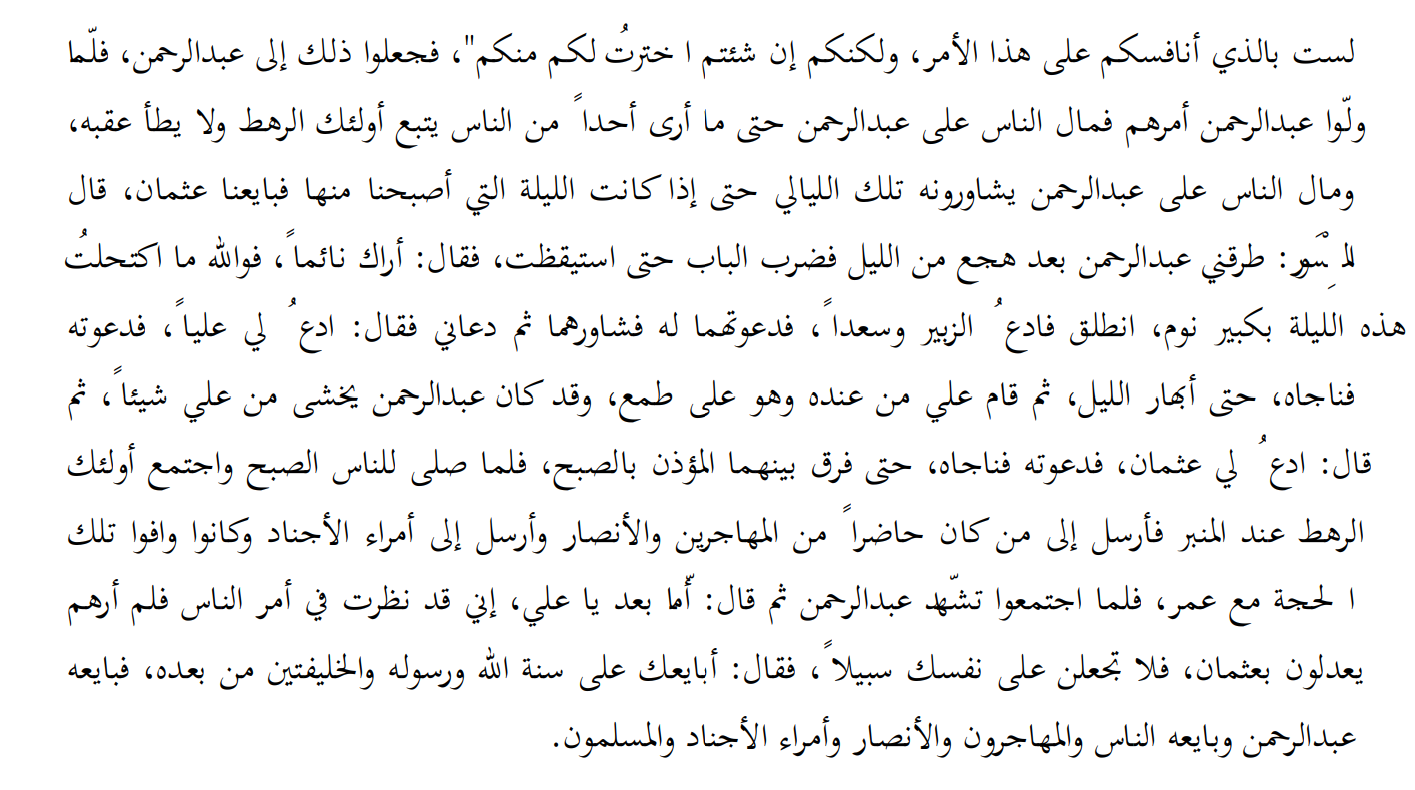
Ina ba ni ne mai yin gogayya da ku a wannan al'amari ba, amma idan kuna so, zan iya zaɓo muku ɗaya daga cikinku. Don haka suka damƙa wannan al'amari ga ‘Abdurrahman. Lokacin da aka damƙa wa ‘Abdurrahman wannan al'amari, mutane suka juya gare shi har ban ga wani da ya bi wannan ƙungiya ko ya bi bayansu ba. Mutane suna komawa wurin ‘Abdurrahman suna neman shawararsa a cikin waɗannan dare, har muka tashi da safe muka ba ‘Uthman mubaya'a. Al-Miswar ya ce: ‘Abdurrahman ya ƙwanƙwasa ƙofata bayan wani ɓangare na dare ya wuce, har na farka. Ya ce: Na ga kana barci. Ga Allah, idanuna ba su samu barci mai yawa a daren nan ba. Ka tashi ka kira Az-Zubair da Sa‘d. Na gayyace su zuwa gare shi. Ya yi shawara da su. Sa'an nan ya kira ni ya ce: Ka kira mini ‘Ali, sai na kira shi. Ya yi magana da shi a asirce har dare ya yi ƙarewa. Sa'an nan ‘Ali ya bar shi da wasu fatu, ‘Abdurrahman kuma yana tsoron wani abu daga ‘Ali. Sa'an nan ya ce: Ka kira mini ‘Uthman, sai na kira shi. Ya yi magana da shi a asirce har suka rabu lokacin da mai kiran sallah ya yi kiran sallar asuba. Bayan ya jagoranci mutane sallar asuba, sai ƙungiyar mutum shida ta taru kusa da minbari, sai ya aika a kira dukan Muhajirai da Ansarawa da suke wurin (a Madina), da kuma shugabannin rundunar da suka yi aikin hajji a waccan shekara tare da ‘Umar. Da suka taru, ‘Abdurrahman ya karanta shahadodin imani guda biyu ya ce: Ya ‘Ali! Na duba al'amarin mutane, ban ga sun daidaita kowa da ‘Uthman ba, don haka kada wani abu ya dame ka. Ya ce kuma (ga ‘Uthman): Ina ba ka mubaya'a bisa tafarkin Allah, da Manzonsa, da halifofi biyu da suka zo bayansa. Sai ‘Abdurrahman, da Muhajirai, da Ansarawa, da shugabannin rundunar, da sauran Musulmi suka ba shi mubaya'a.
“I am not one who competes with you for this matter but if you wish I could choose for you one from among you. So they assigned this to ‘Abdurrahman . When they charged ‘Abdurrahman with this matter, people turned to him to the extent that I did not see any one who followed this group or stepped behind them. The people turned to ‘Abdurrahman consulting him in those nights until the night of which we woke up in the morning and gave our pledge to ‘Uthman. Al-Miswar said: ‘Abdurrahman knocked at my door, after a part of the night had passed, until I woke up. He said: I see you sleeping. By Allah, my eyes did not find much sleep tonight. Set forth and call Az-Zubair and Sa‘d. I invited them to him. He consulted with them. Then he called me and said: Call ‘Ali for me, so I called him. He carried on a whispered conversation with him until the night faded away. Then ‘Ali left him with some expectations, and ‘Abdurrahman was afraid about something from ‘Ali. Then he said call ‘Uthman for me, so I called him. He carried on whispered conversation with him until they departed as the muezzin called for fajr prayer. After he led the people in the fajr prayer, and the group of six persons met near the minbar (pulpit), he sent for all the Muhajirs and Ansar who were present (in Madinah) and sent for the leaders of the army who delivered the pilgrimage that year with ‘Umar. When they met, ‘Abdurrahman recited the two testimonies of faith (shahadahs) and said: O ‘Ali! I viewed the matter of the people and did not see them equalling anyone to ‘Uthman, so do not let anything disturb yourself. And he said (to ‘Uthman): I give you the bay’ah upon the way of Allah, His Messenger and the two Khulafaa who came after him. So ‘Abdurrahman, the Muhajirs, the Ansar, the leaders of the army and rest of the Muslims gave him the bay’ah.”
Don haka, zaɓɓukan waɗanda za a iya zaɓa wa Khilafah an takaita su ga ƙungiyar da ‘Umar (ra) ya ambata bayan Musulmi sun roƙe shi ya yi haka. ‘Abdurrahman bin ‘Auf (ra), bayan ya janye kansa daga takarar Khilafah, ya tambayi ra’ayin Musulmi game da wanda zai zama Khalifah. Sai ya sanar da sunan mutumin da Musulmi suke so bayan ya tuntube su. Bayan ya sanar da sunan mutumin da mutane suke so, aka yi wa mutumin bai‘ah, kuma ta wannan bai‘ah ya zama Khalifah. Saboda haka, hukuncin shari‘a game da nada Khalifah shi ne a takaita waɗanda za a zaɓa wa Khilafah ga waɗanda ke wakiltar ra’ayin mafi yawan Musulmi. Sannan sunayensu ana nuna wa Musulmi, a kuma nemi su zaɓi ɗaya daga cikin waɗanda aka zaɓa ya zama Khalifah ga kowa. Sai a tabbatar da wanda mafi yawan Musulmi suka zaɓa, a karɓi bai‘ah daga dukkan Musulmi a gare shi, ko kowane mutum ya zaɓe shi musamman ko bai zaɓe shi ba. Wannan ita ce hanyar saboda ijma‘in Sahabbai game da ‘Umar (ra) na takaita zaɓɓukan Khilafah ga mutane shida da aka ƙayyade, da kuma yarjejeniyar Sahabbai cewa ‘Abdurrahman (ra) yana neman ra’ayin dukkan Musulmi game da wanda zai zama Khalifah a gare su, kuma yarjejeniyar ba da bai‘ah ga wanda ‘Abdurrahman (ra) ya sanar a matsayin wanda Musulmi suka zaɓa ya zama Khalifah a bayyane take a lokacin da ya ce:
So the nominees for the Khilafah were limited to the group named by ‘Umar (ra) after the Muslims had asked him to do so. ‘Abdurrahman bin ‘Auf (ra), after he withdrew himself from the nomination to the Khilafah, took the opinion of the Muslims about who would be the Khalifah. He then announced the name of the person who the Muslims wanted after consulting with them. After he announced the name of the person who the people wanted, the bay’ah was given to him and he became the Khalifah by this bay’ah. Therefore the hukm shari’ concerning the appointment of the Khalifah is to limit the nominees for the Khilafah by those who represent the opinion of the majority of Muslims. Then their names are displayed to the Muslims and they are asked to select one of the nominees to be Khalifah for all. Then it is determined whom the majority of the Muslims have chosen, and the bay’ah from all the Muslims is taken for him, whether each person had specifically chosen him or not. This is the method because of the Ijma’a of the Sahabah about ‘Umar (ra) limiting the nominees for the Khilafah to six specific persons, and the consensus of the Sahabah that ‘Abdurrahman (ra) takes the opinion of all the Muslims about who will be the Khalifah for them, and the consensus to give the bay’ah to the one who ‘Abdurrahman (ra) announced as the person elected by Muslims as a Khalifah is clear when he said:
Na lura da halayen mutane, kuma na lura cewa ba sa ɗaukar kowa daidai da ʿUthman.
“I have looked at the people's tendencies and noticed that they do not consider anybody equal to `Uthman.”
Duk waɗannan abubuwan suna bayyana hukuncin shari'a game da naɗin Khalifa.
All of these points clarify the hukm shari’ concerning the appointment of the Khalifah.
Batutuwa biyu har yanzu suna buƙatar bincike. Na farko shi ne: su waɗanne Musulmi ne ke naɗa Khalifah? Shin mutane masu tasiri ne, ko wani adadi ƙayyadadde na Musulmi? Ko kuwa dukkan Musulmi ne ke naɗa Khalifah? Na biyu ya shafi abubuwan da ke faruwa a wannan ƙarni a zaɓuka, kamar ƙuri'ar sirri, akwatunan zaɓe da ƙidayar ƙuri'u. Shin waɗannan al'amura sun dace da Musulunci, kuma Musulunci yana halatta su ko a'a?
Two issues remain to be examined. One of them is who are the Muslims who appoint the Khalifah? Are they the influential people or a certain specific number of Muslims? Or do all of the Muslims appoint the Khalifah? The second issue concerns the actions occurring in this century in elections such as secret ballots, polling boxes and counting votes. Are these matters consistent with Islam and does Islam allows them or not?
Game da batu na farko, Allah (swt) ya ba da iko ga Ummah, kuma ya sanya zaben Khalifah ya zama haƙƙi da wajibi ga dukkan Musulmai; bai sanya shi haƙƙin wata ƙungiya ta musamman wadda ta ware wata ba, kuma bai sanya shi haƙƙin wata jama'a da ta bar wata jama'a a gefe ba, domin mubaya'a wajibi ne a kan dukkan Musulmai. Annabi ﷺ ya ce:
As for the first issue, Allah (swt), has given the authority to the Ummah and he (swt) made the appointment of the Khalifah a right and duty for all Muslims; and He did not make it a right for one particular group excluding another, nor for a jama‘ah leaving another jama‘ah aside, since the bay’ah is a duty upon all the Muslims. The Prophet (saw) said:
"Duk wanda ya mutu ba tare da yana da wata mubaya'a a wuyansa ba, to zai mutu mutuwar jahiliyya."
“Whoever dies without having a pledge upon his neck would die the death of jahiliyyah”,
Wannan yana shafar kowane Musulmi. Saboda haka, mutane masu tasiri ba su da keɓantaccen haƙƙin naɗa Khalifah, kuma ba za su iya yin watsi da sauran Musulmi ba. Haka nan, wasu mutane na musamman ba su da keɓantaccen haƙƙi. Maimakon haka, wannan haƙƙi na dukan Musulmi ba tare da togiya ba, har ma ya haɗa da fājirai (mugayen mutane) da munāfiqūn (munafukai), matuƙar dai Musulmi ne balagaggu, domin nassin Shari'a a wannan batu ya zo ta hanyar gaba ɗaya, kuma babu abin da ya zo ya takaita shi (ya mayar da shi ga wasu mutane na musamman) sai ƙin karɓar mubaya'a daga matasan da ba su kai shekarun balaga ba. Don haka dole ne a ɗauki nassin ta hanyar gaba ɗaya.
And this is general for every Muslim. Therefore, the influential people do not possess the exclusive right to appoint the Khalifah and cannot ignore the rest of the Muslims. Nor do specific persons have the exclusive right. Rather, this right is for all the Muslims with no exception, it even includes the fajirs (wicked people) and munafiqeen (hypocrites), provided they are mature Muslims because the Shari’ah text came in a general form in this instance and nothing came to limit it (make it specific to certain people) except the refusal of the pledge from the young who have not yet reached the age of puberty. So the text has to be taken generally.
Duk da haka, ba sharaɗi ba ne cewa dukkan Musulmai su aiwatar da wannan haƙƙi. Ko da yake wajibi ne, domin bai'ah farali ce, amma farali ce ta kifaya (wajibin cika aiki) ba farali ce ta ain (wajibin mutum ɗaya ɗaya) ba. Don haka, idan wasu daga cikin Musulmai suka cika ta, wajibi ya sauka daga kan sauran Musulmai. Amma dole ne a ba dukkan Musulmai dama su yi amfani da haƙƙinsu wajen zaɓen Khalifah, ko sun yi amfani da shi ko ba su yi ba. A wata ma'ana, dole ne kowane Musulmi ya samu damar shiga cikin zaɓen Khalifah. Don haka batun shi ne a ba Musulmai damar aiwatar da aikin kafa Khalifah wanda Allah (swt) ya wajabta musu, ta yadda wannan wajibi zai sauka daga wuyansu. Batun ba shi ne shigar dukkan Musulmai a zahiri cikin aiwatar da wannan aiki ba. Wannan saboda abin da Allah (swt) ya wajabta shi ne kafa Khalifah ga Musulmai da yardarsu, kuma ba sharaɗi ne ga dukkan Musulmai su aiwatar da shi ba. Abubuwa biyu sun samo asali daga wannan: Na farko, yardar dukkan Musulmai wajen kafa Khalifah tana samuwa. Na biyu, yardar dukkan Musulmai game da naɗin ba ta samuwa. Amma a cikin lamuran biyu, an ba Musulmai dama (su shiga cikin naɗin).
However, it is not a condition that all Muslims practise this right. While it is a duty, because the bay’ah is fard, it is fard kifayah (obligation of sufficiency) and not fard ain (individual obligation). Thus, if some of the Muslims fulfill it, the duty drops from the rest of the Muslims. But all Muslims must be enabled to practice their right in electing the Khalifah, regardless of whether they use their right or not. In other words, every Muslim must be able to participate in selecting the Khalifah. So the issue is to enable the Muslims to carry out the duty of establishing the Khalifah which Allah (swt) prescribed upon them, in such a way that this duty falls (from their shoulders). The issue is not the actual participation of all the Muslims in conducting this duty. This is because the duty which Allah (swt) has prescribed is to establish the Khalifah for the Muslims by their consent, and it is not a requirement for all Muslims to perform it. Two matters result from this: One of them is that the consent of all the Muslims in the establishment of the Khalifah is achieved. Secondly, the consent of all the Muslims about the appointment is not achieved. The Muslims are however enabled (to participate in the appointment) in both cases.
"A asali, abubuwa halal ne sai dai idan akwai dalili da ya haramta su."
“In Principle things are permitted unless there exists an evidence of prohibition.”
Bambancin da ke tsakanin tariqah (hanya) da salo shi ne cewa hanya aiki ne wanda ake ɗaukarsa da kansa a matsayin asali, ko reshe ga wani aiki wanda ba shi da dalili gabaɗaya a kan asalinsa; a maimakon haka, dalilinsa na musamman ne a gare shi. Salo kuwa aiki ne wanda reshe ne ga wani aiki—watau asalin—wanda babu dalili gabaɗaya a kansa. Saboda haka, dole hanya ta dogara da dalili daga Shari'a, domin hukunci ne na Shari'a, don haka wajibi ne a bi ta, kuma Musulmi ba shi da zaɓi game da ita sai dai idan hukuncinta ibaha ne (na halatta). Wannan ya bambanta da salo, wanda ba ya dogara da dalilin Shari'a; a maimakon haka, yana cikin hukuncin asalinsa. Saboda haka, ba wajibi ba ne a bi wani salo na musamman ko da Manzon Allah ﷺ ne ya yi shi.
The difference between method (tareeqah) and style is that the method is an action which is considered by itself as an origin, or a branch to an action that does not have a general evidence for its origin; rather its evidence is specific to it. The style is an action which is a branch to an action—i.e. the origin—upon which there is no general evidence. Therefore, the method must depend upon a Shari’ah evidence because it is a Shari’ah rule, thus it must be adhered to and Muslims have no choice concerning it unless its rule is ibaha (of permissibility). This is different from the style which does not depend on a Shari’ah evidence; rather it is included in the rule of its origin. Therefore, it is not obligatory to follow a particular style even if the Messenger (saw)
Haka dai, Musulmi yana da izinin amfani da kowace hanya muddin hakan zai kai ga aikata aikin, don haka hanyar ta zama reshe ga aikin. Saboda haka ana cewa salon hanyar yana bisa nau'in aikin da ake yi.
did so. Rather a Muslim is allowed to use any style as long as it leads to the performance of the action, and thus it becomes a branch to the action. Thus it is said that the style is defined by the type of action.