2.15 Wahayi
2.15 The Revelation
Kowane Musulmi dole ne ya yi imani da wahayi, domin hakan yana daga cikin ginshiƙan imani. Sai dai hujjar wahayi ba ta hankali ba ce, a maimakon haka ana karɓar sa ne bisa nassoshi ingantattu. Tun da wahayi ba shi da wani abu da za a iya ji da hankalin jiki ko kuma hakikanin abu da ake iya gani, hankali ba zai iya tabbatar da ingancinsa ba. Saboda haka duk wani yunƙuri na tabbatar da wahayi ta hanyar hankali zai zama kuskure, domin ba zai yiwu a yi amfani da hankali wajen tabbatar da wani abu da babu hakikanin zahirinsa ba.
Each and every Muslim must believe in revelation, as it is a fundamental aspect of belief. However, the evidence for revelation is not rational, rather it is accepted on the basis of authentic texts. Since revelation does not have a tangible sensation or reality, the mind cannot verify its validity. Therefore every attempt to prove revelation by means of the intellect will be incorrect, as it is not possible to use the mind to prove something without a tangible reality.
Saboda haka, kamar yadda aka ambata a baya, shaidar saukar wahayi ba ta hankali ba ce; a maimakon haka, an kafa ta ne bisa ingantattun riwayoyi. Ayar Alƙur'ani bayyananniya ta tabbatar da cewa Manzon Allah Muhammadﷺ ya karɓi wahayi. Allah ya ce,
Hence, as mentioned earlier, the evidence for revelation is not intellectual; rather it is established on the basis of authentic narrations. The Definite text of the Qur’ān verifies that the messenger Muhammad recieved revelation. Allah says,
Haka nan Allah, Mai girma, Mai hikima, Yana yi maka wahayi, kai da waɗanda suka gabace ka. [TMQ Shura: 3]
"Likewise Allah, the Honourable, the all-wise, reveals to you and to those before you." [TMQ Shura: 3]
Kuma haka muka yi maka wahayi zuwa ga wani abu mai rai da umarninmu. [TMQ Shura:52]
"And likewise we have revealed to you an invigorate thing by our command." [TMQ Shura:52]
{Kuma ba ya magana daga son ransa. Lallai shi wahayi ne da ake yi masa.} [TMQ Najm: 3]
"And he doesn't utter from his own desire. Indeed it is an inspired inspiration" [TMQ Najm: 3]
Lalle ne, ya Annabi! Mun aiko maka wahayi kamar yadda muka aika wa Nuhu da annabawan da suka zo bayansa. [TMQ Nisa: 163]
"Undoubtedly, O prophet! We have sent revelation to you as we sent it to Noah and the prophets after him." [TMQ Nisa: 163]
"Ka bi abin da aka yi maka wahayinsa, kuma ka yi haƙuri har Allah ya yi hukunci, kuma Shi ne mafi alherin masu yanke hukunci." [TMQ 10:109]
"And follow that which is revealed to you and have patience until Allah decrees and He is the best of judges." [TMQ 10:109]
Wahayin da ya sauka ga manzon Allah ﷺ yana da yanayi uku, kuma dukkan annabawan da suka gabace shi ba su karɓi wahayi ta wata hanya ba face waɗannan kawai. Dukkan waɗannan yanayi suna ƙarƙashin wahayi, wanda Allah ya bayyana a cikin Alƙur'ani. Ya ce,
The revelation that descended on the messenger had three states, all prophets before him recieved the revelation through these only and not another. These states are all categorised under the revelation which Allah explains in the Qur’ān. He says,
Ba ya halatta ga wani mutum Allah ya yi magana da shi sai dai ta hanyar wahayi, ko kuma ya kasance daga bayan labulen girma, ko kuma ta hanyar aika manzanni da yin wahayi ga wanda ya so. [TMQ Shura: 51]
"And it is not fit for any man that Allah should speak to him but through revelation, or that the man may be at the other side of the veil of grandeur, or by sending messengers and inspiring whom he wills." [TMQ Shura: 51]
Wato, Allah ba ya magana da mutum sai ta hanyar wahayi, ko ta hanyar magana daga bayan labule, ko ta hanyar aika manzanni. Wahayin da ya sauka ga manzon Allah ﷺ yana da hali biyu. Ya bayyana su ne lokacin da aka taba tambayarsa, "Yaya wahayi yake zuwa gare ka?" Sai ya amsa da cewa,
That is, Allah only communicates with man through inspiration, through verbal contact via a veil or by sending messengers. The revelation that descended upon the messenger had two states. He informed about them when he was once asked, "How does the revelation come to you?" He replied,
Wani lokaci yana zuwa kamar ƙarar kararrawa ko jijjiginta, wanda shi ne ya fi tsananta mini, kuma idan ya bar ni, sai na riƙe duk abin da aka faɗa. Wani lokaci kuma mala'ika yana zuwa mini a siffar mutum, yana magana da ni, sai in fahimci abin da ake faɗa ﷺ. [Bukhari]
"Sometimes it comes like the clattering or the jingling of a bell which is severest on me and when it leaves me, I have absorbed everything. And sometimes the angel comes to me in a form of a man and speaks to me and I am aware of what is being said." [Bukhari]
Waɗannan jihohi biyu kamar haka suke: Na farko: mala'ika yana sanar da annabi ta hanyar alama, ba tare da amfani da kalmomi ko harshe ba. Wahayin yana shiga cikin zuciyar annabi, kamar yadda ya ce ﷺ,
These two states are as follows: Firstly- the angel inspires the prophet by indication and without using words or language. The revelation is inspired into the mind of the prophet , just as he said,
Ruh Al-Quds (Jibril) ya yi min wahayi cewa babu wani rai da zai mutu sai ya cika arzikinsa da ajalinsa. Saboda haka ku ji tsoron Allah, ya ku mutane, kuma ku nemi hanyoyin aikata alheri. [Extraced by AlHakim]
"Ruh Al-Quds (Jibril) inspired in to me that no soul shall die until it has completed its Rizq and its Ajal. Therefore fear Allah O people and acquire the means to do good" [Extraced by AlHakim]
Har ila, Manzon Allah ﷺ yana samun wahayi daga Allah ta hanyar mafarkai, duka a lokacin farkawa da kuma a lokacin barci. Wasu daga cikin abin da aka yi masa wahayi ne yana a farke, kuma yana yin wasu mafarkai, wadanda duka wahayi ne. Kamar yadda Uwar muminai, Aisha ta ce,
Also the messenger whilst dreaming had visions that he received from Allah both in the states of consciousness and sleep. Some of it was inspired to him whilst he was awake and he would have certain visions in his dreams all of which were revelation. As the mother of the believers, Aisha said,
Da farko, Manzon Allah ﷺ ya fara ganin wahayi na gaskiya a barci. Duk wahayin da ya gani gaskiya ne, kamar hasken safiya.
"Firstly, the messenger began seeing true visions in his sleep. Every vision he had was true as clear as the morning."
Manzon Allah ﷺ kuma yakan ji cewa wani nau'i na wahayi zai zo, amma bai zo ba. Aisha ta ruwaito cewa Harith dan Hisham ya tambayi Manzon Allah ﷺ cewa, "Ya Manzon Allah, yaya wahayi yake zuwa gare ka?" Sai Manzon Allah ﷺ ya ce,
The messenger would also feel that some form of revelation was about to come, but it didn't come. Aisha narrated that Harith ibn Hashim asked the messenger , "O messenger, how does the revelation come to you?" The messenger said,
Wani lokaci yakan zo kamar ƙarar kararrawa mai ƙarfi, wadda ta fi tsanani a kaina, kuma idan ta bar ni, sai na fahimci komai. [Bukhari]
"Sometimes it comes like the clattering /jingling of a bell which is severest on me and when it leaves me, I have absorbed everything." [Bukhari]
Duk waɗannan bambance-bambancen, watau wahayi, mafarki, wahayi ba tare da magana ba da duk abin da ya yi kama da su, suna cikin yanayi ɗaya kuma suna shiga ƙarƙashin faɗin Allah,
All these variations i.e. inspiration, dream, revelation without talk and everything similar constitute one state and fall within the saying of Allah ,
"Babu komai face da wahayi" [TMQ Shura: 51]
"Nothing but revelation" [TMQ Shura: 51]
Saboda a fannin harshe, idan aka yi amfani da fi'li "awaaha" (wahayi ga wani), ma'anarsa ita ce nuna alama ko girgiza kai. Saboda haka, Allah yana yi masa wahayi kuma yana zuga shi. Allah ya ce,
Because linguistically when the verb "to reveal to someone" is used it means to indicate or shake ones head. Thus Allah reveals to him and inspires him. Allah says,
"Ubangijinka kuma ya yi wahayi zuwa ga kudan zuma" [TMQ Nahl: 68]
"And your lord inspired the bee", [TMQ Nahl: 68]
Haka wahayin da aka yi wa kudan zuma shi ne: wahayi da ilimin dabi'a da ke cikin zuciyar kudan zuma.
Thus the inspiration to the bee is: the inspiration and the innate knowledge within the bee’s heart.
Yanayin na biyu shi ne wahayin da ake yi ta hanyar magana ta baki daga mala'ika. Ana isar da shi ta baki ga Annabi ﷺ bayan ya sani ta hanyar hujja bayyananniya cewa wannan wahayi ne kuma mai isar da saƙon mala'ika ne, watau Jibril. Allah ya ce,
The second state is the revelation inspired by means of oral communication from the angel. It is transmitted orally to the prophet after he learns through decisive evidence that this is revelation and the message bearer is the angel, i.e. Jibril. Allah says,
Ruhul amin ya sauko da shi. A kan zuciyarka domin ka yi gargaɗi. [TMQ Shuara: 193]
"The trusted spirit has descended with it. On your heart that you may warn." [TMQ Shuara: 193]
Wato, Allah yana aika Jibril wanda yake magana da manzon, wanda a lokaci guda yake ji kuma yana kiyaye kalmominsa. Aisha ta ruwaito cewa Annabi ﷺ ya ce,
In other words, Allah sends Jibril who speaks with the messenger who simultaneously both hears and preserves his words. Aisha narrated that the prophet said,
"Kuma wani lokaci mala'ika yana zuwa wurina a siffar mutum, sai ya yi magana da ni, ni kuma na san abin da yake fada." [Bukhari]
"And sometimes the angel comes to me as a man and he talks to me and I am conscious of what he is saying." [Bukhari]
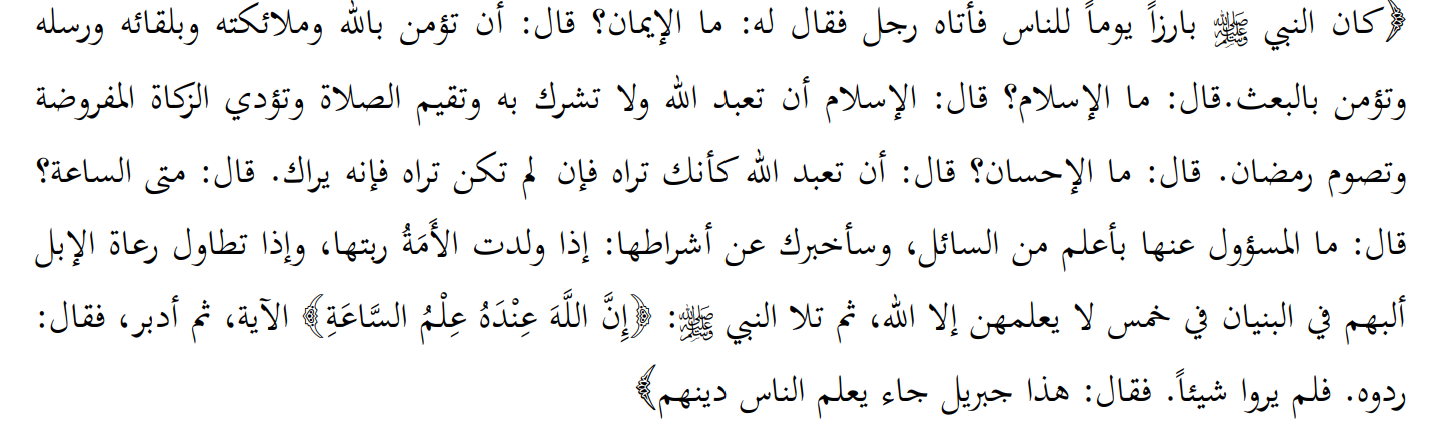
Abu Hurairah ya ruwaito cewa Manzon Allah ﷺ yana tare da mutane wata rana sai wani mutum ya zo ya tambaye shi, "Menene Imani?" Sai ya ce, "Imani shi ne yarda da Allah, da mala'ikunsa, da haduwa da shi, da manzanninsa, da tashin kiyama." Ya ce, "Menene Musulunci?" Sai ya ce, "Musulunci shi ne ka bauta wa Allah kuma kada ka yi shirka da shi, ka tsayar da salla, ka biya zakkar da aka wajabta, kuma ka yi azumin watan Ramadan." Ya ce, "Menene Ihsan?" Sai ya ce, "Shi ne ka bauta wa Allah kamar kana ganinsa, idan kuma ba ka ganinsa, to lallai shi yana ganinka." Ya ce, "Yaushe ne Ranar Alkiyama?" Sai ya ce, "Wanda ake tambaya game da ita bai fi wanda yake tambaya sanin ta ba. Amma zan gaya maka alamominta. Idan uwa ta haifi ubangidanta, kuma idan makiyaya suka yi gine-gine masu tsayi. Hakika ita tana cikin abubuwa biyar da babu wanda ya san su sai Allah." Sannan Manzon Allah ﷺ ya karanta ayar, "Lallai Allah yana da sanin Alkiyama." Sai mutumin ya juya ya tafi. Manzon Allah ﷺ ya ce wa Sahabbai, "Ku kira shi," amma ba su ga komai ba. Sai ya ce, "Wannan Jibrilu ne, ya zo ne domin ya koyar da mutane addininsu." [Bukhari]
Abu Hurairah narrated that the prophet was with the people one day when a person came and asked him, "What is Emaan?" He said, "It is the belief in Allah , his angels, in the meeting with him , his messengers and the resurrection." He asked, "What is Islam?" He said, "Islam is that you worship Allah and do not commit Shirk, establish the prayer, pay the enjoined Zakat and you fast in Ramadan." He said, "What is Ihsaan?" He said, "That you worship Allah as if you see him, and if you can not see him, surely he sees you." He said, "When is the hour?" He said, "The one questioned about it knows no better then the questioner. I will tell you of its signs. When the mother will give birth to her Master and when the shepherd will build tall buildings. It is one of the five things that no one will know them except Allah ." Then the prophet recited the Ayat, "Indeed Allah has the knowledge of the hour." Then the man turned and left. The prophet said to the Sahaba call him but they didn't see anything. He said, "This was Jibril, he came to teach people their Deen." [Bukhari]
Akwai abubuwa da dama da aka ambata a cikin Hadisai inda Jibril ya sauko ya yi magana da Annabi ﷺ, shi kuma yana saurare. Wannan wani nau'i ne na wahayi ga Manzon Allah ﷺ, domin mala'ikan yana fada masa ma'anoni ta hanyar tattaunawa. Wahayin da ake yi da lafazi da ma'ana an keɓe shi ga Alkur'ani mai girma. Amma wahayin da ake yi da ma'ana kawai, Manzon Allah ﷺ yana bayyana shi da kalamansa, ko ta hanyar aiki, watau aikinsa, ko ta hanyar shiru, kuma wannan shi ne Sunna.
There are a number of incidents mentioned in Ahadith in which Jibril descended and talked to the prophet and he would listen. This was a form of revelation for the messenger, as the angel would tell the messenger the meanings in the form of a conversation. The revelation by words and meaning is restricted to the Noble Qur’ān. As for revelation by meaning, the messenger would express this by using his own words, through application i.e. his actions, or by silence and this is the Sunnah.
Hadisin Kudsi ana ɗaukarsa a matsayin Sunnah, domin ko da yake ma'anarsa daga Allah take, amma kalmominsa daga Annabi ﷺ suke. Kalmomin Hadisin Kudsi ba daga Allah suke ba, domin kalmomin da suke daga Allah an keɓe su ne ga Alƙur'ani, kuma ana tabbatar da hakan ta hanyar rashin iya kwaikwayonsa. Ko da yake Sunnah tana zuwa ta hanyar wahayi, mafarki, da kuma abin da ake jefawa cikin zuciya kai tsaye, tana zuwa ma a farke, da kuma a matsayin tattaunawa tsakanin Jibrilu da Manzon Allah ﷺ.
The Hadith Qudsi is regarded as Sunnah because although its meaning is revealed from Allah its words are from the prophet . The words of the Hadith Qudsi are not from Allah because the words that are from Allah are specifically for the Qur’ān and this is proven by its inimitability. Although the Sunnah comes in the forms of inspiration, dream and is cast directly in the heart, it also comes both in wakefulness and as a dialogue between Jibril and the messenger .
Al-Qur'ani ba a saukar da shi sai ta hannun manzo ba, saboda kalmominsa daga Allah suke. Akwai ayoyi masu yawa da ke bayyana saukar Al-Qur'ani. Allah yana cewa,
The Qur’ān is only revealed through the messenger because its words are from Allah . There are numerous ayats detailing the revelation of the Qur’ān. Allah says,
"Kuma mun saukar da Alƙur'ani a gare ka cikin harshen Larabci" [TMQ Shura:7]
"And we have revealed the Quran to you in Arabic" [TMQ Shura:7]
"Kuma abin da Muka yi maka wahayi a cikin Littafi (ya Muhammadu ﷺ), shi ne gaskiya." [TMQ Fatir: 31]
" And what We have revealed to you (O Muhammad [saw]) of the Book, it is the (very) truth " [TMQ Fatir: 31]
Littafin da ake magana a kansa shi ne Alƙur'ani, kuma "min" a nan yana nuna wakilci.
The book referred to is the Qur’ān and “min” here is to indicate representation.
"An saukar mini wannan Alƙur'ani domin in yi muku gargaɗi da shi, ku da duk wanda ya isa gare shi." [TMQ An’aam: 6]
“This Qur'ân has been revealed to me that I may therewith warn you and whomsoever it may reach " [TMQ An’aam: 6]
"Muna ba ka labari mafi kyau (Muhammadu ﷺ) ta hanyar wahayin da Muka yi maka, na wannan Alƙur'ani." [TMQ Yoosuf: 3]
" We relate to you (Muhammad [sal-Allâhu 'alayhi wa sallam]) the best of stories through Our Revelations to you, of this Qur'ân" [TMQ Yoosuf: 3]
"Kuma ka karanta abin da aka yi maka wahayi daga Littafin Ubangijinka (Alƙur'ani). Babu wanda zai iya canja Kalmominsa." Note: The Prophet's honorific ﷺ is not written here because the text addresses him directly with his name in parentheses. Per the rules, the honorific should follow every mention of the Prophet Muhammad, so the correct rendering is: "Kuma ka karanta abin da aka yi maka wahayi daga Littafin Ubangijinka (Alƙur'ani), ya Muhammadu ﷺ. Babu wanda zai iya canja Kalmominsa." [TMQ alKahf: 27]
" And recite what has been revealed to you (O Muhammad PBUH) of the Book (the Qur'ân) of your Lord. None can change His Words, " [TMQ alKahf: 27]
Ita ce Alƙur'ani. Akwai wasu ayoyi kuma, waɗanda ke ambaton saukar wahayi gabaɗaya, har da Sunna. Misali, Allah ya ce,
It is the Qur’ān. There are other ayats as well, which mention the revelation in general including the Sunnah. For example, Allah says,
"Idan na kasance a kan shiriya, to saboda Wahayin Ubangijina da aka yi mini ne." [TMQ As-saba: 50]
" If I remain guided, it is because of the Revelation of my Lord to me” [TMQ As-saba: 50]
Kuma Ya ce,
And He says,
Lalle, Mun saukar maka da Wahayi (ya Muhammadu ﷺ) kamar yadda Muka saukar da Wahayi ga Nuhu da annabawan da suka zo bayansa. [TMQ Nisa: 163]
" Verily, We have sent the Revelation to you (O Muhammad [saw]) as We sent the Revelation to Nûh (Noah) and the Prophets after him" [TMQ Nisa: 163]
Kuma Ya ce,
And He says,
"Kuma ka bi abin da aka yi maka wahayinsa daga Ubangijinka. Lalle ne, Allah Masani ne ga abin da kuke aikatawa." [TMQ Ahzaab: 2]
"And follow that which is revealed to you from your Lord. Verily, Allâh is Well-Acquainted with what you do" [TMQ Ahzaab: 2]
Waɗannan yanayi guda biyu an tattauna su a cikin rubuce-rubuce. Yanayi na uku kuwa an ambace shi a cikin faɗinsa,
These two mentioned states have been discussed in the texts, The third state is mentioned in His saying,
Ko daga bayan labule [TMQ Shura: 51]
"Or from behind a veil” [TMQ Shura: 51]
Wannan ya faru da Musa. Wannan ayar tana nuni ga lamarin da Allah ya yi magana da Musa daga bayan labule. Wato, kamar yadda mutum mai labule yake magana da wasu manyan mutane da mutane masu daraja. Yana magana ne daga bayan labule, kuma duk da cewa mutum yana jin muryar ɗayan, ba ya ganin sa. Wannan ita ce hanyar da Allah ya yi magana da Musa.
This is what happened with Musa . This Ayat is indicating to the incident in which Allah spoke to Musa from behind a veil. That is, just as the veiled person speaks with some dignitaries and with people of distinction. He speaks from behind a veil and although one hears the other person’s voice, he does not see him. This is the manner in which Allah spoke with Musa .
Irin wannan lamari ya faru sau ɗaya kacal ga Annabi ﷺ a lokacin Isra'i da Mi'raj, wanda ba a ambace shi kaɗai a cikin ingantacciyar Hadisi ba, har ma Suratul Najm ta nuna shi. Allah (SWT) ya ce,
Such an incident only occurred once with the prophet during the al-Isra wal-Miraj, which has not only been mentioned in an authentic Hadith, but has also been indicated by Sura al-Najm. Allah says,
Wannan wata Wahayi ce kawai da aka saukar. Ya koyi (wannan Alƙur'ani) daga wanda yake da ƙarfi sosai [Jibrilu]. Wanda ba shi da wani aibi a jiki da hankali, sai ya tashi ya tsaya tsayin daka. Yana cikin mafi girman sararin gabas, sai ya matso kusa ya kuma ƙara kusantowa. Yana tsakanin nisan tsawon baka biyu, ko ma ya fi kusa. Sai (Allah) ya yi wahayi ga bawansa [Muhammadu ﷺ ta hannun Jibrilu (a.s)] duk abin da ya yi wahayi. [TMQ Najm: 4-10]
"It is only a Revelation revealed.He has been taught (this Qur'ân) by one mighty in power [Jibril].One free from any defect in body and mind then he (Jibrîl) rose and became stable.While he [Jibrîl)] was in the highest part of the horizon, Then he [Jibrîl] approached and came closer, And was at a distance of two bows' length or (even) nearer. So (Allâh) revealed to His slave [Muhammad [saw] through Jibrîl [as]] whatever He revealed." [TMQ Najm: 4-10]
Sai dai wannan lamari watau al-Isra wal-Mi'raj, wahayi ya sauka ga Annabi ﷺ ta hanyar ilhama da kuma ta hanyar manzo.
With the exception of this event i.e. al-Isra wal-Miraj, the revelation descended upon the prophet in the form of an inspiration and through a messenger.
Dukkan nau'ikan wahayi hujja ne. Sadarwa tsakanin mala'ika da manzo, ta magana ko ta alama ko ta tattaunawa, wahayi ne bayyananne. Ilhami da mafarkai masu gaskiya ma wahayi ne bayyananne, kuma Allah yana magana da annabawa ma wani nau'in wahayi ne. Wannan wahayi hujja ce ta tabbatacciya, domin an ruwaito shi a cikin nassoshi mafi inganci da tabbaci, masu ma'ana bayyananne.
All the types of revelation are forms of evidence. The communication between the angel and the messenger by talk or indication or conversation is a clear revelation. The inspiration and visions are clear revelations and Allah speaking to the prophets is also a form of revelation. This revelation is a categorical proof as it has been reported in the most authentic and definite texts of definite meaning.