Sun yi haka, kuma bayan sun rubuta kwafi da yawa, Uthman ya mayar da ainihin takardun ga Hafsa. Uthman ya aika da kwafi ɗaya na abin da suka kwafa zuwa kowane lardin Musulunci, kuma ya umarci a ƙone duk sauran rubuce-rubucen Alƙur'ani, ko an rubuta su a guntaye ko a cikakkun kwafi. Adadin kwafin da aka yi bakwai ne. Aka aika da mushafai bakwai zuwa Makka, al-Sham, Yaman, Bahrain, Basra, Kufa, kuma kwafi ɗaya aka ajiye a Madina.
They did so, and when they had written many copies, 'Uthman returned the original manuscripts to Hafsa . 'Uthman sent one copy of what they have copies to every Muslim province, and ordered that all the other Qur’ānic materials, whether written in fragmentary manuscripts or whole copies, be burnt. The number of copies made was seven. The seven mushaf’s were sent to Makkah, al-Sham, Yemen, Bahrain, Basra, Kufah, and one copy was kept in Madinah.
Saboda haka, aikin 'Uthman ba tattara Alkur'ani ba ne, a'a, kwafi ne kawai da rubutawa na abu guda wanda aka rubuta daga Manzon Allah ﷺ kamar yadda yake. Bai yi komai ba sai da ya yi kwafi bakwai daga kwafin da aka ajiye a hannun Hafsa, Uwar Muminai, sannan ya haɗa mutane a kan wannan rubutu guda, ya kuma hana duk wani rubutu ko karatu banda shi. Al'amarin ya tsaya a kan wannan kwafi a matsayin rubutu da karatu. Shi ne irin rubutu da karatun da aka rubuta takardun a gabanin Manzon Allah ﷺ lokacin da wahayi ya sauka. Kuma shi ne kwafin da Abu Bakr ya tattara. Sai Musulmi suka fara yin kwafi daga wannan kwafin, ba daga wani kwafin ba. Ba abin da ya rage sai mushafin 'Uthman a rubutunsa. Sa'ad da masu buga littattafai suka zo, an buga mushaf daga wannan kwafin, tare da irin wannan rubutu da karatu.
Therefore, 'Uthman's action was not the compilation of the Qur’ān rather it constituted in only the copying and transcription of the same thing transcribed from the Messenger of Allah as it was. He did not do anything other than make seven copies from the preserved copy in the possession of Hafsa , the mother of the Believers and unite the people on this single script and forbade any other script or dictation other than it. The matter was settled on this copy as a script and dictation. It is the same script and dictation in which the sheets were written as was written in the presence of Allah's Messenger when the revelation was revealed. And it is the same copy which Abu Bakr had compiled. Then the Muslims began to make copies from this copy and not any other copy. Nothing remained except the mushaf of 'Uthman in its script. When printers came about, the mushaf was printed from this copy with the same script and dictation.
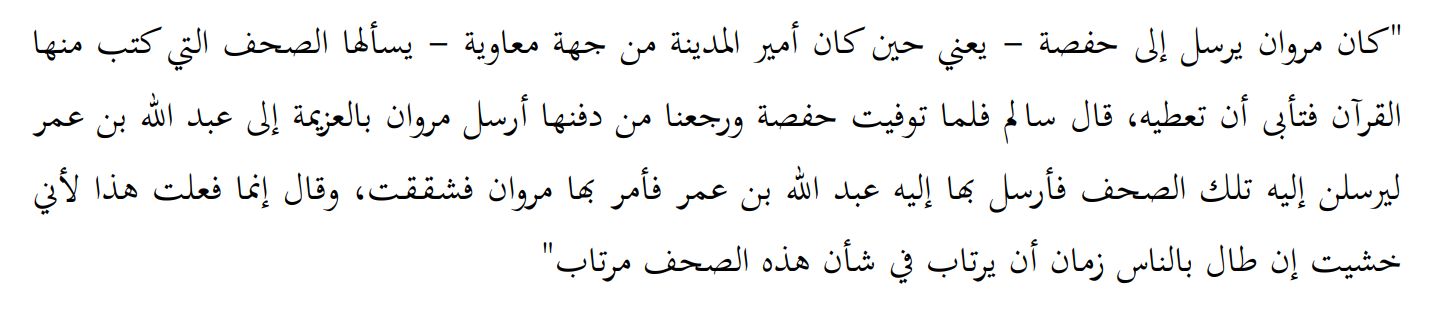
Bambancin da ke tsakanin tattarawar Abu Bakr da ta 'Uthman shi ne: tattarawar Abu Bakr ta faru ne saboda tsoron cewa wani abu daga Alkur'ani zai bata idan wasu daga cikin masu haddarsa suka rasu, dalili shi ne cewa duk da an rubuta shi a kan takardu, amma ba a tara shi a wuri guda kamar littafi guda ɗaya ba. Don haka aka tattara shi a shafuka. Tattarawar 'Uthman kuwa ta faru ne saboda sabanin da ya karu game da wasu fannoni na Alkur'ani, wanda wasu ke karantawa bisa ga yarukansu, wanda hakan ya kai ga wasu su zargi wasu da yin kuskure. An ji tsoron al'amarin ya yi muni, don haka aka kwafi wadannan takardu zuwa mushafi guda ɗaya. Mushafin da muke da shi yanzu a gabanmu shi ne mushafin da aka saukar wa Manzon Allah ﷺ, kuma shi ne wanda aka rubuta a cikin takardun da aka rubuta a gaban Manzon Allah ﷺ. Kuma shi ne mushafin da Abu Bakr ya tara lokacin da aka tara takardun a wuri guda. Haka kuma shi ne wanda 'Uthman ya kwafi kwafe-kwafe bakwai daga cikinsa, ya kuma umarci a ƙone sauran. Kuma shi ne Alkur'ani mai girma iri ɗaya, cikin tsarin ayoyinsa dangane da juna, da tsarinsu a cikin surorinsu, da rubutu da dictation. Amma kwafin da Manzon Allah ﷺ ya yi dictation daga wahayi, wanda aka tara takardunsa tare sannan aka kwafa, ya kasance a adane a hannun Hafsa, uwar muminai, har sai da Marwan ya zama Wali (gwamnan) Madina, sai ya yayyage shi, domin ba a ɗauke shi da muhimmanci ba saboda kwafe-kwafen mushafi sun yaɗu ko'ina. Ibn Shihab ya ruwaito cewa Salim ɗan 'Abdullahi ɗan 'Umar ya sanar da shi:
The difference between the compilation of Abu Bakr and that of 'Uthman is that the compilation of Abu Bakr took place due to the fear that something would be lost from the Qur’ān if any of its carriers (memorisers) were lost, the reason being that even though it was written on sheets but it had not been collected in one place like a single book. Thus, it was compiled in pages. The compilation of 'Uthman took place because the differences increased regarding certain aspects of the Qur’ān which some read in their own dialects and this led some to accuse others of making an error. It was feared that the matter would escalate therefore those sheets were copied into one mushaf. The mushaf that we now have before us is the same mushaf revealed to the Messenger of Allah and it is the same one which was written in the sheets which were written in the presence of the Messenger of Allah . And it is the same mushaf that Abu Bakr brought together when the sheets were compiled in one place. And it is the same one from which 'Uthman transcribed the seven copies and ordered that the rest be burned. And it is the same Noble Qur’ān in its verse arrangement in relation to each other and their arrangment in their respectives Sura’s, script and dictation. As for the copy dictated by the Messenger of Allah from the revelation, whose sheets were compiled together and then copied it remained protected in the possession of Hafsa , the mother of the believers until Marwan became the Wali (governor) of Madinah and he tore it up since it was not considered important because copies of the mushaf had spread everywhere. Ibn Shihab narrated that Salim ibn 'Abd Allah ibn 'Umar informed him: