18 Jihar Musulunci Jiha ce ta mutane, ba jihar tsarin mulkin addini ba.
18 The Islamic State Is A Human State And Not A Theocratic State.
Daular Musulunci ita ce Khilafah, domin ita ce matsayin da wanda ke jagorantar ta ke da dukkan ikon mulki da iko, kuma yana karɓe dukkan dokoki ba tare da togiya ba. Ita ce shugabanci na gaba ɗaya bisa dukkan Musulmai a duniya don aiwatar da dukkan dokokin Shari'ar Musulunci, bisa ga tunanin da ya zo da shi da dokokin da ya shimfiɗa, da kuma ɗaukar da'awar Musulunci zuwa ga duniya, ta hanyar sanar da su game da Musulunci, kiransu zuwa gare shi da jihadi a hanyar Allah. Haka kuma ana kiranta da Imamah da shugabancin masu bi. Matsayi ne na ɗan adam ba na Allah ba, wanda ke wanzuwa don aiwatar da addinin Musulunci a kan mutane da yaɗa shi a tsakaninsu. Tabbas ba Annabta ba ce, domin Annabta da Manzanci suna nufin Annabi ko Manzo wanda Shari'a daga Allah (SWT) ke zuwa masa ta hanyar wahayi don ya isar da ita ga mutane ba tare da la'akari da aiwatar da ita da kansa ba. Allah (SWT) ya ce:
The Islamic State is the Khilafah as it is the position in which the one who supervises it possesses all the competence of ruling and authority, and adopts all the rules without exception. It is the general leadership over all Muslims in the world to implement all the Islamic Shar’a rules, by the thoughts it came with and the rules it legislated, and to carry the Islamic da’wah to the world, by informing them of Islam, calling them to it and jihad in the way of Allah. It is also known as the Imamah and the leadership over the believers. It is a human role not a divine one, which exists to implement the deen of Islam over human beings and to spread it among them. It is definitely not the Prophethood as the Prophethood and Messengership conotates to the Prophet or the Messenger the Shar’a from Allah (saw) via the means of revelation to deliver it to the people without paying attention to his implementing it. Allah (swt) says:
Babu abin da ke kan Manzon face isar da saƙo a fili. [TMQ 24:54]
"There is nothing upon the Messenger except the clear conveyance " [TMQ 24:54]
Da kuma:
And:
Hakika, a kanku ne alhakin isar da saƙo. [TMQ 3:20]
"Verily it is upon you the conveyance " [TMQ 3:20]
Da kuma:
And:
"Babu komai a kan Manzon sai isarwa a bayyane" [TMQ 5:99].
"There is nothing upon the Messenger except the conveyance" [TMQ 5:99].
Wannan ya bambanta da Khilafah, wadda take nufin aiwatar da Shari'ar Allah a kan mutane. Ba sharaɗi ba ne ga Annabi (saw) ko Manzo (saw) ya aiwatar da abin da Allah (swt) ya saukar masa don ya zama Manzo, sai dai sharaɗin zama Manzo ko Annabi shi ne Allah ya saukar masa da Shari'a kuma ya umarce shi da isar da ita. Musa (as), Isa (as) da Ibrahim (as) annabawa ne kuma manzanni, duk da cewa ba su aiwatar da Shari'ar da suka zo da ita ba, kuma ba sarakuna ba ne. Saboda haka, matsayin Annabci da Manzanci ba matsayin Khilafah ba ne. Annabci matsayi ne na Ubangiji wanda Allah yake bayarwa ga wanda Ya ga dama, yayin da Khilafah matsayi ne na mutane wanda Musulmi ke yi wa wanda suka so mubaya'a a kansu daga cikin Musulmi. Ubangijinmu Muhammad ﷺ shi ne sarki wanda ya aiwatar da Shari'ar da ya zo da ita, don haka zai kasance mai kula da Annabci da Manzanci, a lokaci guda kuma zai kasance mai jagorancin Musulmi wajen kafa hukunce-hukuncen Musulunci. Allah (swt) ya umarce shi da yin mulki kamar yadda ya umarce shi da isar da saƙon, kamar yadda Ya ce masa:
This is different from the Khilafah which is the implementation of Allah’s Shar’a upon human beings. It is not a condition upon the Prophet (saw) or Messenger (saw) to implement what Allah (swt) revealed to him in order to be a Messenger, rather the condition to become a Messenger or Prophet is that Allah reveals a Shar’a to him and commands him to convey it. Musa (as), Isa (as) and Ibrahim (as) were Prophets and Messengers though they did not implement the Shariah they came with nor were they rulers. Therefore the post of Prophethood and Messengership is not the post of Khilafah. Prophethood is a divine post which Allah gives to whomever He wills, while the Khilafah is a human post in which the Muslims pledge whomever they wish over them from among the Muslims. Our master Muhammad (saw) was a ruler who implemented the Shari’ah he came with, so he would be in charge of the Prophethood and Messengership while at the same time he would be in charge of the post of leadership of the Muslims in establishing the Islamic rules. Allah (swt) commanded him to rule just like He commanded him to convey the message as He said to him:
"Ka yi hukunci a tsakaninsu da abin da Allah ya saukar" [TMQ 5:47]
"Rule between them by what Allah revealed" [TMQ 5:47]
Da kuma:
And:
Lalle mun saukar maka Littafi da gaskiya, domin ka yi hukunci tsakanin mutane da abin da Allah ya nuna maka. [TMQ 4:105]
"Verily we revealed the Book to you in Truth so that you rule between the people by what Allah showed you" [TMQ 4:105]
Kamar yadda Ya (SWT) ce masa:
Just like He (swt) said to him:
Ya Manzo, ka isar da abin da aka saukar maka daga Ubangijinka [TMQ 5:67]
"O Messenger, convey what has been revealed to you from your Lord "[TMQ 5:67]
Da kuma:
And:
"An saukar mini wannan Alƙur'ani domin in yi muku gargaɗi da duk wanda isarsa ya kai shi." [TMQ 6:19]
"This Qur’an has been revealed to me so that I warn you and whoever it is conveyed to" [TMQ 6:19]
Da kuma:
And:
"Ya kai wanda ya lulluɓe da tufafinsa. Tashi ka yi gargaɗi" [TMQ 74:1].
"O you enshrouded in a cloak. Stand up and warn" [TMQ 74:1].
Sai dai idan yana da alhakin isar da saƙo ta baki, kamar isar da maganar Allah:
Except that when he was in charge of conveying the message by speech like conveying Allah’s saying:
Allah ya halatta ciniki, kuma ya haramta riba." [TMQ 2:275]
Allah has permitted trade and forbidden riba" [TMQ 2:275]
ko ta hanyar aiki, kamar Yarjejeniyar Hudaibiyya, sai ya kasance mai yanke hukunci wajen isar da sako kuma yana umarni da tabbaci a aiwatar da aikin; haka kuma ba zai tuntubi mutane ba, sai dai zai ki duk wata shawara idan aka ba shi wata shawara daban da abin da wahayi ya zo da shi. Idan kuma aka tambaye shi game da wata hukunci da wahayi bai sauka a kanta ba tukuna, sai ya yi shiru ba zai amsa ba sai wahayi ya sauka. Amma idan zai aiwatar da wani aiki, sai ya tuntubi mutane, kuma zai bi ra'ayin ƙwararru ko ra'ayin mafi yawan mutane koda kuwa ya saɓa da ra'ayinsa. Idan kuma zai yi hukunci tsakanin mutane, ba zai yi tabbaci yana cewa hukuncinsa ya dace da gaskiya ba, a maimakon haka yana yin hukunci ne bisa abin da ya ji daga hujjoji. Lokacin da aka saukar da Suratul Bara'ah, sai ya (saw) ya umarci Ali bin Abi Dalib (ra) da ya je ya haɗu da Abubakar, ya umarce shi da ya sanar da kawar da alhaki (Bara'ah) ga mutane a lokacin aikin Hajji. Don haka ya karanta musu a Arafah, ya zagaya wajen mutane har sai da ya isar da saƙon. Lokacin da ya rattaba hannu kan Yarjejeniyar Hudaibiyya, ya ƙi ra'ayin dukan sahabbai (ra) ya tilasta musu ra'ayinsa, domin hakan wahayi ne daga Allah (swt). Lokacin da Jabir ya tambaye shi: "Yaya zan yi hukunci a kan dukiyata?", bai amsa masa ba sai da wahayi ya sauka da hukuncin. Al-Bukhari ya ruwaito ta hanyar bin al-Munkadir wanda ya ce:
or by action like the Treaty of Hudaybiyya, he would be decisive in conveying and command decisively to undertake the action; nor would he consult but would rather reject all opinion if he was advised anything different from what the revelation came with. And when he was asked of a rule for which no revelation had descended yet, he would keep silent and not reply until the revelation descended. Whereas when he would undertake an action he would consult people and act according to the opinion of experts or the opinion of the majority even where it differed from his opinion, and when he would judge between people he would not be decisive saying that what he judged with conformed with the reality rather he was judging according to what he heard of the evidence. When Surah Bara’ah was revealed, he (saw) commanded Ali bin Abi Talib (ra) to go meet Abu Bakr and commanded him to announce inculpability “Bara’ah to the people during the Hajj period. So he read it to them Arafah and went around to the people until he had conveyed it. When he signed the Treaty of Hudaybiyya he rejected the opinion of all the Sahabah (ra) and compelled his opinion upon them as it was revelation from Allah (swt). When Jabir asked him: “How should I judge over my wealth?", He did not answer him until the revelation descended with the rule. Al-Bukhari narrated via bin al-Munkadir who said:
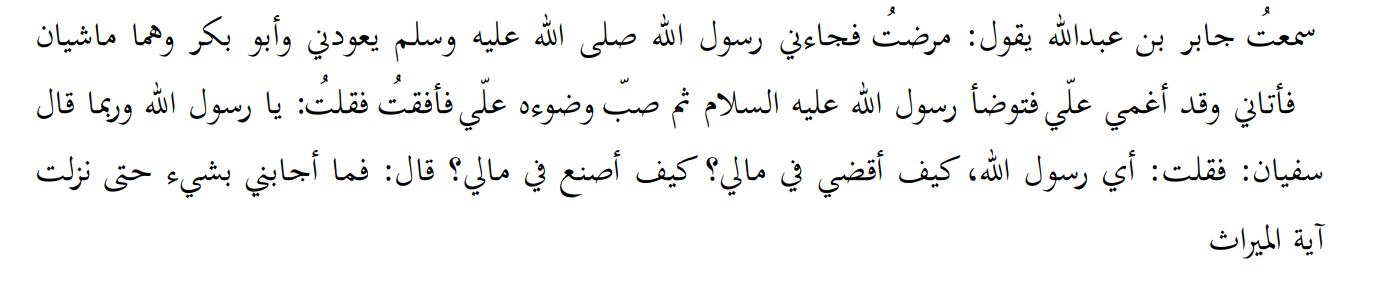
"Na ji Jabir bin Abdullah yana cewa: Ina rashin lafiya sai Manzon Allah ﷺ ya zo ya duba ni tare da Abu Bakr, suna tafiya a ƙafa. Sun same ni ina suma. Sai Manzon Allah ﷺ ya yi alwala, sannan ya zuba min ruwa a kaina. Sai na farka, na ce wa Manzon Allah ﷺ: Ya Manzon Allah, ta yaya zan yi hukunci game da dukiyata? Me zan yi da dukiyata? Sai ya ce: Bai amsa min ko kaɗan ba, sai aka saukar da ayar gado."
“I heard Jabir bin Abdullah saying: I was ill so the Messenger of Allah (saw) came to visit me together with Abu Bakr walking. They found me when I was unconscious. The Messenger of Allah (saw) made wudhu then poured some water upon me. I woke up and said to the Messenger of Allah (saw): O Messenger of Allah, how should I judge over my wealth? What should I do with my wealth? He said: He did not answer me at all until the ayah of inheritance was revealed.”
Wannan yana cikin ɗaukar nauyin Annabci da Manzanci da isar da saƙo ga mutane, sabanin yadda yake nuna hali idan ya ɗauki nauyin mulki. A yaƙin Uhudu ya tara Musulmai a masallaci, ya tuntuɓe su kan ko za a yi yaƙi a cikin Madina ko a waje. Ra'ayin mafi yawa shi ne a yi yaƙi a waje, alhali ra'ayin Manzon Allah ﷺ shi ne a yi yaƙi a ciki. Ya bi ra'ayin mafi yawa, ya fita ya yi yaƙi a wajen Madina. Haka kuma idan ya yi hukunci tsakanin mutane, yakan gargaɗe su kada su sa shi ya yi musu hukunci a kan haƙƙin wani. Al-Bukhari ya ruwaito daga Umm Salama cewa Manzon Allah ﷺ ya ji wata husuma a bakin ƙofar gidansa, sai ya je wurinsu ya ce:
This was in the undertaking of the burden of Prophethood and Messengership and conveying to the people, whereas in undertaking the burden of rule he would behave differently. In Uhud he collected the Muslims in the mosque, consulted over whether to fight inside Madinah or outside; the opinion of the majority was to fight outside while the Messenger’s opinion was to fight inside. He acted upon the majority opinion, left and fought outside Madinah. Similarly when he judged between people, he would warn them from causing him to judge for them against someone else’s due right. Al-Bukhari narrated from Umm Salamah about the Messenger of Allah (saw) that he heard a dispute at the door of his house so he went to them and said:
"Ni mutum ne kawai, kuma masu ƙara da rigingimu suna zuwa wurina, kuma wataƙila wani daga cikinku ya fi ɗayan iya magana (wajen gabatar da hujjarsa), sai in yi zaton cewa yana faɗin gaskiya, in yanke hukunci a cikin amfaninsa. Duk lokacin da na yanke hukunci a cikin amfanin wani, wanda ta haka zai ɗauki haƙƙin wani Musulmi ba bisa ƙa'ida ba, to abin da ya ɗauka ba wani abu ba ne face guntun Wuta, kuma yana hannunsa ya ɗauka ko ya bari."
“I am only a human being, and litigants with cases of dispute come to me, and someone of you may happen to be more eloquent (in presenting his case) than the other, whereby I may consider that he is truthful and pass a judgment in his favor. If ever I pass a judgment in favor of somebody whereby he takes a Muslim's right unjustly, then whatever he takes is nothing but a piece of Fire, and it is up to him to take or leave.”
Haka kuma ya ruwaito daga gare shi cewa ya ce: ﷺ
Similarly he narrated from him that he (saw) said:
"Ina son in haɗu da Allah ‘azza wa jalla ba tare da wani ya nemi daga wurina wata zalunci da na yi masa ba, ko a kan jini ko kan dukiya."
“Verily I wish to meet Allah ‘azza wa jalla without anyone seeking from me an injustice I committed against him, whether in blood or money.”
Wannan yana nuna cewa zai rike mukamai biyu: matsayin Annabci da Manzanci, da matsayin jagorantar Musulmi a duniya wajen kafa Shari'ar Allah (swt) wadda aka saukar masa. Zai yi tasarrufi wajen rike kowane mukami gwargwadon abin da yake bukata, don haka zai aiwatar da daya daban da daya. Ya karbi mubaya'ar mutane a kan mulki, yana karbarta daga mata da maza amma ba daga yara kanana wadanda ba su kai balaga ba tukuna, wanda hakan ya jaddada cewa mubaya'a ce a kan mulki ba a kan Annabci ba. Daga nan ne muka sami cewa Allah (swt) bai taba tsawatar masa ba a kan wani abu da ya shafi isar da sako ko daukar nauyinsa; a maimakon haka, yakan umarce shi kada ya damu saboda rashin amsawar mutane gare shi, domin daukar nauyin sako isarwa kadai ne; don haka ba ya da wani wajibi sai isarwa. Allah (swt) ya ce:
This goes to indicate that he would undertake two roles: the position of Prophethood and Messengership, and the position of leading the Muslims in this world in establishing the Shari’ah of Allah (swt) which was revealed to him. He would dispose in undertaking each role according to what it required, so he would conduct one differently from the other. He took the pledge of the people in ruling, taking it from both women and men but not from young children who had not yet reached puberty, which emphasises that it was a pledge upon ruling not upon Prophethood. From here we find we find that Allah (swt) never censured him in anything to do with conveying the message or undertaking its burden, rather he would request him not to be troubled due to people’s failure to respond to him as the undertaking of the burden of the message was conveying alone; so there was no duty upon him except to convey. Allah (swt) said:
Kada rayukanku su fita suna huci (a banza) saboda su. [TMQ 35:8]
"Let not your souls go out in (vainly) sighing for them" [TMQ 35:8]
Da kuma:
And:
"Kada ka yi baƙin ciki game da abin da suke ƙullawa." [TMQ 16:27]
"Do not grieve over what they are plotting" [TMQ 16:27]
Da kuma:
And:
"Abin da aka wajabta a kanka shi ne isarwa" [TMQ 42:48].
"The only (duty) upon you is conveying" [TMQ 42:48].
Sai dai Allah (SWT) ya yi masa tsawa saboda ɗaukar nauyin mulki da ya yi, a cikin ayyukan da ya aikata wajen aiwatar da hukunce-hukuncen da aka saukar masa a baya kuma aka riga aka isar da su. Allah (SWT) ya yi masa tsawa saboda aikata abin da ya saɓa wa abin da ya fi kyau. Allah (SWT) ya ce:
However Allah (swt) censured him over his undertaking of the burden of ruling in the actions he performed in implementing rules previously revealed to him and already conveyed. Allah (swt) censured him over doing something contrary to what was better. Allah (swt) said:
"Ba ya halatta ga wani Annabi ya kasance yana da fursunonin yaƙi sai bayan ya yi kisa mai girma a cikin duniya." [TMQ 8:67]
"It is not for a Prophet to have captives of war until he made great slaughter in the world" [TMQ 8:67]
Da kuma:
And:
"Allah ya yafe maka! Don me ka ba su izini?" [TMQ 9:43].
"Allah forgive you! Why did you grant them permission?" [TMQ 9:43].
Daga wannan duka a bayyane yake cewa matsayin shugabancin Musulmai a mulki ya bambanta da matsayin Annabci. Daga nan ya bayyana cewa Khilafah, wato shugabanci na gaba ɗaya bisa dukkan Musulmai a duniya, matsayi ne na ɗan adam ba na Ubangiji ba. Tun da matsayi ne da Manzon Allah ﷺ ya kasance yana riƙe da shi, sannan ya bar shi yana mai wajabta wa Musulmi ya karɓe shi bayansa, don ya maye gurbin Manzon Allah ﷺ ya zama khalifansa a mulki amma ba a Annabci ba. Khilafah ce ga Manzon Allah ﷺ wajen jagorantar Musulmai don aiwatar da dokokin Musulunci da isar da saƙo, ba wajen karɓar wahayi ko ɗaukar Shari'a daga Allah ba.
All this is clear that the role of leading Muslims in the rule was different from the role of Prophethood. From this it becomes clear that the Khilafah, which is the general leadership over all Muslims in the world, is a human post not a divine one. Since it is a role which the Messenger (saw) used to be in charge of and he left it while obliging that a Muslim should take it over for him so that he takes the place of the Messenger of Allah (saw) and be his Khalifah in ruling but not in Prophethood. It is a Khilafah to the Messenger in leading the Muslims to implement the Islamic rules and conveying the message not in receiving revelation or taking a Shari’ah from Allah.
Dangane da ma'asumcin Manzo (saw), yana fitowa ne daga kasancewarsa Annabi, ba daga kasancewarsa sarki ba. Wannan saboda ma'asumci sifa ce wajibi ga dukkan Annabawa da Manzanni, ko sun kasance su ne suka yi mulkin mutane da Shari'arsu suka aiwatar da ita, ko kuwa an takaita su ne kawai ga isar da ita ba tare da mulki da ita ko aiwatar da ita ba. Ubangijinmu Musa (as), Ubangijinmu Isa (as) da Ubangijinmu Ibrahim (as) duk ma'asumai ne, kamar yadda Ubangijinmu Muhammad (saw) ma ma'asumi ne, domin ma'asumci na Annabta ne da Risala ba na mulki ba. Game da rashin aikata wani haramun ko barin wani wajibi a lokacin da ya dauki nauyin mulki, wannan ya samo asali ne daga kasancewarsa ma'asumi dangane da Annabta da Risala, ba dangane da kasancewarsa sarki ba. Don haka daukar mulkinsa (saw) bai bukaci a siffanta shi da ma'asumci ba, amma a aikace yana ma'asumi saboda kasancewarsa Annabi kuma Manzo. Saboda haka, zai dauki mulki a matsayinsa na mutum mai mulkin mutane. Alkur'ani ya zo yana bayyana karara cewa shi mutum ne. Allah (swt) ya ce:
As for the Messenger (saw)’s infallibility, it comes from his being a Prophet not from his being a ruler. This is because infallibility is an obligatory attribute for all Prophets and Messengers, irrespective of whether they themselves were the ones to rule over people by their Shari’ah and implement it or whether they were merely restricted to conveying it without ruling with it or implementing it. Our master Musa (as), our master Isa (as) and our master Ibrahim (as) were infallible just like our master Muhammad (saw) was infallible as the infallibility is for Prophethood and the Message not the rule. As for his (saw) not doing any haram action during his undertaking the burden of ruling nor leaving any obligatory action, this came from his being infallible in relation to Prophethood and the Message not in relation to his being a ruler. So his (saw) undertaking the rule did not require his being characterised with infallibility, but practically he was infallible due to his being a Prophet and Messenger. Accordingly, he would undertake the rule in his description as a human being ruling over human beings. The Qur’an has come explicitly stating that he is a human being. Allah (swt) said:
Ka ce: "Lalle ni mutum ne kawai kamar ku." [TMQ 18:110]
"Say: Verily I am only a human similar to you" [TMQ 18:110]
Sannan ya bayyana bambancinsa da sauran mutane (ta hanyar cewa):
Then it clarified distinguishing him from the rest of humanity (by saying):
"An yi min wahayi" [TMQ 6:50].
"It has been revealed to me" [TMQ 6:50].
Al-fariq bayn shi da sauran bil'adama shi ne cewa an yi masa wahayi, watau a cikin Annabci.Ban da haka kuma shi mutum ne kamar sauran mutane. Don haka a cikin mulki shi mutum ne kamar sauran mutane, kuma duk wanda ya zama Khalifa bayansa babu shakka zai zama mutum kamar sauran mutane, tun da shi Khalifansa ne a mulki, ba a Annabci ko a Manzanci ba. Saboda haka kiyaye kuskure (isma) ba sharadi ba ne a gare shi, domin ba yana cikin al'amuran da ke bukatar kiyaye kuskure ba, wanda ake bukata kawai a Annabci. Shi mai mulki ne, ba komai ba, don haka babu wurin bukatar kiyaye kuskure ga wadanda ke rike da shi. Ma, ba a halatta a bukaci kiyaye kuskure ga wanda ya dauki nauyin ba, domin kiyaye kuskure an takaita shi ga Annabawa, kuma ba a halatta ga wanda ba Annabi ba, tun da wanzuwarsa ga Annabi kuma Manzo (ﷺ) wajibi ne don isar da sako. Don haka kiyaye kuskure a isar da sako ne, kuma samun kiyaye kuskure wajen rashin aikata haramun yana biye da kiyaye kuskure a isar da sako ta dabi'a, domin kiyaye kuskure a na biyun ba zai cika ba sai da kiyaye kuskure daga aikata haramun. Al'amarin da ke bukatar hakan shi ne isar da sako.
The distinction from the rest of humanity is that he is revealed to i.e. in the Prophethood. Apart from that he is a human like the rest of mankind. So he is in the rule a human like other people so whoever becomes Khalifah after him would doubtless be a human being like the rest of the people since he is his Khalifah in the rule not in Prophethood or the Message. Therefore infallibility is not a condition for it since it is not one of the matters which require infallibility which is only required for Prophethood. He is a ruler, nothing else, so there is no place for requiring infallibility for those who are in charge of it. In fact, it is not allowed to require infallibility for the one undertaking it as infallibility is restricted to Prophets and it is not allowed for other than Prophets as its existence for the Prophet and Messenger (saw) is required for conveyance. So it is infallibility in conveyance and its acquirement in never performing a haram naturally follows the infallibility in conveyance as the infallibility in the latter cannot be complete save with the infallibility from performing haram. The matter which requires it is the conveyance, The Islamic Personality Vol 2 95
ba ga mutanen ba, ko imani ko rashin imani, ko kuskure a cikin ayyuka ko babu shi ba; a maimakon haka, abin da ke bukatar hakan shi ne isar da saƙo, ba wani abu ba. Wannan saboda idan ba a sanya shi maras kuskure daga Allah (SWT) ba, to zai iya yiwuwa ya ɓoye saƙon, ya ƙara a cikinsa ko ya rage, ya yi ƙarya ga Allah (ta hanyar faɗin abin da Allah bai faɗa ba) ko kuma ya yi kuskure ya isar da wani abu daban da abin da aka umarce shi ya isar. Duk wannan ana musanta shi a cikin saƙo daga Allah (SWT), kuma ana musanta shi a matsayinsa na Manzo wanda dole ne a yi imani da shi. Saboda haka dole ne Manzo ya kasance da siffar rashin kuskure wajen isar da saƙon, kuma rashin kuskure daga aikata haramun na zuwa ta hanyar halitta saboda wannan. Saboda wannan, malamai sun sha banban game da rashin kuskuren Annabawa daga aikata haramun: wasu sun ce yana da rashin kuskure daga aikata manyan zunubai (kabair) kawai, kuma ƙananan zunubai (saghair) ana karɓa daga gare shi, yayin da wasu suka ce yana da rashin kuskure daga aikata manyan da ƙananan zunubai duka. Sun faɗi haka bisa ga ko ayyukan suna da alaƙa da kammala isar da saƙon ko a'a. Idan kammala isar da saƙon yana da alaƙa da su, to rashin kuskure cikin isar da saƙon ya shafe su, har Annabi ya zama maras kuskure daga (aikata) su, domin ba a kammala isar da saƙon sai da rashin kuskuren sa daga gare su. Amma idan kammala isar da saƙon ba ya da alaƙa da su, to rashin kuskure ba ya shafe su, don haka ba ya rashin kuskure daga gare su, domin ana cika isar da saƙon ba tare da su ba. Bisa haka babu sabani tsakanin Musulmi cewa Manzo (saw) ba shi da rashin kuskure wajen aikata ayyukan da ba su kai ga abin da ya fi kyau ba, domin isar da saƙon ba ya dogara da su. Don haka rashin kuskure yana keɓe ga isar da saƙo, saboda haka ba ya wanzuwa sai ga Annabawa da Manzanni, kuma ba zai yiwu a samu a wani wanda ba su ba.
Hakika hujjar ismah (rashin kuskure) ta hankali ce, ba ta nassi ba, domin babu wata nassin Shari'a, ko a bayyane a cikin Alkur'ani ko a Hadisi, da ke tabbatar da kasancewar ismah ga kowa, ko Annabawa, ko Manzanni, ko wasunsu. Dangane da maganar Allah:
Verily the evidence for infallibility is rational not textual as there has not come any Shari’ah texts, whether a clear text in the Qur’an or Hadith, upon the existence of infallibility for anyone whether the Prophets, the Messengers or others. As for Allah’s statement:
"Lalle Allah yana nufin ya kawar da ƙazanta (rijs) daga gare ku, ku mutanen gidan, kuma ya tsarkake ku sosai" [TMQ 33:33],
"Verily, Allah only intends to remove filth (rijs) from you, the family of the house, and purify you completely" [TMQ 33:33],
Ma'anarsa ita ce cewa Yana nufin ya kawar muku da duk wani shakka da zargi. Wannan aya tana cikin ayoyi uku. Allah (SWT) ya ce:
Its meaning is that He intends to remove from you any doubt and accusation. This ayah is a piece among three ayat. Allah (swt) said:
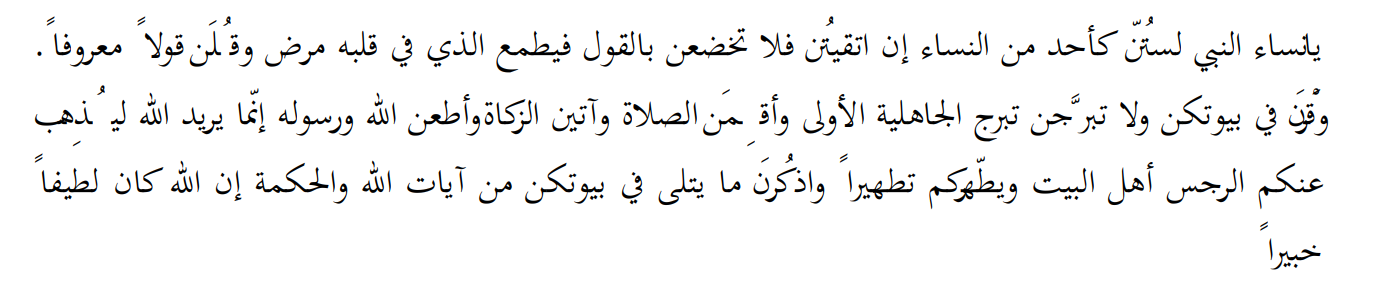
"Ya matan Annabi, ba ku kamar kowacce mace. Idan kun kasance masu tsoron Allah, to kada ku yi taushin magana, don kada wanda ke da cuta a zuciyarsa ya yi sha'awa, amma ku faɗi magana ta gaskiya. Ku zauna a cikin gidajenku, kada ku yi ado da fitowa kamar yadda mata suka yi a zamanin jahiliyya na farko, ku tsayar da salla, ku bayar da zakka, ku yi wa Allah da Manzonsa biyayya. Lalle Allah yana so kawai ya kawar da datti daga gare ku, ya ku mutanen gida, ya tsarkake ku sosai. Ku tuna abin da ake karantawa a gidajenku na ayoyin Allah da hikima. Lalle Allah Mai lura ne, Masani ne." [Kur'ani 33:32-34]
"O wives of the Prophet, you are not like any other woman. If you fear (Allah) then be not too complaisant of speech lest one in whose heart is a disease should be moved with desire but speak a speech (that is) just. And stay quietly in your houses and make not a dazzling display like that of the former times of ignorance, and establish prayer and give the zakat and obey Allah and His Messenger. Verily Allah only wishes to remove filth from you, O family of the house, and purify you completely. And remember what is recited in your homes of the signs of Allah and the Wisdom. Verily Allah is Courteous, All-Knowing" [TMQ 33:32-34].
Babu wata alaka a kowace hanya tsakanin wannan ayar da kuma kasancewa ba ya kuskure (isma). Ba zai yiwu a fahimci daga maganarSa "don ya kawar muku da ƙazanta" cewa yana nufin ya sa ku ba ku kuskure ba. Hakika, kawar da ƙazanta shi ne kawar da dukkan datti, kuma ma'anar a nan ƙazanta ce ta misali, watau shakka da zato, kamar yadda yake bayyana a fili daga jimlolin da suka gabaci wannan jumla a cikin ayoyi biyun. Tsarkakewa a nan shi ne tsarkakewa daga shakka da zato, domin ma'anar kalmar ƙazanta ita ce ƙazanta ta zahiri, ƙazanta ta misali, har ma da azaba, kamar yadda ta zo a cikin Alƙur'ani da waɗannan ma'anoni. Allah (SWT) ya ce:
There is no relationship between this ayah and infallibility in any way whatsoever. It is not possible to understand from His statement “to remove filth from you” i.e. to make you infallible. Rather the removing of filth is the removing of all dirt and the meaning here is metaphorical filth i.e. doubt and suspicion as is explicitly clear in the sentences before this sentence in the two ayat. The purification here is cleansing from doubt and suspicion because the meaning(s) of the word filth is material filth, metaphorical filth and even punishment as it has come in the Qur’an with these meanings. Allah (swt) said:
Ku nisanci ƙazantar gumaka. [TMQ 22:30]
"Avoid the filth of the idols" [TMQ 22:30]
Da kuma:
And:
Haka kuma Allah yana sanya ƙazanta a kan waɗanda ba sa yin imani. [Suratul An'am 6:125]
"Similarly does Allah ordain the filth upon those who do not believe" [TMQ 6:125].
A cikin waɗannan ayoyi biyu, ƙazanta ta kasance ƙazanta ta misali. Allah (SWT) ya ce:
In these two ayat, filth is metaphorical filth. And Allah (swt) said:
Ko naman naman alade, domin lallai shi abin ƙazanta ne. [TMQ 22:30]
"Or the meat of pig for verily it is filth" [TMQ 22:30]
wato, watau najasa ta zahiri, wato datti ta jiki. Allah (SWT) ya ce:
i.e. ritual impurity meaning physical filth. And Allah (swt) said:
"Ta haka Allah yake sanya fushi a kan waɗanda ba su yi imani ba" [TMQ 6:125].
"Thus Allâh puts the wrath on those who believe not" [TMQ 6:125].
To nufin cire ƙazanta daga gare ku a cikin ayar tana nufin cire ƙazanta ta alama, wato shakka. Amma game da faɗinSa: "Kuma ya tsarkake ku sosai", kalmar yutahirukum (ya tsarkake ku) da kalmar tsarkakewa (tathir) ba su taɓa zuwa da ma'anar kasancewa ba kuskure, ba a harshen Larabci ba, ba a cikin Alƙur'ani ba, ba kuma a cikin Hadisi ba. A harshe, tahara (tsarkakewa) wani abu, tatheera (tsarkakewa) yana nufin cire ƙazanta daga gare shi, mace tahir (mai tsarki) daga haila, kuma tahira (mai tsarki) daga ƙazanta da lahani, tahara kuma a shari'a yana nufin cire hadath. Annabi ﷺ ya ce:
So His statement in the ayah “to remove the filth from you” means to remove metaphorical filth i.e. suspicion. As for His saying: “And purify you completely” verily the word yutahirukum (to purify you) and the word purification never came with the meaning of infallibility, neither in the language, Qur’an or the Hadith. In the language, to purify (tahara) something purification (tatheera) means to remove impurity from it, and the woman is pure (tahir) from menstruation and (tahira) from impurity and defects, and (tahara) in the Shar’a is removing the (hadath). He (saw) said:
Allah ba ya karɓar salla ba tare da tsarki ba (tuhur).
“Allah does not accept prayer without purity (tuhur)”
Kuma an zo da wannan ma'ana a cikin Alkur'ani. Allah (SWT) ya ce:
And it has come in the Qur’an with this meaning. Allah (swt) said:
"Ka tsarkake tufafinka." [TMQ 74:4]
"And purify your garment" [TMQ 74:4]
Da kuma:
And:
"Ruwa domin ku tsarkaku da shi" [TMQ 8:11]
"Water so that you may be purified by it" [TMQ 8:11]
Da kuma:
And:
Kada ku kusance su har sai sun tsarkake kansu. [TMQ 2:222]
Do not approach them until they purify themselves [TMQ 2:222]
"Ya zaɓe ka, ya tsarkake ka" [TMQ 3:42
"Chose you and purified you" [TMQ 3:42
ma'ana, daga kurakurai kuma:
i.e. from faults and also:
"Kuma idan kun kasance (junub) to ku tsarkake kanku" [TMQ 5:6]
"And if you are (junub) then purify yourselves" [TMQ 5:6]
Watau daga najasa. Tsarkakewar muminai ta zo ma lokacin da Allah (SWT) ya ce:
I.e from the impurity. The purification of the believers also came when Allah (swt) said:
"Allah ba ya nufin ya sanya muku wahala (haraji) amma yana son ya tsarkake ku, kuma ya cika ni'imarsa a kanku" [TMQ 5:6].
"Allah does not wish to make difficulty (haraj) for you but rather He wishes to purify you and complete His blessing upon you" [TMQ 5:6].
Duk waɗannan rubutun sun nuna cewa ma'anar āyar ita ce Allah (SWT) ya tsarkake su daga shakka da zato, kuma sun musanta cewa ma'anarta ita ce kasancewa maras kuskure (ismah), don haka āyar ba ta nuna kasancewa maras kuskure ba.
All these texts specify that the meaning of the ayah is that Allah (swt) cleansed them from doubt and suspicion, and negates that its meaning is infallibility hence the ayah does not indicate infallibility.
Saboda haka babu wata shaida daga nassi ga kasancewar kariya daga kuskure ga kowa; akwai shaidar hankali kawai a kanta. Hankali ne yake tilasta cewa a samu kariya daga kuskure wajen isar da saƙo ga Annabi da Manzo, domin kasancewarsa Annabi da Manzo yana bukatar ya zama mara kuskure, in ba haka ba ba zai iya zama Annabi ko Manzo ba. Hankali ne yake tilasta cewa wanda ba a ba shi nauyin isar da saƙo daga Allah (SWT) ba, ba a yarda ya zama mara kuskure ba, domin shi mutum ne, kuma halittarsa (fitra) wadda Allah (SWT) ya halicce shi da ita ita ce kuskure da mantuwa su faru a cikinsa. Kuma muddin ba a ba shi nauyin saƙo daga Allah (SWT) ba, to babu wani abu da yake bukatar ya zama mara kuskure. Idan aka ce shi mara kuskure ne, to wannan yana nufin an ɗora masa nauyin saƙo daga Allah, wanda hakan ba a yarda da shi ba, tun da babu wani Annabi bayan Muhammadu, Manzon Allah ﷺ. Allah (SWT) ya ce:
Therefore there is no textual evidence for the existence of infallibility for anyone; there is only rational proof for it. The mind is what compels that there be infallibility in conveyance for the Prophet and Messenger as his being a Prophet and Messenger requires that he be infallible otherwise he cannot be a Prophet or Messenger. The mind is the one which compels that one not given the responsibility to convey a message from Allah (swt) is not allowed to be infallible as he is a human being, and his nature (fitra) with which Allah (swt) created him is that error and forgetfulness occur in him. And as long as he is not given responsibility with a message from Allah (swt), this means there is nothing which requires that he be infallible. If it is claimed that he is infallible, then this means that he is responsible with a message from Allah which is not permitted since there is no Prophet after Muhammad, the Messenger of Allah (saw). Allah (swt) said:
Amma shi Manzon Allah ne kuma shi ne ƙarshen Annabawa ﷺ [TMQ 33:40].
" But he is the Messenger of Allah and seal of the Prophets" [TMQ 33:40].
Claiming infallibility is claiming Messengership, since the Messenger is a conveyor from Allah, and within him, by virtue of his attributes as a human being, there is the potential for error and misguidance in conveying from Allah. Protecting the message of Allah from error and change in its conveyance requires that the Messenger be infallible from error and misguidance. For this reason alone, infallibility is an attribute of the Messenger, and it alone requires infallibility. If it is claimed for anyone other than him, while it is known that the only matter requiring it is conveying the message from Allah, then this is equivalent to claiming for that other person what requires infallibility and its cause, i.e. conveying the message. Thus it would be claiming that he is responsible for conveying a message from Allah (SWT). Therefore it is not permissible to require infallibility of the Khalifah, since requiring it means that he is responsible for conveying a message from Allah (SWT), thus requiring him to be infallible, and this is not permitted.
Claiming infallibility means claiming Messengership since the Messenger is a conveyor from Allah, and there is within him due to his attributes as a human being the potential of error and misguidance in conveying from Allah, protecting the message of Allah from error and change in the conveyance requires that the Messenger be infallible from error and misguidance. For this reason alone, infallibility is an attribute of the Messenger and it alone requires infallibility. If it is claimed for anyone other than him while being known that the only matter requiring it is conveying the message from Allah then it is equivalent to claiming for this other person what requires infallibility and its cause i.e. conveying the message. Thus it would be claiming that he is responsible to convey a message from Allah (swt). Therefore it is not allowed to require infallibility for the Khalifah as requiring it means that he is responsible to convey a message from Allah (swt) thus requiring him to be infallible, and this is not permitted.
Wannan ya bayyana cewa Khalifa mutum ne wanda zai iya yin kuskure ko kuma ya yi daidai, kuma yana iya faruwa daga gare shi abin da ke faruwa daga kowane mutum na sakaci da mantuwa, ƙarya, cin amana, zunubai, domin shi mutum ne ba Annabi ko Manzo ba. Manzon Allah ﷺ ya sanar da cewa yana yiwuwa Imam ya yi kuskure, kuma ya sanar da cewa na iya faruwa daga gare shi abin da zai sa mutane su ƙi shi su la'ance shi saboda zalunci, zunubai da sauransu. Ya ma sanar da cewa kafirci bayyananne na iya faruwa daga gare shi. Muslim ya ruwaito: Zuhayr bin Harb ya ba ni labari cewa Shababa ya ba mu labari cewa Warqa ya ba ni labari daga Aby Zayyad daga Al-'Araj daga Abu Hurayra daga Manzon Allah ﷺ wanda ya ce:
This makes it clear that the Khalifah is a human being who can make a mistake or be correct, and it is allowed to occur from him what occurs from any human being of neglect and forgetfulness, falsehood, treachery, sins as he is a human being and not a Prophet or Messenger. The Messenger (saw) informed that it is possible for the Imam to err, and he informed that it may occur from him what may cause people the hate him and curse him due to injustice, sins etc. He even informed that clear disbelief may occur from him. Muslim narrated: Zuhayr bin Harb related to me that Shababa related to us that Warqa related to me from Aby Zayyad from Al- ‘Araj from Abu Hurayray from the Prophet (saw) who said:
Lalle Imam garkuwa ne, ana yaƙi a bayansa, kuma ana kāriya da shi. Idan ya umarta da taqwa ga Allah ‘azza wa jalla, kuma ya yi adalci, to yana da lada saboda hakan. Idan kuwa ya umarta da wani abu banda haka, to akwai irin wannan (azaba) a kansa.
“Verily the Imam is a shield from behind whom they fight and by whom they are protected. If he commanded with the fear (taqwa) of Allah ‘azza wa jalla and does justice then there is reward for that for him. If he commands with other than that, then there is the same against him.”
Wannan yana nufin cewa Imam ba ya da kariya daga kuskure, kuma yana yiwuwa ya umarci wani abu sabanin tsoron Allah. Muslim ya kuma ruwaito: Uthman bin Abi Sheeba ya ba mu labari cewa Jareer ya ba mu labari daga Al-‘Amash daga Zayd bin Wahhab daga Abdullah wanda ya ce: Manzon Allah ﷺ ya ce:
This means that the Imam is not infallible and it is possible for him to command other than the fear of Allah. Muslim also narrated: Uthman bin Abi Sheeba related to us that Jareer related to us from Al-‘Amash from Zayd bin Wahhab from Abdullah who said: The Messenger of Allah (saw) said:
Lalle, bayan raina za a samu wasu fifiko marasa adalci da abubuwa waɗanda za ku ƙi. Suka ce: Ya Manzon Allah, me za ka umurce mu da shi idan hakan ya same mu? Ya ce: Ku cika haƙƙoƙin da ke kanku, kuma ku roƙi Allah abin da ke haƙƙinku.ﷺ
“Verily there will be after me some improper preferences and matters which you will reject. They said: O Messenger of Allah, what would you command anyone of us when that reaches him? He said: Fulfill the rights due from you and ask Allah (for) what is due to you.”
Muslim ya ruwaito: Ishaq bin Ibrahim Al-Handhali ya ba mu labari cewa Isa bin Yunus ya sanar da mu cewa Al-Awza'i ya ba mu labari daga Zayd bin Yazid bin Jabir daga Zareeq bin Hayyan daga Muslim bin Qurta daga 'Awf bin Malik daga Manzon Allah ﷺ wanda ya ce:
Muslim narrated: Ishaq bin Ibrahim Al-Handhalee related to us that Isa bin Yunus informed us that Al-Awza’i related to us from Zayd bin Yazid bin Jabir from Zareeq bin Hayyan from Muslim bin Qurta from ‘Awf bin Malik from the Messenger of Allah (saw) who said:
Mafi kyau daga cikin shugabanninku su ne waɗanda kuke ƙauna kuma suke ƙaunarku, waɗanda suke yi muku addu'a kuma ku yi musu addu'a, kuma mafi muni daga cikin shugabanninku su ne waɗanda kuke ƙi kuma suke ƙinku, waɗanda kuke la'antar su kuma suke la'antar ku. An tambaya (ta waɗanda suke wurin): Ba za mu kifar da su ba da taimakon takobi? Ya ce: A'a, matuƙar suna tsayar da salla a cikinku. Idan kuka ga wani abu abin ƙyama a cikinsu, to ku ƙi tafiyar da mulkinsu, amma kada ku janye kanku daga biyayyarsu.
“The best of your rulers are those whom you love and who love you, who invoke God's blessings upon you and you invoke His blessings upon them. And the worst of your rulers are those whom you hate and who hate you and whom you curse and who curse you. It was asked (by those present): Shouldn't we overthrow them with the help of the sword? He said: No, as long as they establish prayer among you. If you then find anything detestable in them. You should hate their administration, but do not withdraw yourselves from their obedience.”
Al-Bukhari ya ruwaito: "Isma'il ya ba mu labari cewa Ibn Wahhab ya ba ni labari daga Amru, daga Bukayr, daga Busr bin Sa'id, daga Junada bin Abu Umayyah, wanda ya ce: Mun shiga wajen 'Ubadah bin As-Samit, wanda yake rashin lafiya, sai muka ce: Allah ya sa ka warke. Ka ba mu labarin wani hadisi da ka ji daga Annabi ﷺ wanda Allah zai amfanar da kai da shi. Ya ce:"
Al-Bukhari narrated: “Ismail related to us that Bin Wahhab related to me from Amru from Bukayr from Busr bin Said from Junada bin Abu Umayyah who said: We entered to ‘Ubadah bin As-Samit who was ill and we said: May Allah improve you. Relate to us a hadith which you heard from the Prophet by which Allah will help you. He said:
"Annabi ﷺ ya kira mu, sai muka yi masa mubaya'a. Ya ce a cikin abin da ya karɓa daga gare mu cewa mun yi masa mubaya'a na ji da biyayya a cikin abin da yake burge mu da abin da muke ƙi, a cikin wahala da sauƙi, da kuma lokacin da aka fifita wasu a kanmu, da cewa ba za mu yi jayayya da umarni ga masu iko ba. (Ya ce): Sai dai idan kun ga kafirci bayyananne (kufr bawah) wanda kuke da hujja bayyananniya (sultan) daga Allah a kansa."
“The Prophet (saw) called us so we gave him a pledge. So he said in what we took from us that we pledged him to hear and obey in what attracts us and what we hate, in hardship and ease, and when others are preferred over us and that we do not dispute the rule with those in authority (He said): Unless you see clear disbelief (kufr bawah) upon which you have from Allah a clear proof (sultan).”
Kuma daga Aisha, wadda ta ce: "Manzon Allah ﷺ ya ce:
And from Aisha who said: “The Messenger of Allah (saw) said:
"Ku kauce wa hukunce-hukuncen shari'a a kan Musulmi gwargwadon iyawa. Idan yana da hanyar fita, to ku bar shi a kan hanyarsa, domin idan Imam ya yi kuskure wajen yafewa, ya fi kyau a kan ya yi kuskure wajen hukunci."
" Avert the legal penalties from the Muslims as much as possible, if he has a way out then leave him to his way, for if the Imam makes a mistake in forgiving it would be better than making mistake in punishment.”
Tirmizi ya rawaito wannan hadisi wanda ke nuna a fili cewa Imam na iya yin kuskure, ya manta, kuma ya yi zunubi. Duk da haka, Manzo ﷺ ya umarci a ci gaba da biyayya gare shi muddin yana mulki da Musulunci, kuma kafirci bayyananne bai faru daga gare shi ba, kuma bai umarci zunubi ba. Bayan labarin Manzo ﷺ game da Khulafa'u cewa za a samu wasu da Musulmi za su ƙi, duk da haka ya umarci biyayya, shin akwai wata dama bayan haka na cewa Khalifa dole ne ya zama ba ya yin kuskure, kuma cewa ba a halatta daga gare shi abin da ake halatta ga mutane ba? Wannan yana daga cikin hakikanin Khalifa dangane da rashin sharadin rashin kuskure, ma dai ma rashin izinin sanya shi sharadi kwata-kwata. Duk da haka, waɗanda suka ce wajibi ne Khalifa ya zama ba ya kuskure sun gabatar da hujjoji ga ra'ayinsu, don haka dole ne mu bincika mu bayyana abin da ke cikinsu. Waɗannan hujjoji an taƙaita su cikin hujjoji huɗu.
Tirmidhi narrated this hadith which is clear that the Imam can err, forget and sin. Despite that, the Messenger (saw) commanded to continue obeying him as long as he rules by Islam and clear disbelief has not occurred from him and he has not commanded with sin. After the news of the Messenger (saw) about the Khulafaa that there will be some which the Muslims will dislike yet he commanded obedience, is there after that any possibility of saying that the Khalifah must be infallible and that it is not permitted from him what is permitted from human beings? This is from the reality of the Khalifah in relation to the absence of the condition of infallibility, rather even the absence of permission to even make it a condition. However, those who said it is required that the Khalifah be infallible have presented evidences for their view, so we must examine and clarify what is within them. These evidences are summarised in four evidences:
1. Limamin yana tsaye a matsayin Manzo wajen kiyaye Shari'ah, isar da ita da koyar da ita, sa ido kan al'amuran al'umma, kafa adalci a tsakaninsu, taimakon wanda aka zalunta, kafa hukunce-hukuncen hudood na wajibi da ta'zeer na tsawatarwa, da aiwatar da Musulunci bisa tafarkin Shari'ah. Saboda haka ya zama dole ya kasance ba shi da kuskure kuma tsarkakke daga dukkan sharri, babba ko karami, ko an aikata shi da gangan ko ta hanyar mantuwa, tun daga farkon rayuwarsa har zuwa karshenta.
1. The Imam stands in the position of the Messenger in preserving the Shari’ah , conveying and teaching it, supervising the citizens’ affairs, establishing justice among them, assisting the oppressed, establishing the mandatory Islamic punishments (hudood) and discretionary punishments (ta’zeer) and implementing Islam in the Shari’ah way. Therefore it is inevitable that he be infallible and pure from all evil, large or small, whether they occurred deliberately or through forgetfulness, from the beginning of his life to the end.
Alkawarina ba ya shafar azzalumai. [TMQ 2:124]
"My promise does not include the oppressors" [TMQ 2:124]
Maganar Allah (SWT) tana cikin hujja a kan wajabcin kasancewar wani Imam maras kuskure, wanda ke kare Shari'ah. Wannan ayar tana cikin Suratul Baqara. Allah (SWT) ya ce:
The statement from Allah (swt) is an evidence upon the obligation of an infallible Imam who is a protector of Shari’ah. This ayah is in Surah Al-Baqarah. Allah (swt) said:
Kuma a lokacin da Ibrahim Ubangijinsa ya jarabce shi da wasu kalmomi, ya cika su. Ya ce: "Lalle ni, zan sanya ka shugaba ga mutane." Ya ce: "Kuma daga zuriyata fa?" Ya ce: "Alkawarina ba zai kai ga azzalumai ba."
"And when Ibrahim was tested by his Lord with certain words which he fulfilled. He said: I will make you an Imam for the people. He said: And of my offspring? He said: My promise will not reach the oppressors" [TMQ 2:124].
Kalmomin "yana sa shi" su ne waɗanda ke mai da shi Imam, kamar yadda ayar da ta zo bayan wannan ayar ta nuna. Sa'ad da Ibrahim ya ji maganar Allah:
The words making him are those making him an Imam as the ayah coming after this ayah give sense to. When Ibrahim heard Allah’s statement:
Lalle ni zan sanya ka zama Imami ga mutane. [TMQ 2:124]
"Verily I will make you an Imam for the people" [TMQ 2:124]
Kuma ya ga girman wannan matsayi mai daraja; ya yi fatan zuriyarsa su samu rabo daga gare shi. Sai Allah (SWT) ya ce:
And saw the greatness of this honourable post; he hoped that his descendants would have a share of it. So Allah (swt) said:
"Alkawarina bai isa ga azzalumai ba" [TMQ 2:124].
"My promise does not reach the oppressors" [TMQ 2:124].
Ma'anarsa ita ce wannan matsayi ba za a ba wanda yake da aibi ko wanda zai gurbata da zalunci ba, wanda ya fi fadi fiye da batun ko wannan mutum yana zalunci ga kansa ko ga wani, koda kuwa na dan lokaci ne kawai a rayuwarsa. Abin nufi shi ne, ana bayar da shi ga wanda ba ya aikata wani zalunci a rayuwarsa ba.
Its meaning is that this post will not be given to someone who is blemished or will become stained with injustice, which is more general than whether this one is unjust to his own soul or someone else even if only for a short time in his life. Rather it is given to someone who does not do any injustice in his life.
b) Allah (SWT) ya ce:
b) Allah (swt) said:
"Shin wanda ya ke shiryarwa zuwa ga gaskiya ya fi cancanta a bi shi, ko kuwa wanda ba ya shiryarwa sai an shiryar da shi?" [TMQ 10:35].
"Is the one guided to the Truth of more right to be followed or the one who does not guide unless he is guided?" [TMQ 10:35].
Wannan hujja ce kan wajabcin kasancewar Imam ba ya yin kuskure (ma'asumi), domin shi yana shiryarwa zuwa gaskiya, amma wanda kuskure ke iya faruwa a gare shi ba ya shiryarwa zuwa gare ta, ko da yake yana iya faruwa cewa ya kai ga gaskiya.
This is an evidence for the obligation of the infallibility of the Imam as he guides to the truth, and the one from whom an error is possible does not guide to it though it may happen that he achieves the truth.
c) Allah (SWT) ya ce:
c) Allah (swt) said:
"Ku yi biyayya ga Allah, ku yi biyayya ga Manzon Allah ﷺ, da kuma masu iko daga cikinku" [TMQ 4:59].
"Obey Allah and obey the Messenger and those in authority among you" [TMQ 4:59].
Wannan aya hujja ce kan rashin kuskuren waɗanda ke da iko, watau rashin kuskuren Imam, domin Allah (SWT) ya umurci a yi biyayya ga waɗanda ke da iko ba tare da iyakancewa ba, ba tare da ƙayyade biyayyar ga wani mutum ko wani lokaci ba. Wannan yana buƙatar cewa wanda ake biyayya da shi ya zama marar kuskure, domin mai kuskure zai iya umurtar da aikata zunubi da kuskure. Idan aka wajabta biyayyarsa alhali kuwa wannan halin nasa haramun ne, wannan yana nufin cewa Ubangiji wanda al'amarinsa ya ɗaukaka ya umurta da haɗa abubuwa biyu masu adawa da juna ko masu karo da juna, kuma hakan ba zai yiwu ba. Saboda haka, wanda ake biyayya da shi dole ne ya zama marar kuskure. Haka kuma, Allah (SWT) ya haɗa biyayyar waɗanda ke da iko da biyayyar Manzon Allah ﷺ, wanda biyayyarsa kuma an haɗa ta da biyayyar Allah (SWT), kuma wannan yana buƙatar ɗaukaka. Waɗanda ake nufi da masu iko a nan su ne Imamai marasa kuskure. Waɗannan su ne hujjojin waɗanda ke cewa sharaɗin Imam shi ne ya zama marar kuskure. Amsar kowane ɗayan waɗannan hujjoji an taƙaita ta kamar haka:
This ayah is an evidence for the infallibility of those in authority i.e. infallibility of the Imam, because Allah (swt) commanded the obedience of those in authority in an unrestricted manner without specifying the obedience for a specific or period. This requires that the obeyed one is infallible as a fallible one can command with sin and error. If his obedience was obliged while this is (his) situation though it is forbidden, this obliges that the Lord whose matter is glorified has commanded to combine two opposites or contradictory matters which is impossible. The obeyed one must be infallible. Also, Allah (swt) linked obedience to those in authority with obedience to the Messenger (saw) whose obedience is linked to His (swt) obedience which requires exaltation. Those meant in authority here are the infallible Imams. These are the evidences of those who say that it is a condition that the Imam be infallible. The response to each one of this is summarised in the following:
Da farko: Khalifah yana maye gurbin Manzo a mulki ta hanyar aiwatar da Shari'ah, ba ta hanyar isar da ita daga Allah (swt) ba; shi Khalifan Manzo (saw) ne a mulki, ba a isar da sako daga Allah (swt) ba. Wannan ba ya bukatar ya zama maras kuskure, domin ofishin mulki ba ya bukatar rashin kuskure, ko ta hanyar hankali ko ta hanyar Shari'ah. Gaskiya ne akwai wasu halaye da ake bukata ga Khalifah, wato: Musulunci, kasancewa namiji, 'yanci (ba bawa ba), balaga (watau ya kai shekarun balaga), hankali, adalci da iya aiki. Kowace daga cikin wadannan halaye an wajabta ta ne bisa dalilai daga Shari'ah. Sai dai wajabta wadannan sharuda ba ya nufin Khalifah ba zai iya saba musu ba; abin da suke nufi shi ne wanda yake rike da wannan matsayi yana wajabta ya kasance da wadannan halaye a lokacin da aka nada shi, ba cewa ba zai iya rasa su ba. Yana yiwuwa ya rasa su, a lokacin ko dai ya cancanci a cire shi, ko kuma ya bar Khilafah (watau ba ya ci gaba da kasancewa Khalifah). Wajabta wadannan halaye ga Khalifah kamar wajabta adalci ga shaida ne dangane da bayaninsa da shi domin a karbi shaidarsa; wannan ba ya nufin a bukaci ya zama maras kuskure daga saba masa. Saboda haka matsayin Khalifah a wurin Manzo a mulki ba shaida ba ce cewa dole ne ya zama maras kuskure. Dangane da isar da Shari'ah da Musulmai ke yi, ba isar da ita daga Allah (swt) ba ce. Maimakon haka, aiki ne na abin da Allah (swt) ya bukaci Musulmai su yi na yada da'wah ga bil'adama, koyar da su tunanin Musulunci da dokokinsa, kuma ba zai taba nufin wani abu daban ba. Ba isarwa ce daga Allah (swt) ba; a maimakon haka, nauyi ne daga cikin nauyayyakin da Manzo (saw) ya zo da su, kuma ba kamar isar da Manzo (saw) ya yi daga Allah (swt) ba. Saboda haka ba ya bukatar rashin kuskure; aikata shi kamar aikata sauran nauyayyakin Shari'ah ne. Ba a wajabta wa Khalifah a matsayinsa na Khalifah ba; sai dai ya wajaba ga kowane Musulmi mai ilimin Shari'a. Ana umurtar Khalifah ya isar da Shari'a a matsayinsa na Musulmi; wannan a matsayinsa na malami idan yana malami, domin isarwa wajibi ne ga Musulmin da ya san Shari'a a cikin abin da ya sani. Ma'asumci ba ya wajaba ga masu isarwa, kuma ba sharaɗi ba ne a gare su. Amma ɗaukar da'awar Musulunci da ta wajaba a kan Khalifah a matsayinsa na Khalifah, wannan ya wajaba a kansa a matsayinsa na shugaba wanda ikon yana hannunsa. Ya wajaba a kansa ya ɗauke ta ta wata hanya ta musamman, watau jihadi, wanda ba ya buƙatar ma'asumci. Ma'ana, babu wurin da za a buƙace shi.
"Lallai za a naɗa muku shugabanni. Za ku san (wasu daga cikin abin da suke yi) kuma ku ƙi (wasu daga cikin abin da suke yi). Duk wanda ya ƙi munkar da take daga gare su zai kuɓuta daga laifi, kuma duk wanda ya yi inkari da ita zai sami tsira; amma duk wanda ya yarda da ita kuma ya bi su (ba zai kuɓuta daga laifi ko ya sami tsira ba). Suka ce: Ya Manzon Allah, ba za mu yaƙe su ba? Ya ce: A'a, matuƙar suna yin salla."
“Verily there will be appointed rulers over you. You will recognise (some of what they do) and deny (some of what they do). Whoever dislikes (the munkar from them) will be guiltless, and whoever denies it will be safe; but whoever is pleased and follows (will not be guiltless or safe). They said: O Messenger of Allah, should we not fight them? He said: No, not as long as they prayed.”
Ta haka Shari'a ta bayyana hanyar hana Khalifa aikata zunubai. Ba ta hanyar kasancewar wani Imam da zai hana shi ba, sai dai al-Ummah ce ke yin haka. Duk wanda ya ce Khalifa yana bukatar wani Khalifa domin ya hana shi aikata zunubai, bai fahimci ma'anar hukunci ba, kuma bai da cikakkiyar masaniya a kansa, domin Khalifa ba ya hana wani Khalifa, sai dai ya yi yaki da shi saboda mulki. Ko kuma ya bi shi, ta yadda zai zama gwamna ko Wali, ba Khalifa ba, ko kuma ya yi yaki da shi saboda tawaye. To ta yaya za a yi tunanin cewa Khalifa yana hana wani Khalifa aikata zunubai?
Through this the Shar’a clarified the method to prevent the Khalifah form committing sins. It is not via the existence of an Imam who prevents him but rather the Ummah does that. The one who says that the Khalifah requires another Khalifah to prevent him from committing sins does not understand what ruling means and he does not have a vision of it because the Khalifah does not prevent another Khalifah but rather he fights him over for the rule. Or he follows him, thereby becoming a governor or Wali not the Khalifah, or he fights him for rebellion. So how can one imagine that a Khalifah prevents another Khalifah from committing sins?
Na uku: Imamanci ba matsayi ne na Ubangiji ba, matsayi ne na ɗan adam. Ba ya nan don kare hukuncin Shari'a, face don aiwatar da Shari'ar da Allah (swt) ya saukar wa Ubangijinmu Muhammad ﷺ. Dangane da kare Shari'a kuwa, lalle Allah (swt) yana tabbatar da kare ta, domin Ya tabbatar da kare Alƙur'ani. Allah (swt) ya ce:
Thirdly: The Imamah is not a divine post but a human one. It does not exist to protect the Shari’ah rule but rather to implement the Shari’ah which Allah (swt) revealed to our master Muhammad (saw). As for the protection of the Shari’ah, verily Allah (swt) guarantees to protect it when He (swt) guarantees to protect the Qur’an. Allah (swt) said:
"Lalle Mu ne Muka saukar da Ambato, kuma lalle Mu ne masu kiyaye shi" [TMQ 15:9].
"Verily We revealed the Remembrance and We will be its protector" [TMQ 15:9].
Hadafin kafa Khalifah ba shi ne a naɗa shi domin ya kare duk abin da Annabi (saw) ya zo da shi, har a ce wajibi ne ya san dukkan hukunce-hukunce kuma ya zama mai kare su duka ba. Hadafin naɗa shi shi ne kafa hukunce-hukuncen Littafi da Sunna, watau aiwatar da Musulunci da isar da da'awarsa zuwa ga duniya, wanda kuma ba ya buƙatar ya san dukkan hukunce-hukunce ko ya kare su duka. Saboda haka, ba a bukatar ya zama marar kuskure, don haka naɗa shi ba lallai ne ya saɓa wa hadafin da aka naɗa shi domin shi ba. Amma game da amincewar mutane da shi, har su ɗauki dukkan hukunce-hukunce daga gare shi a matsayin hukunce-hukuncen Allah (swt) a zahiri ba tare da wata shakka ba wadda ke hana aiki da bin su, wannan ba ya fitowa daga ko Khalifah marar kuskure ne ko mai kuskure. Maimakon haka, yana fitowa ne daga hujjar hukuncin kansa: idan hujja ce ta Shari'a kuma an ciro ta ta hanyar ƙa'idar istidlali ta Shari'a, mutane za su amince cewa wannan hukunci hukunci ne na Shari'a, kuma babu wata shakka da za ta shiga cikinsu da ta hana su aiki da shi da bin sa, ba tare da sun duba wane ne Khalifah ba, ko da shi kansa ya saɓa da hukuncin da suka ciro. Wannan saboda sabanin ra'ayi a cire hukunci ba ya sa hukunci ya zama halal wurin wani mujtahidi, ya zama haram wurin wani. Maimakon haka, hukunci ne na Shari'a a wurin dukkan Musulmai muddin akwai (ko da) hujja mai ɓoye-ɓoye (shubhat dalil) daga hujjojin Shari'a a gaban wanda ya ciro hukuncin, kuma yana yiwuwa bisa ilimin harshe da na Shari'a a ciro irin wannan istidlali. Dangane da kasancewarsa mai kuskure saboda yiwuwar zunubi da kuskure a kansa, har hakan ya kai ga rashin amincewa da shi, kuma ba a tabbatar cewa abin da yake jagoranta shi ne shari'ar Allah (swt) ba, batun a nan batun hukunci ne da mai mulki: wato hukuncin da yake yi da shi da abin da yake kaiwa, da mai mulkin da yake mulki yana kaiwa. Amanar da ake nema ba ita ce ko shugaba ya kai ga dokar Allah (swt) ba, ko yana yin hukunci da ita ko a'a. Abin la'akari shi ne kawai dokar da yake yin hukunci da ita kuma yake karɓa dangane da ita, ko dokar Musulunci ce ko a'a. Ba ya dogara ga mutumin da ya bayar da ita ko shi maras kuskure ne ko a'a. Abin da ke sa mutane su amince da dokar gaba ɗaya, har shakka ba ta shiga cikinta ba wadda za ta hana su aiki da ita ko bin ta, shi ne la'akarinsu ga dokar kanta ko halal ce ko a'a. Ba ya dogara ga ko Khalifah da suke karɓar dokar daga gare shi maras kuskure ne ko a'a.
The objective in establishing the Khalifah is not that he is appointed to protect all that the Prophet (saw) came with such that it is said that it is obligatory for him to know all the rules and be a protector for all of them. Rather the objective in establishing him is to establish the rules of the Book and Sunnah i.e. to implement Islam and carry its da’wah to the world which does not require from him to know all the rules and protect all of them. Therefore it is not required for him to be infallible so accordingly appointing him does not neccesarily mean contradicting the objective for which he was appointed. As for the people’s trust in him such that they take all rules from him as the rules of Allah (swt) in reality without any doubt which prevents acting upon and following them, this does not come from the Khalifah being infallible or fallible. Rather it comes from the evidence of the rule itself; if it is a Shari’ah evidence and has been deduced by a Shari’ah deduction, the people will trust that this rule is a Shari’ah rule and no doubt will enter into them in this situation preventing them from acting upon and following it without looking to who the Khalifah is, even if he himself differs from the rule they deduced. This is because a difference of opinion in deduction does not make a rule legitimate before a mujtahid and illegitimate before another. Rather it is a Shari’ah rule before all Muslims as long as there is (even) obscure evidence (shubha daleel) from the Shari’ah evidence before the deducer of the rule and it is possible according to the linguistic and Shari’ah knowledge's that one can deduce this type of deduction. As for his being fallible due to the possibility of sin and error upon him leading to lack of trust in him, and that one is not definite that what he leads to is the law of Allah (swt), the issue here is one of the rule and the ruler i.e. the rule he rules by and arrives at and the ruler who rules and arrives at. The trust sought is not whether the ruler arrives at Allah’s (swt) law or whether he rules by it or not. The consideration is only in the rule which he rules by and adopts in relation to it being an Islamic law or not. It is not in relation to the person who gives it as to whether he is infallible or not. That which makes the people implicitly trust the rule so as to prevent doubt entering into it which would prevent them from acting upon or following it is their consideration of the rule itself as to whether it is legitimate or not. It does not depend on whether the Khalifah from whom they take the rule is infallible or not.
"Alkawarina bai shafi azzalumai ba" [TMQ 2:124],
"My promise does not cover the oppressors" [TMQ 2:124],
Kalmar "Imam" a cikin wannan magana ba ta nufin Khilafah ko mulki. Kalmar "Imam" ta zo a cikin Alqur'ani mai girma a ayoyi da yawa. Allah (SWT) ya ce:
The word Imam therein does not mean the Khilafah or the rule. The word Imam came in the Glorious Qur'an in many ayat. Allah (swt) said:
"Kuma kafin shi littafin Musa ya kasance jagora da rahama." [TMQ 11:17]
"And before him the book of Musa (as an) Imam and mercy" [TMQ 11:17]
Da kuma:
And:
"Kuma waɗanda ke cewa: Ya Ubangijinmu, Ka ba mu, daga matanmu da zuriyarmu, abin farin ciki ga idanunmu, Ka sa mu zama shugabanni ga masu taƙawa." [TMQ 25:74]
"And those who say: O our Lord, grant for us from our wives and our offspring the comfort of our eyes and make us Imams for the pious" [TMQ 25:74].
Ma'anar kalmar Imam a cikin wadannan ayoyi biyu shi ne shiriya. Imam Al-Bukhari ya ce: "Maganar Allah (SWT):
The meaning of the word Imam in these two ayat is a guide. Imam Al-Bukhari said: “The statement of Allah (swt):
"Kuma ka sanya mu shugabanni ga masu takawa" [TMQ 25:74].
"And make us Imams for the pious" [TMQ 25:74].
Ya ce: "Shugabanni waɗanda suke bin waɗanda suka gabace mu, kuma waɗanda suka zo bayanmu suna bin su." Kalmar "Imam" a cikin maganar Allah:
He said: Leaders who follow those before us and are followed by those after us.” The word Imam in Allah’s statement:
Kuma a lokacin da Ibrahim Ubangijinsa ya jarrabe shi da wasu kalmomi, sai ya cika su. Ya ce: "Ni zan sanya ka shugaba ga mutane." Ya ce: "Kuma zuriyata fa?" Ya ce: "Alkawarina ba ya kai ga azzalumai."
"And when Ibrahim was tested by his Lord with some words which he fulfilled. He said: I make you an Imam for the people. He said: And my descendants? He said: My promise does not cover the oppressors" [TMQ 2:124 ].
Ma'anar nan ita ce Annabci da koyi, domin ayoyin da ke biye da ita suna magana ne game da Ka'aba, da mutanen Isma'il, sannan kuma bayar da Annabci ga Ibrahim, don haka ma'anar ta zama: Mun sanya ka zama Imami wanda mutane ke koyi da shi, kuma Annabi wanda mutane ke bi. Ba zai yiwu kalmar Imami a nan ta nufi Khilafah ko mulki ba, musamman tunda Ibrahim bai taba rike mulki ba, kuma ba sarki ba ne, illa Annabi kuma Manzo. Saboda haka Allah (SWT) ya ce masa wannan matsayi wanda shi ne koyi da Annabci ba zai je ga azzalumai ba, a lokacin da ya roki Allah (SWT) ya ba zuriyarsa abin da Ya ba shi. Don haka babu wata hujja a cikin ayar kan kasancewar Khalifa ba ya yin kuskure. Bugu da kari, akasin ma'anar kalmar azzalumai shi ne amintattu, ba mutanen da ba sa yin kuskure ba. Saboda haka wadanda ba azzalumai ba ba yana nufin cewa ba sa yin kuskure ba ne; a maimakon haka yana nufin wadanda ke da halin rashin zalunci wanda shi ne adalci. Amma game da nassi na biyu, wato ayar:
The meaning here is Prophethood and example as the ayat which are after it discuss about the Ka’abah, the people of Ismail then the granting of Prophethood to Ibrahim so the meaning becomes: We made you an Imam whom the people imitate and a Prophet whom people follow. It is not possible that the word Imam here means the Khilafah or rule, especially since Ibrahim was never in charge of the rule nor was he a ruler but was a Prophet and Messenger. So Allah (swt) said to him that this post which is the example and Prophethood is not for oppressors when he requested from Him (swt) to ordain for his descendants what He ordained for him. So there is no evidence in the ayah for the infallibility of the Khalifah. Moreover, the opposite meaning for the word oppressors is trustworthy not infallible persons. So those who are not oppressors does not mean that they are infallible; rather it means those who are characterised with the absence of oppression which is justice. As for the second text which is the ayah:
"Shin wanda ake shiryarwa zuwa ga Gaskiya" [TMQ 10:35],
"Is the one guided to the Truth" [TMQ 10:35],
Ma'anarsa da Allah (SWT) ya fi sani shi ne: Shin wanda yake bin shiriya, watau Manzon Allah (SWT), shi ne ya fi cancanta a bi shi, ko kuwa wanda yake ɓata, wanda ba ya shiryarwa sai an shiryar da shi? Dukkan maudu'in shiriya ne da bin mai shiryarwa, kuma babu alaƙa da shi da mulki ko Khilafah. Imam yana mulkin mutane, aikinsa mulki ne ba shiriya ba; yana hukunta masu ɓata da masu rashin biyayya, kuma yana yaƙi da kafirai. Kalmar "mai shiryarwa" ba a amfani da ita a nan sai ga Manzo. Ma'anar ba ta shafi Khalifa ba, kuma babu alaƙa tsakanin wannan ayar da kare-karen Khalifa daga kuskure. Shin mulki shiriya ne, ko kuwa aiwatar da Shari'a ne?
Its meaning and Allah (swt) knows best is: Is the one who is following the guidance i.e. the Messenger (swt) more worthy to be followed or the one who is misguided nor does he guide except if another guides him. The whole subject is guidance and following the guide, and it has no relationship with the rule or Khilafah. The Imam rules the people and his duty is ruling not guidance; he punishes the misguided and disobedient persons, and fights the disbelievers. The word guide is not used here except for the Messenger. The meaning does not apply upon the Khalifah, and there is no relationship between this ayah and Khalifah’s infallibility. Is the rule guidance or the implementation of the Shari’ah ?
I don't see a third text in our conversation. Could you paste the ayah (the English text you'd like translated into Hausa) here, and I'll translate it for you?
As for the third text which is the ayah:
"Ku yi biyayya ga Allah, ku yi biyayya ga Manzon Allah ﷺ, da kuma masu iko daga cikinku" [TMQ 4:59],
"Obey Allah and obey the Messenger and those in authority among you" [TMQ 4:59],
Wannan umarni ne na biyayya ga masu iko, kuma an haɗa shi da biyayya ga Allah (SWT) da biyayya ga Manzo ﷺ. Hujja ce cewa hukuncinsa kamar hukuncin biyayya gare Shi (SWT) da biyayya ga Manzo ﷺ yake, ba wani abu ba. Ya zo a aikace gabaɗaya cikin ayar; sai dai wasu ayoyi da hadisai masu yawa sun takaita shi. An takaita shi ta hanyar ayoyi da hadisan da suka shafi biyayya a cikin abin da ba zunubi ba ne, kuma abin da ba kafirci ba ne; kuma bai tsaya a nan ba, sai dai ya umarci yaƙi da Imam. Ayoyi da hadisan da suka takaita shi a bayyane suke a kan haka. Allah (SWT) ya ce:
It is the command to obey those in authority, and linking this with obedience to Allah (swt) and obedience to the Messenger (saw). It is evidence that its rule is like the rule of obeying Him (swt) and obeying the Messenger (saw), nothing else. It came in practice generally within the ayah; it is, however, specified by other ayat and numerous ahadith. It was specified by those ayat and ahadith related to obedience in other than sin and other than disbelief; and it did not stop there but rather commanded fighting the Imam. The specifying ayat and ahadith are explicit upon this. Allah (swt) said:
Kada ka bi wanda muka sa zuciyarsa ta manta da ambatonmu. [TMQ 18:28]
"Do not obey the one whose heart we have made forget our remembrance" [TMQ 18:28]
Da kuma:
And:
Kada ku bi kafirai. [TMQ 25:52]
"Do not obey the disbelievers" [TMQ 25:52]
Da kuma:
And:
Kada ku yi biyayya ga maƙaryata [TMQ 68:8]
"Do not obey the liars" [TMQ 68:8]
Da kuma:
And:
Kada ku bi duk wanda ya yawaita rantsuwa, mai wulakanci. [TMQ 68:10]
"Do not obey each despicable swearer" [TMQ 68:10]
Da kuma:
And:
Kada ku yi biyayya ga kowane daga cikinsu wanda ya yi zunubi ko kafiri. [TMQ 76:24]
"Do not obey among them the sinful or the disbeliever" [TMQ 76:24]
Maganar da aka yi wa Manzo (ﷺ) magana ce ga Al'ummarsa muddin babu wata hujja da ta zo cewa ta keɓanta da shi da kuma cikin abubuwan da suka keɓance shi; kuma babu hujja da ta zo a nan cewa ta keɓance da shi, don haka magana ce ga Al'ummarsa. Al-Bukhari ya ruwaito daga Nafi' daga Abdullah (ra) daga Annabi (ﷺ) wanda ya ce:
The speech to the Messenger (saw) is the speech to his Ummah as long as there came no evidence that it is specific for him and among his specificities; no evidence came here that it is specific for him so it is a speech to his Ummah. Al-Bukhari narrated from Nafi’ from Abdullah (ra) from the Prophet (saw) who said:
Wajibi ne ga Musulmi ya ji kuma ya yi biyayya a cikin abin da yake so da abin da yake ƙi, sai dai idan an umarce shi da zunubi. Idan an umarce shi da zunubi, to babu ji ko biyayya.
“To hear and to obey is obligatory upon the Muslim person in what he likes and dislikes except if he is commanded with a sin. If he is commanded with a sin, there is no hearing or obedience.”
Kuma ya ﷺ ya ce game da biyayya ga Khalifofi da shugabanni, bisa ga abin da Muslim ya ruwaito:
And he (saw) said in the matter of obeying the Khalifahs and leaders according to what Muslim narrated:
Suka ce: Ba za mu yi yaƙi da su ba ne? Ya ce: A'a, muddin suna yin salla.
“They said: Should we not fight them? He said: Not as long as they prayed.”
Ya kuma ruwaito:
He also narrated:
An aka ce: Ya Manzon Allah, ba za mu yaƙe su da takobi ba? Ya ce: A'a, matuƙar suna tsayar da salla a cikinku.” Kuma: “…sai dai idan kun ga kafirci bayyananne.”
“It was said: O Messenger of Allah, should we not confront them with the sword? He said: Not as long as they establish the prayer over you?” and: “…except if you see clear disbelief.”
Al-Bukhari da Muslim sun ruwaito:
And Al-Bukhari and Muslim narrated:
"Duk wanda ya ƙi (to, shi) ba shi da laifi, kuma duk wanda ya yi watsi da shi (to, shi) yana cikin aminci, amma duk wanda ya bi (ba shi da laifi ba kuma yana cikin aminci ba)" (Muslim ne ya ruwaito shi)
“Whoever dislikes (then he) is guiltless and whoever rejects (then he) is safe, but whoever follows (is neither guiltless nor safe)” (Reported by Muslim)
Waɗannan ayoyi da hadisai sun ƙayyade biyayya ga Khalifa a cikin abin da ba zunubi ko kafirci ba. Saboda haka ba a samun maganar cewa mai kuskure zai iya umartar da zunubi da kuskure, ta yadda idan ana wajabta biyayyarsa hakan zai kai ga cewa Allah (SWT) ya umarci haɗuwar abubuwa biyu masu saɓani, ta wajen umartar da biyayyar Khalifa da hana zunubai. Wannan magana ba ta tabbata ba, domin babu haɗuwar abubuwa biyu masu saɓani a nan, saboda Yana umartar biyayya a cikin abin da ba zunubi ba ne kuma ba kafirci ba, yana umartar rashin biyayya a cikin zunubi da kafirci, kuma yana umartar hana zunubai. Don haka babu saɓani a umarnin Allah (SWT) a wannan al'amari. Wannan yana bayyana cewa wannan ayar ba ta dace a zama hujja ga wajabcin ismah (rashin kuskure) ba, don haka irin wannan dalili da ita ya faɗi.
These ayat and ahadith specify the obedience to the Khalifah for other than sin or disbelief. Therefore the statement does not come that the fallible can command with sin and error such that if his obedience is obliged this would necessarily mean that Allah (swt) has commanded the joining between two contradictory matters by commanding obedience to the Khalifah and prohibiting sins. This statement does not come because there does not exist the joining between two contradictory matters as He commands obedience in other that sin and disbelief, commands with non-obedience in sin and disbelief, and commands the prohibition of sins. So there is no contradiction in His commands (swt) in this issue. This clarifies that this ayah is not suitable as evidence upon the requirement of infallibility so such deduction by it fails.
Waɗannan su ne dalilan waɗanda suka faɗi (wajabcin) cewa mutum ya zama maras kuskure. Kowane ɗaya daga cikinsu ya faɗi daga matsayin fahimta da ƙididdiga, kuma bai dace ya zama hujja ba. Saboda haka, daga wannan an bayyana cewa ba a bukatar Khalifah ya zama maras kuskure; a'a, ba a yarda a sanya wannan ba, kuma cewa Khilafah matsayi ne na ɗan adam ba na Allah ba. Don haka Ƙasar Musulunci ƙasa ce ta ɗan adam, ba ƙasar tiyokarase ba.
These are the evidences of those stating (the requirement) of infallibility. Each one of them has fallen from the rank of deduction and is not suitable as proof. Therefore from this it is clarified that it is not required from the Khalifah that he be infallible rather it is not allowed to entail this and that the Khilafah is a human post not a divine one. Thus the Islamic State is a human state and not a Theocratic state.