10.14 犹太复国主义定居者与拉丁中世纪十字军的传说性地名学
10.14 The Legendary Toponymy Of Zionist Settlers And The Latin Medieval Crusaders
以色列的更名委员会沿用了19世纪基督教圣经地理学家和圣经考古学家的方法,例如维克多·盖林(Victor Guérin)和爱德华·罗宾逊(Edward Robinson)。他们与中世纪拉丁十字军朝圣者一样,正如莫里斯·哈布瓦赫(Maurice Halbwachs)在《圣地的传说地形学:福音书与集体记忆研究》(La Topographie légendaire des évangiles en terre sainte: étude de mémoire collective,1941)中所述,从《圣经》、《塔木德》和《密西拿》的神话叙事中“发现”、制造并复制了特定的地名。
Israeli renaming committees followed the methods of Christian scriptural geographers and biblical archaeologists of the 19th century such as Victor Guérin and Edward Robinson who, like the Latin medieval Crusader pilgrims in Maurice Halbwachs’ La Topographie légendaire des évangiles en terre sainte: étude de mémoire collective (1941), ‘discovered’, produced and reproduced particular place names from the myth narratives of the Bible, Talmud and Mishna.
《地名灭绝、模仿与去阿拉伯化:挪用巴勒斯坦遗产,抹除巴勒斯坦的过去》
Toponymicide, Mimicry And De-arabisation: Appropriating Palestinian Heritage, Erasing The Palestinian Past
巴勒斯坦人与其他土著民族有着共同的遭遇:他们的自决权和叙述权遭到否定,其物质文化被摧毁,其历史则被欧洲白人定居者和殖民者抹去、重新讲述、重新编造或加以扭曲。弗朗西斯·詹宁斯在《美洲的入侵》(1975)一书中指出,欧洲白人定居者的霸权叙事占据主导地位:几代历史学家怀着文化优越感书写美洲土著民族的历史,抹杀或歪曲了土著民族的真实历史以及他们与欧洲定居者之间的关系。在《去殖民化的研究方法》中
The Palestinians share common experiences with other indigenous peoples who had their self-determination and narrative denied, their material culture destroyed and their histories erased, retold, reinvented or distorted by European white settlers and colonisers. In The Invasion of America (1975), Francis Jennings highlighted the hegemonic narratives of the European white settlers by pointing out that for generations historians wrote about the indigenous peoples of America from an attitude of cultural superiority that erased or distorted the actual history of the indigenous peoples and their relations with the European settlers. In Decolonizing Methodologies:
《研究方法与土著人民》中,毛利学者琳达·图希瓦伊·史密斯认为,欧洲殖民定居者的殖民活动至今仍在伤害和摧毁土著人民;对土著历史观的否定,在确立殖民意识形态中起到了关键作用,其部分原因在于土著观点被视为错误或原始的,而主要原因则在于“它们挑战并抵制了殖民的使命”(Smith, L. 1999: 29)。她指出:
Research and Indigenous Peoples, Maori scholar Linda Tuhiwai Smith argues that the impact of European settler-colonisation is continuing to hurt and destroy indigenous peoples; that the negation of indigenous views of history played a crucial role in asserting colonial ideology, partly because indigenous views were regarded as incorrect or primitive, but primarily because ‘they challenged and resisted the mission of colonisation’ (Smith, L. 1999: 29). She states:
在殖民主义统治之下,土著民族一直在反抗西方的历史观,却又在某种程度上认同这种历史观。我们常常任由自己的“历史”被他人讲述,结果在听到它被重新讲述时,自己反而成了局外人……世界地图强化了我们处于世界边缘的位置,尽管我们仍被视为帝国的一部分。这包括我们必须学习我们土地的新名称。其他象征我们忠诚的符号,例如国旗,也是帝国课程的重要组成部分。随着我们被系统地排除在书写本土历史之外,我们看待世界的方式已经在被重新定义。
Under colonialism indigenous peoples have struggled against a Western view of history and yet been complicit with the view. We have often allowed our ‘histories’ to be told and have then become outsiders as we heard them being retold ... Maps of the world reinforced our place on the periphery of the world, although we were still considered part of the Empire. This included having to learn new names for our lands. Other symbols of our loyalty, such as the flag, were also an integral part of the imperial curriculum. Our orientation to the world was already being redefined as we were being excluded systematically from the writing of the history of our own lands.
(Smith, L. 1999: 33)
(Smith, L. 1999: 33)
尽管延续了纳克巴之前的一些模式,但在纳克巴之后,犹太复国主义的地名策略采取了更为激烈的“记忆清除”和抹除手段,旨在使巴勒斯坦人与其历史割裂。随着1948年期间及之后数百个巴勒斯坦村庄和城镇遭到物理摧毁,以色列国家的重点转向了从历史和地理中抹去巴勒斯坦原住民地名记忆。
Although continuing some of the pre-Nakba patterns, Zionist toponymic strategies in the post-Nakba period pursued more drastic memoricide and erasure and the detachment of the Palestinians from their history. With the physical destruction of hundreds of Palestinian villages and towns during and after 1948, the Israeli state now focused on the erasure of indigenous Palestinian toponymic memory from history and geography.
阿拉伯地名被挪用与模仿的例子
Examples Of Appropriation Of Arabic Toponyms And Mimicry
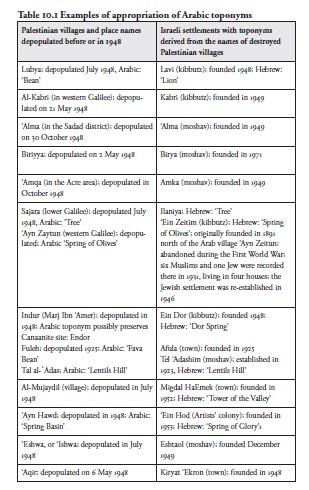
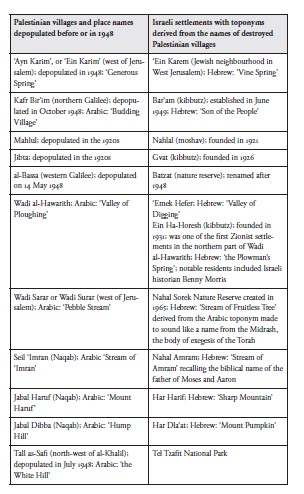
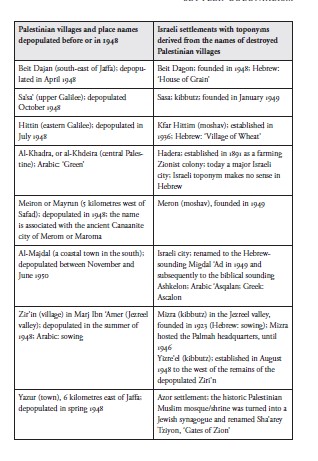
巴勒斯坦阿拉伯语地名对以色列地名的影响,在借用的阿拉伯地名、阿拉伯地名的意译以及更名的构词模式中都清晰可见。表10.1列出了一些新的希伯来语式地名,它们源自、派生于或仿照了那些在1948年之前或期间被遗弃并摧毁的巴勒斯坦村庄的阿拉伯语地名。
The influence of Palestinian Arabic toponyms on the Israeli toponyms are clear in loan Arabic place names, translations of Arabic place names and morphological patterns of renaming. Table 10.1 shows new Hebrew-sounding toponyms based on, derived from or modelled on the Arabic toponyms of Palestinian villages depopulated and destroyed before or in 1948.
1956年后的2004年3月,即在“大灾难”(Nakba)发生五十六年之后,以色列记者吉迪恩·利维(Gideon Levy)写道:“犹太复国主义的集体记忆既存在于我们的文化景观之中,也存在于我们的物理景观之中,然而巴勒斯坦人所付出的沉重代价——生命的损失、数百个村庄的毁灭,以及巴勒斯坦难民持续的困境——却很少获得公众的承认。”(Levy 2004)
Fifty-six years after the Nakba, in March 2004, Israeli journalist Gideon Levy wrote: ‘The Zionist collective memory exists in both our cultural and physical landscape, yet the heavy price paid by the Palestinians – in lives, in the destruction of hundreds of villages, and in the continuing plight of the Palestinian refugees – receives little public recognition’ (Levy 2004).
莱维补充道:
Levy adds:
看看这株仙人掌。它覆盖着一堆石头。这堆石头曾经是一座房屋、一间棚屋、一个羊圈、一所学校,或是一道石墙。曾经——直到56年前,也就是一代半人之前,并不算很久以前。仙人掌曾把各家房屋和一块块地分隔开来,是一道活的篱笆,如今也成了那段生活曾经存在过的唯一纪念碑。 再看看仙人掌周围的松树林。它底下曾经有一座村庄。它的405座房屋在1948年的一天之内全部被毁,2,350名居民四散各地。没有人曾经告诉我们这件事。松树是在那之后不久由犹太民族基金会(JNF)种下的,我们小时候每个星期五都会为它捐款,目的是掩盖这些废墟,掩盖人们可能回返的可能性,或许也掩盖一点羞耻与愧疚。(Levy 2004)
Look at this prickly pear plant. It’s covering a mound of stones. This mound of stones was once a house, or a shed, or a sheep pen, or a school, or a stone fence. Once – until 56 years ago, a generation and a half ago – not that long ago. The cactus separated the houses and one lot from another, a living fence that is now also the only monument to the life that once was here. Take a look at the grove of pines around the prickly pear as well. Beneath it there was once a village. All of its 405 houses were destroyed in one day in 1948 and its 2,350 inhabitants scattered all over. No one ever told us about this. The pines were planted right afterward by the Jewish National Fund (JNF), to which we contributed in our childhood, every Friday, in order to cover the ruins, to cover the possibility of return and maybe also a little of the shame and the guilt. (Levy 2004)
1992年,由巴勒斯坦历史学家瓦利德·哈立迪(Walid Khalidi)指导、一支由巴勒斯坦实地研究人员和学者组成的团队完成了一项具有里程碑意义的研究,详细记述了位于1949年……内的数百个村庄遭到摧毁的情况。
A monumental 1992 study by a team of Palestinian field researchers and academics under the direction of Palestinian historian Walid Khalidi details the destruction of hundreds of villages falling inside the 1949
停战线。该研究记录了每个村庄被占领和人口被迫迁离的具体情况,并描述了村庄现存的状况。卡利迪的团队实地考察了除十四处遗址之外的所有地点,撰写了全面的报告并拍摄了照片。在沃利德·卡利迪(1992)记录在案的418个被迁空的村庄中,293个(70%)被彻底摧毁,90个(22%)大部分被毁。另有七个幸存下来,其中包括耶路撒冷以西的‘Ayn Karim,但这些村庄已被以色列定居者接管。一些古朴的阿拉伯村落和街区确实得到了大体保存,并经过了士绅化改造,但其中已没有巴勒斯坦人居住(部分原居民成为以色列境内的内部难民),这些地方被划定为犹太人的“艺术村”(Benvenisti 1986: 25;Masalha 2005, 2012)。一个细心的旅行者仍能看到被毁巴勒斯坦村庄的一些痕迹,但总体而言,留下的只是散落的石块和瓦砾。此外,新国家还将不动产据为己有,包括城市住宅区、交通基础设施、警察局、铁路、学校、图书馆、教堂和清真寺,以及书籍、档案和照片收藏,还有私人财物,包括银器、家具、画作和地毯(Khalidi, W. 1992)。
armistice lines. The study gives the circumstances of each village’s occupation and depopulation, and a description of what remains. Khalidi’s team visited all except fourteen sites, made comprehensive reports and took photographs. Of the 418 depopulated villages documented by Walid Khalidi (1992), 293 (70 per cent) were totally destroyed and ninety (22 per cent) were largely destroyed. Seven survived, including ‘Ayn Karim (west of Jerusalem), but were taken over by Israeli settlers. A few of the quaint Arab villages and neighbourhoods have actually been largely preserved and gentrified. But they are empty of Palestinians (some of the former residents are internal refugees in Israel) and are designated as Jewish ‘artistic colonies’ (Benvenisti 1986: 25; Masalha 2005, 2012). While an observant traveller can still see some evidence of the destroyed Palestinian villages, in the main all that is left is a scattering of stones and rubble. But the new state also appropriated for itself both immovable assets, including urban residential quarters, transport infrastructure, police stations, railways, schools, libraries, churches and mosques, as well as books, archival and photo collections, and personal possessions, including silver, furniture, pictures and carpets (Khalidi, W. 1992).