5. Al-hasan Ibn Ali
5. Al-hasan Ibn Ali
Qu’Allah l’agrée
May Allah Be Pleased With Him
Al-Hasan ibn Ali ibn Abi Talib, qu’Allah l’agrée, Abu Muhammad, le petit-fils du Messager d'Allah ﷺ, son descendant et le dernier des califes selon les paroles explicites du Prophète ﷺ.
Al-Hasan ibn Ali ibn Abi Talib, may Allah be pleased with him, Abu Muhammad, the grandson of the Messenger of Allah, may Allah bless him and grant him peace, his descendant and the last of the khulafa by his (the Prophet’s, may Allah bless him and grant him peace) explicit words.
Ibn Sacd a rapporté que Tmran ibn Sulayman a dit : Al-Hasan et al-Hussein sont deux des noms des gens du Paradis. Les Arabes n'utilisaient pas ces noms durant l'ignorance préislamique (Jahiliyyah).
Ibn Sacd narrated that Tmran ibn Sulayman safd: Al-Hasan and al-Hussein are two of the names of the people of the Garden. The Arabs did not use these names in the Jahiliyyah.
Al-Hasan, qu’Allah l’agrée, est né au milieu du ramadan, la troisième année de l'émigration (Hijrah). Des hadiths ont été rapportés de sa part, transmis par le Prophète ﷺ. cA’ishah, qu’Allah l’agrée, a rapporté des hadiths de sa part, ainsi qu'un grand nombre de Compagnons, parmi lesquels son fils al-Hasan, Abu’l-Hawra’ Rabicah ibn Sinan, Ash-Shacbi, Abu Wa’il et Ibn Sirin.
Al-Hasan, may Allah be pleased with him, was born in the middle of Ramadan in the third year of the Hijrah. Hadith have been related from him from the Prophet, may Allah bless him and grant him peace. cA’ishah, may Allah be pleased with her, related hadith from him, and a great number of the Followers, of them his son al-Hasan, Abu’l-Hawra’ Rabicah ibn Sinan, Ash-Shacbi, Abu Wa’il and Ibn Sirin.
Il ressemblait au Prophète ﷺ. Le Prophète ﷺ le nomma al-Hasan, sacrifia un mouton pour lui le septième jour, lui rase les cheveux et ordonna que le poids des cheveux en argent soit donné en aumône (Sadaqah). Il était le cinquième de la famille du manteau (lorsque le Prophète ﷺ a dit : « Ô Allah, ceux-là sont ma famille »). Abu Ahmad al-Askari a dit : Ce nom n'était pas connu durant l'ignorance préislamique (Jahiliyyah).
He resembled the Prophet, may Allah bless him and grant him peace. The Prophet, may Allah bless him and grant him peace, named him al-Hasan, slaughtered a sheep for him on his seventh day, shaved off his hair and ordered that the weight of the hair in silver should be given away as sadaqah. He was the fifth of the family of the mantle (when the Prophet, may Allah bless him and grant him peace, said, ‘O Allah, these are my family.’X Abu Ahmad al-cAskari said: This name was not known in the Jahiliyyah.
Al-Mufaddal a dit : Allah a voilé les noms d'al-Hasan et d'al-Hussein jusqu'à ce que le Prophète ﷺ les utilise pour nommer ses deux petits-fils.
Al-Mufaddal said: Allah veiled the names of al-Hasan and alT h e H isto r y o f t h e K h a l ifa h s Hussein until the Prophet, may Allah bless him and grant him peace, used them to name his two grandsons.
Al-Bukhari a rapporté qu'Anas a dit : Personne ne ressemblait plus au Prophète ﷺ qu'al-Hasan ibn Ali.
Al-Bukhari narrated that Anas said: No-one more resembled the Prophet, may Allah bless him and grant him peace, than al-Hasan ibn cAli.
Les deux Shaykhs ont rapporté qu'al-Bara’ a dit : « J'ai vu le Prophète ﷺ avec al-Hasan sur son épaule, disant : "Ô Allah, je l'aime, alors aime-le." » Al-Bukhari a rapporté qu'Abu Bakrah a dit : « J'ai entendu le Prophète ﷺ sur le minbar, avec al-Hasan à ses côtés regardant les gens une fois et le regardant lui une fois, disant : "Ce fils est un chef, et il est probable qu'à travers lui Allah établisse la paix entre deux groupes de musulmans." » Al-Bukhari a rapporté qu'Ibn cUmar a dit : Le Prophète ﷺ a dit : « Ils sont mes deux descendants (littéralement "mes deux brins de basilic" ou "mes deux plantes [ou fleurs] odorantes") dans ce monde », désignant al-Hasan et al-Hussein.
The two Shaykhs narrated that al-Bara’ said: I saw the Prophet, may Allah bless him and grant him peace, with al-Hasan upon his shoulder, saying, ‘O Allah, I love him, so love him.’ Al-Bukhari narrated that Abu Bakrah said: I heard the Prophet, may Allah bless him and grant him peace, upon the minbar, with al-Hasan by his side looking at the people one time and looking at him one time, saying, ‘This son of mine is a chief, and it is likely that through him Allah will make peace between two parties of the Muslims.’ Al-Bukhari narrated that Ibn cUmar said: The Prophet, may Allah bless him and grant him peace, said, ‘They are my two descendants (literally ‘my two sprigs of basil’ or ‘my two sweet-smelling plants [or flowers]’) in the world,’ meaning al-Hasan and al-Hussein.
At-Tirmidhi et al-Hakim ont rapporté qu'Abu Sacid al-Khudri a dit : Le Messager d'Allah ﷺ a dit : « Al-Hasan et al-Hussein sont les deux maîtres des jeunes gens du Paradis. » At-Tirmidhi a rapporté qu'Usamah ibn Zaid a dit : J'ai vu le Prophète ﷺ alors qu'al-Hasan et al-Hussein étaient sur ses hanches (un de chaque côté), et il a dit : « Ce sont mes deux fils et les deux fils de ma fille. Ô Allah, je les aime, alors aime-les et aime quiconque les aime. » Il a rapporté qu'Anas a dit : On a demandé au Prophète ﷺ : « Qui parmi les gens de votre maison vous est le plus cher ? » Il a dit : « Al-Hasan et al-Hussein. » Al-Hakim a rapporté qu'Ibn cAbbas a dit : Le Prophète ﷺ s'est approché en portant al-Hasan sur son épaule. Un homme l'a rencontré et a dit : « Quel monture bénie tu as, petit ! » Le Prophète ﷺ a répondu : « Et quel cavalier béni il est. » Ibn Sacd a rapporté qu'« Abdullah ibn az-Zubayr a dit : Celui qui ressemble le plus au Prophète ﷺ parmi sa famille et qui lui est le plus cher est al-Hasan ibn cAli. Je l'ai vu venir alors qu'il était en prosternation et monter sur ses épaules — ou il a dit, « son dos » — et il ne l'a pas fait descendre avant de descendre lui-même. Je l'ai vu alors qu'il était incliné dans la prière et il écartait ses jambes pour lui afin qu'il puisse passer de l'autre côté. » Ibn Sacd a rapporté qu'Abu Salamah ibn cAbd ar-Rahman a dit :
At-Tirmidhi and al-Hakim narrated that Abu Sacid al-Khudri said: The Messenger of Allah, may Allah bless him and grant him peace, said, ‘Al-Hasan and al-Hussein are the two lords of the youth of the people of the Garden.’ At-Tirmidhi narrated that Usamah ibn Zaid said: I saw the Prophet, may Allah bless him and grant him peace, and al-Hasan and al-Hussein were upon his hips (one on each), and he said, ‘These are my two sons and the two sons of my daughter. O Allah, I love them, so love them and love whoever loves them.’ He narrated that Anas said: The Prophet, may Allah bless him and grant him peace, was asked, ‘Who of the people of your house are most beloved to you?’ He said, ‘Al-Hasan and al-Hussein.’ Al-Hakim narrated that Ibn cAbbas said: The Prophet, may Allah bless him and grant him peace, approached carrying al-Hasan on his shoulder. A man met him and said, ‘What a blessed mount you have, boy!’ The Prophet, may Allah bless him and grant him peace, replied, And what a blessed rider is he.’ Ibn Sacd narrated that “Abdullah ibn az-Zubayr said: The one most like the Prophet, may Allah bless him and grant him peace, of his family and the most beloved to him is al-Hasan ibn cAli. I saw him come while he was prostrate and mount his shoulders — or he said, ‘his back’ - and he did not make him get down until he himself got down. I saw him while he was bowing in prayer and he would separate his legs for him so that he could pass through the other side.’ Ibn Sacd narrated that Abu Salamah ibn cAbd ar-Rahman said:
Le Prophète ﷺ tirait la langue pour al-Hasan ibn Ali, puis quand le nourrisson voyait la rougeur de la langue, il s'en réjouissait avec lui.
The Prophet, may Allah bless him and grant him peace, used to put forth his tongue for al-Hasan ibn cAli, then when the infant saw the redness of the tongue, he would be merry with him.
Al-Hakim a rapporté que Zuhayr ibn al-Arqam a dit : Al-Hasan ibn Ali s'est levé pour prononcer la khutbah, et un homme d'Azd Shanu’ah s'est levé et a dit : « Je témoigne que j'ai vu le Prophète ﷺ le placer sur ses genoux (hubwah désigne le fait de s'asseoir sur les talons avec les jambes repliées contre le ventre, souvent avec un tissu enroulé autour des jambes et du dos pour le soutien), disant : "Que celui qui m'aime l'aime, et que celui qui est présent le transmette à celui qui est absent", et si ce n'était pour la haute considération envers le Messager d'Allah ﷺ, je ne l'aurais rapporté à personne. » Al-Hasan, qu’Allah l’agrée, possédait de nombreuses vertus : il était noble, patient, doté de tranquillité, de gravité et de modestie ; il était libéralement généreux, très loué ; il n'aimait ni les séditions ni l'épée ; il s'était marié à de nombreuses reprises ; et il pouvait accorder à un seul homme autant que cent mille.
Al-Hakim narrated that Zuhayr ibn al-Arqam said: Al-Hasan ibn cAli stood to deliver the khutbah, and a man from Azd Shanu’ah stood up and said, ‘I witness that I saw the Prophet, may Allah bless him and grant him peace, place him in his lap (hubwah denotes sitting on the haunches with the legs drawn in to the belly, often with a cloth wrapped around the legs and the back in support), saying, “Whoever loves me, let him love him, and let the one who is present convey it to whoever is absent,” and if it were not for high regard for the Messenger of Allah, may Allah bless him and grant him peace, I would not have related it to anyone.’ Al-Hasan, may Allah be pleased with him, had many virtues: he was lordly, forbearing, possessing tranquillity, gravity and modesty; he was liberally generous, much praised; he disliked seditions and the sword; he married a great deal; and he would bestow upon a single man as much as one hundred thousand.
Al-Hakim a rapporté que cAbdullah ibn cUbayd ibn cUmayr a dit :
Al-Hakim narrated that cAbdullah ibn cUbayd ibn cUmayr said:
Al-Hasan a effectué le pèlerinage (Hajj) vingt-cinq fois à pied, et des montures de race noble étaient conduites avec lui.
Al-Hasan performed the Hajj twenty-five times walking, and the high-bred, riding beasts were led along with him.
Ibn Sacd a rapporté que cUmayr ibn Ishaq a dit : « Personne n'a jamais parlé en ma présence dont il était plus préférable, lorsqu'il parlait, qu'il se taise qu'al-Hasan ibn cAli. Je n'ai jamais entendu de sa part de parole inappropriée, sauf une seule fois. Il y eut un différend entre al-Hasan et cAmr ibn cUthman au sujet d'une terre. Al-Hasan proposa quelque chose que cAmr n'apprécia pas. Al-Hasan dit : "Il n'y a rien pour nous d'autre que d'agir malgré lui (littéralement 'que son nez s'écrase dans la poussière')". Ce fut la parole la plus inappropriée que j'aie jamais entendue de sa part. »
Ibn Sacd narrated that cUmayr ibn Ishaq said: No-one ever spoke in my presence who it was more preferable, when he talked, that he should not be silent than al-Hasan ibn cAli. I never heard from him an improper word except for one time. There was a dispute between al-Hasan and cAmr ibn cUthman about some land. Al- Hasan proposed something which cAmr did not like. Al-Hasan said, ‘There is nothing for it with us but to act in spite of him (literally ‘that his nose cleave to the dust’).’ This was the most improper word I ever heard from him.
Ibn Sacd a rapporté que cUmayr ibn Ishaq a dit : Marwan était l'émir sur nous, et il insultait cAli chaque Jumucah depuis le minbar, tandis qu'al-Hasan écoutait sans répondre. Puis il envoya un homme vers lui en disant : « Je jure par cAli, par cAli, par cAli, et par toi, par toi ! Je ne trouve aucune ressemblance pour toi sinon la mule, à laquelle on demande : "Qui est ton père ?" et elle répond : "Ma mère est une jument." » Al-Hasan lui dit : « Retourne vers lui et dis-lui : "Par Allah, je n'effacerai pour toi rien de ce que tu as dit en t'insultant. Cependant, toi et moi avons un rendez-vous ensemble devant Allah. Ensuite, si tu es véridique, qu'Allah te récompense pour ta véracité. Si tu es un menteur, alors Allah est pire en représailles." » Ibn Sacd a rapporté que Zurayq ibn Sawwar a dit : Il y eut quelques paroles entre al-Hasan et Marwan, puis Marwan s'approcha de lui et se montra très dur envers lui — et al-Hasan resta silencieux. Marwan se moucha avec sa main droite. Al-Hasan lui dit : « Malheur à toi ! Ne sais-tu pas que la main droite est pour le visage, et la gauche pour les parties privées (et pour les choses impures en général) ? Je suis dégoûté par toi (littéralement "souillure pour toi") ! » Marwan resta silencieux.
Ibn Sacd narrated that cUmayr ibn Ishaq said: Marwan was the amir over us, and he used to abuse cAli every Jumucah from the minbar, while al-Hasan would listen and make no reply. Then he sent a man to him saying, ‘I swear by cAli, by cAli, by cAli, and by you, by you! I don’t find any likeness for you except the mule, to which it is said, “Who is your father?” and it replies, “My mother is a mare.’” Al-Hasan said to him, ‘Return to him and say to him, “By Allah, I will not efface for you anything of what you have said by abusing you. However, you and I have an appointment together before Allah. Then, if you are truthful, may Allah recompense you for your truthfulness. If you are a liar, then Allah is worse in revenge.’” Ibn Sacd narrated that Zurayq ibn Sawwar said: There were some words between al-Hasan and Marwan, then Marwan approached him, became very tough on him — and al-Hasan was silent. Marwan blew his nose using his right hand. Al-Hasan said to him, ‘Woe to you! Do you not know that the right hand is for the face, and the left for the private parts (and for unclean matters generally)? I am disgusted with you (literally ‘filth to you’)!’ Marwan became silent.
Ibn Sacd a rapporté d'Ashcath ibn Sawwar qu'un homme a dit : Un homme s'est assis avec al-Hasan et il (al-Hasan) a dit : « Vous vous êtes assis avec nous au moment où nous allions nous lever. Permettrez-vous ? » Ibn Sacd a rapporté que cAli ibn Zaid ibn Judacan a dit : Al-Hasan a donné ses biens deux fois pour l'amour d'Allah, et Allah a divisé ses biens et les a partagés avec lui trois fois, à tel point qu'il donnait une sandale et en gardait une avec lui, ou donnait un chausson de cuir (connu sous le nom de khuff) et en gardait un autre.
Ibn Sacd narrated from Ashcath ibn Sawwar that a man said: A man sat down with al-Hasan and he (al-Hasan) said, ‘You have sat down with us at the moment we were going to stand. Will you permit?’ Ibn Sacd narrated that cAli ibn Zaid ibn Judacan said: Al-Hasan gave forth his property twice for the sake of Allah, and Allah divided up his property and shared it with him three times, to such an extent that he used to give a sandal and keep a sandal with him, or give away a leather sock (known as khuff) and keep another sock.
Ibn Sacd a rapporté que ‘Ali ibn al-Hussein a dit : Al-Hasan était porté sur le divorce, et il ne se séparait d'une femme que pour qu'elle l'aimât. Il a épousé quatre-vingt-dix femmes.
Ibn Sacd narrated that cAli ibn al-Hussein said: Al-Hasan was given to divorcing women, and he did not separate from a woman but that she loved him. He married ninety women.
Ibn Sacd a rapporté d'après Jacfar ibn Muhammad que son père a dit :
Ibn Sacd narrated from Jacfar ibn Muhammad that his father said:
Al-Hasan se mariait et divorçait tellement qu'il me faisait craindre qu'il ne suscite de l'inimitié envers nous parmi les tribus.
Al-Hasan used to marry and divorce so much that I was afraid he would cause enmity towards us among the tribes.
Ibn Sacd a rapporté de Jacfar ibn Muhammad que son père a dit : ‘Ali a dit : « Ô gens de Kufa, ne mariez pas (vos femmes] à al-Hasan car c'est un homme qui divorce beaucoup. » Un homme de Hamadan a dit : « Par Allah, nous le lui marierons (à nos femmes]. »
Ibn Sacd narrated from Jacfar ibn Muhammad that his father said: cAli said, ‘People of Kufa, do not marry (your womenfolk) to al-Hasan because he is a man much given to divorce.’ A man from Hamadan said, ‘By Allah, we will marry him (to our womenfolk).
« Quiconque lui plaît, il peut la garder, et quiconque lui déplaît, il peut la divorcer. » Ibn Sacd a rapporté que cAbdullah ibn Hasan a dit : Hasan était un homme qui épousait beaucoup de femmes, et elles lui plaisaient très rarement. Il y avait très peu de femmes qu'il épousait qui ne l'aimaient pas et n'étaient pas passionnément attachées à lui.
Whosoever pleases him he can keep, and whosoever displeases him he can divorce.’ Ibn Sacd narrated that cAbdullah ibn Hasan said: Hasan was a man who used to marry women a great deal, and they very rarely found favour with him. There were very few women he married who did not love him and were not passionately attached to him.
Ibn Asakir a rapporté que Juwayriyyah ibn Asma’ a dit : « Quand al-Hasan est mort, Marwan a pleuré lors de sa prière funéraire. Al-Hussein lui dit alors : "Pleures-tu alors que tu l'as contraint à avaler ce que tu as fait ?" Il répondit : "J'ai fait cela à quelqu'un de plus patient que lui", en désignant la montagne. (La montagne était, de manière proverbiale, l'incarnation de la patience). »
Ibn cAsakir narrated that Juwayriyyah ibn Asma’ said: When al- Hasan died, Marwan wept at his funeral prayer. Al-Hussein said to him, ‘Do you weep when you forced him to swallow that which you did?’ He said, ‘I used to do that to one more forbearing than this,’ and he pointed towards the mountain. (The mountain was proverbially the epitome of forbearance).
Ibn cAsakir a rapporté qu'al-Mubarrad a dit : Quelqu'un a dit à al-Hasan ibn cAli : « Abu Dharr dit : "La pauvreté m'est plus chère que la richesse, et la maladie m'est plus chère que la santé." » Il a dit : « Puisse Allah faire miséricorde à Abu Dharr. Quant à moi, je dis : "Quiconque dépend absolument de la bonté de ce qu'Allah a choisi pour lui ne souhaite être dans aucun autre état que celui qu'Allah a choisi pour lui." » Telle est la limite de la recherche sur le sujet du contentement envers ce que le destin décide.
Ibn cAsakir narrated that al-Mubarrad said: Someone said to al- Hasan ibn cAli, ‘Abu Dharr says, “Poverty is more beloved to me than wealth, and illness more beloved to me than health.’” He said, ‘May Allah show mercy to Abu Dharr. As for me, I say, “Whoever is absolutely dependent on the goodness of Allah’s choosing for him does not wish to be in any state other than the one which Allah has chosen for him.’” This is the limit in research into the subject of contentment with that which destiny turns about.
Al-Hasan, qu’Allah l’agrée, prit en charge le califat après la mort de son père par l'allégeance du peuple de Kufa, et il y resta pendant six mois et quelques jours. Puis Mucawiyah se leva contre lui — et la chose appartient à Allah — alors al-Hasan lui envoya un message pour lui proposer de lui céder le califat, à condition que le califat lui revienne après lui, que personne parmi les gens de Madinah, d'al-Hijaz et d'Iraq ne soit recherché pour vengeance ou représailles pour quoi que ce soit de ce qui s'était passé à l'époque de son père, et qu'il rembourserait ses dettes pour lui. Mucawiyah accepta ce qu'il demanda, ils conclurent un traité sur cette base, et le miracle prophétique devint évident dans ses paroles, que la paix et la bénédiction d'Allah soient sur lui : « Allah fera la paix par son intermédiaire entre deux groupes de musulmans. » Il abdiqua du califat pour lui. Al-Balqini chercha à prouver par son abdication du califat — qui est le plus haut rang — qu'il est permis d'abdiquer et de renoncer à des fonctions et des postes. Son abdication eut lieu en l'an 41 AH, au mois de Rabic al-Awwal. Il a également été dit que c'était en Rabic al-Akhir, ou Jumada al-Ula. Ses compagnons lui dirent : « Ô honte des mu’minin ! » et il répondait : « La honte vaut mieux que le Feu. » Un homme lui dit : « Que la paix soit sur toi, humiliateur des croyants ! » Il répondit : « Je ne suis pas l'humiliateur des croyants, mais je n'ai pas voulu vous tuer pour la souveraineté. » Ensuite al-Hasan partit de Kufa pour Madinah et y résida.
Al-Hasan, may Allah be pleased with him, took charge of the khilafah after the death of his father through the pledge of allegiance of the people of Kufa, and he remained in it for six months and some days. Then Mucawiyah came out against him - and the matter belongs to Allah — and so al-Hasan sent a message to him to offer to surrender the khilafah to him, on condition that the khilafah should be his after him, that no-one of the people of Madinah, al- Hijaz and Iraq should be sought out for revenge or retaliation for anything which had happened in the time of his father, and that he would pay off his debts for him. Mucawiyah agreed to what he asked, they concluded a treaty upon that basis, and the prophetic miracle became evident in his words, may Allah bless him and grant him peace, ‘Allah will make peace through him between two groups of the Muslims.’ He abdicated from the khilafah for him. Al-Balqini sought to prove from his abdication from the khilafah — which is the greatest rank - that it is permitted to abdicate from and renounce offices and positions. His abdication from it was in the year 41 AH, in the month of Rabic al-Awwal. It has also been said that it was in Rabic al-Akhir, or Jumada al-Ula. His companions said to him, ‘O disgrace of the mu’minin\’ and he would say, ‘Disgrace is better than the Fire.’ A man said to him, ‘Peace be upon you, humiliator of the believers!’ He said, ‘I am not the humiliator of the believers, but I disliked to kill you for the sovereignty.’ Then al-Hasan moved from Kufa to Madinah and resided there.
Al-Hakim a rapporté que Jubayr ibn Nufayr a dit : J'ai dit à al-Hasan : « Les gens disent que tu veux le califat. » Il a répondu : « Les chefs des Arabes étaient avec moi, en guerre avec quiconque j'étais en guerre, et en paix avec quiconque j'étais en paix. J'ai abandonné cela en désirant la Face d'Allah, et pour empêcher l'effusion du sang de la communauté (Ummah) de Muhammad ﷺ. »
Al-Hakim narrated that Jubayr ibn Nufayr said: I said to al-Hasan, ‘People are saying that you want the khilafah.’ He said, ‘The chiefs of the Arabs were with me, at war with whomever I was at war with, and at peace with whomever I was at peace with. I abandoned that desiring the Face of Allah, and to prevent spilling the blood of the ummah of Muhammad, may Allah bless him and grant him peace.
« Maintenant, plus tard, devrai-je m'en emparer par la force avec l'aide des troupeaux de chèvres des gens d'al-Hijaz ? » Al-Hasan, qu’Allah l’agrée, est mort à Madinah par empoisonnement. Son épouse, Jacdah bint al-Ashcath ibn Qais, l'a empoisonné. Yazid ibn Mucawiyah lui avait suggéré secrètement de l'empoisonner et qu'il l'épouserait ensuite, et elle s'y est conformée. Quand al-Hasan est mort, elle envoya un message à Yazid lui demandant de tenir la promesse qu'il lui avait faite. Il répondit : « Nous n'avons pas été satisfaits de toi pour al-Hasan, devrions-nous alors être satisfaits de toi pour nous-mêmes ? » Sa mort eut lieu en 49 AH. Il a également été dit que c'était le cinq de Rabic al-Awwal de l'an 50 AH.
Now later, shall I take it by force with the help of the herds of goats of the people of al-Hijaz?’ Al-Hasan, may Allah be pleased with him, died in Madinah through poisoning. His wife, Jacdah bint al-Ashcath ibn Qais poisoned him. Yazid ibn Mucawiyah suggested secretly to her that she should poison him and that then he would marry her, and she did so. When al-Hasan died, she sent a message to Yazid asking him for the fulfilment of what he had promised her. He said, ‘We were not pleased with you for al-Hasan, so should we then be pleased with you for ourselves?’ His death was in 49 AH. It has also been said that it was on the fifth of Rabic al-Awwal in the year 50 AH.
Et il a été dit que cela s'est produit en 51 AH. Son frère se disputait avec lui pour qu'il lui dise qui lui avait donné la boisson (empoisonnée), mais il ne voulait pas lui dire. Il a dit : « Allah est le plus sévère dans Sa vengeance s'il s'agit de celui que je soupçonne. Sinon, alors aucune personne innocente ne doit être tuée en représailles pour moi. »14
And it has been said that it was in 51 AH. His brother argued with him to get him to tell him who had given him the (poisoned) drink, but he would not tell him. He said, ‘Allah is most severe in revenge if it should be the one I suspect. If not, then no innocent person must be killed in retaliation for me.’14
Ibn Sacd a rapporté que 'Imran ibn 'Abdullah ibn Talhah a dit :
Ibn Sacd narrated that cImran ibn “Abdullah ibn Talhah said:
Al-Hasan ﷺ a vu comme s'il y avait écrit entre ses yeux : « Dis : "Il est Allah, l'Unique" » (Qur’an 112: 1) et sa famille s'en réjouit. Ils le racontèrent à Sa'id ibn al-Musayyab qui dit : « Si son rêve est vrai, alors il ne lui reste que très peu de jours à vivre. » Il ne vécut que quelques jours de plus avant de mourir.
Al-Hasan saw as if there were written between his eyes, ‘Say, “He Allah is One"' (Qur’an 112: 1) and his family rejoiced at that. They told it to Sacid ibn al-Musayyab and he said, ‘If his dream is true, then he has very few days left to live.’ He only lived a few days more before he died.
Al-Bayhaqi et Ibn cAsakir ont rapporté par l'intermédiaire d'Abu’l-Mundhir Hisham ibn Muhammad que son père a dit : Al-Hasan ibn cAli était dans le besoin (en ce qui concerne ses subsistances), et sa pension était de cent 14 Contrairement à sa pratique habituelle, as-Suyuti ne donne aucune source pour cette histoire.
Al-Bayhaqi and Ibn cAsakir narrated by way of Abu’l-Mundhir Hisham ibn Muhammad that his father said: Al-Hasan ibn cAli was constricted (in his provision), and his stipend was one hundred 14 Contrary to his usual practice, as-Suyuti gives no source for this story.
Dans *In Defence Against Disaster*, le juge (Qadi) Abu Bakr ibn al-Arabi dit concernant l'allégation selon laquelle le Commandeur des croyants (Amir al-Mu’minin) Mucawiyah, qu’Allah l’agrée, aurait empoisonné al-Hasan, « ...c'était une affaire inconnue. Seul Allah en sait quelque chose. Comment pouvez-vous le présumer sans preuve et l'attribuer à l'une de Ses créatures à une époque lointaine alors que nous n'avons aucune transmission authentique à ce sujet ? » (p. 203). Il en va de même pour cette histoire. Dans le même livre, le juge (Qadi) innocente Yazid d'une grande partie de la calomnie portée contre lui et dit : « [Ahmad ibn Hanbal] l'a inclus parmi les hommes de zuhd (se détachant du monde) »
In Defence Against Disaster, Qadi Abu Bakr ibn al-Arabi says concerning the allegation that the Amir al-Mu’minin Mucawiyah, may Allah be pleased with him, poisoned al-Hasan, ‘...it was an unknown business. Only Allah knows about it. How can you assume it without proof and ascribe it to one of His creatures in a distant time when we do not have any sound transmission about it?’ (p. 203) The same applies to this story. In the same book, the Qadi exonerates Yazid of a great deal of the slander levelled at him and says, ‘[Ahmad ibn Hanbal] included him among the men of zuhd (doing without the world)
des Compagnons et des Suivants... En effet, il l'a inclus dans le groupe des Compagnons avant de procéder à la mention des Suivants.
of the Companions and Followers... Indeed, he included him in the group of Companions before he proceeded to mention the Followers.’.
mille par an. Muawiyah le lui retint une année, et il fut extrêmement éprouvé par le besoin. Il dit : « J'ai demandé un encrier afin de pouvoir écrire à Muawiyah pour lui rappeler ma situation, puis je me suis retenu. J'ai vu le Messager d'Allah ﷺ (en rêve) et il a dit : "Comment vas-tu, Hasan ?" J'ai dit : "Bien, ô père." Et je me suis plaint auprès de lui de la rétention de ce bien à mon égard. Il a dit : "As-tu demandé un encrier pour écrire à une créature comme toi pour lui rappeler cela ?" J'ai dit : "Oui, Messager d'Allah. Que dois-je faire ?" Il a dit : "Dis :"
thousand a year. Muawiyah withheld it from him one year, and he was extremely constricted. He said, ‘I called for an ink-pot so that I might write to Muawiyah to remind him about myself, and then I controlled (myself). I saw the Messenger of Allah, may Allah bless him and grant him peace, (in a dream) and he said, “How are you, Hasan?” I said, “Well, father.” And I complained to him about the withholding of the property from me. He said, “Did you call for an ink-pot to write to a creature like yourself to remind him of that?” I said, “Yes, Messenger of Allah. What should I do?” He said, “Say:
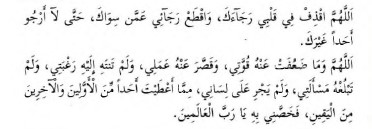
« Ô Allah, dépose dans mon cœur l'espoir en Toi, et coupe mon espoir en tout ce qui est autre que Toi, jusqu'à ce que je n'espère personne d'autre que Toi. Ô Allah, pour ce dont ma force est trop faible, ce que mon action ne peut atteindre, ce que mon désir n'atteint pas, ce que mon invocation n'atteint pas, et ce qui ne coule pas sur ma langue, de cette certitude que Tu as donnée à quiconque parmi les peuples anciens et ultérieurs, alors accorde-le-moi exclusivement, Seigneur des Mondes. » Il dit : « Puis, par Allah, je n'avais pas persévéré dans cela pendant une semaine avant que Mucawiyah ne m'envoie un million et cinq cent mille, et je dis : "Louange à Allah qui n'oublie point celui qui se souvient de Lui et ne déçoit point celui qui L'implore." J'ai vu le Prophète ﷺ en rêve et il a dit : "Hasan, comment vas-tu ?" J'ai dit : "Bien, Messager d'Allah ﷺ", et je lui ai raconté mon histoire. Il a dit : "Mon fils, tel est le sort de celui qui espère (quelque chose) du Créateur et n'espère (rien) de la créature." » Il y a dans at-Tuyuriyyat que Sulaym ibn cIsa, le récitant du Qur'an des gens de Kufa, a dit : Lorsque la mort est venue à al-Hasan, il fut saisi d'agitation et de chagrin. Al-Hussein lui dit : « Mon frère, qu'est-ce que cette agitation et ce chagrin ? Tu vas vers le Messager d'Allah ﷺ, et cAli et ils sont tes deux pères, et vers Khadijah et Fatimah et elles sont tes deux mères, et vers al-Qasim et at-Tahir et ils sont tes deux oncles maternels, et vers Hamzah et Jacfar et ils sont tes deux oncles paternels. » Al-Hasan lui dit : « Frère, j'entre dans une affaire d'Allah, exalté soit-Il, semblable à laquelle je n'ai jamais été, et je vois une création d'Allah, semblable à laquelle je n'en ai jamais vu. » Ibn ‘Abd al-Barr a dit : De diverses sources, nous rapportons que lorsque son heure vint, il dit à son frère : « Mon frère, ton père a levé les yeux vers cette autorité et Allah l'en a préservé et a confié la gestion de celle-ci (le califat) à Abu Bakr. Plus tard, il a levé les yeux vers elle, mais elle lui fut détournée au profit de ‘Umar. Plus tard encore, il n'avait aucun doute, au moment de la Commission, qu'elle ne lui échapperait pas, mais elle lui fut détournée au profit de ‘Uthman. Lorsque ‘Uthman fut tué, alors ‘Ali reçut l'allégeance. Ensuite, nous fûmes entravés jusqu'à ce que les épées soient dégainées, et ainsi (le califat) ne fut jamais paisiblement le sien. Par Allah, je ne pense pas qu'Allah réunira la prophétie et le califat en nous. Je ne sais pas si les insensés de Kufa ne tenteront pas de te nommer calife et de te chasser. J'ai demandé à ‘A’ishah, qu’Allah l’agrée, que je sois enterré avec le Messager d'Allah ﷺ, et elle a dit : "Oui". Quand je mourrai, interroge-la à ce sujet, mais je prévois seulement que les gens tenteront de t'en empêcher. S'ils le font, ne discute pas avec eux. » Lorsqu'il mourut, al-Hussein vint auprès de la Mère des Croyants, ‘A’ishah, qu’Allah l’agrée, et elle dit : « Oui, et c'est un honneur », mais Marwan les en empêcha. Ensuite, al-Hussein et ceux qui étaient avec lui dégainèrent leurs épées, jusqu'à ce qu'Abu Hurayrah les en empêche, et ainsi il fut enterré à al-Baqi aux côtés de sa mère, qu’Allah l’agrée.