5. Al-Hasan Ibn Ali
5. Al-hasan Ibn Ali
Que Allah esté complacido con él
May Allah Be Pleased With Him
Al-Hasan ibn Ali ibn Abi Talib, que Allah esté complacido con él, Abu Muhammad, nieto del Mensajero de Allah ﷺ, su descendiente y el último de los jalifas según las palabras explícitas del Profeta ﷺ.
Al-Hasan ibn Ali ibn Abi Talib, may Allah be pleased with him, Abu Muhammad, the grandson of the Messenger of Allah, may Allah bless him and grant him peace, his descendant and the last of the khulafa by his (the Prophet’s, may Allah bless him and grant him peace) explicit words.
Ibn Sa'd narró que Tamrán ibn Sulaymán dijo: Al-Hasan y al-Husáin son dos de los nombres de los habitantes del Jardín. Los árabes no usaban estos nombres en la yahiliyya.
Ibn Sacd narrated that Tmran ibn Sulayman safd: Al-Hasan and al-Hussein are two of the names of the people of the Garden. The Arabs did not use these names in the Jahiliyyah.
Al-Hasan, que Allah esté complacido con él, nació a mediados de Ramadán en el tercer año de la Hégira. Se han transmitido hadices de él por medio del Profeta ﷺ. ʿĀʾisha, que Allah esté complacida con ella, transmitió hadices de él, y también un gran número de los Tabiʿun, entre ellos su hijo al-Hasan, Abu’l-Hawra’ Rabiʿa ibn Sinan, Ash-Shaʿbi, Abu Wa’il e Ibn Sirin.
Al-Hasan, may Allah be pleased with him, was born in the middle of Ramadan in the third year of the Hijrah. Hadith have been related from him from the Prophet, may Allah bless him and grant him peace. cA’ishah, may Allah be pleased with her, related hadith from him, and a great number of the Followers, of them his son al-Hasan, Abu’l-Hawra’ Rabicah ibn Sinan, Ash-Shacbi, Abu Wa’il and Ibn Sirin.
Se parecía al Profeta ﷺ. El Profeta ﷺ le puso el nombre de al-Hasan, sacrificó una oveja por él en su séptimo día, le afeitó el cabello y ordenó que se donara en plata el peso de ese cabello como sadaqah. Fue el quinto de la familia del manto (cuando el Profeta ﷺ dijo: «¡Oh Allah, estos son mi familia!»). X Abu Ahmad al-cAskari dijo: Este nombre no era conocido en la Yahiliyyah.
He resembled the Prophet, may Allah bless him and grant him peace. The Prophet, may Allah bless him and grant him peace, named him al-Hasan, slaughtered a sheep for him on his seventh day, shaved off his hair and ordered that the weight of the hair in silver should be given away as sadaqah. He was the fifth of the family of the mantle (when the Prophet, may Allah bless him and grant him peace, said, ‘O Allah, these are my family.’X Abu Ahmad al-cAskari said: This name was not known in the Jahiliyyah.
Al-Mufaddal dijo: Allah ocultó los nombres de al-Hasan y al-Husáyn hasta que el Profeta, que Allah lo bendiga y le conceda paz ﷺ, los usó para nombrar a sus dos nietos.
Al-Mufaddal said: Allah veiled the names of al-Hasan and alT h e H isto r y o f t h e K h a l ifa h s Hussein until the Prophet, may Allah bless him and grant him peace, used them to name his two grandsons.
Al-Bujari narró que Anas dijo: Nadie se parecía más al Profeta ﷺ que al-Hasan ibn Ali.
Al-Bukhari narrated that Anas said: No-one more resembled the Prophet, may Allah bless him and grant him peace, than al-Hasan ibn cAli.
Los dos Shaykhs narraron que al-Bara’ dijo: Vi al Profeta ﷺ con al-Hasan sobre sus hombros, diciendo: «¡Oh Allah, lo amo, así que ámalo!». Al-Bujari narró que Abu Bakrah dijo: Oí al Profeta ﷺ sobre el minbar, con al-Hasan a su lado, mirando a la gente en una ocasión y mirándolo a él en otra, y diciendo: «Este hijo mío es un señor, y es posible que por medio de él Allah establezca la paz entre dos bandos de los musulmanes». Al-Bujari narró que Ibn Umar dijo: El Profeta ﷺ dijo: «Ellos son mis dos brotes de albahaca (literalmente «mis dos plantas [o flores] de aroma dulce») en el mundo», refiriéndose a al-Hasan y al-Husein.
The two Shaykhs narrated that al-Bara’ said: I saw the Prophet, may Allah bless him and grant him peace, with al-Hasan upon his shoulder, saying, ‘O Allah, I love him, so love him.’ Al-Bukhari narrated that Abu Bakrah said: I heard the Prophet, may Allah bless him and grant him peace, upon the minbar, with al-Hasan by his side looking at the people one time and looking at him one time, saying, ‘This son of mine is a chief, and it is likely that through him Allah will make peace between two parties of the Muslims.’ Al-Bukhari narrated that Ibn cUmar said: The Prophet, may Allah bless him and grant him peace, said, ‘They are my two descendants (literally ‘my two sprigs of basil’ or ‘my two sweet-smelling plants [or flowers]’) in the world,’ meaning al-Hasan and al-Hussein.
Al-Tirmidhi y al-Hakim narraron que Abu Sa'id al-Juri dijo: El Mensajero de Allah ﷺ dijo: «Al-Hasan y al-Husáin son los dos señores de los jóvenes de los habitantes del Paraíso». Al-Tirmidhi narró que Usama ibn Zaid dijo: Vi al Profeta ﷺ con al-Hasan y al-Husáin sobre sus caderas (uno a cada lado), y dijo: «Estos son mis dos hijos y los dos hijos de mi hija. ¡Oh Allah!, los amo, así que ámalos y ama a quien los ame». Narró que Anas dijo: Se preguntó al Profeta ﷺ: «¿Quién de los miembros de tu casa te es más querido?». Dijo: «Al-Hasan y al-Husáin». Al-Hakim narró que Ibn cAbbas dijo: El Profeta ﷺ se acercó llevando a al-Hasan sobre sus hombros. Un hombre se lo encontró y le dijo: «¡Qué montura tan bendita tienes, muchacho!». El Profeta ﷺ respondió: «¡Y qué jinete tan bendito es él!». Ibn Sa'd narró que cAbdullah ibn al-Zubair dijo: Quien más se parecía al Profeta ﷺ de su familia y le era más querido era al-Hasan ibn cAli. Lo vi llegar mientras él estaba postrado, subirse a sus hombros —o dijo: «a su espalda»— y no lo hizo bajar hasta que él mismo bajó. Lo vi mientras se inclinaba en la oración, y él le abría las piernas para que pudiera pasar por el otro lado. Ibn Sa'd narró que Abu Salamah ibn cAbd al-Rahman dijo:
At-Tirmidhi and al-Hakim narrated that Abu Sacid al-Khudri said: The Messenger of Allah, may Allah bless him and grant him peace, said, ‘Al-Hasan and al-Hussein are the two lords of the youth of the people of the Garden.’ At-Tirmidhi narrated that Usamah ibn Zaid said: I saw the Prophet, may Allah bless him and grant him peace, and al-Hasan and al-Hussein were upon his hips (one on each), and he said, ‘These are my two sons and the two sons of my daughter. O Allah, I love them, so love them and love whoever loves them.’ He narrated that Anas said: The Prophet, may Allah bless him and grant him peace, was asked, ‘Who of the people of your house are most beloved to you?’ He said, ‘Al-Hasan and al-Hussein.’ Al-Hakim narrated that Ibn cAbbas said: The Prophet, may Allah bless him and grant him peace, approached carrying al-Hasan on his shoulder. A man met him and said, ‘What a blessed mount you have, boy!’ The Prophet, may Allah bless him and grant him peace, replied, And what a blessed rider is he.’ Ibn Sacd narrated that “Abdullah ibn az-Zubayr said: The one most like the Prophet, may Allah bless him and grant him peace, of his family and the most beloved to him is al-Hasan ibn cAli. I saw him come while he was prostrate and mount his shoulders — or he said, ‘his back’ - and he did not make him get down until he himself got down. I saw him while he was bowing in prayer and he would separate his legs for him so that he could pass through the other side.’ Ibn Sacd narrated that Abu Salamah ibn cAbd ar-Rahman said:
El Profeta ﷺ solía sacar su lengua para al-Hasan ibn 'Ali, y cuando el niño veía el color rojizo de la lengua, se alegraba con él.
The Prophet, may Allah bless him and grant him peace, used to put forth his tongue for al-Hasan ibn cAli, then when the infant saw the redness of the tongue, he would be merry with him.
Al-Hakim narró que Zuhayr ibn al-Arqam dijo: Al-Hasan ibn Ali se levantó para pronunciar la jutba, y un hombre de Azd Shanu'ah se puso de pie y dijo: "Doy testimonio de que vi al Profeta ﷺ sentarlo en su regazo (hubwah denota sentarse sobre los talones con las piernas recogidas contra el vientre, a menudo con una tela envuelta alrededor de las piernas y la espalda como apoyo), diciendo: 'Quien me ama, que lo ame a él, y que quien esté presente se lo transmita a quien esté ausente', y si no fuera por la gran estima que tengo por el Mensajero de Allah ﷺ, no lo habría relatado a nadie." Al-Hasan, que Allah esté complacido con él, tenía muchas virtudes: era noble, paciente, poseía serenidad, gravedad y modestia; era sumamente generoso y muy elogiado; detestaba las discordias y la espada; se casó en muchas ocasiones; y llegaba a dar a un solo hombre hasta cien mil.
Al-Hakim narrated that Zuhayr ibn al-Arqam said: Al-Hasan ibn cAli stood to deliver the khutbah, and a man from Azd Shanu’ah stood up and said, ‘I witness that I saw the Prophet, may Allah bless him and grant him peace, place him in his lap (hubwah denotes sitting on the haunches with the legs drawn in to the belly, often with a cloth wrapped around the legs and the back in support), saying, “Whoever loves me, let him love him, and let the one who is present convey it to whoever is absent,” and if it were not for high regard for the Messenger of Allah, may Allah bless him and grant him peace, I would not have related it to anyone.’ Al-Hasan, may Allah be pleased with him, had many virtues: he was lordly, forbearing, possessing tranquillity, gravity and modesty; he was liberally generous, much praised; he disliked seditions and the sword; he married a great deal; and he would bestow upon a single man as much as one hundred thousand.
Al-Hakim narró que cAbdullah ibn cUbayd ibn cUmayr dijo:
Al-Hakim narrated that cAbdullah ibn cUbayd ibn cUmayr said:
Al-Hasan realizó el Hach veinticinco veces a pie, y las bestias de raza noble eran conducidas junto a él.
Al-Hasan performed the Hajj twenty-five times walking, and the high-bred, riding beasts were led along with him.
Ibn Sa'd narró que cUmayr ibn Ishaq dijo: Nunca nadie habló en mi presencia cuyo hablar fuera más preferible que su silencio que al-Hasan ibn cAli. Nunca le oí una palabra impropia salvo en una ocasión. Hubo una disputa entre al-Hasan y cAmr ibn cUthman sobre unas tierras. Al-Hasan propuso algo que a cAmr no le gustó. Al-Hasan dijo: "No nos queda más remedio que actuar a pesar de él" (literalmente, "que su nariz se pegue al polvo"). Esta fue la palabra más impropia que jamás le oí.
Ibn Sacd narrated that cUmayr ibn Ishaq said: No-one ever spoke in my presence who it was more preferable, when he talked, that he should not be silent than al-Hasan ibn cAli. I never heard from him an improper word except for one time. There was a dispute between al-Hasan and cAmr ibn cUthman about some land. Al- Hasan proposed something which cAmr did not like. Al-Hasan said, ‘There is nothing for it with us but to act in spite of him (literally ‘that his nose cleave to the dust’).’ This was the most improper word I ever heard from him.
Ibn Sa'd narró que 'Umayr ibn Ishaq dijo: Marwan era el amir sobre nosotros, y solía insultar a 'Ali cada viernes desde el minbar, mientras al-Hasan escuchaba y no respondía. Entonces le envió a un hombre diciendo: "¡Juro por 'Ali, por 'Ali, por 'Ali, y por ti, ¡por ti! No encuentro semejanza para ti sino la mula, a la que se le pregunta: '¿Quién es tu padre?' y responde: 'Mi madre es una yegua.'" Al-Hasan le dijo: "Vuelve a él y dile: 'Por Allah, no borraré para ti nada de lo que has dicho insultándote. Sin embargo, tú y yo tenemos una cita juntos ante Allah. Entonces, si eres veraz, que Allah te recompense por tu veracidad. Si eres un mentiroso, entonces Allah es peor en la venganza.'" Ibn Sa'd narró que Zurayq ibn Sawwar dijo: Hubo algunas palabras entre al-Hasan y Marwan, entonces Marwan se acercó a él, se mostró muy duro con él, y al-Hasan guardó silencio. Marwan se sonó la nariz con su mano derecha. Al-Hasan le dijo: "¡Ay de ti! ¿No sabes que la mano derecha es para el rostro, y la izquierda para las partes íntimas (y para las cosas impuras en general)? ¡Me das asco (literalmente, 'inmundicia para ti')!" Marwan guardó silencio.
Ibn Sacd narrated that cUmayr ibn Ishaq said: Marwan was the amir over us, and he used to abuse cAli every Jumucah from the minbar, while al-Hasan would listen and make no reply. Then he sent a man to him saying, ‘I swear by cAli, by cAli, by cAli, and by you, by you! I don’t find any likeness for you except the mule, to which it is said, “Who is your father?” and it replies, “My mother is a mare.’” Al-Hasan said to him, ‘Return to him and say to him, “By Allah, I will not efface for you anything of what you have said by abusing you. However, you and I have an appointment together before Allah. Then, if you are truthful, may Allah recompense you for your truthfulness. If you are a liar, then Allah is worse in revenge.’” Ibn Sacd narrated that Zurayq ibn Sawwar said: There were some words between al-Hasan and Marwan, then Marwan approached him, became very tough on him — and al-Hasan was silent. Marwan blew his nose using his right hand. Al-Hasan said to him, ‘Woe to you! Do you not know that the right hand is for the face, and the left for the private parts (and for unclean matters generally)? I am disgusted with you (literally ‘filth to you’)!’ Marwan became silent.
Ibn Sa῾d narró de Ash῾ath ibn Sawwar que un hombre dijo: Un hombre se sentó con al-Hasan y él (al-Hasan) dijo: «Te has sentado con nosotros en el momento en que íbamos a levantarnos. ¿Lo permitirás?». Ibn Sa῾d narró que ῾Ali ibn Zaid ibn Yud῾an dijo: Al-Hasan entregó sus bienes dos veces por la causa de Allah, y Allah dividió sus bienes y los compartió con él tres veces, hasta el punto de que solía dar una sandalia y quedarse con la otra, o regalar un calcetín de cuero (conocido como khuff) y quedarse con el otro.
Ibn Sacd narrated from Ashcath ibn Sawwar that a man said: A man sat down with al-Hasan and he (al-Hasan) said, ‘You have sat down with us at the moment we were going to stand. Will you permit?’ Ibn Sacd narrated that cAli ibn Zaid ibn Judacan said: Al-Hasan gave forth his property twice for the sake of Allah, and Allah divided up his property and shared it with him three times, to such an extent that he used to give a sandal and keep a sandal with him, or give away a leather sock (known as khuff) and keep another sock.
Ibn Sa'd narró que 'Alī ibn al-Husayn dijo: Al-Hasan era dado a divorciar mujeres, y no se separaba de una mujer sin que ella lo amara. Se casó con noventa mujeres.
Ibn Sacd narrated that cAli ibn al-Hussein said: Al-Hasan was given to divorcing women, and he did not separate from a woman but that she loved him. He married ninety women.
Ibn Sa'd narró de Ja'far ibn Muhammad que su padre dijo:
Ibn Sacd narrated from Jacfar ibn Muhammad that his father said:
Al-Hasan solía casarse y divorciarse tanto que temía que provocara enemistad entre nosotros entre las tribus.
Al-Hasan used to marry and divorce so much that I was afraid he would cause enmity towards us among the tribes.
Ibn Sa'd narró de Ÿa'far ibn Muhammad que su padre dijo: 'Alí dijo: "¡Gente de Kufa! No caséis a vuestras mujeres con al-Hasan, porque es un hombre muy dado al divorcio".' Un hombre de Hamadán dijo: 'Por Alá, lo casaremos con nuestras mujeres.'
Ibn Sacd narrated from Jacfar ibn Muhammad that his father said: cAli said, ‘People of Kufa, do not marry (your womenfolk) to al-Hasan because he is a man much given to divorce.’ A man from Hamadan said, ‘By Allah, we will marry him (to our womenfolk).
«Quien le agrade, puede quedárselo, y quien le desagrade, puede divorciarse de él». Ibn Sa'd narró que Abdullah ibn Hasan dijo: Hasan era un hombre que solía casarse con muchas mujeres, y muy rara vez ellas llegaban a agradarle. Fueron muy pocas las mujeres con las que se casó que no lo amaran y no estuvieran profundamente apegadas a él.
Whosoever pleases him he can keep, and whosoever displeases him he can divorce.’ Ibn Sacd narrated that cAbdullah ibn Hasan said: Hasan was a man who used to marry women a great deal, and they very rarely found favour with him. There were very few women he married who did not love him and were not passionately attached to him.
Ibn cAsakir narró que Juwayriyyah ibn Asma' dijo: Cuando al-Hasan murió, Marwan lloró en su oración fúnebre. Al-Husáyn le dijo: "¿Lloras cuando lo obligaste a tragar aquello que tragó?". Él respondió: "Yo hacía eso con alguien más paciente que este", y señaló hacia la montaña. (La montaña era proverbialmente el máximo exponente de la paciencia).
Ibn cAsakir narrated that Juwayriyyah ibn Asma’ said: When al- Hasan died, Marwan wept at his funeral prayer. Al-Hussein said to him, ‘Do you weep when you forced him to swallow that which you did?’ He said, ‘I used to do that to one more forbearing than this,’ and he pointed towards the mountain. (The mountain was proverbially the epitome of forbearance).
Ibn cAsakir narró que al-Mubarrad dijo: Alguien le dijo a al-Hasan ibn cAli: "Abu Dharr dice: 'La pobreza me es más querida que la riqueza, y la enfermedad me es más querida que la salud'". Él dijo: "Que Allah tenga misericordia de Abu Dharr. En cuanto a mí, digo: 'Quien depende por completo de la bondad de la elección de Allah para él, no desea estar en ningún estado distinto de aquel que Allah ha elegido para él'". Este es el límite en la investigación sobre el tema de la satisfacción con aquello hacia lo que gira el destino.
Ibn cAsakir narrated that al-Mubarrad said: Someone said to al- Hasan ibn cAli, ‘Abu Dharr says, “Poverty is more beloved to me than wealth, and illness more beloved to me than health.’” He said, ‘May Allah show mercy to Abu Dharr. As for me, I say, “Whoever is absolutely dependent on the goodness of Allah’s choosing for him does not wish to be in any state other than the one which Allah has chosen for him.’” This is the limit in research into the subject of contentment with that which destiny turns about.
Al-Hasan, que Allah esté complacido con él, asumió el califato tras la muerte de su padre mediante el juramento de lealtad de la gente de Kufa, y permaneció en él seis meses y algunos días. Luego Mu'awiyah se rebeló contra él —y el asunto pertenece a Allah—, y al-Hasan le envió un mensaje ofreciéndole entregarle el califato, con la condición de que el califato fuera suyo después de él, que nadie de la gente de Madinah, del Hiyaz e Iraq fuera buscado para vengarse o tomar represalias por algo ocurrido en tiempos de su padre, y que él saldaría sus deudas. Mu'awiyah aceptó lo que le pedía, concluyeron un tratado sobre esa base, y se hizo evidente el milagro profético en sus palabras, que la bendición y la paz de Allah sean con él: «Allah hará que por medio de él se reconcilien dos grupos de los musulmanes». Renunció al califato en favor de Mu'awiyah. Al-Balqini intentó demostrar, a partir de su renuncia al califato —que es el rango más elevado—, que es lícito abdicar y renunciar a cargos y posiciones. Su abdicación fue en el año 41 de la Hégira, en el mes de Rabi' al-Awwal. También se ha dicho que fue en Rabi' al-Ajir o en Yumada al-Ula. Sus compañeros le dijeron: «¡Oh deshonra de los creyentes!», y él respondía: «La deshonra es mejor que el Fuego». Un hombre le dijo: «¡La paz sea contigo, humillador de los creyentes!». Él respondió: «No soy el humillador de los creyentes, sino que me disgustó matarte por el poder». Luego al-Hasan se trasladó de Kufa a Madinah y residió allí.
Al-Hasan, may Allah be pleased with him, took charge of the khilafah after the death of his father through the pledge of allegiance of the people of Kufa, and he remained in it for six months and some days. Then Mucawiyah came out against him - and the matter belongs to Allah — and so al-Hasan sent a message to him to offer to surrender the khilafah to him, on condition that the khilafah should be his after him, that no-one of the people of Madinah, al- Hijaz and Iraq should be sought out for revenge or retaliation for anything which had happened in the time of his father, and that he would pay off his debts for him. Mucawiyah agreed to what he asked, they concluded a treaty upon that basis, and the prophetic miracle became evident in his words, may Allah bless him and grant him peace, ‘Allah will make peace through him between two groups of the Muslims.’ He abdicated from the khilafah for him. Al-Balqini sought to prove from his abdication from the khilafah — which is the greatest rank - that it is permitted to abdicate from and renounce offices and positions. His abdication from it was in the year 41 AH, in the month of Rabic al-Awwal. It has also been said that it was in Rabic al-Akhir, or Jumada al-Ula. His companions said to him, ‘O disgrace of the mu’minin\’ and he would say, ‘Disgrace is better than the Fire.’ A man said to him, ‘Peace be upon you, humiliator of the believers!’ He said, ‘I am not the humiliator of the believers, but I disliked to kill you for the sovereignty.’ Then al-Hasan moved from Kufa to Madinah and resided there.
Al-Hakim narró que Jubayr ibn Nufayr dijo: Le dije a al-Hasan: "La gente dice que quieres el califato". Él dijo: "Los jefes de los árabes estaban conmigo, en guerra con quienes yo estaba en guerra, y en paz con quienes yo estaba en paz. Abandoné eso buscando el Rostro de Allah, y para evitar derramar la sangre de la comunidad de Muhammad ﷺ".
Al-Hakim narrated that Jubayr ibn Nufayr said: I said to al-Hasan, ‘People are saying that you want the khilafah.’ He said, ‘The chiefs of the Arabs were with me, at war with whomever I was at war with, and at peace with whomever I was at peace with. I abandoned that desiring the Face of Allah, and to prevent spilling the blood of the ummah of Muhammad, may Allah bless him and grant him peace.
—¿Y luego, lo tomaré por la fuerza con la ayuda de los rebaños de cabras de la gente de al-Hiyaz? Al-Hasan, que Allah esté complacido con él, murió en Medina envenenado. Su esposa, Ŷa'da bint al-Ash'ath ibn Qais, lo envenenó. Yazid ibn Mu'awiya le sugirió en secreto que lo envenenara y que luego se casaría con ella, y ella lo hizo. Cuando al-Hasan murió, ella envió un mensaje a Yazid pidiéndole que cumpliera lo que le había prometido. Él respondió: "No nos complació que te casaras con al-Hasan, ¿y entonces nos iba a complacer que te casaras con nosotros?". Su muerte fue en el año 49 AH. También se ha dicho que fue el cinco de Rabi' al-Awwal del año 50 AH.
Now later, shall I take it by force with the help of the herds of goats of the people of al-Hijaz?’ Al-Hasan, may Allah be pleased with him, died in Madinah through poisoning. His wife, Jacdah bint al-Ashcath ibn Qais poisoned him. Yazid ibn Mucawiyah suggested secretly to her that she should poison him and that then he would marry her, and she did so. When al-Hasan died, she sent a message to Yazid asking him for the fulfilment of what he had promised her. He said, ‘We were not pleased with you for al-Hasan, so should we then be pleased with you for ourselves?’ His death was in 49 AH. It has also been said that it was on the fifth of Rabic al-Awwal in the year 50 AH.
Y se ha dicho que fue en el año 51 AH. Su hermano discutió con él para que le dijera quién le había dado la bebida (envenenada), pero él no quiso decirlo. Dijo: «Allah es el más severo en la venganza si se trata de aquel que sospecho. Si no, entonces no debe matarse a ningún inocente en represalia por mí».14
And it has been said that it was in 51 AH. His brother argued with him to get him to tell him who had given him the (poisoned) drink, but he would not tell him. He said, ‘Allah is most severe in revenge if it should be the one I suspect. If not, then no innocent person must be killed in retaliation for me.’14
Ibn Sa'd narró que 'Imrān ibn 'Abdullāh ibn Talḥah dijo:
Ibn Sacd narrated that cImran ibn “Abdullah ibn Talhah said:
Al-Hasan vio en sueños como si estuviera escrito entre sus ojos: «Di: "Él es Allah, Uno"» (Corán 112: 1), y su familia se alegró por ello. Se lo contaron a Sa'īd ibn al-Musayyab, quien dijo: «Si su sueño es verdadero, entonces le quedan muy pocos días de vida». Vivió solo unos pocos días más antes de morir.
Al-Hasan saw as if there were written between his eyes, ‘Say, “He Allah is One"' (Qur’an 112: 1) and his family rejoiced at that. They told it to Sacid ibn al-Musayyab and he said, ‘If his dream is true, then he has very few days left to live.’ He only lived a few days more before he died.
Al-Bayhaqi e Ibn ʿAsākir narraron, por vía de Abu l-Mundhir Hisham ibn Muhammad, que su padre dijo: Al-Hasan ibn ʿAli estaba en estrechez (en su sustento), y su estipendio era de cien 14 A diferencia de su práctica habitual, as-Suyuti no ofrece fuente alguna para este relato.
Al-Bayhaqi and Ibn cAsakir narrated by way of Abu’l-Mundhir Hisham ibn Muhammad that his father said: Al-Hasan ibn cAli was constricted (in his provision), and his stipend was one hundred 14 Contrary to his usual practice, as-Suyuti gives no source for this story.
En *In Defence Against Disaster*, el Qadi Abu Bakr ibn al-Arabi dice, en relación con la acusación de que el Amir al-Mu'minin Mucawiyah, que Allah esté complacido con él, envenenó a al-Hasan, «...fue un asunto desconocido. Solo Allah sabe de ello. ¿Cómo puedes suponerlo sin pruebas y atribuirlo a una de Sus criaturas en un tiempo lejano, cuando no tenemos ninguna transmisión sólida al respecto?» (p. 203). Lo mismo se aplica a esta historia. En el mismo libro, el Qadi exculpa a Yazid de gran parte de la calumnia dirigida contra él y dice: «[Ahmad ibn Hanbal] lo incluyó entre los hombres de zuhd (quienes prescinden del mundo)».
In Defence Against Disaster, Qadi Abu Bakr ibn al-Arabi says concerning the allegation that the Amir al-Mu’minin Mucawiyah, may Allah be pleased with him, poisoned al-Hasan, ‘...it was an unknown business. Only Allah knows about it. How can you assume it without proof and ascribe it to one of His creatures in a distant time when we do not have any sound transmission about it?’ (p. 203) The same applies to this story. In the same book, the Qadi exonerates Yazid of a great deal of the slander levelled at him and says, ‘[Ahmad ibn Hanbal] included him among the men of zuhd (doing without the world)
de los Compañeros y los Seguidores... En efecto, lo incluyó en el grupo de los Compañeros antes de pasar a mencionar a los Seguidores».
of the Companions and Followers... Indeed, he included him in the group of Companions before he proceeded to mention the Followers.’.
…mil al año. Muawiyah se la retuvo un año, y él quedó extremadamente angustiado. Dijo: «Pedí un tintero para escribir a Muawiyah y recordarle mi situación, pero luego me contuve. Vi al Mensajero de Allah ﷺ (en un sueño), y me dijo: “¿Cómo estás, Hasan?”. Respondí: “Bien, padre”. Y me quejé ante él de que se me había retenido la propiedad. Me dijo: “¿Pediste un tintero para escribir a una criatura como tú para recordarle eso?”. Respondí: “Sí, Mensajero de Allah. ¿Qué debo hacer?”. Me dijo: “Di:
thousand a year. Muawiyah withheld it from him one year, and he was extremely constricted. He said, ‘I called for an ink-pot so that I might write to Muawiyah to remind him about myself, and then I controlled (myself). I saw the Messenger of Allah, may Allah bless him and grant him peace, (in a dream) and he said, “How are you, Hasan?” I said, “Well, father.” And I complained to him about the withholding of the property from me. He said, “Did you call for an ink-pot to write to a creature like yourself to remind him of that?” I said, “Yes, Messenger of Allah. What should I do?” He said, “Say:
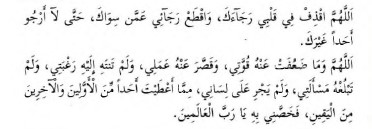
¡Oh Allah!, infunde en mi corazón la esperanza en Ti, y corta mi esperanza en todo lo que no seas Tú, hasta que no espere a nadie que no seas Tú. ¡Oh Allah!, aquello para lo que mi fuerza es demasiado débil, y mi obra se queda corta, lo que mi deseo no alcanza, mi súplica no llega y lo que no fluye sobre mi lengua, de esa certeza que has concedido a cualquiera de los antiguos y de los pueblos posteriores, entonces concédemela a mí en exclusiva, Señor de los mundos.” Dijo: “Por Allah, no había persistido en ello ni una semana cuando Mu'awiyah me envió un millón y quinientos mil, y dije: “Alabado sea Allah, Que no olvida a quien le recuerda ni defrauda a quien le suplica.” Vi al Profeta ﷺ en sueños, y me dijo: “Hasan, ¿cómo estás?” Le dije: “Bien, Mensajero de Allah”, y le conté mi historia. Dijo: “Hijo mío, así es para quien espera algo del Creador y no espera algo de la criatura.” En at-Tuyuriyyat se encuentra que Sulaym ibn 'Isa, el recitador del Corán de los habitantes de Kufa, dijo: Cuando llegó la muerte a al-Hasan, fue presa de la agitación y el dolor. Al-Husayn le dijo: “Hermano mío, ¿qué es esta agitación y este dolor? Vas al encuentro del Mensajero de Allah ﷺ, y 'Ali y ellos son tus dos padres, y a Jadiya y Fatima, que son tus dos madres, y a al-Qasim y at-Tahir, que son tus dos tíos maternos, y a Hamza y Ya'far, que son tus dos tíos paternos.” Al-Hasan le dijo: “Hermano, estoy entrando en un asunto de Allah, exaltado sea, semejante al que nunca he entrado, y veo una creación de Allah semejante a la que nunca he visto.” Ibn cAbd al-Barr dijo: De diversas fuentes relatamos que, cuando le llegó su hora, dijo a su hermano: «Hermano mío, tu padre elevó sus ojos a esta autoridad, pero Allah lo apartó de ella y puso a Abu Bakr al frente de ella (el califato). Después, volvió a elevar sus ojos hacia ella, pero le fue desviada hacia cUmar. Más tarde, en el momento del Consejo, no tuvo duda de que no le sería pasada por alto, pero le fue desviada hacia cUthman. Cuando cUthman fue asesinado, se prestó juramento de lealtad a cAli. Luego fuimos contenidos hasta que se desenvainaron las espadas, y así (el califato) nunca fue suyo sin perturbaciones. Por Allah, no creo que Allah reúna en nosotros la profecía y el califato. No sé si los necios de Kufa intentarán nombrarte califa y expulsarte». He pedido a cA'isha, que Allah esté complacido con ella, que se me entierre junto al Mensajero de Allah ﷺ, y ella dijo: «Sí». Cuando yo muera, pregúntale por eso, pero solo prevelo que la gente intentará impedírtelo. Si lo hacen, no discutas con ellos». Cuando murió, al-Husayn acudió a la Madre de los Creyentes, cA'isha, que Allah esté complacido con ella, y ella dijo: «Sí, y es un honor», pero Marwan se lo impidió. Entonces al-Husayn y quienes estaban con él empuñaron sus espadas, hasta que Abu Hurayrah los detuvo, y así fue enterrado en al-Baqic, junto a su madre, que Allah esté complacido con ella.
O Allah, cast into my heart hope in You, and cut off my hope in everything other than You, until I don’t hope for anyone other than You. O Allah, that for which my strength is too weak, and my action falls short of, my desire does not attain, my supplication does not reach, and what does not flow upon my tongue, of that certainty which You have given anyone of the ancients and the later peoples, then single me out for it, Lord of the Worlds.’” He said, ‘Then, by Allah, I had not persisted in it for a week before Mucawiyah sent me one million and five hundred thousand, and I said, “Praise be to Allah Who does not forget whoever remembers Him and doesn’t disappoint whoever supplicates Him.” I saw the Prophet, may Allah bless him and his family and grant them peace, in sleep and he said, “Hasan, how are you?” I said, “Well, Messenger of Allah,” and I told him my story. He said, “My son, that is how it is for whoever hopes for (something) from the Creator and does not hope for (something) from the creature.’” There is in at-Tuyuriyyat that Sulaym ibn cIsa, the Qur’an reciter of the people of Kufa, said: When death came to al-Hasan he was overcome with agitation and grief. Al-Hussein said to him, ‘My brother, what is this agitation and grief? You are going to the Messenger of Allah, may Allah bless him and his family and grant them peace, and cAli and they are your two fathers, and to Khadijah and Fatimah and they are your two mothers, and to al-Qasim and at-Tahir and they are your two maternal uncles, and to Hamzah and Jacfar and they are your two paternal uncles.’ Al-Hasan said to him, ‘Brother, I am entering into a matter of Allah’s, exalted is He, the like of which I have never entered, and I see a creation of Allah’s the like of which I have never seen.’ Ibn cAbd al-Barr said: From various sources we relate that when his time came, he said to his brother, ‘My brother, your father raised his eyes to this authority and Allah averted him from it and put Abu Bakr in charge of it (the khilafah). Later, he raised his eyes to it, but it was turned away from him to cUmar. Later again, he had no doubt at the time of the Council that it would not pass him by, but it was turned away from him to cUthman. When TJthman was killed, then °Ali was pledged allegiance. Then we were restrained until swords were unsheathed and so it (the khilafah) was never undisturbedly his. By Allah, I don’t think that Allah will combine prophecy and khilafah in us. I don’t know but that the fools of Kufa will try to appoint you as khalifah and drive you out. I have asked cA’ishah, may Allah be pleased with her, that I should be buried with the Messenger of Allah, may Allah bless him and his family and grant them peace, and she said, “Yes.” When I die, ask her about that, but I only anticipate that people will try to prevent you. If they do, don’t bandy words with them.’ When he died, al-Hussein came to the Mother of the Believers, cA’ishah, may Allah be pleased with her, and she said, ‘Yes, and it is an honour,’ but Marwan prevented them. Then al-Hussein and those with him donned their swords, until Abu Hurayrah prevented them, and so he was buried in al- Baqic by the side of his mother, may Allah be pleased with her.