…u oyatning Ellchi Allohga nisbatan nozil bo‘lganini aytgani, u amakisi Abu Tolibni Islomga da’vat qilmoqchi bo‘lgan paytda. So‘ngra Sahoba (r.a.) dan keyin Tobi’inlar keldi, ular Sahobalar zikr qilgan barcha narsalarni shu tarzda rivoyat qildilar. Tobi’inlar orasida Qur’oni Karimning oyatlarini sharh qilganlar yoki nozil bo‘lish sababini bayon qilganlar bor edi, bu ularning tafsirdagi shaxsiy ijtihodlari bilan yoki boshqalardan eshitgan narsalari asosida edi. Tobi’inlardan keyin ulamolar keldi va tafsirni kengaytirdilar hamda yahudiy va nasroniylardan rivoyatlar keltirdilar. Har bir asr va avlodda mufassirlar ketma-ket almashinib keldilar, ular Qur’onni sharh qilib, o‘zlaridan oldin kelganlar ustiga tafsirni har bir davrda kengaytirdilar. Mufassirlar oyatlardan hukmlar chiqarishga va ular orqali o‘z mazhablarining irodaga erkinlik (ixtiyor) va taqdirga qat’iy bo‘ysunish (jabr) masalalaridagi qarashlarini izohlashga kirishdilar. Ular fiqhdagi, ilmi kalomdagi, balog‘atdagi, sarf va nahv kabi ilmlardagi moyilliklariga ko‘ra o‘z fikrlarini isbotlovchi oyatlarni sharh qila boshladilar. Sahobalar davridan hozirgacha turli asrlardagi tafsirlarni o‘rganish shuni ko‘rsatadiki, har bir asrda Qur’on tafsiri o‘sha davrdagi ilmiy harakatning ta’siri ostida bo‘lgan, u davrning qarashlarini, nazariyalarini va mazhablarini aks ettirgan. Davrning fikrlari, qarashlari va qoidalari ta’siridan xoli bo‘lgan tafsirlar kam uchragan.
that he said the verse had been revealed concerning the Messenger of Allah when he tried to win over his uncle Abu Talib to Islam. Then came the Tabi'un after the Sahabah who reported everything the Sahabah mentioned in this manner. From among the Tabi'un there were those who explained the verses of the Noble Qur’ān or stated the cause of revelation, either as their own Ijtihād in tafsīr or by hearing it from (other authorities). After the Tabi'un the 'Ulama came and expanded the tafsīr and quoted reports from the Jews and Christians. The mufassirun succeeded one after another in every age and generation, who explained the Qur’ān and expanded the tafsīr in each age on what had come before. The mufassirun began to give their attention to the verses to deduce rulings from them and explain their schools of thought in terms of freewill (ikhtiyar) and predestination (jabr). And they began to explain verses proving their opinions according to their inclinations in legislation, scholasticism ('ilm al-Kalam), rhetorics (balaagha), declension (sarf) and grammar etc. What is apparent from an examination of the tafaseers through the different ages since the time of the Sahabah until now is that the tafsīr of the Qur’ān in every age was influenced by the scholarly movement of the time, it presented a picture which reflected the views, theories and schools of thought of the time. Seldom were there tafsīrs that were free from the influence of opinions, thoughts and rules of the time.
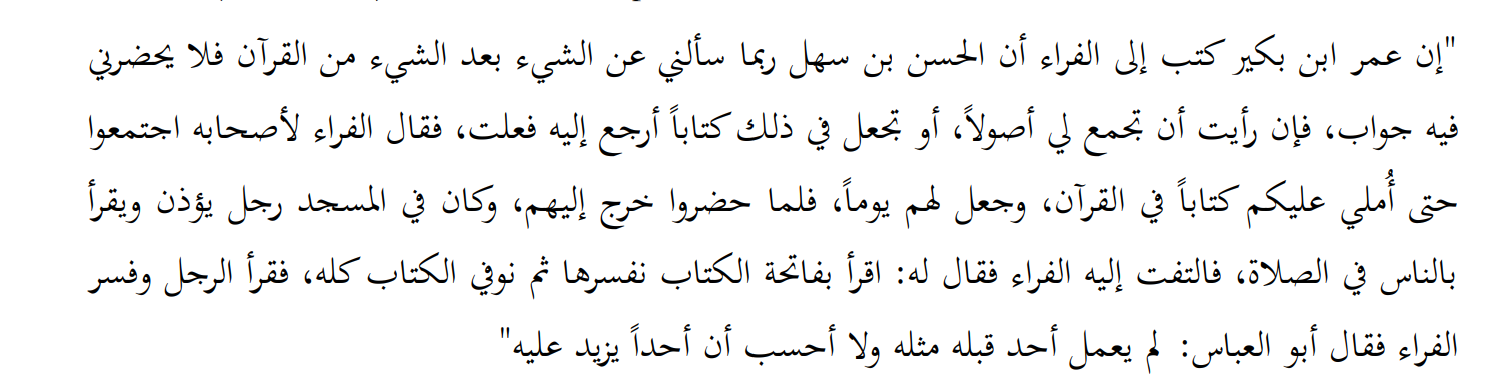
Biroq, bu tafsirlarning barchasi tafsir yozila boshlagan birinchi kundan, ya'ni Sahobalar davridan boshlab kitoblarda to'planmagan. Balki ular zamonlar o'tishi bilan vaziyatdan vaziyatga qarab o'zgarib borgan. Dastlab tafsir hadisning bir qismi va uning boblaridan biri bo'lgan. Hadis barcha islomiy ilmlarni o'z ichiga olgan keng qamrovli mavzu edi. Shu sababli hadis rivoyat qiluvchi shaxs huquqiy hukmni o'z ichiga olgan hadisni rivoyat qilganidek, Qur'on oyatining tafsirini o'z ichiga olgan hadisni ham rivoyat qilgan. Keyin, Abbosiylar davrining boshlarida va Umaviylar davrining oxirida, ya'ni hijriy ikkinchi asrning boshlarida, mualliflar o'xshash va tegishli bo'lgan barcha hadislarni bir mavzu ostida jamlay boshladilar va ularni boshqa mavzulardan ajratdilar. Shunday qilib, hadis tarkibidagi tafsir va fiqh kabi ilmlar bir-biridan ajratildi. Ilmlarda yuz bergan narsa hadis, siyrat, fiqh va tafsir jihatidan yuz berdi. Shunday qilib, tafsir ilmi vujudga keldi va mustaqil ilm sifatida alohida o'rganiladigan bo'ldi. Biroq, tafsirlar muayyan tartibli shaklga ega bo'lmagan, ya'ni Qur'on oyatlari mushafdagi tartib kabi tartibli keltirilmagan, so'ng ularning tafsiri berilmagan. Balki rivoyat qilingan tafsirlar turli joylarga tarqalgan edi. Ular hadisdagi kabi turli-tuman oyatlarning tafsiri edi. Bu holat tafsir hadisdan ajralib, mustaqil ilm sifatida shakllana boshlaguniga qadar davom etdi. Qur'onning har bir oyati yoki oyatning bir qismi uchun, bu oyatlarni mushafdagi tartibga ko'ra joylashtirgan holda tafsir yozildi. Qur'onni oyatma-oyat keltirib, ularni birin-ketin izohlashni birinchi bo'lib amalga oshirgan kishi al-Farra' (vafoti h. 207) bo'ldi. Ibn an-Nadim o'zining "al-Fihrist" kitobida xabar berishicha:
However, all of these tafsīrs were not compiled in books from the first day mufassirun came to exist i.e, from the time of the Sahabah. Rather, they changed from situation to situation through the ages. In the beginning, the tafsīr used to be a part of the hadīth and one of its chapters. The hadīth was the all-extensive topic which encompassed all the Islamic disciplines. So the transmitter of a hadīth just as he would narrate a hadīth containing a legal ruling he would also narrate a hadīth which contained the tafsīr of a Qur’ānic verse. Then writers, in the beginning of the Abbasid era and towards the end of the Umayyad era i.e, in the beginning of the second century hijri, began to bring together all the similar and relevant ahadīth under a topic and separate them from other topics. So the disciplines such as tafsīr and fiqh which the hadīth contains were separated from each other. What resulted from the sciences is what resulted in terms of hadīth, Sīrah, jurisprudence and tafsīr. Thus, the science of tafsīr came to exist and it became an independent science which was studied on its own. However, the tafsīrs did not take any organised form, in that verses of Qur’ān were not mentioned in an ordered manner like the arrangement found in the mushaf (Qur’ān) and then followed by their tafsīr. Rather the tafsīrs narrated were scattered here and there. They were tafsīr for miscellaneous verses as was the case with the hadīth. This situation continued until the tafsīr became separated from the hadīth and began to stand up as a science in its own right. Tafsīr was written for each ayah of the Qur’ān or part of an ayah, arranging these verses according to the order in mushaf. The first one to undertake the tafsīr of the Qur’ān quoting ayah after ayah and explain them one after another was al-Farra' (d.207 A.H.). Ibn al-Nadim reports in his book alFihirst that: